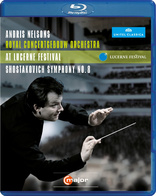
Shostakovich: Symphony Nº 8 Blu-ray Movie
HomeShostakovich: Symphony Nº 8 Blu-ray Movie 
Lucerne Festival Sep 2011C MAJOR | 2011 | 100 min | Not rated | May 29, 2012

Movie rating
7.2 | / 10 |
Blu-ray rating
| Users |  | 0.0 |
| Reviewer |  | 3.5 |
| Overall | | 3.5 |
Overview
Shostakovich: Symphony Nº 8 (2011)
| Music | 100% |
Specifications
Video
Video codec: MPEG-4 AVC
Video resolution: 1080i
Aspect ratio: 1.78:1
Original aspect ratio: 1.78:1
Audio
English: DTS-HD Master Audio 5.1
English: LPCM 2.0
Subtitles
None
Discs
25GB Blu-ray Disc
Single disc (1 BD)
Playback
Region A (B, C untested)
Review
Rating summary
| Movie | | 3.5 |
| Video |  | 4.5 |
| Audio | | 4.5 |
| Extras | | 0.0 |
| Overall | | 3.5 |
Shostakovich: Symphony Nº 8 Blu-ray Movie Review
An underappreciated Shostakovich symphony receives a thrilling performance.
Reviewed by Jeffrey Kauffman August 23, 2012Dmitri Shostakovich is an easy composer to admire, but he’s often a hard one to really love. Prickly, discordant and dryly intellectual, Shostakovich’s music is often brilliantly witty or tragically morose, but it’s so relentlessly “heavy” at times that it can almost be a burden to listen to it with any degree of emotional empathy. Shostakovich also typically avoids the easily accessible, albeit at times sentimental, melodism of his compatriot Sergei Prokofiev, preferring instead to build huge slabs of sound which, while undeniably gorgeous, have the effect of pummeling the listener into submission rather than ingratiating themselves subliminally. These differing techniques make comparing two wartime symphonies of these Russian titans very, very interesting. Prokofiev’s majestic Fifth Symphony, written in an astoundingly short one month period in 1944, remains one of the most performed “modern” symphonies in the orchestral repertoire, a ravishing piece of elegantly crafted melody that seems to dream of a peaceful future even as it recounts untold tragedy. The piece is sumptuously resplendent, with one unforgettable melody after another pouring out as if Prokofiev had simply turned on some sort of “genius spigot” and let the music flow. Shostakovich’s Eighth Symphony on the other hand was penned a year earlier, in 1943, but has languished in appreciation through the years, never quite attaining the popularity or renown of several of Shostakovich’s other large orchestral outings. As difficult as it may be for the general listener to easily assimilate and appreciate, it evidently was even more so to Shostakovich’s Soviet “handlers”, bureaucrats who spent their lives attempting to fit Shostakovich’s “square peg” compositional style into their “round hole” propaganda machine. The Soviets desperately wanted Shostakovich’s Eighth to be a memorial to the then recent Battle of Stalingrad, but when it failed to fit snugly into their preconceived notions of what such a piece should sound like, they promptly banned performances of the piece, relegating it to a less known status until well after Stalin’s death when it began making sporadic appearances once again.
The Eighth is an undeniably difficult work, but it also offers some of Shostakovich’s most heartfelt musical ruminations. Huge, almost epic in scale, and spanning a somewhat unusual five movements, the piece offers everything from the elegiac, including a notable (no pun intended) and langorous English Horn solo in the first movement, to the bizarre, an almost Mahler-esque allegretto that hints that it’s parodying the German tendency toward martial supremacy but which may in fact be just as critical of the Soviet military. The Eighth segues from massive pronouncements that are the musical equivalent of political screeds to quiet, almost hushed, reverence, as in its virtually inaudible finale, when the tumult that has come before rather suddenly and unexpectedly dissolves into a major tonality and a feeling of rest.
The fact that the Eighth ends (to paraphrase a certain iconic 20th century poet) not with a bang but with a whimper made it a “hard sell” for Soviet propagandists who seemingly spent their lives trying first to mold Shostakovich to their own artistic whims and then, after he had produced whatever masterpiece he was currently working on, attempting to get that masterpiece to meld with their own preconceived notions of what Art meant. It was of course a laughably impossible task, and one can’t help but wonder if Shostakovich made many of his pieces, especially his later symphonies, purposefully obtuse so that they wouldn’t easily be sliced, diced and analytically dissected by Soviet bureaucrats.
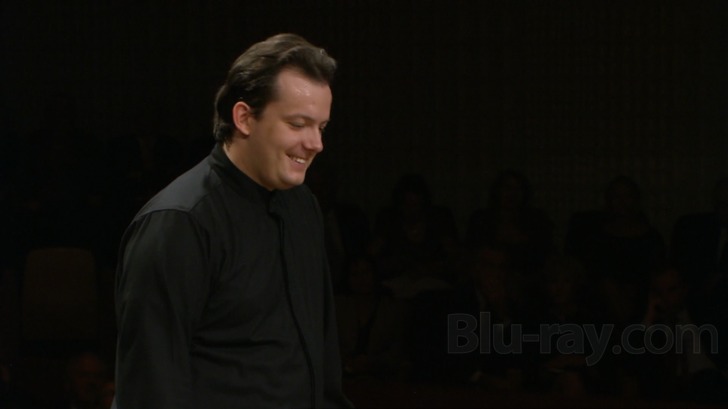
Conductor Andris Nelsons, a youngish, baby faced baton wielder who is rapidly becoming one of the Continent’s leading musical forces, leads the Concertgebouw Orchestra in a thrilling rendition of the Eighth in this concert which was part of the 2011 Lucerne Festival. Nelsons also adds a couple of frankly odd prelude pieces. The first of these is Richard Wagner’s Overture to Rienzi. This huge and frankly occasionally lumbering piece dates from the early years of Wagner’s forays into opera, and came before Wagner had fully developed his radical ideas of a new kind of music theater. Still there are hints of the Wagner to come, especially in the slowly building opening measures of the Overture, which presage some of the more languid portions of some of the Ring Cycle. Nelsons observes the somewhat traditional architecture of the piece and draws some especially fine nuances out of the heraldic brass motifs that start to dot the piece in its second half.
The second pre-Eighth Symphony piece here is one of the most spectacular orchestral showcases by that “showiest” of composers and orchestrators, Richard Strauss. His “Dance of the Seven Veils” from Salome is a typically over the top piece of faux Orientalism as poured through the prism of Strauss’ peculiarly ostenstatious orchestral vocabulary. This is a piece literally exploding with percussive fury, and Nelsons makes the most of what is one of the most colorful pieces of this composer’s almost always hyperbolically colored oeuvre. The dynamic range of this piece is astounding, and in fact makes for a perfectly appropriate prelude to Shostakovich’s Eighth, which also has huge variances in dynamics, from the whisper of individual winds and reeds to some incredibly bombastic effects with tympani.
While this might at first glance seem a rather piecemeal program, all three pieces show off the Royal Concertgebouw Orchestra and conductor Andris Nelsons in a very positive light. Nelsons is an incredibly energetic conductor, one who seems at times ready to almost pounce on the players with a barely contained ferocity. The concert is a bit disturbing in a way to watch, as Nelsons begins perspiring rather heavily even in the fairly calm (at least relatively speaking) opening Overture to Rienzi, and he is virtually drenched in his own sweat by the middle of the Salome piece, a tendency which only increases throughout the massive and demanding Eighth. It becomes a little like watching someone’s inadvertent extreme aerobic workout.
Shostakovich: Symphony Nº 8 Blu-ray Movie, Video Quality
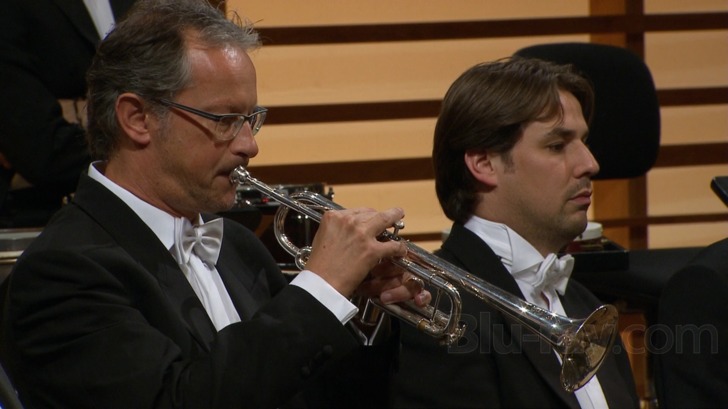
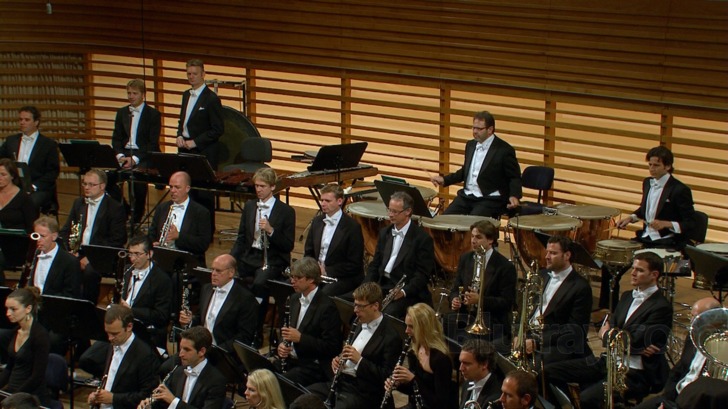
Andris Nelsons / Royal Concertgebouw Orchestra Shostakovich Symphony No. 8 from the 2011 Lucerne Festival is presented on Blu-ray courtesy of Unitel Classica and C Major with an AVC encoded 1080i transfer in 1.78:1. This is a sparklingly clear and well defined high definition presentation recorded in the KKL Luzern Concerthall. Despite the fact that Nelsons is clad entirely in black and is surrounded by a dimly lit concert hall, black levels are really excellent and there is no crush whatsoever, with clearly delineated differences between Nelsons' outfit and the surrounding darkness. The camera coverage of this concert is superb, including some incredibly up close and personal shots (note the unbelievable close-ups of the bassoon player, for example) which captures some exceptional fine detail. That fine detail may in fact be a bit of a problem for some viewers once Nelsons starts perspiring so heavily as he literally awash in his own sweat not soon after this concert begins.
Shostakovich: Symphony Nº 8 Blu-ray Movie, Audio Quality
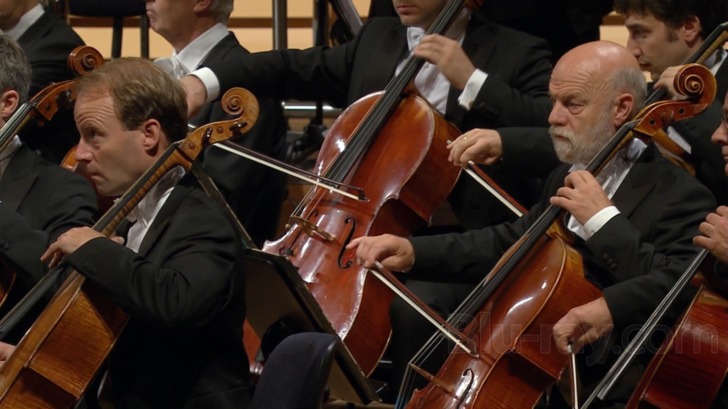
Andris Nelsons / Royal Concertgebouw Orchestra Shostakovich Symphony No. 8 from the 2011 Lucerne Festival features the typical array of two lossless tracks, a DTS-HD Master Audio 5.1 surround mix and an uncompressed LPCM 2.0 stereo fold down. Both of these tracks offer sterling fidelity and some incredible dynamic range. The 5.1 track is beautifully spacious and captures the really nice sounding hall ambience of the KKL Luzern Concerthall. The orchestra is splayed nicely across the front three channels, with occasional soli smartly and accurately positioned from a directional standpoint. The occasional audience noise and hall ambience helps fill out the rear channels very successfully.
Shostakovich: Symphony Nº 8 Blu-ray Movie, Special Features and Extras
No supplements other than trailers are included on this release.
Shostakovich: Symphony Nº 8 Blu-ray Movie, Overall Score and Recommendation
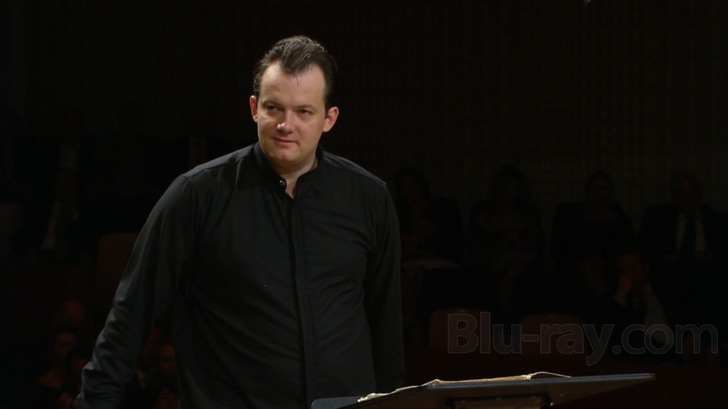
It's really instructive to pay attention to the audience response at the end of Andris Nelsons / Royal Concertgebouw Orchestra Shostakovich Symphony No. 8 from the 2011 Lucerne Festival's performance of the titular piece. The Eighth really isn't very well known, despite it having achieved a latter day luster since its so-called "rehabilitation" in the late fifties. But the piece ends so anachronistically, with a veritable orchestral whisper, that you can almost hear the audience collectively wondering "Is it over? Should we applaud now?" It actually takes them several seconds to respond, and then only after Nelsons kind of gives a prompting gesture to the orchestra (and vicariously to the audience) that, yes, we've come to the end. This is a frankly odd grouping of three pieces, but it works surprisingly well, and Nelsons acquits himself quite admirably in a far reaching concert of vastly different styles. The Royal Concertgebouw is a bit reserved in the Rienzi Overture, perhaps appropriately so, but they let their hair down (so to speak) in a rousing "Dance of the Seven Veils" from Salome, and then show both their restrained and extroverted sides in a beautifully detailed reading of Shostakovich's Eighth. This Blu-ray features excellent video and audio and even without any supplements to speak of, comes Recommended.