Sherlock Jr. / Three Ages Blu-ray Movie
HomeSherlock Jr. / Three Ages Blu-ray Movie 
Kino Lorber | 1923-1924 | 2 Movies | 108 min | Not rated | Nov 16, 2010

Movie rating
Movie has not been rated yetBlu-ray rating
| Users |  | 5.0 |
| Reviewer |  | 4.0 |
| Overall | | 4.1 |
Overview
Sherlock Jr. / Three Ages (1923-1924)
See individual titles for their synopses.
| Romance | 100% |
| Comedy | 5% |
| Action | Insignificant |
Specifications
Video
Video codec: MPEG-4 AVC
Video resolution: 1080p
Aspect ratio: 1.32:1
Original aspect ratio: 1.33:1
Audio
Music: DTS-HD Master Audio 5.1
Music: LPCM 2.0 (48kHz, 16-bit)
Music: Dolby Digital 2.0
Music: Dolby Digital Mono
Subtitles
None
Discs
50GB Blu-ray Disc
Single disc (1 BD)
Playback
Region free
Review
Rating summary
| Movie | | 4.0 |
| Video | | 4.0 |
| Audio |  | 4.5 |
| Extras |  | 2.5 |
| Overall | | 4.0 |
Sherlock Jr. / Three Ages Blu-ray Movie Review
Buster Keaton double feature on Blu-ray? Sign me up.
Reviewed by Casey Broadwater November 9, 2010For reasons that almost entirely elude me, I’ve always preferred Buster Keaton to Charlie Chaplin. Of course, trying to compare them at all is a reductive exercise in futility—they were both utter geniuses, and I think we can forego the squabbling and leave it at that—but there’s something about Keaton, the Great Stone Face, that just instinctually does it for me, that makes me burst into an insuppressible smile whenever he pratfalls across the screen. (As a critic, I’m anything but poker-faced. If I think a movie is sublime, you’ll catch me beaming, even if the film is a bleak, Bergman-esque rumination on death, fate, or the loss of faith. To wit: Winter Light makes my cheeks hurt.) I love Keaton’s dry, deadpan persona and the exacting mixture of grace and intentional clumsiness with which he takes a tumble. I gape at his acrobatic gags—his truly are motion pictures—and appreciate the ahead-of-its-time structural cleverness of his often elliptical or self-referential plots. Along with his iconic porkpie, Keaton wore many hats—actor, producer, writer, director, stuntman, scenarist—making him one of cinema’s few all-encompassing artists. Understandably, I’ve been overjoyed that Kino-Lorber has been on such a Keaton kick lately. Within the span of a year, they’ve released stunning high definition editions of The General, Steamboat Bill, Jr., and now, this Blu-ray double feature of Sherlock, Jr. and Three Ages.
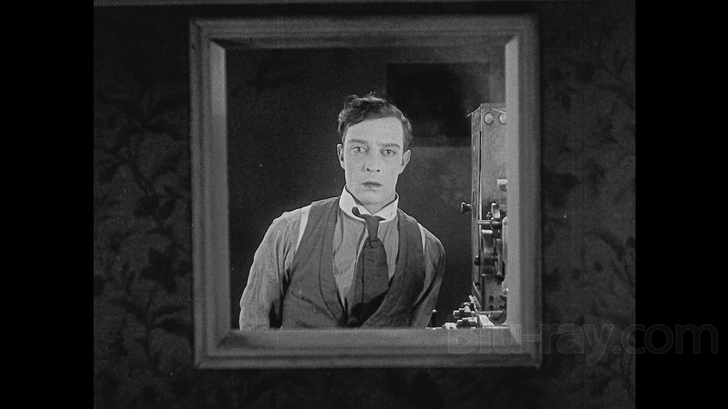
Inside looking out, outside looking in.
Although it was a box-office bomb and took a critical drubbing when it was released in 1924—Variety even called it “as unfunny as a hospital operating room”—the 44-minute Sherlock, Jr. has since become the subject of much reevaluation and is now recognized as one of the most innovative comedies of the silent era. It may not have the panache and sheer spectacle of the Keaton films to come—most notably, the big budget Civil War staging of The General and the truly dangerous stunt work in Steamboat Bill, Jr.—but Sherlock reveals the germination of Keaton as a comedic stylist and fearless performer. Here, he plays a movie theater janitor and projectionist who dreams of becoming a detective. His would-be girlfriend (Kathryn McGuire) has been wooed away by another man (Ward Crane), a cheat who frames Buster for the theft of a pocket watch, and Buster, with the help of a “How-To-Be A Detective” manual, sets out to clear his name and win back his love. Only, Buster takes the book’s advice much too literally. When it says “Shadow Your Man Closely,” he comically follows mere inches behind his rival, and ends up drenched in water from a railway tank—prefiguring a gag in The General—his pursuit botched and his hopes dashed.
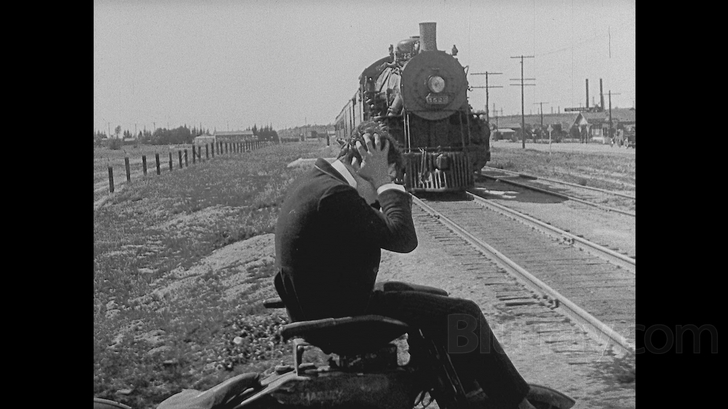
But from whence does our hero’s salvation come? From the cinema, of course. Buster goes back to his old job and dozes off in the projection room while showing a film called Hearts and Pearls. In his dream, he walks down the central aisle of the theater and hops inside the screen, inserting himself into the action. The sequence is cleverly executed, using double exposures and extremely precise matting, and Keaton devises slapstick gags that find him reacting to split-second cuts in the film-within-a-film. He ambles down a city street, and when the film switches to a shot of a perilous cliff, he nearly walks right off it. When he attempts to dive from a rock into the ocean, the film cuts suddenly to a wintry landscape and he goes head-first into a snowbank. Keaton is playing with the mutability and non-linearity of cinema itself, and after a series of these gags, the camera swoops forward past the proscenium, effectively taking us into the world of Hearts and Pearls, where Keaton’s character becomes Sherlock, Jr., a “crime-crushing criminologist.” In “real” life, he’s diminutive and ineffectual, but in the imaginative realm of the cinema, he’s nigh- invincible, escaping from gangsters and rescuing his heroine. Naturally, this involves many of Keaton’s characteristically bravura stunts, which are equal parts vaudevillian romp, magical Houdini-esque showmanship, and high-flying action. In the central set piece, Keaton speeds off while balancing on the handlebars of a motorcycle, an impressive feat that must’ve required endless practice.
Meanwhile, the real Sherlock, Jr. of the film is the girl, who, while Keaton is sleeping at the projector, solves the mystery of the missing pocket watch. As he wakes from his dream, she visits him in the projection booth right as Hearts and Pearls is coming to a close. He doesn’t know how to express his love, so he imitates the actions of the film’s male star, peering out through the booth’s window at the screen below for reference while we, the audience, look in at Keaton, the window frame itself mimicking the shape of a screen. We’re watching an actor playing a character who’s looking for guidance by watching an actor. It’s a wonderful meta-movie moment—one that suggests cinema’s power to influence and codify normative social interactions—but Keaton doesn’t over-intellectualize it. He’s after laughs, primarily, but that fact that his visual jokes frequently resonate on a deeper artistic level doubtlessly contributes to his enduring popularity. For Sherlock, Jr.’s final gag, Keaton once again references cinema’s ability to skip through time. After Keaton plants a shy kiss on the girl’s lips—following the lead of the leading man— Hearts and Pearls fades to black and reemerges on a scene of the hero and heroine surrounded by a gaggle of children. Keaton’s eyes bulge, although we’re not sure if it's the suggestion of sex or the promise of impending familial responsibility that provokes the response. Either way, it’s funny, and though it’s easy to read into Keaton’s films with an eye toward their structural and thematic brilliance, the lasting impression is of their humor and warmth.
For the second half of the double header, Kino-Lorber has included 1923’s Three Ages, which is usually referred to as the first true “Keaton” film, that is, the first feature-length production that he wrote, starred in, directed, and produced. Though he had made a name for himself in two- reel shorts, Three Ages would be a kind of litmus test to see whether Keaton could make it as a star in features. The film was envisioned as three separate narratives, set in the Stone Age, Ancient Rome, and the Jazz Age; this way, if the film as a whole flopped, Metro Pictures—soon to be absorbed into MGM—could at least split it in thirds and market each sub-story on its own. You can think of Three Ages as a spoof on D.W. Griffith’s similarly time-hopping Intolerance, and also see it as an early influence on Mel Brooks’ History of the World, Part I, but the story is too lightweight to be a true satire—it really only parodies the form of Intolerance, not its content—and while there are a few great gags, the film is hampered by its tri-pronged structure.
In each segment, Keaton plays a lovelorn schmuck competing with a more masculine, capable rival (Wallace Beery) for the affections of a willowy young lass (Margaret Leahy). “LOVE is the unchanging axis on which the world resolves,” reads a title at the beginning, but this premise is what makes Three Ages so repetitively dull compared to Keaton’s later films. In trying to show that love is the same throughout the ages, the film resigns itself to sameness, with each section of the story too closely mirroring the others. Still, there’s some funny stuff here. Keaton makes possibly the most effeminate caveman ever, and there’s a great gag during the “Rome in All Her Glory” setting where he falls into a lion’s den and, misremembering the story about pulling the thorn from a lion’s paw, gives the feline a pedicure instead. (Look out, however, for the slightly racist— or, at least, uncomfortably stereotyped—scene where African slaves shoot craps.) It never rises to the brilliant comic heights of Keaton’s best films, but Three Ages is good for more than a few laughs.
Sherlock Jr. / Three Ages Blu-ray Movie, Video Quality
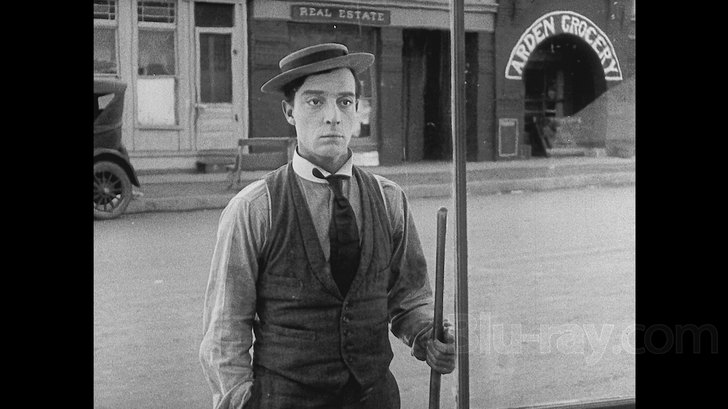
It's a fact: Films, of any age, are only going to look as good on Blu-ray as the prints from which they're sourced. When we start talking about silent
movies from the 1920s, we have to consider 80+ years of print damage due to variables like wear and tear and improper storage. Sherlock Jr.
and Three Ages, from 1924 and 1923, are the oldest silent films that Kino-Lorber has released on Blu-ray thus far, so it's understandable that
neither film looks quite as strong—in terms of overall clarity/cleanliness—as The General or Steamboat Bill, Jr., which came a few years
later in Keaton's career. Nevertheless, Sherlock Jr. has been beautifully and faithfully presented with a 1080p/AVC-encoded transfer that shows
no signs of de-graining or edge enhancement. (You will notice some slight black haloing around some hard lines, but sine Kino has categorically
denounced the use of digital sharpening, I can only guess that these artifacts are inherent in the Blu-ray compression/mastering process.) White specks
and both vertical and horizontal scratches are present through most of the film—you'll also catch two or three shots that have been sourced from a
different, more duped-looking print—but I find it's quite easy to mentally tune out the damage once you're engrossed with the moving image behind it.
Detail is strong, especially in the period clothing, and the monochromatic gradation is excellent, with deep blacks, a rich mid-range of grays, and whites
that are bright but never blown out. In this, Sherlock Jr. has an edge over Steamboat Bill, which I felt looked slightly too contrast-y. The
picture looks wonderful in motion.
Unfortunately, Three Ages doesn't fare nearly as well. It's been given a 1080i transfer—yes, interlaced—and while I didn't catch any overt
combing artifacts while watching the film, the image is quite soft, displaying significantly less detail than Sherlock, Jr. The print is more battered
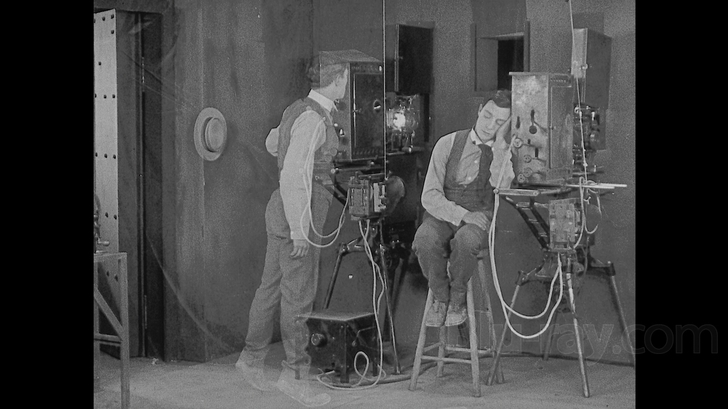
as well, with more staining, flicker, warping, and debris, although rarely to the level of distraction. Note that screenshots 1-15 are from Sherlock
Jr., while 16-20 are from Three Ages.
Sherlock Jr. / Three Ages Blu-ray Movie, Audio Quality
As usual, Kino has given viewers plenty of audio options. The default track for Sherlock Jr. is a DTS-HD Master Audio 5.1 mix of the Mont Alto Orchestra Score, which, fidelity-wise, may sound new—with a clean, dynamically vibrant presentation that makes use of all 5.1 channels—but the music itself is appropriately old-timey. (There's also a 2.0 LPCM fold-down of this mix.) For an actual old-time mix, try the Dolby Digital mono track of vintage music synchronized by Jay Ward, which is full of warbly, loveably muffled retro instrumentation. And then, on the completely opposite end of the spectrum, there's the Club Foot Orchestra Score, presented in Dolby Digital 2.0, a jaunty contemporary mix that makes musical allusions to a variety of pop songs and scores from the '50s, '60s, and beyond. Three Ages is fully loaded as well. The headline track is a LPCM 2.0 piano and string-based score by Robert Israel, but you can also access a Lee Erwin organ score and an anonymous piano score, both presented in Dolby Digital mono. All of the tracks are effective in their own ways—accenting the action and emotions of the films rather than trying to overpower them—so whether you're in the mood for creaky organ or lively modern orchestration, Kino has you covered.
Sherlock Jr. / Three Ages Blu-ray Movie, Special Features and Extras
Sherlock Jr.
Commentary by Film Historian David Kalat
Kalat sounds like he's reading from a script, but otherwise this is a terrific commentary, fully loaded with Keaton trivia, "making of" details, and insight
into the film's themes and standing within Keaton's oeuvre.
Tour of Filming Locations (1080i, 9:57)
John Bengston, author of Silent Echoes, discusses where specific scenes from Sherlock Jr. were shot, complete with both vintage and
contemporary photographs of the locations.
Movie Magic & Mysteries (1080i, 22:36)
A short documentary on the making of Sherlock, Jr., written by David B. Pearson, that covers the history of the project, how certain effect
shots were achieved, and the influence of "Fatty" Arbuckle.
Stills (1080p)
An easy-to-navigate gallery with 27 high definition stills.
Three Ages
Tour of Filming Locations (1080i, 7:58)
Once again, John Bengston gives a virtual tour of the filming locations.
Man's Genesis (1080i, 9:10)
An excerpt from the D.W. Griffith short that partially inspired the Stone Age section of Three Ages.
Three Separate Ages (1080p, 14:48, 18:56, and 26:28)
A "speculative" re-edit of the film into three two-reel shorts.
Stills (1080p)
A gallery with 21 high definition stills.
Sherlock Jr. / Three Ages Blu-ray Movie, Overall Score and Recommendation

I can't get enough Buster Keaton on Blu-ray—bring on Our Hospitality and The Navigator! Once again, Kino-Lorber has done a fantastic job with their latest silent film release, giving Sherlock, Jr.—a nearly 90-year-old film—a 1080p transfer that, age-related scratches and flecks aside, is absolutely beautiful. Three Ages doesn't fare quite as well visually, with more print damage, a softer appearance overall, and a 1080i presentation, but don't let this deter you. If you're a silent film enthusiast, this double feature definitely deserves a spot in your collection. Highly recommended!