Seven Wonders of the Buddhist World Blu-ray Movie
HomeSeven Wonders of the Buddhist World Blu-ray Movie 
PBS | 2011 | 74 min | Not rated | May 15, 2012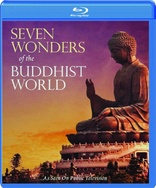

Movie rating
6.1 | / 10 |
Blu-ray rating
| Users |  | 0.0 |
| Reviewer |  | 3.5 |
| Overall | | 3.5 |
Overview
Seven Wonders of the Buddhist World (2011)
| Documentary | 100% |
Specifications
Video
Video codec: MPEG-4 AVC
Video resolution: 1080i
Aspect ratio: 1.78:1
Audio
English: DTS-HD Master Audio 2.0 (48kHz, 24-bit)
Subtitles
English
Discs
25GB Blu-ray Disc
Single disc (1 BD)
Playback
Region A (C untested)
Review
Rating summary
| Movie |  | 4.0 |
| Video | | 4.0 |
| Audio |  | 3.0 |
| Extras | | 0.0 |
| Overall | | 3.5 |
Seven Wonders of the Buddhist World Blu-ray Movie Review
The OTHER nirvana.
Reviewed by Brian Orndorf June 6, 2012Bettany Hughes is a historian and a popular television documentary host with an interest in world culture and religion that she wants to share with her audience. “Seven Wonders of the Buddhist World” is a travelogue program devoted to her thirst for knowledge, moving beyond the classroom to consume religious locales and practices in person, bringing along cameras to share this wealth of experience, providing atmosphere to the education. Despite the ravages of humidity and arduous distances, Hughes finds her way to seven places of unimaginable beauty and spiritual depth, stepping foot on Buddhist history with a goal to provide the average viewer with a deeper understanding of Buddhism and all of its colorful and meaningful practices.
The first stop on Hughes’s tour is the Mahbodhi Temple in Bodhgaya, India, a place of “great awakening” and the location of Buddha’s origin story. Here is where Buddha’s enlightenment began, launching the three principals of the religion, also known as the “three jewels.” A site of tremendous importance to Buddhists, the area is a holy place of astonishing history and natural beauty, also home to the Bodhi Tree, a scared fig tree that set the stage for Buddha’s journey of self. Here, Hughes plans out her travels, communicating a need to grasp ideas of Buddhism and its place in a global community growing to appreciate the religion’s messages of inner peace.
Moving over to the Boudhanath Stupa in Kathmandu, Nepal, Hughes encounters a towering monument built over a tiny part of Buddha’s remains (the rest of him is spread out over the Asian world), finished in the 14th century. This area is also known for the birth of Sangha, a monastic tradition comprised of monks and nuns who help educate outsiders and preserve the peace in younger generations. Hughes also introduces the idea of Dharma, or teaching of Buddhism, challenging followers to understand the richness of this education. Attracting a horde of Buddhists every day, Hughes finds herself overwhelmed at the Boudhanath Stupa, with the sensations of life and religion coming together as one.
At the Temple of the Tooth in Kandy, Sri Lanka, Hughes discovers a building devoted to the protection of a piece of Buddha’s incisor, visited by thousands of Buddhists every year. The temple is also a source of holy water used by followers to ward off illness and illuminate the soul, while babies are prepared to establish Karma, initiating a spiritual evenness soon to be tested by the threats and temptation of the outside world. Hughes delves into the concept of Karma and its place in the Buddhist world, while communicating a sense of amazement that such a teaching could thrive in a land torn apart by decades of civil war.
Located inside the Wat Pho Temple in Bangkok, Thailand is the golden statute of the Reclining Buddha, an enormous piece of art that symbolizes a sense of peace and reflection, erected on a grand scale to dwarf visitors and inspire awe. The largest and oldest temple in the city, Wat Pho is also home to over 1,000 Buddha images. While she strolls around taking in the sights, Hughes investigates the concept of Samsara, a cycle of birth and rebirth, and establishes a curiosity about Nirvana, a profound place of mental expansion that’s come to represent an end game of sorts for the religion.
Within Angkor Wat in Cambodia lies a crumbling complex devoted to the art of meditation, with the grounds patterned off the shifting nature of Buddhism over the years, supplying a home to the flowering of the religion, marked by ornate decoration and symbolic architecture. Hughes marvels over the history of the location, while taking time to note the miracle of such a place existing after the Khmer Rouge regime sought to destroy Buddhism during the 1970s. The host also notes the return of Buddhism to the land, making a comeback with citizens now more open to expressing their religious choices in public, invigorating Angkor Wat once again.
At the Giant Buddha in Po Lin, Hong Kong, Hughes encounters a massive statue of Buddha looking out over the land, posed in a spiritual manner, covered with art and symbols that deepen the meaning of the work. Completed in 1993, the grounds are devoted to the practice of Zen, a meditative state that looks to purge the chaos of life out of the mind, leaving a spirit free from anger and concern, wholly focused on inner peace. This clarity of mind is a challenge for Hughes, who partakes in some meditation, curious with the process and the concentration required to bring the body to a full stop. Cameras also catch a water bowl mediation ceremony, where participants use stillness of self to carry liquid across a rough terrain, relaxing skill to focus on a balance of the soul.
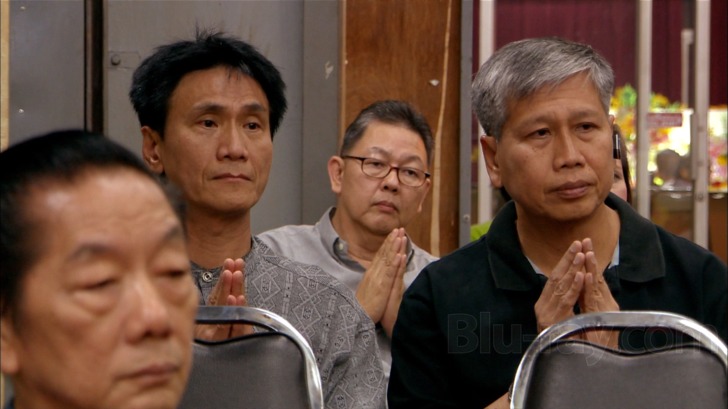
Finally, Hughes travels to the His Lai Temple in Los Angeles to visit a home of Buddhist splendor in the middle of a hectic, disorganized city committed to distractions of all kind. It’s this path to Nirvana in the western world that intrigues Hughes, looking for a place “beyond words, beyond logic” in a malevolent metropolis. With the religion growing in popularity, there’s no shortage of visitors to the temple, presenting a place of comfort for Buddhists looking to slip away from the city and clear their heads and strengthen their souls. However, not everyone in the neighborhood was tickled to have the temple nearby, with years of legal work and exploratory discussions required before permits were distributed and construction could begin. It seems America is still trying to wrap their minds round a religion of self-worth and individual motivation.
Seven Wonders of the Buddhist World Blu-ray Movie, Video Quality
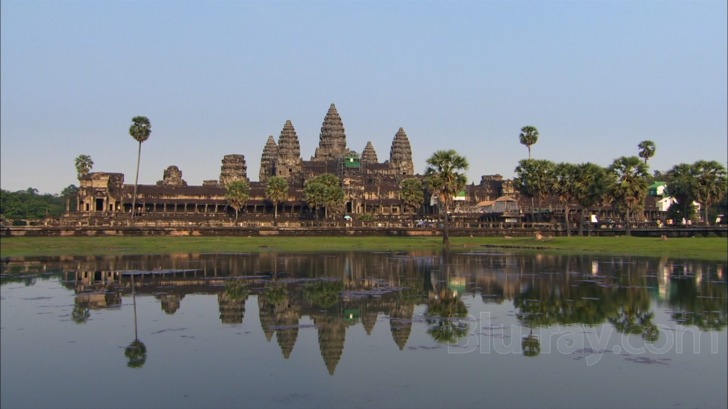
The AVC encoded image (1.78:1 aspect ratio) presentation is a stable HD viewing experience, lacking a film-like quality common in today's documentary marketplace. This is a clean viewing experience concentrated on the nuances of the locations, capturing artful beauty and naturalistic splendor, with a satisfactory sense of environmental changes, especially heat, which can be easily read on the faces of the interviewees and Hughes herself, delivering flush skintones. There's a bright color palette to enjoy, with intense golds and deep greens keeping the tourism exciting and evocative, while hues from clothing also provide a pleasing push. Detail is strong, creating pauseable moments with the disc, allowing curious viewers to take an extended look at the ornamentation and craftsmanship of the temples, while facial textures are expressive, displaying skin imperfections. The use of stock footage during the Angkor Wat visit is obvious, but there are no digital hiccups during the show, with sturdy black levels keeping distances and temple corners in view.
Seven Wonders of the Buddhist World Blu-ray Movie, Audio Quality

The 2.0 DTS-HD MA sound mix is a simple as can be, with a forward push of voices and scoring to sell the journey with the bare minimum in dimension and sonic power. Interviews and narration are crisp and deep, keeping Hughes's conversations easily understood. Music is supportive without overwhelming the audio information, keeping a low profile for much of the show. No distortion is detected, leaving the track satisfactory but never as remarkable as its subject matter.
Seven Wonders of the Buddhist World Blu-ray Movie, Special Features and Extras

There is no supplementary material on this disc.
Seven Wonders of the Buddhist World Blu-ray Movie, Overall Score and Recommendation
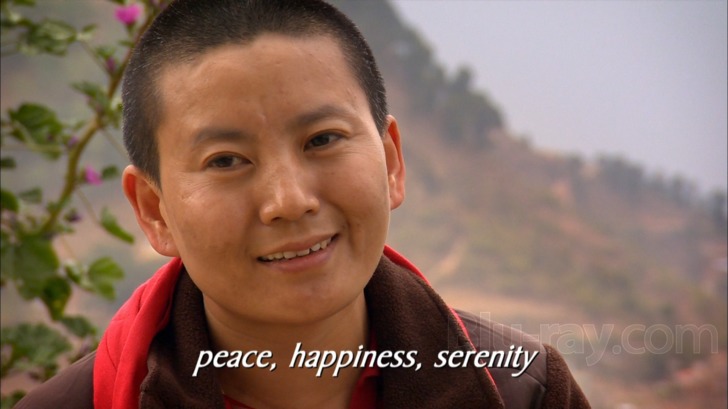
A trip around the globe, "Seven Wonders of the Buddhist World" accomplishes exactly what it sets out to do, providing viewers with an appreciation for religious history and temple design, hosted with vigor by a clearly engaged Hughes. There's also an elementary understanding of Buddhism here that's immensely appreciated and quite interesting, providing those without a deeper awareness of the religion an entry point to a bold new world of thought, guided by a most enlightened sense of self-worth and heavenly purpose. The buildings presented here are merely the first step of the spiritual journey.