Serge Gainsbourg: Aux armes et cætera Blu-ray Movie
HomeSerge Gainsbourg: Aux armes et cætera Blu-ray Movie 
Blu-ray AudioUniversal Music | 1979 | 33 min | Not rated | Oct 30, 2013
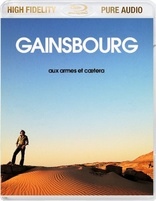

Movie rating
7.1 | / 10 |
Blu-ray rating
| Users |  | 0.0 |
| Reviewer |  | 4.0 |
| Overall | | 4.0 |
Overview
Serge Gainsbourg: Aux armes et cætera (1979)
| Music | 100% |
Specifications
Video
Video codec: MPEG-4 AVC
Video resolution: 1080p
Aspect ratio: 1.78:1
Original aspect ratio: 1.78:1
Audio
French: LPCM 2.0
French: DTS-HD Master Audio 2.0
French: Dolby TrueHD 2.0
Subtitles
None
Discs
Blu-ray Disc
Single disc (1 BD)
Playback
Region A (B, C untested)
Review
Rating summary
| Movie | | 4.0 |
| Video | | 0.0 |
| Audio |  | 5.0 |
| Extras | | 0.0 |
| Overall | | 4.0 |
Serge Gainsbourg: Aux armes et cætera Blu-ray Movie Review
Reviewed by Jeffrey Kauffman August 24, 2024Who's your favorite reggae artist? Any number of names like Bob Marley, Jimmy Cliff and/or Peter Tosh might occur to fans. Oh, and of course Serge Gainsbourg. Wait. . . what? That's right! The erstwhile enfant terrible and agent provocateur of French pop music, one who famously invited worldwide umbrage from prudish types for Je t'aime... moi non plus, actually had a whole "reggae period" that lasted for a few years from the late seventies to the early eighties. Aux Armes et cætera was the first album from this period, and it in fact featured some "native" reggae royalty, including Rita Marley. Reggae tunes often had a somewhat subversive subtext or even text ( I Shot the Sheriff springs instantly to mind), but given Gainsbourg's tendency toward pushing buttons, it may not come as a huge surprise that he offers a title tune that is a reggae infused redaction of the French national anthem La Marseillaise. Suffice it to say while France may have been, well, laissez faire about Gainsbourg's famous duet with Jane Birkin (after an earlier version with none other than Brigitte Bardot), they weren't about to hear their literal call to arms "refashioned" in such a provocative manner, and hilarity, as they say, did not ensue. Kind of interestingly in that regard, and especially considering the reaction the song got in France, Gainsbourg's "adaptation" is certainly nowhere near as overt as Jimi Hendrix's blistering Star Spangled Banner or the Sex Pistols' God Save the Queen. One way or the other, either in spite of or quite likely because of the controversy, the album became a massive hit and probably helped to introduce Gainsbourg to a whole younger generation who may not have been aware of his previous controversies. The album has some driving rhythms and Gainsbourg's typically trenchant lyrics, but it may frankly come off as ersatz reggae at times, the work of a talented dilettante rather than a natural born espouser of the idiom.
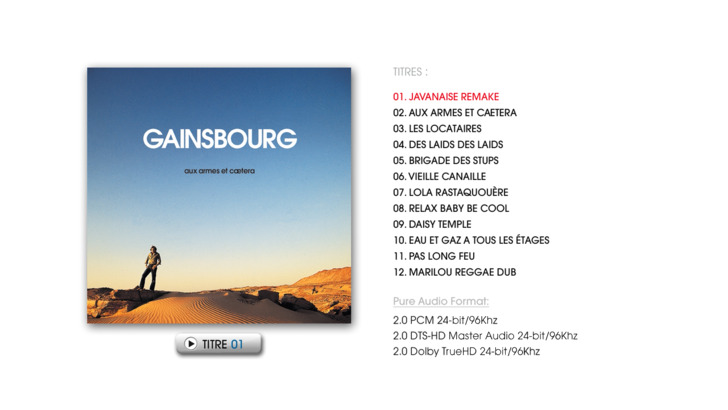
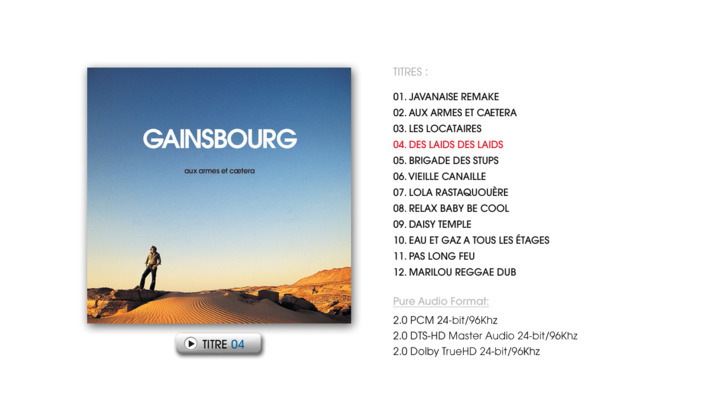
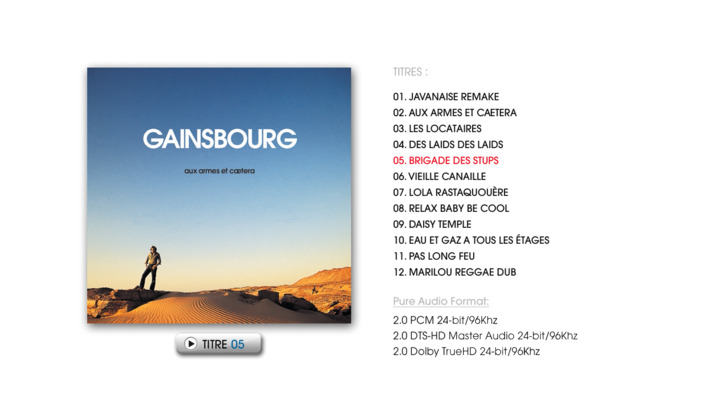
The album's track list can be seen in the screenshots of the disc menu I've uploaded to accompany this review.
Serge Gainsbourg: Aux armes et cætera Blu-ray Movie, Video Quality
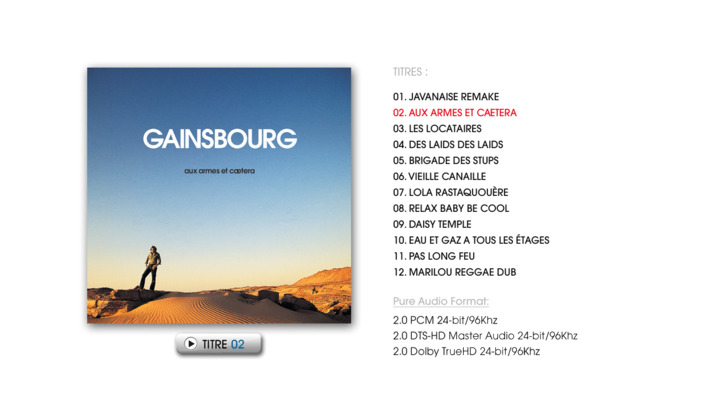
This is an early "high fidelity pure audio" release from Universal Music Group (and Mercury, kind of surprisingly), that has a static menu. You need to navigate down to the audio codec listings to switch. The "Titre" listing under the album will move independently with the chapter ahead button while the first track is still highlighted, or if you want to skip, you can navigate down to any specific title and click on it.
Serge Gainsbourg: Aux armes et cætera Blu-ray Movie, Audio Quality
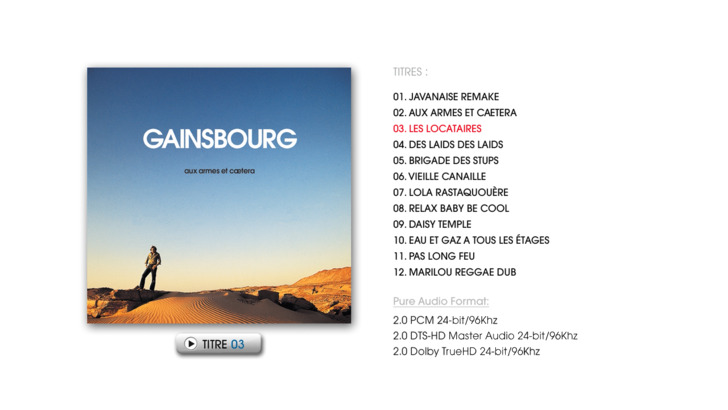
Aux Armes et cætera features stereo audio in each of the "big three" codecs, all at 96/24. Better ears than mine may be able to discern large differences between these options, but I frankly couldn't. All three offer excellent fidelity and some especially nice midrange and low end (though I can't help but wonder what a 5.1 or even 4.0 rendering might have done with the bass and drums). Stereo imaging is nicely spacious, and includes some wacky sound effects along the way that almost reminded me of some of Enoch Light's early efforts for Command.
Serge Gainsbourg: Aux armes et cætera Blu-ray Movie, Special Features and Extras
There are no on disc supplements. The insert booklet contains an essay (in French), the track listing with writer and publisher credits, and band credits.
Serge Gainsbourg: Aux armes et cætera Blu-ray Movie, Overall Score and Recommendation
Aux Armes et cætera is really fascinating mashup of Gainsbourg's Gallic sensibility with the "quiet storm" aspects of Jamaica. This audio Blu- ray offers excellent fidelity and should be enjoyed by fans. Recommended.