Satanic Sisters Blu-ray Movie
HomeSatanic Sisters Blu-ray Movie 
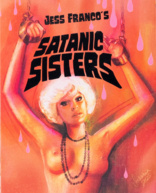
Sexy Sisters / Die teuflischen Schwestern / Slipcover in Original PressingDelirium Home Video | 1976 | 87 min | Not rated | Apr 28, 2026
Price
Movie rating
6.1 | / 10 |
Blu-ray rating
| Users |  | 0.0 |
| Reviewer |  | 3.5 |
| Overall | | 3.5 |
Overview
Satanic Sisters (1976)
Countess Edna Luise Von Stein keeps her disturbed sister Milly prisoner. Confined to her bed, Milly suffers from a deep sexual trauma resulting from being raped as a child by a man after she had surprised him and her sister in bed. Edna and her accomplice Dr. Barrios have hatched a plot to have Milly declared insane. Over the years Barrios has been injecting Milly with a drug that has turned her into a nymphomaniac. Milly's only hope is Joe, the only one of her numerous lovers to have ever succeeded in pleasuring her, who has fallen in love with her. Will he succeed in rescuing her from Edna and Barrios, and will Milly be able to live a normal life?
Starring: Karine Gambier, Pamela Stanford, Jack Taylor (II), Esther Moser, Marianne GrafDirector: Jesús Franco
| Horror | Uncertain |
| Erotic | Uncertain |
| Thriller | Uncertain |
| Crime | Uncertain |
Specifications
Video
Video codec: MPEG-4 AVC
Video resolution: 1080p
Aspect ratio: 1.85:1
Original aspect ratio: 1.85:1
Audio
English: DTS-HD Master Audio 2.0
English: DTS-HD Master Audio 5.1
Subtitles
English SDH
Discs
Blu-ray Disc
Single disc (1 BD)
Packaging
Slipcover in original pressing
Playback
Region A, B (C untested)
Review
Rating summary
| Movie | | 3.5 |
| Video |  | 3.0 |
| Audio | | 3.5 |
| Extras | | 3.5 |
| Overall | | 3.5 |
Satanic Sisters Blu-ray Movie Review
Reviewed by Justin Dekker May 12, 2026The second title from Delirium Home Video, 1977's 'Satanic Sisters' (aka "Sexy Sisters", aka Die Die Teuflischen Schwestern") arrives on Blu-ray disc. Directed by the infamous Jess Franco ('She Killed in Ecstasy', 'Female Vampire'), the film stars frequent Franco collaborator Pamela Stanford ('Lorna, the Exorcist', Nathalie: Escape from Hell'), French adult film actress Karine Gambier ('Gefangene Frauen', 'Women in Cellblock 9'), Jack Taylor ('Dr. Jekyll vs. The Werewolf') and Erik Falk ('Rolls Royce Baby'). The release features a host of on-disc supplemental materials that are highlighted by a piece contributed by author and leading Francophile Stephen Thrower. A limited slipcover is included with the first 2000 units.
Please note: Much of the text below previously appeared in the my review of the original withdrawn release of Delirium Home Video's 'Satanic Sisters' from 2025.
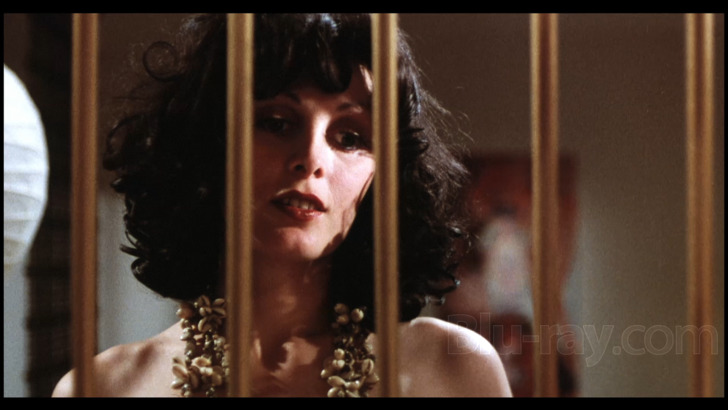
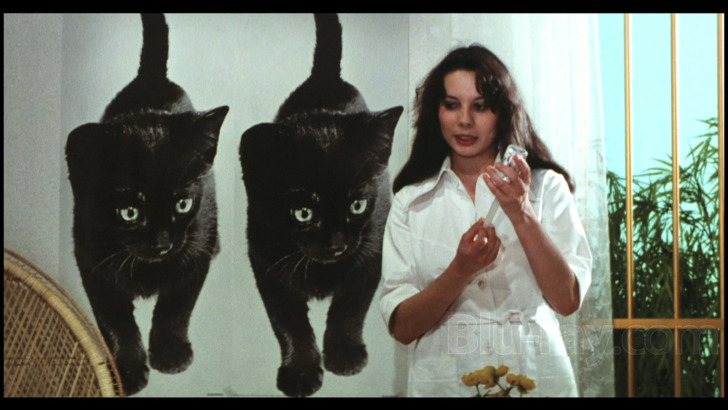
Edna (Pamela Stanford) lives with her half-sister Milicent (Karine Gambier). With help from a small staff and Dr. Charles (Jack Taylor), Edna cares for Milicent, who needs to be kept restrained due to her overwhelming and all-consuming nymphomania. Part of that care sees Edna luring men back to their home to service Millicent's insatiable appetites. But all is not quite as it seems, as Edna is found to be working in league with the unscrupulous Dr. Charles who routinely administers the injections that are the cause of Milicent's condition. When she finally finds someone with whom she can connect despite her condition, it will be up to her new-found love to save her before she is swindled out of her sizeable inheritance.
In the tradition of some of Franco's best work, much of Satanic Sisters plays out like some sort of twisted dream. After watching Edna ply Joe with her Venus flytrap wiles, he's hopelessly ensnared. Joe (and the audience) drifts along wherever and with whatever Edna decrees. When she doesn't approve of his car, he quickly lets her drive him to her home. When she directs her maid to undress him, he offers neither resistance nor even a hint of shyness. When she changes the game entirely and informs him that, despite her actions and advances up to this point that he's to spend the night with her obviously unstable sister, he simply goes with the flow. When the night is over and he awakens in his car, he is unable to find his way back to the house until a chance encounter later allows him to follow Edna. Logic and reality have no place here, events merely unfold in the manner in which Franco needs them to.
The more time the film spends with Milicent, the more reality begins to bend further. While she dreams or fantasizes about obtaining her freedom from confinement, she (and we) have difficulty understanding when and if she has left the gilded cage (replete with a golden door and golden bars) that is her home. While clearly enjoying the water, it's uncertain if she actually visited an outdoor swimming pool and the beach, as in both instances she's seen engaging in some of the behavior that results in her being confined. All that is truly certain is that hers is a troubled and joyless existence, an erotic dream with no pleasure and no end.
Satanic Sisters Blu-ray Movie, Video Quality
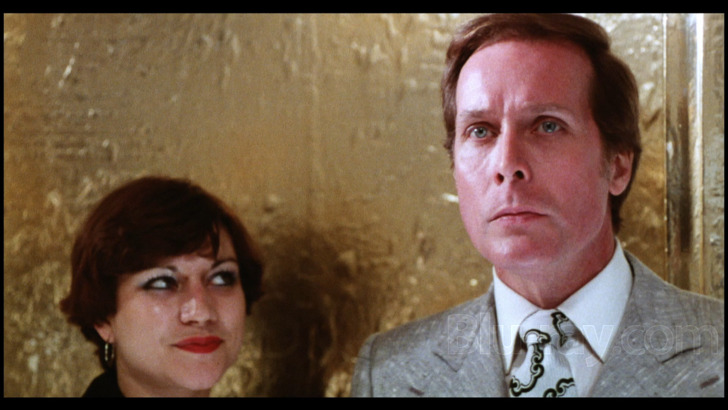
I spent a fair amount of time going back and forth between Delirium's new release and the withdrawn iteration which arrived on the market very
briefly last year. To my eye, they are essentially identical. The small bit of wobble remains in the opening credits as the film's title is
displayed in white on a red field, and during the first wide shot of the two female performers and the pair of musicians who support them. Similar
fluctuations is skin tones appear in a similar fashion at identical points in the film, and so on. As with the Ascot release of the title from some years
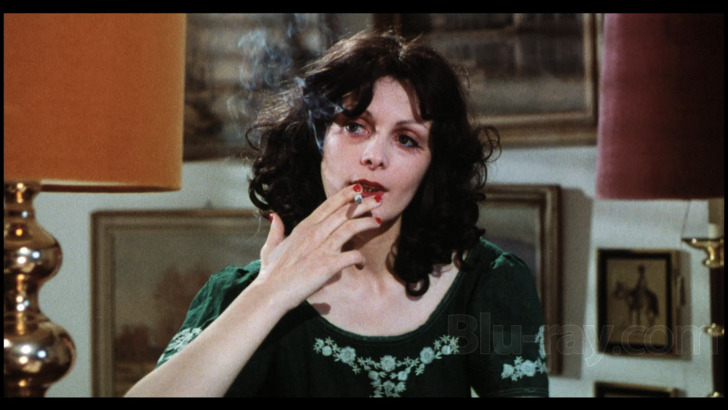
ago, the early goings, approximately the first 25 minutes or so, fare the worst. Here, flesh tones veer from vintage but healthy looks, to reddish, to
washed-out. Day-for-night shots are problematic here as well, reading far darker than they should. One such scene, where Pamela Stanford and Kurt
Meinicke (Joe) park in his VW to become better acquainted, sees the picture take on a slightly yellowish hue. Here softness invades, and crush is also
an issue. When taking some time to bounce back and forth between this disc and Ascot's release from 2013, I noticed that their disc struggled in
these moments also, just not quite as much. On that disc, the scene in the car softens and shadow consumes much of the detail, but the colors
remain closer to true. When back at Edna and Milicent's home, Meinicke's face still darkens on the Ascot disc, but does not mimic the very deep red
that is visible on the Delirium disc.
That aside, outside of those opening two reels, the rest of the film is much in line with what one would expect from a lower-budget production from
the 1970s and things improve quite a bit. There is the odd missing frame, minor damage, an instance of flickering, and the like. But on the whole,
colors are much more stable, residing within an acceptable but slightly washed-out palette that again, is in keeping with films of the era that have not
undergone massive restoration. Skin tones improve. There is still some variance from scene to scene, but on the whole, they look much healthier and
realistic which is important for a film with such a significant amount of its runtime devoted to soft-core couplings. Fine detail also comes into focus
much more with fine lines, wrinkles, hairstyle particulars, and other elements of the actors' appearances being open for investigation, and are
particularly so in the close-ups of which Franco was fond. Darker areas of Edna and Milicent's home can be deep, but can also absorb detail. Given its
age and its origin, it's a solid enough transfer.
Satanic Sisters Blu-ray Movie, Audio Quality
The original Delirium release had a Dolby Digital 5.1 and Dolby Digital 2.0 audio option, as well as a German 2.0 option with English subtitles. At that time, the German 2.0 was my preferred track for viewing the film. This new Delirium release drops the German track in favor of two English DTS-HD MA tracks, a 5.1 and a 2.0 track, respectively. They largely perform in fashion similar to their predecessors, though there are some differences. The throwaway piece of dialogue between two attendees at the show during the film's opening is somewhat lost in the DD 5.1 mix. Though the new DTS-HD MA 5.1 track still struggles to bring that bit a of dialogue out from under the dreamy sitar work, it's a bit more audible here. In the new track, however, music seems to be slightly more robust and precise, filling the stage a bit more convincingly. Once dialogue begins in earnest, though, the immersion ceases and the track focuses on Stanford's Edna and her indecent proposal, though he odd bit of dialogue from those in the club sounds muffled, and later, back at her home it's a bit echoey in spots. The track has two main objectives; reproducing dialogue and moans, and handling the exotic and jazzy score. The 5.1 score does quite well with the music. Instrumentation is precise, though the moments of immersion past the opening club scene are scarce. In fact, once we're past that trademark Franco scene, it becomes a much more front-focused affair from an audio perspective. Bass support is thin, but by the same token there aren't exactly many instances where a bigger bottom end would have been useful or appropriate. The 2.0 track removes the immersion present in that first scene in the club as expected, with the throwaway line of background dialogue still being a bit hard to hear, but it fares somewhat better. The dubbed dialogue, though feels tighter, with the echoing much less of an issue. Music is likewise slightly more robust in the the DTS-HD MA track than in it's stereo predecessor. Otherwise the two tracks perform similarly, with the track handling dialogue, moans, music, and mundane sound effects well. Going forward, the 2.0 track, which provides a pleasing and authentic viewing experience will be my choice.
Satanic Sisters Blu-ray Movie, Special Features and Extras
For this new release of Satanic Sisters, while most of the on-disc extras from the first release make their way to this one, there has been one
important deletion, one small addition, and relatively even exchange as detailed below.
New to this Delirium Home Video release!
- German Trailer (3.16) - With forced French subtitles.
- Audio Commentary by Author Dennis Daniel - Daniel begins with a discussion of the opening club scene, the likes of which was something of a staple for Franco. He then addresses his love of Franco's films, beginning with what started his personal fandom and what makes Franco so appealing to him. From there, he launches into something of a defense for Franco's body of work before getting into the film itself and its stars, Pamela Stanford and Karine Gambier, and his particular affinity for Gambier is apparent. He shares a extensively from an interview he did with Franco in 1999, where Jess shared information about his family, his upbringing, and his love of cinema, and the censorship in place under the Franco regime (which finally ended when Jess was 45), before delving into his film career. He's less concerned with tracking the onscreen action and tailoring his comments accordingly than he is in sharing his love for the cast and Franco's films. Later in the track, he lists what he believes are Franco's essential films, which every new fan must see, including The Awful Dr. Orloff, The Diabolical Dr. Z, 99 Women, The Bloody Judge, and Count Dracula among others. It's an interesting, free-form track.
- Official Trailer (1.04)
- Twins of Evil: Author Stephen Thrower on 'Satanic Sisters' (22.32) - Thrower covers a great deal of ground in a short amount of time. He discusses the working relationship Franco had with Dietrich, the films they made together, how Franco's habit of working on several films at once created tension between the two, and the cast for this film which is a mix of Franco and Dietrich "regulars". He eventually settles in and focuses on this film in particular, and he takes a moment to point out the Rolls from Rolls Royce Baby, which returns here for a cameo of sorts. The short is up to Thrower's usual standards and is a "must watch".
- Photo Gallery (2.16) - A collection of stills automatically advances to a sitar soundtrack.
- Erwin C. Dietrich Trailer Reel (5.41) - Trailers for Barbed Wire Dolls, Doriana Gray, Love Camp, and Love Letters of a Portuguese Nun are included.
- Franco, Bloody Franco (40.24) - This is an audio interview with Jess Franco from June of 1976 in Zürich, and is subtitled in English. The interview starts with Franco discussing his film, Jack the Ripper which starred Klaus Kinski, whom Franco professed to adore. He talks about having Zürich stand in for London in the film, being more impressed with the architecture there than in the city that was the actual home to the events depicted. He also discusses knowing Peter Baumgartner when the two played in various bands in Paris during the early 1950s (Franco played trumpet). He spends time talking about other directors like Terence Fisher and Roger Corman, and professes (up to that point), the fastest he ever shot a film was in just one week, not being able to match Corman's 3-day mark. Stills and lobby cards scroll by for the course of the interview. This interview previously appeared on the Ascot release of Love Camp but was in French with German subtitles so it had little value to those who aren't fluent in either of those languages. Its inclusion on the original release with English subtitles was a most welcome surprise, and its deletion from this one is a palpable loss.
- Vintage Trailer Reel (6.44) - Bearing a title card that reads "vintage Jess Franco VHS trailers (sic)", trailers include Oasis of the Zombies, Demoniac, A Virgin Among the Living Dead, The Screaming Dead, Erotikill, and The Invisible Dead.
Satanic Sisters Blu-ray Movie, Overall Score and Recommendation
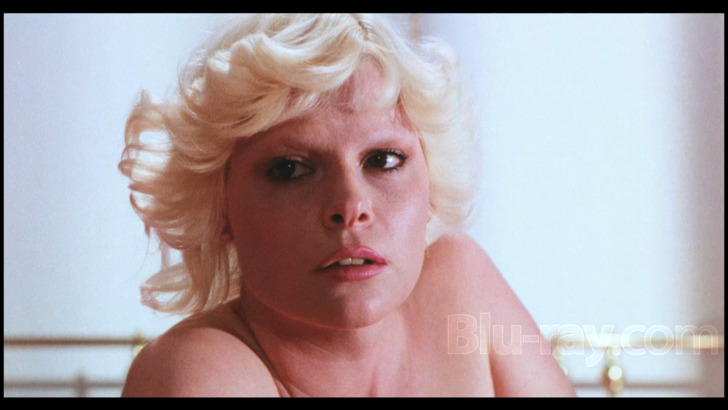
Franco's work may not be for everyone, but the Erwin C. Dietrich financed and influenced Satanic Sisters is one of the more approachable and conventional of the director's work, even if it does push some boundaries. Many of Franco's tendencies are on display here, make no mistake, including the opening scene with a largely mute audience paying rapt attention to a small stage show, the blurring of dream and reality, and a number of familiar faces from his other films. Pamela Stanford and Karine Gambier easily carry the film and command the viewer's attention in every scene. While it may not make every Franco fan's list of the director's top-tier films, it's certainly on mine, and Delirium's disc is fairly solid. Those lucky enough to grab a copy of the original Delirium release will want to hang on to it if for other reason than the inclusion of the lengthy audio interview with Franco, and may not see a compelling reason to double-dip here. For those who missed that first release, the new Delirium disc still sports a healthy assortment of on- disc supplemental material highlighted by Dennis Daniel's commentary and a segment with Stephen Thrower, as well as improved English audio options. Satanic Sisters comes recommended to Franco's fans and the Franco-curious.
Other editions
Sexy Sisters: Other Editions

Similar titles
Similar titles you might also like

Through the Looking Glass 4K
1976

Vampire Ecstasy
The Devil's Playground
1973

Corruption
Last House on Dead End Street
1977-1983

Ilsa, Harem Keeper of the Oil Sheiks 4K
Kino Cult #41
1976
Whirlpool
1970

Night Has a Thousand Desires
Night of 1000 Sexes / Mil sexos tiene la noche
1984
Blood Mania
1970

Embrace of the Vampire
1995

Embrace of the Vampire
2013
Murder Weapon
Beverly Hills Corpse
1989

Portraits of Andrea Palmer
2017

Female Vampire
La comtesse noire
1973

Stripped to Kill
Limited Edition - 1,200 copies | SOLD OUT
1987

Ilsa, The Wicked Warden 4K
Greta, The Mad Butcher / Greta - Haus ohne Männer | Kino Cult #48
1977

A Woman's Torment
1977

Sorceress
Temptress
1995
Sacrilege
1971
The Devil Inside Her
1977

Exorcism
L'éventreur de Notre-Dame
1974

Lorna the Exorcist
Les possédées du diable / Kino Cult #1
1974