Samurai Wolf I & II Blu-ray Movie
HomeSamurai Wolf I & II Blu-ray Movie 
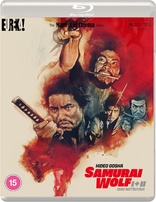
Masters of CinemaEureka Entertainment | 1966-1967 | 2 Movies | 144 min | Rated BBFC: 15 | Jan 29, 2024
Price
List price:Listed on Amazon marketplace

Movie rating
Movie has not been rated yetBlu-ray rating
| Users |  | 4.0 |
| Reviewer |  | 4.5 |
| Overall | | 4.0 |
Overview
Samurai Wolf I & II (1966-1967)
| Foreign | 100% |
| Drama | 14% |
| Adventure | Insignificant |
| Action | Insignificant |
Specifications
Video
Video codec: MPEG-4 AVC
Video resolution: 1080p
Aspect ratio: 2.35:1
Original aspect ratio: 2.35:1
Audio
Japanese: LPCM 2.0
Subtitles
English
Discs
Blu-ray Disc
Two-disc set (2 BDs)
Packaging
Slipcover in original pressing
Playback
Region B (locked)
Review
Rating summary
| Movie | | 4.0 |
| Video | | 4.5 |
| Audio | | 4.5 |
| Extras | | 4.0 |
| Overall | | 4.5 |
Samurai Wolf I & II Blu-ray Movie Review
Reviewed by Dr. Svet Atanasov December 26, 2023Hideo Gosha's "Samurai Wolf" (1966) and "Samurai Wolf II: Hell Cut" (1967) arrive on Blu-ray courtesy of Eureka Entertainment. The supplemental features on the release include exclusive new program with critic Tony Rayns; recent program with Tomoe Gosha; recent audio commentary by author and critic Chris Poggiali; and more. In Japanese, with optional English subtitles for the main feature. Region-B "locked".
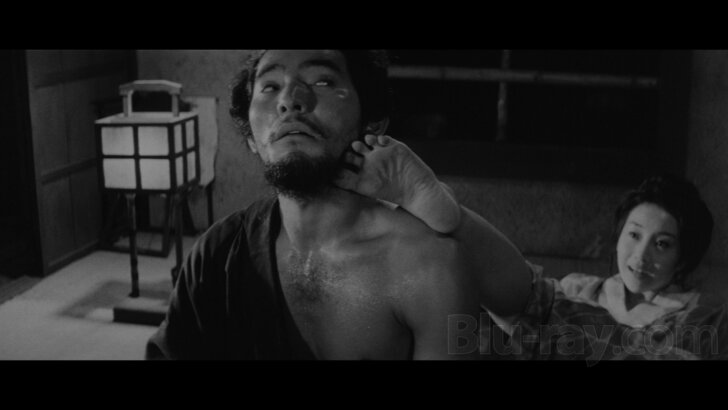
Hideo Gosha’s admiration for the classic American western makes Jean-Pierre Melville’s obsession with it appear like a minor distraction. If you keep this in mind nothing in Gosha’s Samurai Wolf and Samurai Wolf II: Hell Cut will surprise you. On the contrary, it will instantly begin to make perfect sense to you.
The two films do not have to be seen in the proper order to be enjoyed. Their main protagonist, Kiba (Isao Natsuyagi), is a wandering ronin -- repeatedly referred to as Furious Wolf -- who gets stuck in completely different situations where he encounters unique characters. The second film uses several flashbacks to reveal important information about Kiba’s relationship with his late father, but it will not be a spoiler if you become familiar with it before you see the first film. Also, you easily can see these films on the same night as both are approximately seventy-five minutes long.
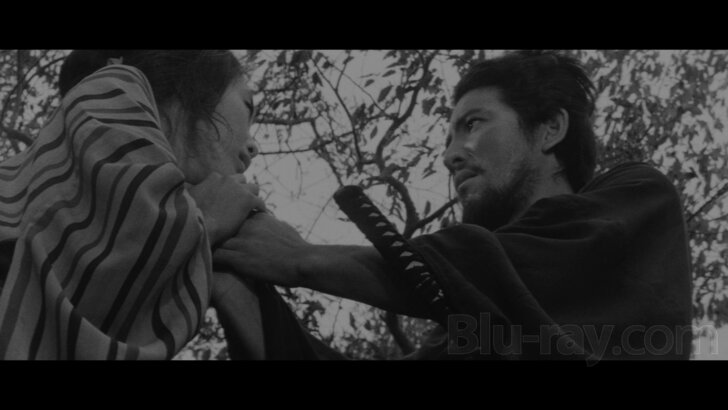
Gosha sets both films in remote rural locations where shady characters and outlaws are involved in scams that are supposed to make them very rich. In the first film, Kiba arrives at a waystation whose owner, a beautiful blind lady (Junko Miyazono), seduces and then convinces him to help with the transport of a large load of gold. Soon after, Kiba becomes a target for a gang of outlaws determined to steal the gold and an ambitious daimyo (Tatsuo Ondo) who is hell-bent on becoming the next owner of the waystation. While Kiba tries to deliver on his promise to help, several ronin, all handling a sword as well as he does, are summoned to take him out.
In the second film, Kiba reaches a massive mine that until recently has provided the Shogun with regular loads of gold, and once again becomes involved in a dangerous kabuki play. This time the players are the mine’s shady owner who has figured out a way to cheat the Shogun, a dim-witted woman driven by a thirst for revenge, a master swordsman with a huge ego, and a violent thief (Ko Nishimura) who has been betrayed by his former partners.
Even though it is clear that Gosha was inspired by the classic American western, Samurai Wolf and Samurai Wolf II: Hell Cut are actually a lot easier to compare to the exotic and frequently hyperviolent Italian spaghetti westerns. Of course, this makes perfect sense because the spaghetti westerns were heavily influenced by the classic American western as well. In other words, in both films, there is a lot of stylistic overlapping that is quite interesting to analyze because it can be traced back to foreign places where the western had different identities.
But just as Melville’s gangster films paid homage to the classic American western and classic film noir and in the process acquired unique identities, Samurai Wolf and Samurai Wolf II: Hell Cut are impossible to describe as anything else but uniquely Japanese period crime films because they comfortably develop unique identities as well. What makes the crucial difference in them? The special characters and their most unpredictable behavior. Here’s an example that is not a spoiler: In both films, the female characters are impossible to properly read until Gosha forces them to take off their masks. On top of this, all the leading male characters have flaws and weaknesses that make their decisions difficult to predict as well. The famous classic Japanese samurai films are not populated with such characters. They quickly divide their characters into good and bad, and then proceed to tell a story in which the former find a way to emerge victorious.
The visual style of Samurai Wolf and Samurai Wolf II: Hell Cut is very interesting, too. For example, both blend fast zooms and cuts with slow-motion footage that makes the sword action very attractive. Gosha’s fondness for minimalism syncs nicely with it as well.
Toshiaki Tsushima’s soundtrack easily could be mistaken as a creation of one of the legendary Italian maestros who scored such cult spaghetti westerns as The Great Silence, Day of Anger, and Sartana.
Samurai Wolf I & II Blu-ray Movie, Video Quality
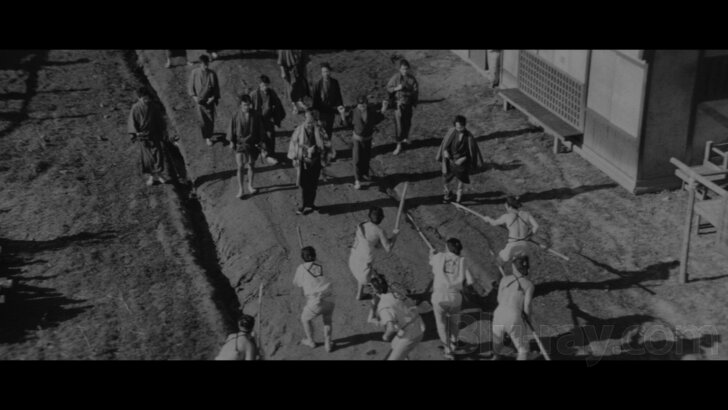
Presented in an aspect ratio of 2.35:1, encoded with MPEG-4 AVC and granted a 1080p transfer, Samurai Wolf and Samurai Wolf II: Hell Cut arrive on Blu-ray courtesy of Eureka Entertainment.
The release introduces Toei's recent 2K restorations of the two films. In the United States, Film Movement introduced these restorations with this release earlier this year.
On this release, the gamma levels on the presentations of Samurai Wolf and Samurai Wolf II: Hell Cut are set differently. (I mentioned in our review of the Film Movement release that gamma levels there are not set properly. A high-end player can make adjustments on the fly, but for obvious reasons, this is not an ideal scenario). As a result, the dynamic range of the visuals is superior. However, there are a couple of indoor/nighttime segments where it appears that some of the blacks begin to crush a bit now. The effect is more obvious in Samurai Wolf II: Hell Cut, but perhaps because there is slightly more dark material there. The rest looks very good. There are no traces of problematic digital corrections. However, you need to keep in mind that in both films there are inherited density fluctuations that introduce what you may perceive as flatness. In other words, if grain exposure is not even throughout both films and in certain areas delineation and depth are impacted in some particular ways, what you are seeing are not the effects of poor lab work. Some surface imperfections remain too, like blemished and small marks, but there are no large cuts, debris, warped or torn frames to report. (Note: This is a Region-B "locked" Blu-ray release. Therefore, you must have a native Region-B or Region-Free player in order to access its content).
Samurai Wolf I & II Blu-ray Movie, Audio Quality
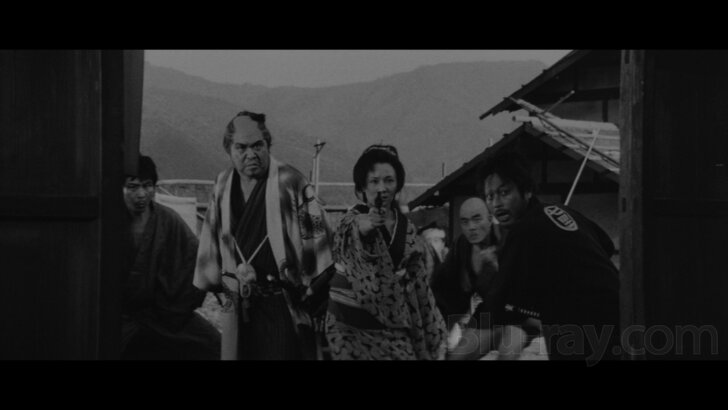
Samurai Wolf and Samurai Wolf II: Hell Cut are presented with Japanese LPCM 2.0 tracks. Optional English subtitles are provided for each film. When turned on, they appear inside the image frame.
I do not have any new comments to add about the quality of the lossless tracks on each film. They are very healthy. Also, the most unusual but very effective soundtracks -- both mimicking the style of the classic spaghetti western soundtracks -- create some quite spectacular contrasts. In select areas, you will notice some unevenness, but it is never distracting. I did not encounter any encoding anomalies to report.
Samurai Wolf I & II Blu-ray Movie, Special Features and Extras
DISC ONE - SAMURAI WOLF
- Outlaw Director: Hideo Gosha - in this recent program, Tomoe Gosha, daughter of director Hideo Gosha, discusses her father's TV and film work, his admiration for the classic American western, and the unique characters that populated his films and their relationship with violence. There are some particularly interesting comments about the choreography and filming of the sword fights in Samurai Wolf and Samurai Wolf II: Hell Cut. In Japanese, with English subtitles. (16 min).
- Commentary - this recent audio commentary was recorded by author and critic Chris Poggiali. It offers plenty of interesting information about the genre identities of Samurai Wolf and Samurai Wolf II: Hell Cut, the personality and image of its main protagonist, Hideo Gosha's work on both films (with interesting comments about the different camerawork), the careers of some of the principal actors, etc.
- Commentary - in this exclusive new audio commentary, author and critic Jasper Sharp discusses the conception, production, and premature termination of the Samurai Wolf films, as well as their placement in Hideo Gosha's body of work. Also, Mr. Sharp shares plenty of interesting information about Gosha's career and specifically TV career, other cast members and their work, the evolution (and perhaps devolution) of the classic samurai film, etc.
- Tony Rayns on Samurai Wolf - in this exclusive new program, critic Tony Rayns discusses the history of the B-film in Hollywood and explains why Samurai Wolf and Samurai Wolf II: Hell Cut are special Japanese B-films. In English, not subtitled. (22 min).
- Cover - reversible cover featuring original poster artwork.
- Booklet - an illustrated collector's booklet featuring new writing on the film by Japanese cinema expert Tom Mes and technical credits.
Samurai Wolf I & II Blu-ray Movie, Overall Score and Recommendation
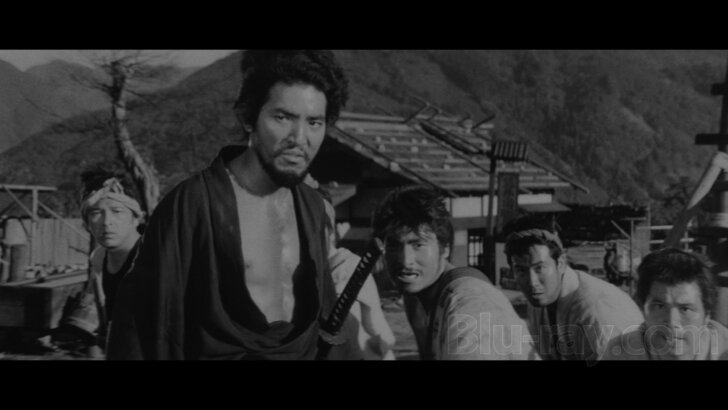
Outlaws, thieves, whores, and shady characters representing the law. Barren landscapes where human life is worthless. A brave loner who cannot stop living on the edge. If this reads like a short but pretty accurate description of an unnamed western, well, it is not. While incomplete, it is a pretty accurate description of Hideo Gosha's Samurai Wolf and Samurai Wolf II: Hell Cut. I thought that both were outstanding, featuring some of the most unpredictable characters I have seen in samurai films in a very long time. Eureka Entertainment's two-disc set introduces the recent, very nice 2K restorations of these films that were prepared on behalf of Toei in Japan. HIGHLY RECOMMENDED.