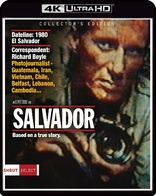
Salvador 4K Blu-ray Movie
HomeSalvador 4K Blu-ray Movie 
4K Ultra HD + Blu-rayShout Factory | 1986 | 122 min | Rated R | Sep 02, 2025


Movie rating
7.3 | / 10 |
Blu-ray rating
| Users |  | 4.0 |
| Reviewer |  | 3.5 |
| Overall | | 3.5 |
Overview
Salvador 4K (1986)
A sleazy, boozing journalist decides to go to Central America and cover the war there, but finds himself in a more dangerous situation than he ever expected.
Starring: James Woods, Jim Belushi, Michael Murphy (I), John Savage (I), Elpidia CarrilloDirector: Oliver Stone
| War | Uncertain |
| Biography | Uncertain |
| History | Uncertain |
| Thriller | Uncertain |
| Drama | Uncertain |
Specifications
Video
Video codec: HEVC / H.265
Video resolution: 4K (2160p)
Aspect ratio: 1.85:1
Original aspect ratio: 1.85:1
Audio
English: Dolby Atmos
English: Dolby TrueHD 7.1 (48kHz, 24-bit)
English: DTS-HD Master Audio 5.1 (48kHz, 24-bit)
English: DTS-HD Master Audio 2.0 Mono (48kHz, 24-bit)
Atmos: 3407 kbps, 5.1: 3133 kbps, 2.0: 2008 kbps
Subtitles
English SDH
Discs
Blu-ray Disc
Two-disc set (2 BDs)
4K Ultra HD
Packaging
Slipcover in original pressing
Playback
Region A (B, C untested)
Review
Rating summary
| Movie |  | 4.5 |
| Video |  | 0.0 |
| Audio | | 3.5 |
| Extras | | 4.5 |
| Overall | | 3.5 |
Salvador 4K Blu-ray Movie Review
Reviewed by Dr. Stephen Larson September 22, 2025The only prior Blu-ray edition of Oliver Stone's third feature Salvador we have reviewed is Sandpiper Pictures' extras-less BD-25 from a few years ago. To read my colleague Kenneth Brown's views of the film and his take on the a/v transfers, please consult the link above.
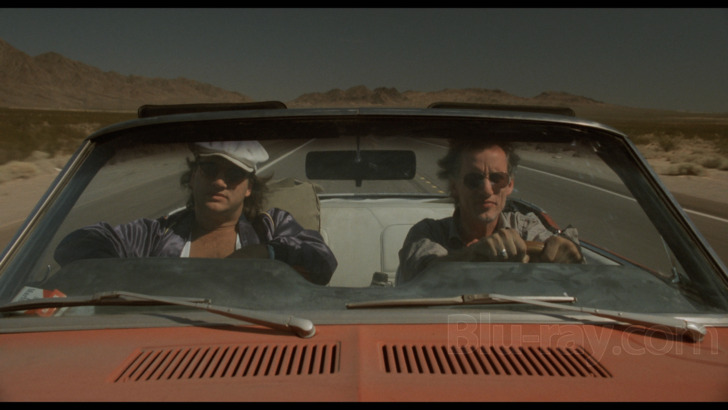
On the road to El Salvador.
Salvador 4K Blu-ray Movie, Video Quality
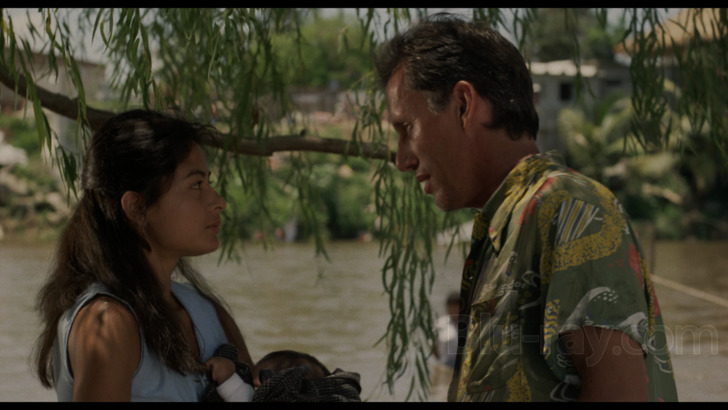
Shout Select's two-disc "Collector's Edition," which is housed in a slipcover, includes a 4K Ultra HD Blu-ray for the feature and a separate Blu-ray for the bonus materials. The main movie is encoded on a triple-layered disc (feature size: 80.1 GB). The native 1.85:1 presentation appears in Dolby Vision (HDR10 compatible) The UHD employs a Full Enhancement Layer (FEL) with Profile 7.6. Writer/director Oliver Stone supervised and approved a 4K restoration derived from the original camera negative.
When I was researching the complete production history of Salvador for my undergraduate senior thesis and watched MGM 2001 DVD, I said to myself: "It's a miracle the film looks this good considering everything that happened during the making of it!" MGM's transfer is progressive and in anamorphic widescreen. The SD image's only drawback is source-related flaws that pop up periodically. The transfers on Twilight Time's 2014 LE Blu-ray and the Eureka/Masters of Cinema Blu-ray are each 2K scans of that DVD master (as is Sandpipers' disc). (The DVD-era MGM logo appears at the beginning of the TT and MoC BD-50s.)
I have incorporated a graphical comparison between the Shout, MGM, TT, Eureka, and the 1986 Vestron LaserDisc, which along with Vestron's VHS, was Salvador maiden debut on home video. The Vestron LD is an open-matte version sourced from a 35 mm projection print. The interlacing looked so hideous that I converted it to progressive via the algorithm QTGMC (Medium preset). I then used an upscaling tool to upconvert the resolution to 720p. You will notice change-cue marks in Screenshot #s 6, 8, and 10. (These are obviously nonexistent on the Shout in my identical screen captures.) Before a change in shots on the LD, dye and color streaks appear on Doctor Rock (Jim Belushi) and in the background (frame grab #12 from the LD). In addition, there's a few dust particles in the sky by Major Max's right-hand man (Ramon Menendez) in #14. These are nonexistent on the Shout. The framing on the LD is sometimes interesting to see extra details: e.g., the face of a guard holding an Uzi in #21 is matted out in the later 1.85:1 presentations.
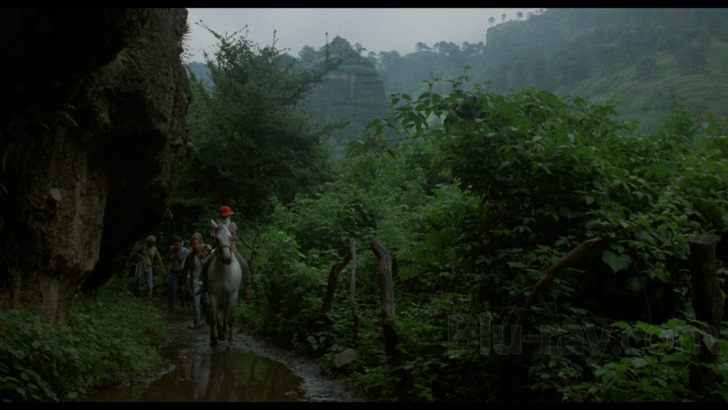
I viewed and sampled the 4K in both HDR10 and DV. Cinematographer Robert Richardson was perfectly suited to film this contemporary (and very relevant) war drama since he worked in documentary just prior to Salvador. The malaise wasn't a pretty picture to photograph as there's a surfeit of grime, sweat, and blood throughout. But the vegetation seen in the Mexican countryside was quite beautiful for him to capture (see #5). Primaries are nicely saturated without appearing overly saturated. Grain comes through clearly along the San Francisco skyline and in both interiors and exteriors for the scenes set in El Salvador. Highlights are attractively rendered without getting overblown. For instance, the sun shines rather exquisitely in the top background in the aftermath of a late-night scene in the film's second half. Dirt and debris pop up only a few times. My video score for the UHD is 4.75/5.00. The 4K disc sports a mean video bitrate of 80.7 Mbps while the full disc carries an overall bitrate of 93.2 Mbps.
Screenshot #s 1-5, 7, 9, 11, 13, 15, 20, 25, 30, 35, & 40 = Shout Select 2025 4K Ultra HD BD-100 (downsampled to 1080p)
Screenshot #s 6, 8, 10, 12, 14, 16, 21, 26, 31, & 36 = Vestron Video 1986 LaserDisc (Open Matte) (upscaled to 720p)
Screenshot #s 17, 22, 27, 32, & 37 = MGM Home Entertainment 2001 Special Edition DVD (upscaled to 720p)
Screenshot #s 18, 23, 28, 33, & 38 = Twilight Time 2014 BD-50
Screenshot #s 19, 24, 29, 34, & 39 = Eureka Entertainment 2018 BD-50
A dozen chapter stops accompany the 122-minute film on the Shout.
Salvador 4K Blu-ray Movie, Audio Quality
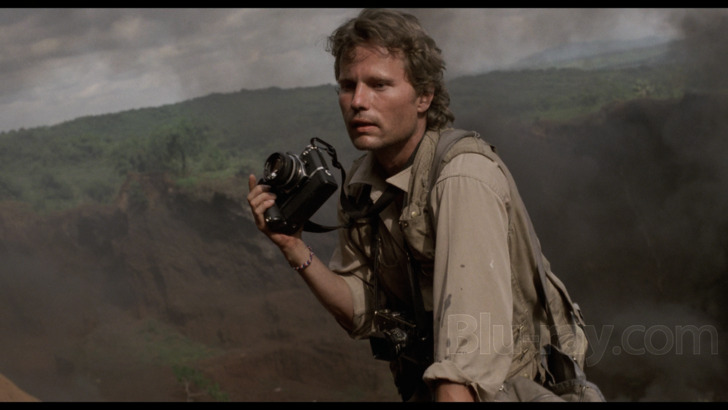
Shout has supplied three audio track options to watch Salvador with on the UHD (in addition to an archival commentary): a new Dolby Atmos mix (Dolby TrueHD 7.1 compatible) encoded at an average bitrate of 3407 kbps and a maximum bitrate of 5856 kbps; a DTS-HD Master Audio 5.1 Surround downmix of the Atmos (3133 kbps, 24-bit); and a DTS-HD Master Audio 2.0 Mono track (2008 kbps, 24-bit), which is folded down from the Atmos.
Before discussing those presentations, I want to clear up a long mystery about Salvador's audio mixes theatrically and on home video. I can confirm that a Dolby Stereo track was part of that history. I know this for two reasons: (1) In July 1986, a Cineplex Odeon theatre in Canada Square presented Salvador with Dolby Stereo. (The sound format is listed parenthetically next to the film in a theatre guide's showtimes that I found in The Toronto Star from that year.) In addition, the Dolby Stereo logo and "IN SELECTED THEATRES" is printed in poster adverts I located in Arizona, California, Nevada, and New York newspapers I retrieved. I don't believe this was a marketing gimmick. There were theatres that presented Salvador in stereo. (2) I tested and played the three sides of my Vestron LD extensively; they come with dual-channel sound that is stereo (albeit analog). Later, I could clearly hear the militaristic drums from Georges Delerue's flawless score coming out of the SL/SR on my Klipsch speakers. Moreover, when I recorded the two LDs in OBS Studio, I received a stereo signal. There were two horizontal colored sound meters under the words "Video Capture Device" that were not moving at the same frequencies or in perfect unison. (If they were, it would be a mono mix.) I was able to see visual differences in the meters while the three sides played and recorded.
When Salvador played in North America, the United Kingdom, and Australia during its quite brief theatrical run, it also was presented with a monaural mix as my archival research appears to back up. The mono mix possibly first appeared on the MGM DVD in 2001. I located a VHS of the film released by Polygram in the '90s with the Dolby Surround logo on the box so it was probably 2.0 stereo then. (I don't own that videotape so I can't officially verify the sound.) Unfortunately, unlike the TT and Eureka BDs, the 2.0 mono on the Shout is essentially a downmix of the Atmos. I compared this track with the stereo on the LD and personally prefer the latter. Even though it doesn't even use the format's CX-noise reduction system, it is quite clear throughout the film except for two or three instances of audible hiss. I compared an office scene with Ambassador Thomas Kelly (Michael Murphy), his assistant, Richard Boyle (James Woods), and Cathy Moore (Cynthia Gibb). Even though the sound on both mixes is rather uneven in terms of pitch levels with the dialogue, the mixed-down mono is a bit garbled and muffled. While spoken words in this scene are a little faint on the stereo LD, treble and fidelity are very good. There isn't much in the way of upper-ranges for dynamics on the Vestron, but the mix exceeded my expectations when I first heard it.
The 5.1 on the Shout has also been folded down from the Atmos. MGM first made a 5.1 remix for the initial DVD but it's unfortunately not included here. It is present on the Eureka and TT discs.
The Dolby Atmos on the Shout UDH is a very good remix possibly created from the original stems. It makes fine use of the heights and elevation channels when military helicopters fly overhead. Gunshots, sparks, and explosions create fine separation and fill the surrounds. Delerue's score sounds subdued during a mass exodus from a Salvadoran cathedral, though. The English dialogue is generally clear and intelligible except for the more uneven presentation in the ambassador's office scene I noted.
I also want to address the auto-generated teletext track that is unfortunately not as complete as what appeared on the LD or MGM. For example, they are used for an identificatory purpose to introduce certain characters. Notice that the LD and DVD include a little more information about Col. Julio Figueroa (Jorge Luke) on the third line in Screenshot #s 31 and 32. The TT and Shout lack that line (#s 33 and 35). The Eureka doesn't even display any intertitles about Figueroa (see #34).
Shout has included an optional English SDH track for spoken English. For the Spanish dialogue, dark yellow subs appear (see frame grab #40). You will notice how small the font is for the captions on the LD in #36. The burned-in white subs almost blend in with Archbishop Romero's (José Carlos Ruiz) clerical robe.
Salvador 4K Blu-ray Movie, Special Features and Extras

Shout has ported over a vintage audio commentary and making-of doc on Salvador (each of which were on the original DVD). It has recorded eight recent interviews.
Shout! Studios DISC ONE: 4K UHD — Feature Film
- Audio Commentary with Director/Co-Writer Oliver Stone (2001) - this feature-length track isn't one of Stone's longer commentaries simply because of occasional gaps between his remarks. Still, he tells some great stories from the Mexican shoot and his thought process behind scripting certain scenes. In English, not subtitled.
Shout! Studios DISC TWO: Blu-ray — Special Features
- Audio Commentary with Director/Co-Writer Oliver Stone (2001) - this feature-length track isn't one of Stone's longer commentaries simply because of occasional gaps between his remarks. Still, he tells some great stories from the Mexican shoot and his thought process behind scripting certain scenes. In English, not subtitled.
- NEW Interview with Oliver Stone (24:52, 1080p) - Stone looks back at his screenwriting gigs from the late '70s to the mid '80s. He tells of Richard Boyle taking him to Central America in 1985. Stone also goes into considerable depth of filming the picture in Mexico and of the trials and tribulations of shooting there. He talks affectionately about British film producer John Daly and the distribution of Salvador. Stone tells an interesting anecdote about Robert Richardson filming a documentary in Salvador (which helped land him DP on Salvador). In addition, he discusses other crew members and goes through his casting choices, including an actor he offered the lead to but did not accept. Stone closes with his memories of Oscar night, 1987. In English, not subtitled.
- NEW Shooting SALVADOR – Interview with Actor James Woods (41:36, 1080p) - an outstanding interview with the Hollywood legend! Woods is consistently engaging and appears to genuinely enjoy talking about Salvador and the beginning of his three collaborations (as well as friendship) with Stone. He speaks about the early days of becoming attached to the project, Hemdale, and getting to know Richard Boyle. Woods explains how his real-life persona differs significantly from the character he portrays. It's also refreshing to hear the actor discuss James Belushi and his performance as Dr. Rock. Woods gives his opinion of the one scene he believes netted him an Oscar nomination for this war drama. He also divulges his personal favorite scene in the film and why. It's fascinating to hear him reveal the different ideas he had for his character and how he thought certain scenes should be depicted in contradistinction to Stone's ideas. Woods also explains how the director respected, as well honored, his divergent opinions! Woods compares his version of how filming unfolded for a couple of scenes late in the movie compared to Stone's account in the memoir, Chasing the Light. Woods covers a range of topics in substantial depth across forty minutes. In English, not subtitled.
- NEW Shooting SALVADOR – Interview with Actor John Savage (10:20, 1080p) - Savage appears remotely as he is interviewed from his home. He talks about filming in Mexico, working with James Woods, the chemistry between Woods and Jim Belushi, the horse trainers that helped the actors, and a picture in the doorway he wanted to capture. In English, not subtitled.
- NEW Shooting SALVADOR – Interview with Actor Michael Murphy (22:31, 1080p) - Murphy appears remotely in what may be his house. He talks about his character of Ambassador Thomas Kelly in Salvador and briefly about Robert E. White, the American diplomat whom Kelly is based on. Murphy describes Oliver Stone's personality during the period in which they worked and Stone's direction of him. Murphy also discusses Robert Altman and the "gonzo filmmaking" style he has in common with Stone. Murphy additionally reminisces about filming in Acapulco and the conditions there for cast/crew. He shares some amusing anecdotes about James Woods and scenes they appeared in together. In English, not subtitled.
- NEW Shooting SALVADOR – Interview with Actor Tony Plana (29:36, 1080p) - Plana explains in pretty lengthy detail how Major Max in Salvador is based on Major Roberto D'Aubuisson, who founded the Nationalist Republican Alliance (ARENA). Plana relates an interesting story of visiting a university archive in California, which also had a Latin American Studies department, and viewing VHS tapes of D'Aubuisson delivering speeches and appearing in commercials. Plana gives quite a bit of historical detail about D'Aubuisson and the death squads. He also remembers the audition he gave and a scene he appeared in with James Woods (one of Plana's favorites). In addition, he describes Stone's direction of him in the ARENA congregation scene. In the last part of the interview, Plana briefly talks about the two other films he made with Stone. Finally, he unpacks Stone's style as a storyteller and the filmmaker's avidity for tackling provocative historical subjects. In English, not subtitled.
- NEW Shooting SALVADOR – Interview with Editor Claire Simpson (26:39, 1080p) - Simpson recalls meeting Oliver Stone in New York City where he had his first child and a documentary (Soldiers in Hiding) Simpson edited that Stone saw and led him to hiring her. She explains the circumstances of how she left the East Coast for Mexico City to work on Salvador. (She also tells of later moving to Los Angeles to finish editing Salvador.) More, Simpson recollects lunching with Richard Boyle and why James Woods was a shrewd choice to play him. She compares and contrasts cutting on film versus editing on digital. In English, not subtitled.
- NEW Shooting SALVADOR – Interview with Costume Designer Kathryn Morrison (20:51, 1080p) - Morrison said she was initially hired as a "costume consultant" on Salvador but when her role was expanded, she was promoted to costume designer. She tells the story about how she got to work on Salvador courtesy of her close relationship with James Woods. She describes costuming all of the American actors and working with the crew in Mexico. Morrison explains the process of finding the right apparel to age the actors. Additionally, Morrison reveals when she knew she wanted to continue as a costume designer. In English, not subtitled.
- NEW Shooting SALVADOR – Interview with Prosthetic Makeup Artist Gordon J. Smith (33:09, 1080p) - Smith goes back to the very beginning when he first became acquainted with Oliver Stone. This was through his friendship with production designer Bruno Rubeo, whose association with Carlo Rambaldi inspired both Rubeo and Smith to get into filmmaking. (Smith says Rubeo worked with Rambaldi on Dune [1984]). When Smith turns his attention to Salvador, he reveals producer Gerald Green's parsimonious ways. Smith got twelve (real) skeletons into Mexico; they were later incorporated into scenes. The f/x makeup artist explains the makeup he used for the prosthetics and a notable scene where his work was demonstrated (and also camouflaged in a way). Smith remembers meeting and working with Richard Boyle. Additionally, he discusses his collaborations with Richardson and Stone. In English, not subtitled.
- Into the Valley of Death – The Making of Salvador (2001) (1:02:53, 480i) - a retrospective about making Salvador directed by Charles Kiselyak. Interviewees include Boyle, Stone, Belushi, Woods, and former US ambassador Robert E. White. The talking heads are intercut with archival news footage, early screen tests, and behind-the-scenes footage of the shoot. Deleted scenes are also discussed. Interestingly, White mentions one decision Kelly makes in the film that he did not in his role as ambassador. The then-new interviews and excerpted clips appear in 16:9. They look a bit zoomed in compared to the letterboxed presentation on the MGM DVD. The program comes with Dolby Digital 2.0 Stereo (192 kbps). Most of the content is in English. (Spanish portions extracted from Salvador appear with embedded English subs.)
- Deleted Scenes (27:18 altogether, 480i) - a reel containing both excised and alternate/extended scenes from Salvador. Some scenes include additional snippets that didn't survive final cut. A few others encompass different content altogether. The reels appears as raw footage. It likely had been stored in film canisters since 1985/86 and had not been open by Stone (or someone else) until MGM produced its Special Edition DVD in 2001. I would argue on the one hand that about half of the footage was extraneous and deserved to be relegated to the cutting room floor. But on the other hand, some scenes could have justifiably been left in. For example, there's a lingering subplot concerning a character I had been wondering about; one scene tells what happened to him. Another scene develops the Major Max character further. A scene deleted late in the film shows more grisly details of the war and humanizes the innocent victims. It also portrays a "parting scene" between two of the journalists. I believe if Stone had kept three of these scenes in the theatrical version, the film would have been even better. They are presented in "open matte" 1.33:1. Some of the Spanish dialogue appears with compulsory English subtitles. Other non-English dialogue isn't accompanied with captions or subs.
- Original Theatrical Trailer (1:58, upconverted to 1080p) - Hemdale's official trailer for Salvador hasn't been restored as it's riddled with film artifacts. While letterboxed, the trailer appears mildly cropped.
Eureka Entertainment Exclusive Supplements
- An Extensive Archival Interview with Oliver Stone at the BFI (42:13, 720p) - this interview was held on January 19, 1994 at the National Film Theatre in London. The Q&A followed a screening of Heaven and Earth. Stone discusses his Vietnam movies and other works, including Salvador. Audience questions are faintly audible. All content is in English, not subtitled.
- A Rarely Heard, Lengthy Audio Interview with Oliver Stone from 1986 (63:55) - Eureka doesn't provide any time markers for this interview but my research into The Gurardian paper archives indicates it occurred on September 10, 1986 at the National Film Theatre in London. When selected, it runs as an alternate audio track while the feature plays on the Euerka BD and DVD. Stone mentions that Salvador was submitted to the Cannes Film Festival and explains what happened. He talks about his script for Year of the Dragon (1985) and war dramas of the era such as Under Fire and The Killing Fields (1984). A bulk of the discussion centers on the sociopolitical quagmire in Central America and Latin America during the '80s. Stone field several questions from the audience about Salvador. Jim Belushi also attended the event to comment on Doctor Rock. An archival gem!
- Collector's Booklet - a 30-page booklet featuring the essay, "Dodging the Bullets: Oliver Stone and Salvador," by critic and journalist Barry Forshaw; a dozen large stills; production notes from Hemdale's original pressbook; and a list of production credits. Forshaw's piece is well-researched and informed (with perhaps one factual error on when Boyle and Stone first met). His writings also addresses Stone's cinematic style and influences. The pressbook contains direct quotes about producing the film from Boyle, Stone, Stone, producer Gerald Green, Woods, Belushi, and John Savage.
Twilight Time Exclusive Extras
- Isolated Score Track - in DTS-HD Master Audio 2.0 (1672 kbps, 24-bit). Sound is mono.
- Leaflet - an 8-page insert with an essay on Salvador by Julie Kirgo, stills from the movie, a downsized original poster, and production credits for the disc. Kirgo's piece focuses on the theme of chaos and Woods's performance.
Salvador 4K Blu-ray Movie, Overall Score and Recommendation
Salvador marked the beginning of Oliver Stone's guerrilla filmmaking style, which he has maintained in different shades and iterations up to the present. The siege at Santa Ana and other parts of the film are remarkable in how they were mounted considering the low budget. (The battle staged at Santa Ana demonstrates the influence Pontecorvo's The Battle of Algiers had on Stone.)
Shout Select's UHD would have been definitive had it included a Dolby Stereo mix (in lossless), a "true mono" mix, and the fine 5.1 remix that originated on the MGM DVD. My audio score of 3.5/5.0 reflects the incompleteness of extant sound options that needed to be here. The Atmos track is quite good but it's not direct OGA. In addition, MGM's auto-generated subtitle track with all the intertitles identifying various characters should have been included here. (It appears to be a duplicate of the Twilight Time Blu-ray.) The movie, 4K transfer, and bonus features are STRONGLY RECOMMENDED.


Similar titles
Similar titles you might also like

Born on the Fourth of July 4K
Shout Select | Collector's Edition
1989

The Year of Living Dangerously
1982

Under Fire
1983

Heaven & Earth
Limited Edition to 3000 - SOLD OUT
1993

The Killing Fields
1984

Che: Part One
2008

Cromwell
1970

The Day After
1983

Valkyrie
2008

The Conspirator
2010

Eye in the Sky
2015

Michael Collins
Warner Archive Collection
1996
The Manchurian Candidate 4K
20th Anniversary Edition
2004

Breaker Morant
1980
Fat Man and Little Boy
1989

One Man's Hero
1999

Fail Safe
1964

Emperor
2012

Restrepo
2010

Che: Part Two
2008