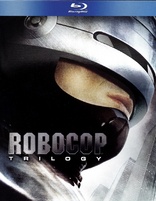
RoboCop Trilogy Blu-ray Movie
HomeRoboCop Trilogy Blu-ray Movie 
RoboCop / RoboCop 2 / RoboCop 3Metro-Goldwyn-Mayer | 1987-1993 | 3 Movies | 323 min | Unrated | Oct 05, 2010
Price
List price:Listed on Amazon marketplace

Movie rating
Movie has not been rated yetBlu-ray rating
| Users |  | 3.5 |
| Reviewer |  | 3.0 |
| Overall | | 3.4 |
Overview
RoboCop Trilogy (1987-1993)
See individual titles for their synopses.
| Action | 100% |
| Thriller | 96% |
| Sci-Fi | 80% |
| Crime | 39% |
| Drama | Insignificant |
Specifications
Video
Video codec: MPEG-4 AVC
Video resolution: 1080p
Aspect ratio: 1.85:1
Original aspect ratio: 1.85:1
Audio
English: DTS-HD Master Audio 5.1
English: Dolby Digital 4.0
French: Dolby Digital 5.1
French: DTS 5.1
Spanish: Dolby Digital 5.1
Subtitles
English SDH, French, Spanish
Discs
50GB Blu-ray Disc
Three-disc set (3 BDs)
Playback
Region A (locked)
Review
Rating summary
| Movie | | 3.0 |
| Video | | 3.5 |
| Audio | | 3.5 |
| Extras |  | 0.5 |
| Overall | | 3.0 |
RoboCop Trilogy Blu-ray Movie Review
He’s programmed to serve, protect, and kick some serious ass.
Reviewed by Casey Broadwater October 22, 2010I guess the unofficial term is sequel-itis; that is, the statistical likelihood that sequels will pale in the shadow of their predecessors. There are exceptions, of course—The Godfather Part II, The Empire Strikes Back, etc.—but these are rarities. It’s much more likely that if you plotted out any given franchise’s critical/financial success like a line chart, you’d get a double black diamond-worthy slope that descends steeply into mediocrity. A prime example is the RoboCop trilogy. The first film, while not exactly an indisputable classic, is an action film with more than just bullets and explosions on its brain. 1987’s Robocop is indeed extraordinarily violent—so much so that the MPAA initially slapped it with the dreaded “X” rating—but it’s also a dark, clever, frequently hilarious satire on corporate America. The war-on-drugs-centric RoboCop 2, which followed in 1990, is just as violent but not nearly as funny, and it’s cursed with a script that has more loose ends than a frayed rope. Finally, with Orion Pictures embroiled in bankruptcy, the sometimes laughably bad third act in the trilogy got shelved until the summer of 1993, when, upon release, it promptly bombed at the box office. Potential theatergoers shrugged. Who cares? There’s only so much you can do with a crime fighting Tin Man. That said, I watched all three movies in succession the other day, and while the quality of the filmmaking definitely gets worse with each entry, I can’t say that I wasn’t entertained. Even at its worse—RoboCop 3—the series is action-packed and laugh-out-loud-worthy, even if the latter is sometimes unintentional.

Don't tell me you didn't used to run around with a Nintendo lightgun, pretending you were this guy.
Make no mistake, the humor in the first film is very much intentional, starting from the parody of air-headed, disaster-obsessed newscasters who claim, “Give us three minutes, and we’ll give you the world.” This particular world is a dystopian Detroit of the not-so-distant future, a grimy, economically depressed hub for vicious gangs who take particular pleasure in killing cops. Mega-corporation Omni Consumer Products, led by a CEO everyone calls the Old Man (Dan O’Herlihy), has been hired out to privatize the city’s woefully inadequate police force. In an early scene, we see senior president Dick Jones (Ronnie Cox) present his solution to Detroit’s crime wave: the ED-209 law enforcement droid, a bi-pedal robot that looks like a cross between an AT-ST from Star Wars and an omni-directional microphone. (You’ll know what I mean when you see it.) Demonstrating the bot’s functionality to the OCP’s assembled board members, Jones has one unlucky exec point a gun at the droid. The ED-209 fritzes out and pumps the poor guy full of lead, turning him into bloody pulp. It’s horrifyingly violent and—unexpectedly—incredibly funny, so over- the-top that you realize, for the first time, that the movie isn’t taking itself too seriously.
Jones’ rival, junior executive Bob Morton (Miguel Ferrer) proffers an alternative to the ED-209’s glitchy unreliability—the RoboCop program, which would create a half-machine, half-human hybrid. All they need is a volunteer. Conveniently, crime boss Clarence Boddicker (Kurtwood Smith) and his thugs have just captured hero cop Alexander Murphy (Peter Weller), who was out patrolling a new beat with his partner Anne (Nancy Allen). They blow off a few of Murphy’s limbs with shotguns—another violent, oh my gosh, I can’t believe I’m watching this moment—and then put a bullet in his head. When Murphy wakes up—or, is booted up, rather—he finds that his brain and face have been attached to a hulking robotic body. This Frankenstein/Tin Man/Christ figure is now the OCP’s premiere crime fighting machine, nigh invincible, armed to the teeth, programmed to serve and protect. However, while he’s bound to certain I, Robot-ish principles—keeping him from attacking his creators, for example—he’s also dimly aware of his past, pre-cyborg life. When he eventually remembers what happened to him, Murphy’s sense of humanity begins to emerge and— fitting with human nature—he sets out to get retribution.
And does he ever. Revenge, in RoboCop, is a dish served as cold as steel. But there’s more to the film than vengeance and extravagantly choreographed violence. Director Paul Verhoeven may have made a muck of his career with Showgirls and Hollow Man, but he was on top of his game here, crafting an action/thriller/dark-comedy that satisfies on multiple fronts. You want gunfire and explosions? I have a feeling the young Michael Bay was paying close attention to RoboCop. You want despicable villains wholly deserving of their comeuppances? Boddicker and Dick Jones deliver. You want smart satire of corrupt Reagan-era corporate ideology and a pre-apocalyptic vision of America down the economic crapper? Omni Consumer Products and dystopian Detroit are as harrowingly hilarious as they come. There are a few shortcomings—the man/machine philosophical dilemma isn’t explored as aptly as it could have been, and Murphy’s relationship with his partner never really gels—but Verhoevan keeps the pace brisk enough that any flaws simply get sucked up and obscured in the film’s whirlwind of carnage.
Verhoevan left the series after the first entry, and the directing duties of RoboCop 2 fell to Irvin Kershner, who had previously helmed The Empire Strikes Back under the all-seeing guidance of George Lucas. When the sequel picks up, Detroit is in dire straits. The local government is in debt to the evil OCP corporation, who are this close to foreclosing, razing the entire metropolitan area, and building Delta City—a proposed utopia of glass and steel—in its place. To further their dastardly aims, they cut all police funding, forcing a strike, and pump the money into the development of, yes, RoboCop 2, a new and improved model. Meanwhile, the city’s underworld is under the control of Cain (Tom Noonan), a cult leader who peddles a new designer drug called “Nuke.” (Did I mention that Cain has a 12-year-old apprentice, Hob (Gabriel Damon), who swears like a sailor and carries garroting wire? It’s more than a little ridiculous.) RoboCop gets sent back out to beat the streets, but he’s essentially been neutered by Dr. Juliette Faxx (Belinda Bauer), the new director of the RoboCop program, who has tweaked our hero’s settings so that he’s more of a peaceful community patrolman than an ass-kicking crime fighter. (This is played for laughs and it just doesn’t work. Who wants an emasculated RoboCop?) Murphy eventually gets his mojo back, in time to fight Cain, who has been selected—for reasons inexplicable to me—to be the human brain inside RoboCop 2.
The screenplay for the sequel was originally penned by Frank Miller—of Sin City fame—but his draft was deemed unfilmable by studio execs and was subject to endless rewrites. Unfortunately, this lack of a cohesive vision comes through in the film, which stumbles blindly from one sub- plot to the next and introduces several ideas that, at best, remain half-baked at the end. For but one example, we meet Murphy’s wife, who shows up at the police station to see if there’s anything left of her former husband in the bionic RoboCop. There’s so much potential here—Can she love a machine? What does it mean to be human? Does Murphy/RoboCop still feel desire?—but it goes completely wasted. RoboCop dismisses her, claiming that he isn’t Murphy any longer, and we never see her again. Nancy Allen returns as Murphy’s partner Alice, but their relationship remains merely perfunctory. There’s just no thematic unity here, nothing to hold the story together on an emotional level. The result is a film that’s exceedingly violent, but not much else. Even the satirical TV commercials that pepper the movie—there’s one for a sun block that has carcinogenic ingredients— seem less clever this time around. (The best one, from the first film, is for a Battleship-like family board game called NUKEM. “Oh no,” says a boy in the commercial, “Pakistan’s invading my border!) RoboCop 2 does feature some insane stop-motion animation in the final battle, though, which gives the film some aww, look how primitive our technology was charm.
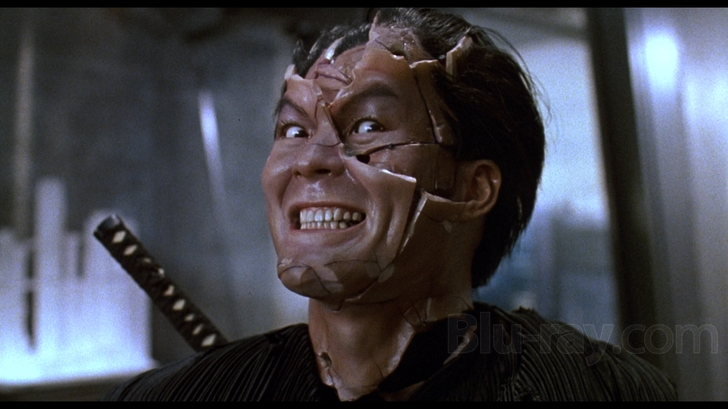
The third film, sadly, has no charm at all beyond being so bad that it’s, well, an unintentional hoot. To start with, Peter Weller decided not to re-don the RoboCop costume, and the titular role is played instead by Robert John Burke, who gives our erstwhile hero such a goofy voice that it’s hard to take anything he says seriously. That said, he does get a jetpack this time around. Radical! Instead of hard-R-for-extreme-violence, this 1993 entry is rated a rather soft PG-13, which seems to confirm that the studio honchos were intent on attracting a predominately teenaged audience. Need more proof? How about the robot samurai? Yes, in RoboCop 3, the Omni Consumer Product corporation has been taken over by a Japanese company that has robotic swordsmen at its disposal. Tubular! Despite the implied promise of severed limbs galore and much arterial bloodletting, however, the violence in RoboCop 3 is seriously toned down. There are massive shootouts, yes, but no one ever seems to get hit. It’s like a particularly dull episode of The A-Team.
The plot, at least, is more coherent than the scattershot story of RoboCop 2. Here, the OCP is finally getting around to building Delta City, which means they have to round up all the undesirable residents of Detroit and bus them off to internment camps. (That is, kill them. There’s a definite OCP-as-Nazi Party vibe in this one.) RoboCop falls in with a group of rebels hiding in a church, where he befriends a half-Japanese pre-teen computer hacker (Remy Ryan), and finally finds a new family to replace the one that the screenwriters in the second film never bothered to mention again. There are stabs at black humor—like an exec that jumps to his death from the window of his high-rise office—but most of it falls short, if you’ll pardon the pun. Instead of being a satire, RoboCop 3 seems more like a bad parody of the first two films.
RoboCop Trilogy Blu-ray Movie, Video Quality
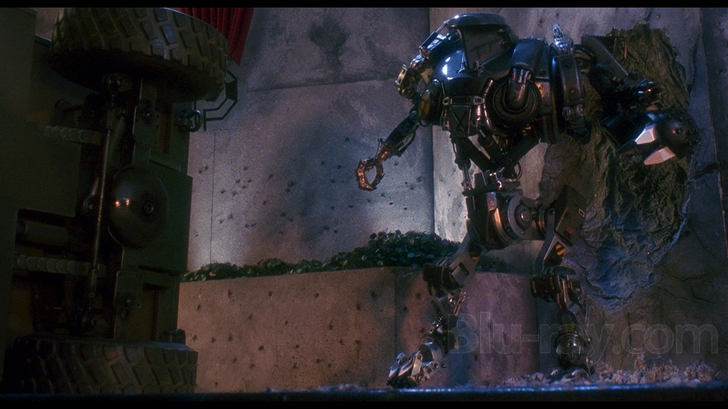
While the RoboCop franchise gets worse with each entry—starting with the kickass first film and ending with the drudgery of the third—the
opposite is true of the series' picture quality on Blu-ray. For 1987's RoboCop, MGM has simply reused the same single layer disc as the 2007
standalone release—antiquated MPEG-2 transfer and all—merely changing the disc art for uniformity within the set. While this is definitely the best the
film has ever looked, you get a sense that with a proper AVC encode, a 50 GB dual layer disc, and a higher bitrate, the first RoboCop would have
a lot more polish. I'm guessing what we have here is a recycled version of the high definition master that was originally intended for the film's DVD
release. Overall clarity is slightly soft, and although color looks accurate for the most part, if subdued, black levels are often murky and grayish while
simultaneously crushing shadow detail. (This is particularly noticeable during later scenes, like the sequence with the thug who gets turned into a
mutant.) The mixture of grain and digital noise also has a tendency to look somewhat chunky.
Thankfully, the image improves rather dramatically for the two sequels, which have both been granted 1080p/AVC-encoded transfers and placed on 50
GB discs. Clarity is much more tightly refined—especially in the third film—giving us sharper detail on Murphy's various metallic parts and revealing the
fine texture of the actors' faces. Color is also more vibrant, from the iridescent sheen of RoboCop's suit to the orange fireball blast of explosions. While
blacks can still seem a bit washed out, digital noise is much less apparent in darker portions of the image, and the natural texture of the film grain is
finer in general. I honestly can't imagine the latter two films looking much better than they do here.
(For those of you keeping score, I'd give the first film a 2.5/5, the second a 3.5/5, and the third a solid 4/5.)
RoboCop Trilogy Blu-ray Movie, Audio Quality
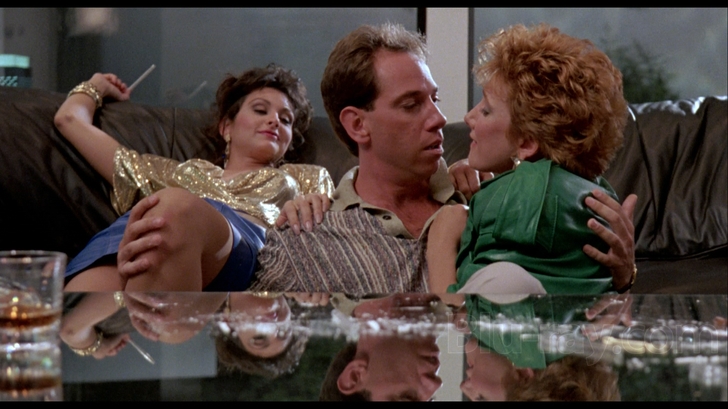
The audio quality follows the same pattern, improving in dynamic breadth, clarity, and immersiveness from one film to the next. You'll find DTS-HD
Master Audio 5.1 surround tracks across the board here, and each is only as good as the original source elements. The first film has its share of explosive
audio moments, but the gunfire lacks true punch—it sounds slightly muffled—and most of the activity is contained in the front channels. Some scenes,
like those in the police station, are filled with ambience, and there are even some occasional cross-channel movements—like rockets ripping through the
rears—but nothing that stands out as particularly impressive. By the same token, there are no audio hiccups either—the score has appropriate heft, the
effects sound as good as they can, and the dialogue is easily discernable. (Quick side note: Does anyone else think RoboCop's footsteps in this film sound
vaguely like an 808 kick drum?) In the second and third films, the tracks get progressively louder, punchier, and more involving. Gunshots ping
directionally through the rear speakers instead of popping off inertly up front, vehicles make rip-roaring cross-channel runs, and the LFE channel is given
more opportunities to rumble. Obviously, there are few sequences that come even remotely close to the intricate, bombastic sound design of more
modern action films, but given the late '80s, early '90s vintage of the RoboCop series, I don't think we could ask for much more.
Note: English SDH and Spanish subtitles are available on all three films, and French on the latter two.
RoboCop Trilogy Blu-ray Movie, Special Features and Extras
The big disappointment of this box set is that there are no real special features at all. Oh, you'll see an "Extras" tab on the menu of each disc, sure, but all you'll find within are high definition theatrical trailers. Bummer.
RoboCop Trilogy Blu-ray Movie, Overall Score and Recommendation

In my mind, RoboCop is just as much an icon of the '80s as Ronald Reagan or Max Headroom. The first film is more than just an ultra-violent extravaganza—which it is, oh how it is—it's also a deeply, darkly comic satire on corporate corruption, economic depression, and disaster-obsessive media coverage. While RoboCop 2 is good fun as well—if less pointed—the series ends in mediocrity with RoboCop 3, a PG-13 entry that's dull and dumbed down in nearly every regard. MGM has finally gathered the trilogy together, and although 2007's standalone Blu-ray release of RoboCop is recycled here, the latter two films receive satisfying all-new high definition transfers. The only downside? All you get for special features is a handful of theatrical trailers. Still, this is the RoboCop trilogy, not Lord of the Rings. Aside from the extras that were on the Criterion DVD release, I'm not sure what else they could've ported over here. For most fans, having the three films on Blu-ray will be more than enough.