Renee Fleming In Concert Blu-ray Movie
HomeRenee Fleming In Concert Blu-ray Movie 
Salzburg Festival 2011 - Strauss: Lieder and Eine AlpensinfonieOpus Arte | 2011 | 84 min | Rated E | Jun 12, 2012

Movie rating
7.4 | / 10 |
Blu-ray rating
| Users |  | 4.0 |
| Reviewer |  | 4.5 |
| Overall | | 4.0 |
Overview
Renee Fleming In Concert (2011)
Starring: Renée Fleming, Christian Thielemann| Music | 100% |
Specifications
Video
Video codec: MPEG-4 AVC
Video resolution: 1080i
Aspect ratio: 1.78:1
Original aspect ratio: 1.78:1
Audio
German: DTS-HD Master Audio 5.1
German: LPCM 2.0
Subtitles
English, French, German, Spanish
Discs
25GB Blu-ray Disc
Single disc (1 BD)
Playback
Region A (B, C untested)
Review
Rating summary
| Movie | | 4.5 |
| Video | | 4.5 |
| Audio | | 4.5 |
| Extras |  | 0.0 |
| Overall | | 4.5 |
Renee Fleming In Concert Blu-ray Movie Review
Reviewed by Jeffrey Kauffman July 7, 2012Salzburg is certainly one of the most charming cities in Europe, especially its core central Old Town area which seems to be a direct portal back to the Baroque. Buildings seemingly crafted out of gingerbread line narrow streets, façades are brightly painted and even some costumed shop owners hearken back to a bygone age. The city has become a cultural touchstone of sorts since 1965, when the film version of The Sound of Music was released and introduced a worldwide audience into the scenic splendors of the area, but the title of that film could well be a tagline for a cultural event that long predates the Rodgers and Hammerstein musical and, for Europeans anyway, has come to define the city much more than even the blockbuster musical film. The Salzburg Festival was founded in 1920 by five titans of German and/or Austrian art who sought to raise the annual celebration from the ashes of World War I, which had put the kibosh on what had been occasional performances of music and drama. This quintet included director Max Reinhardt, poet and playwright Hugo von Hofmannstahl, conductor Franz Schalk, set designer Alfred Roller and the man who is perhaps still best associated with the Festival, legendary composer Richard Strauss. In fact it was at the 1936 Salzburg Festival that the Trapp Family Singers actually performed, setting the stage (no pun intended) for what is the (fictionalized) climax of The Sound of Music. Rather surprisingly even with the terror and chaos caused by the German annexation of Austria, the only World War II era year that the Salzburg Festival didn’t go on was 1944 (due to the then recent plot to assassinate Hitler), and by 1945 the Festival was up and running again, albeit somewhat worse for the wear. Over the ensuing several years, though, the Festival managed to regain its artistic excellence and cultural import, and it remains one of the highlights of the European cultural calendar each year, coming to define the halcyon days of midsummer with exciting performances of chamber and orchestral music, as well as an annual mounting of von Hofmannsthal’s version of Everyman.
Richard Strauss’ compositional legacy is undeniably iconic, and yet the composer himself might be scratching his head over the vagaries of fate were he still alive today. Strauss was convinced his relationship with the Nazi regime would make performances of his work next to impossible in the post-War years, and there’s no denying there was a slow (yet steady) reestablishment of his reputation in the late forties. But not even Strauss could have foreseen the completely unexpected pop cultural phenomenon that was generated by the use of his epic Also Sprach Zarathustra in Stanley Kubrick’s 2001: A Space Odyssey, a film which suddenly catapulted Strauss to the top of the pop charts and opened up his vast aural vistas to a whole new generation and indeed probably a much wider audience than all the masses that had heard his work previously up to that point. (Unfortunately the film also had the side effect of linking Strauss with that other Strauss, Johann II, a linkage Richard himself was adamant not be made and which in its own way led to Der Rosenkavalier, as if Richard were stating defiantly, “You want waltzes? I’ll give you waltzes!”)
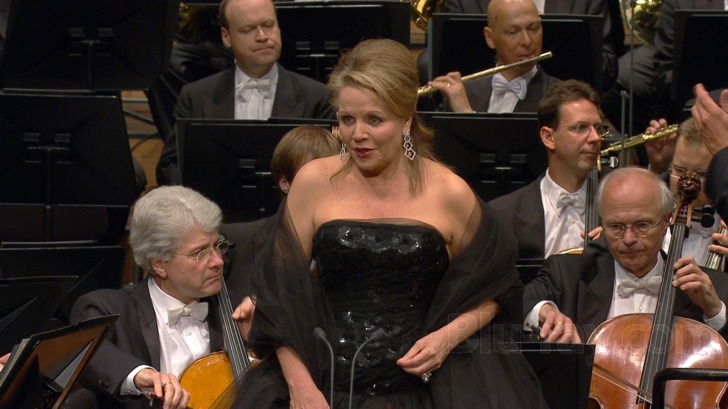
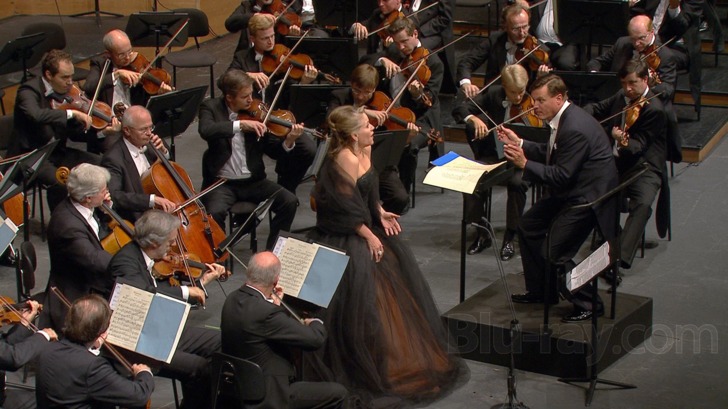
Strauss takes center stage in this lovely and thrilling 2011 concert from the Salzburg Festival, held in the city’s iconic Grosse Festspielhaus and featuring soprano Renée Fleming with the Vienna Philharmonic under the baton of the inimitable Christian Thielemann. With a “cast” like that, it’s hard to go wrong, and this is a fantastic overview of just how wide ranging Strauss’ compositional efforts really were. Rather interestingly, four lieder are chosen, but they’re not the composer’s legendary Four Last Songs, the elegiac present the elderly Strauss gifted soprano Maria Jeritza with shortly before his death and which Jeritza kept a secret until her death in 1983. Instead Fleming and Thielemann have chosen earlier works by Strauss, all dating from between 1895-1900. Three of these were initially written by Strauss for piano and voice, with the composer himself orchestrating two of them, Befreit, Op. 39 No. 4 and Winterliebe, Op. 48 No. 5. Robert Heger orchestrated Traum durch die Dämmerung, Op. 29 No. 1. The fourth piece, Gesang der Apollopreisterin, Op. 33 No. 2 was written originally for orchestra and voice.
The compositional and emotional variety on display in these four songs is quite remarkable, but so very typical of Strauss, who seemed to delight in defying audiences’ expectations, especially those of “esteemed” critics who were constantly thrown for a loop by his refusal to follow accepted tropes. Befreit is a somewhat morose, melancholy piece, a sort of deathbed elegy that quite craftily sets a repeated “O joy” in minor tonalities. In complete contrast, Winterliebe is an ebullient piece of high energy and almost orgasmic melismas which Fleming handles with relative ease. Traum durch die Dämmerung isn’t especially well served by the Heger orchestration, which, though certainly competent, doesn’t quite have the magic of Strauss’ own touch with the orchestra. Speaking of orgiastic melismas, Gesang der Apollopriesterin finds Strauss at his most hedonistic, clearly presaging such later works as the lascivious Salome in sheer orchestral splendor and libidinous content.
Fleming’s mini-concert comes to a close with a brief snippet from Strauss’ Arabella, an aria from the Act I finale which finds the singer-actress in a particularly coquettish mode. This is some of Strauss’ most immediately accessible operatic music and it brings the vocal side of the evening to an appropriately melodic close.
It’s worth noting that even after Fleming’s tour of various Strauss endeavors, there is still close to an hour left in this concert, time given over to one of his strangely lesser performed tone poems, Eine Alpensinfornie. While this longest of Strauss’ ten tone poems is certainly well known to Strauss aficionados, for some reason this towering (no pun intended) work hasn’t quite matriculated into the public consciousness the way so many other of Strauss’ large scale (again, no pun intended) orchestral offerings have. This is sonic painting of the highest order, obviously highly influential for any number of later composers, including Ferde Grofé’s Grand Canyon Suite. But Strauss here was following a programmatic tradition himself, one that traces back at the very least to Beethoven’s Sixth Symphony. Strauss paints sound pictures here of the highest (sorry) order, evoking a hike in the Alps which is full of the wonder of “eternal nature”, something perhaps on the composer’s mind with the then recent death of Gustav Mahler.
This is musical performance of the highest order, with Thielemann bringing his typically picayune attention to detail and filling the orchestral side of things with incredible nuance and precision. It’s fascinating to watch Thielemann and Fleming in the soprano’s part of the concert: their eye contact is almost palpable, as they seem to be communicating subliminally with each other, extending phrases ever so slightly with a tenuto here or a fermata there, and giving the music life and energy. Luckily, that very communication is shared with a rapt and adoring audience, and is so powerful it reaches through the screen to the vicarious audience in home theater land.
Renee Fleming In Concert Blu-ray Movie, Video Quality
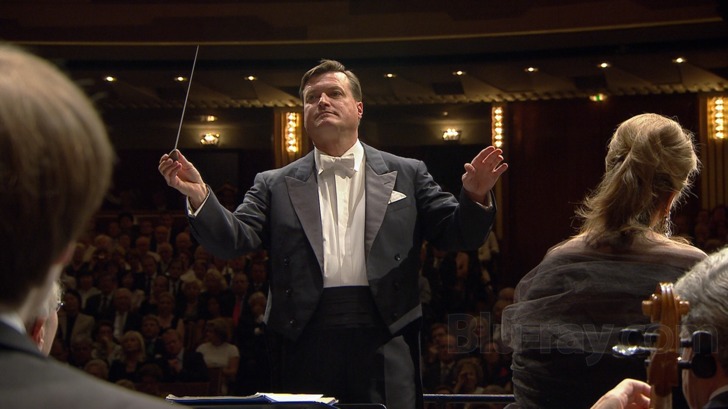
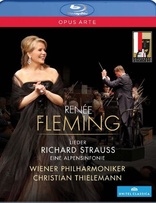
Renée Fleming in Concert is presented on Blu-ray courtesy of Unitel Classica and Opus Arte with an AVC encoded 1080i transfer in 1.78:1. (It's probably worth noting that the actual cover title for this release is more geared toward Richard Strauss, highlighting his compositions included here and labeling Fleming, Thielemann and the Vienna Philharmonic as "mere" performers.) This is one of the nicest looking live concert releases I've personally seen this year, perhaps due to the nice lighting of Salzburg's impressive Grosse Festspielhaus. Colors pop very well and fine detail is extremely pleasing, to the point where even midrange shots show things like brand names inscribed in the bells of trombones. There is some very minor aliasing a time or two on some close-hatched patterns on instruments and outfits, and Fleming's black dress tends to blend into the dark background, but otherwise this is a beautifully sharp and clear presentation that should please demanding videophiles.
Renee Fleming In Concert Blu-ray Movie, Audio Quality
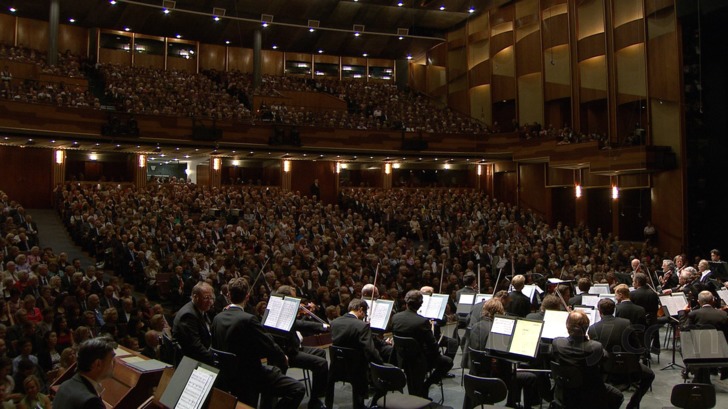
Renée Fleming in Concert features both a DTS-HD Master Audio 5.1 mix as well as an LPCM 2.0 stereo fold down. This is gorgeously performed music and both lossless tracks support the immense dynamic range that is part and parcel of Strauss' orchestral vocabulary. Brass is especially impressive in both of these lossless formats, with crisp attacks and a nicely burnished sound. The 5.1 mix nicely widens the soundfield and allows a beautiful depth of listening into Strauss' sometimes convoluted inner lines. There are occasional very minor balance issues during the Fleming portion of the concert, with the singer's lower range getting just slightly buried in the immense orchestral forces Strauss musters as accompaniment, but otherwise this is sterling audio that is a true joy to listen to.
Renee Fleming In Concert Blu-ray Movie, Special Features and Extras
Sadly, no supplements are included on this Blu-ray disc. We've become accustomed to some fantastic supplements on other Thielemann releases, and it certainly would have been nice to have had a retrospective featurette on the Salzburg Festival here, especially given the Strauss connection.
Renee Fleming In Concert Blu-ray Movie, Overall Score and Recommendation

If you've never been able to get to Salzburg for a Festival performance, Renée Fleming in Concert is probably the next best thing. Gorgeous music simply pours out of these gifted musicians, and the rapport between Fleming and Thielemann is really remarkable. Even though this Blu-ray release has no supplements, its video and audio are so outstanding that it comes Highly recommended.