Red Riding Trilogy Blu-ray Movie
HomeRed Riding Trilogy Blu-ray Movie 
IFC Films | 2009 | 3 Movies | 308 min | Not rated | Aug 31, 2010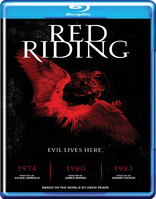
Price
List price:Listed on Amazon marketplace

Movie rating
Movie has not been rated yetBlu-ray rating
| Users |  | 4.2 |
| Reviewer |  | 4.0 |
| Overall | | 4.0 |
Overview
Red Riding Trilogy (2009)
An ambitious, dark, and thrilling trilogy of interlinking films set in Yorkshire in the 1970s and 80s.
| Drama | 100% |
| Psychological thriller | 43% |
| Crime | 41% |
| Mystery | 33% |
Specifications
Video
Video codec: MPEG-4 AVC
Video resolution: 1080p
Aspect ratio: 1.85:1, 2.35:1
Original aspect ratio: 2.39:1, 1.85:1
Audio
English: Dolby Digital 5.1
English: Dolby Digital 2.0
Subtitles
English SDH, Spanish
Discs
50GB Blu-ray Disc
Two-disc set (1 BD, 1 DVD)
Playback
Region A (locked)
Review
Rating summary
| Movie | | 4.5 |
| Video |  | 3.5 |
| Audio |  | 3.0 |
| Extras |  | 2.5 |
| Overall | | 4.0 |
Red Riding Trilogy Blu-ray Movie Review
“We’re the North, we do what we want.”
Reviewed by Casey Broadwater September 2, 2010Based on a quartet of books by English crime writer David Pearce, the Red Riding trilogy is a series of films that fictionalizes several real-life murder cases—including that of the Yorkshire Ripper, a serial killer who terrorized Northern England in the 1970s—to tell an intricate story of police corruption, small town secrets, and ultimately, redemption. Don’t let the “true crime” label fool you. Red Riding is a drama at heart—and a great one at that—more intent on examining its characters and its particular era in British society than delivering visceral genre thrills. That’s not to say, however, that you won’t be shocked, scared, or even appalled. Although most of the murders occur off-screen, there are some grisly moments of violence, and the trilogy makes no bones about plumbing extremely dark thematic depths, including child abduction and pedophilia. Whoever coined the term “murder most foul” could’ve been talking about Red Riding. And yet, the killings are only a backdrop here. The real story is about police impunity, conspiratorial cover-ups, and the elusiveness of the truth. Originally broadcast on the U.K.'s Channel 4, the three films —each helmed by a different director—got a brief run in U.S. theaters as a single 5-hour experience. Now, IFC and MPI have brought the trilogy to Blu-ray, where it can be digested at home in more manageable chunks. If you’ll permit me one piece of advice: chew slowly. These films are worth savoring.
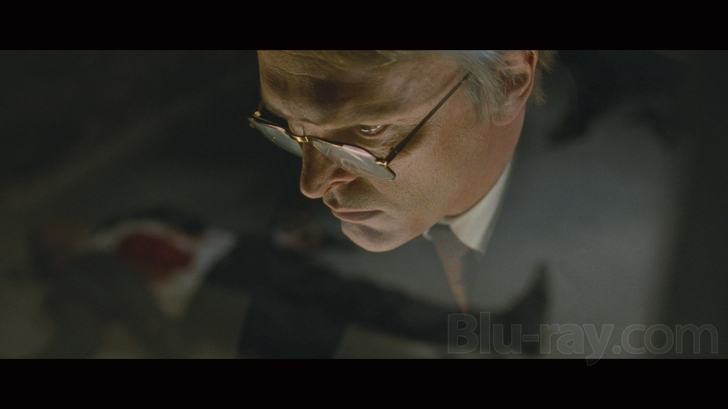
“We’re the North, we do what we want,” is a mantra repeated often throughout Red Riding. North, here, is West Yorkshire, about as far away—culturally and distance-wise—as you can get from London and “the South” without leaving England. It might as well be a different country, and the provincial bureaucracy has its own corrupt ways of doing business. In the first film, 1974—directed with restrained zeal by Brideshead Revisited’s Julian Jarrold—several young girls have gone missing. The latest, Clare Kempley, is found dead in a construction zone owned by bigwig entrepreneur Jon Dawson (Sean Bean), a tycoon who has the police deep in his pockets after offering them a slice of his latest land development deal. Clare has been raped and tortured; the words “4 LUV” have been carved into her chest and a pair of swan wings stitched haphazardly onto her back. Eddie Dunford (Andrew Garfield), a young reporter from the local rag looking to break his first big story, begins investigating, but he’s too cocksure, too naïve about the dangerous world he’s trying to navigate. His first mistake is sleeping with Paula Garlard (Rebecca Hall), the mother of one of the victims and—unbeknownst to him at the time— Jon Dawson’s mistress. To say that Dunford is out of his depth is a massive understatement, and as he follows up on leads from BJ (Robert Sheehan)—a male prostitute who will appear in all three films—he faces police threats, resorts to dubious journalistic practices, and is driven to violence and self-destruction. The price of the truth is steep, a theme that will haunt the other protagonists in the series.
The second entry, 1980, is where the trilogy really begins to show its ingeniousness, wedding narrative intricacy with betrayal and tragedy of Shakespearean scope. This one is handled by documentarian John Marsh (Man on Wire), who injects the film with procedural realism straight out of HBO’s The Wire. Here, the West Yorkshire police force is facing public criticism for its handling of the Yorkshire Ripper case, so the Home Office sends in an outsider, Peter Hunter (Paddy Considine), to take over the investigation. In U.S. terms, this would be like sending in the F.B.I. to handle a small town crime—inevitably infuriating the local law enforcement. And sure enough, Constable Bill Malloy (Warren Clarke) and his lackeys are peeved and on-guard, not just because their territory is being infringed upon, but because they’ve all got something to hide. The frankly terrifying idea presented here is that the police are using the Ripper’s crimes to hide their own, and more so, that they might even be perpetrating murders, masking them to fit the killer’s modus operandi. Hunter assembles a team, which includes his best friend John Nolan (Tony Pitts) and former lover Helen Marshall (Maxine Peake), and begins to reevaluate the Ripper case while doing some internal affairs work on the sly. “How deep does the rot go? And who stops it?” asks Hunter, elucidating the film’s theme. He takes on the Herculean task himself, but he’s ultimately not strong enough to handle it. He’s got a sick wife at home and his reignited relationship with Helen is compromising the investigation. The Ripper is eventually found, but this only throws the Yorkshire force into a deadly violent scramble to cover their tracks.
The final film in the series, 1983, is like an optical illusion—director Anand Tucker (Shopgirl) gives us flashbacks and alternate narrative angles, changing our perception of events and driving the trilogy to a thrilling, emotionally gratifying conclusion. Another schoolgirl has gone missing, and Yorkshire police officer Maurice Jobson (David Morrissey) sees connections between this disappearance and the prior rash of abductions. Heretofore, Jobson had been in collusion with Bill Malloy and the rest of the corrupt force—he appears as a minor character in the previous films—but he begins to have a slow moral awakening when he sees his co-workers torturing Leonard Cole (Gerard Kearns), an innocent man who’s set to be framed for the kidnapping. This is all too familiar for Jobson, who forcibly coerced a half-wit into confessing to the murder of the previous girls in 1974. Knowing full well that the real murderer is still at large, Jobson goes on a personal quest to find the killer and atone for his involvement in the cover-up. He’s unknowingly aided by John Piggott (Mark Addy), an overweight lawyer whose late father was also involved in the conspiracy. The collective sins of the community’s authority figures are revealed in a series of events that slide horrifyingly—but satisfyingly—into place. Redemption, justice, and illumination are the key words here, and the themes are mirrored visually in the director’s compositions, which frequently feature horizontal lens flares, shafts of light bursting symbolically out of the darkness and across the frame.
Taken as a whole, the Red Riding trilogy is dense and occasionally overwhelming; there are scores of names and faces to remember and it’s often left up to the viewer to play connect-the-dots with plot points when associations are merely suggested in the script. The series is also five hours long. While these salient facts may dissuade some audiences from latching onto Red Riding, the complexity and breadth of the plot is a definite selling point for viewers looking for a mentally engaging thriller that doesn’t pander or patronize. I’ve really only touched on the intricacies and cohesiveness of the storytelling, which even includes sub-textual, fable-like imagery where the characters are symbolized by animals—from a badger and a swan to an owl and, of course, the wolf. Although the series is unflagging in its realism, Red Riding does have a certain dark fairytale quality. Innocence is exploited and a sense of the ominous drapes the three films like a shroud. You’ve probably noticed that I haven’t said much about the acting, but the only reason I haven’t called out any specific performances is because all of the actors are uniformly excellent. You would never know these are essentially made-for-TV movies. This is a tense, challenging, often unsettling viewing experience, and consequently, it’s deeply rewarding for anyone willing to put the time and brainpower into it.
Red Riding Trilogy Blu-ray Movie, Video Quality
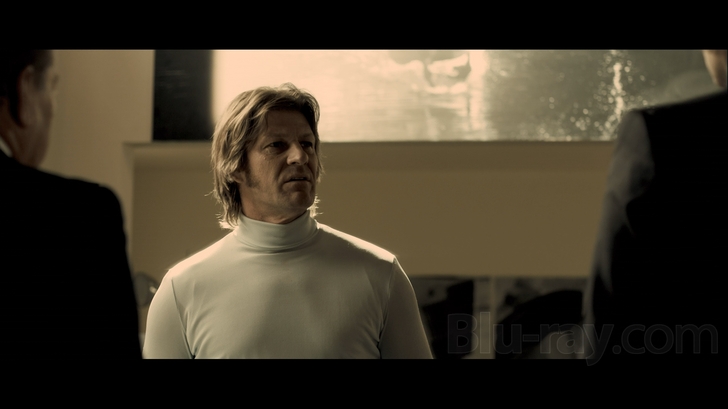
For whatever reason, but presumably to save money on packaging, MPI and IFC have decided to put all three films—all 308 minutes—onto a single BD-50. I know, I know; I was wary as well. Fortunately, the 1080p/AVC-encoded transfers aren't as riddled with compression problems as you might think. Each film presents a very different visual experience. 1974 was shot on 16mm and it shows; the 1.85:1-framed image has a grainy, gritty, sometimes hazy quality that's certainly intentional but isn't exactly objectively eye pleasing. Because 16mm is essentially half of the resolution of 35mm, clarity is definitely on the soft side. Fine detail is apparent in close-ups, but much of the film has a soft, slightly undefined look. Color is appropriately dingy, with lots of grimy neutrals and yellowish highlights, but black levels are a murky gray—especially in darker scenes, where both grain and noise spike. Filmed on 35mm, 1980 is a vast improvement. The 2.35:1 image is sharper, tighter, and cleaner than its predecessor, with a finer grain structure and better-resolved textures. Color is also more saturated and black levels deeper, resulting in strong contrast. Finally, 1983 was shot using the RED One high definition video camera, which provides the sharpest, most vivid picture of the trilogy. It's also the most stylized, with creamy, faux-vintage tones, stark contrast, and lens flares that send shafts of light shooting horizontally across the frame. I'm sure each film could've looked moderately better if they were all relegated to separate discs, but I have few real complaints about the picture quality. My biggest worry was compression, but aside from some occasional noise and a few instances of very mild banding—that you have to go out of your way to look for—there are no distractions here. Don't let the presence of three films on one disc sway you from a purchase.
Red Riding Trilogy Blu-ray Movie, Audio Quality
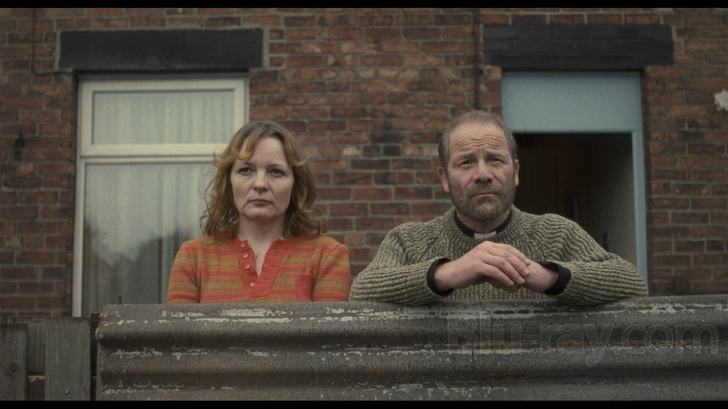
While the picture quality is better than I had anticipated, the trilogy's audio is a slight disappointment, mostly because there are no lossless options here. Each film has been given a mere Dolby Digital 5.1 surround track. With no high definition source material to compare them to, I can't say what we're losing in these lossy mixes, but there were definitely a few instances when I felt the tracks could be cleaner and more dynamically vibrant. The sound design, in general, is very front-centric and restrained, revealing the trilogy's origins as a made-for-TV miniseries. The rear channels have little to do. Cross-channel movements are rare—you'll get the occasional car moving from side to side or front to back—and directionality is seldom used to pinpoint the exact location of sounds. At best, we get some convincing ambience—police station chatter, falling rain, construction noises, wind—and eerie music bled effectively into the surround speakers. Dialogue is nicely balanced in the mix, but it would probably sound crisper and cleaner in a lossless track. I ended up turning the subtitles on, but this was mostly to help in catching the intricacies of the northern English slang.
Red Riding Trilogy Blu-ray Movie, Special Features and Extras
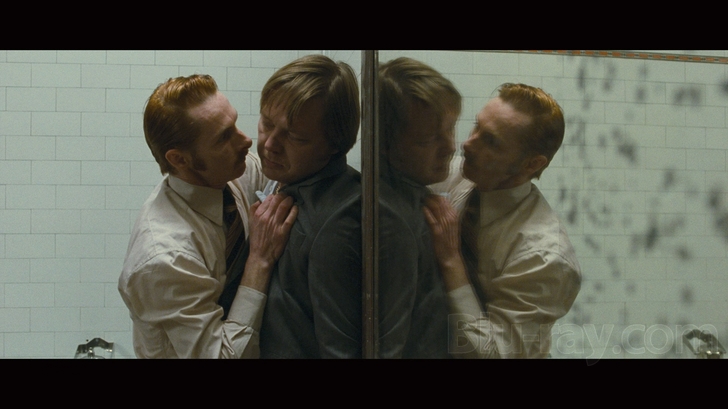
There are no bonus features on the Blu-ray disc whatsoever—with three full-length films there already, I wouldn't want there to be—but the release also includes a DVD with a smattering of supplements. For each film in the trilogy there's a TV Spot (1:02 apiece) and a short collection of Deleted Scenes (7:11, 6:49, 8:09). The section for 1974 includes an Interview with Julian Jarrold (11:26), in which the director fields questions about the film's themes, the casting, and his treatment of the sometimes-tricky material, and under 1980 and 1983 you'll find brief Making Of featurettes (18:46 and 6:41), mostly comprised of on-set footage and interviews with a few of the key players. Wrapping it up, we have a TV Spot for the trilogy (00:32), a Theatrical Trailer (2:29), and a short Behind the Scenes promo (3:02). All bonus features are in standard definition, and many of them are windowboxed.
Red Riding Trilogy Blu-ray Movie, Overall Score and Recommendation
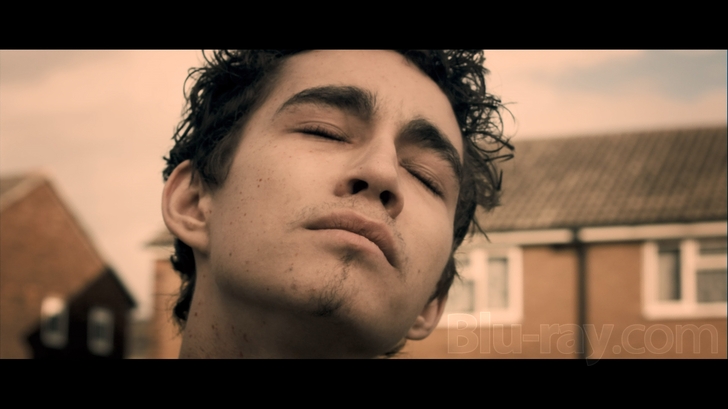
First appearing as a three-part broadcast on Channel 4 in the U.K., and then making it to U.S. theaters as a single, exhausting 5-hour experience, the Red Riding trilogy now arrives on Blu-ray, where it can be savored and revisited at your leisure. And it definitely pays to take your time with these films, as the intricacies of the plot almost demand a second (or third) viewing. While the "better than The Godfather" comparisons are hyperbolic, the trilogy is certainly rewarding. Part cultural time capsule, part corrupt cop drama, and part serial killer mystery, Red Riding operates on multiple levels to tell a decade-spanning story that slices open the seedy underbelly of a provincial town, exposing the nastiness within. The films are all crammed onto a single BD-50 and lack lossless audio options, but this isn't reason enough to skip out on a truly great trilogy. Highly recommended!