Rattle Conducts Tchaikovsky, Stravinsky & Rachmaninov Blu-ray Movie
HomeRattle Conducts Tchaikovsky, Stravinsky & Rachmaninov Blu-ray Movie 
EUROARTS | 2010 | 104 min | Not rated | Jun 29, 2010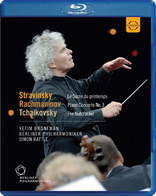

Movie rating
6.8 | / 10 |
Blu-ray rating
| Users |  | 0.0 |
| Reviewer |  | 4.5 |
| Overall | | 4.5 |
Overview
Rattle Conducts Tchaikovsky, Stravinsky & Rachmaninov (2010)
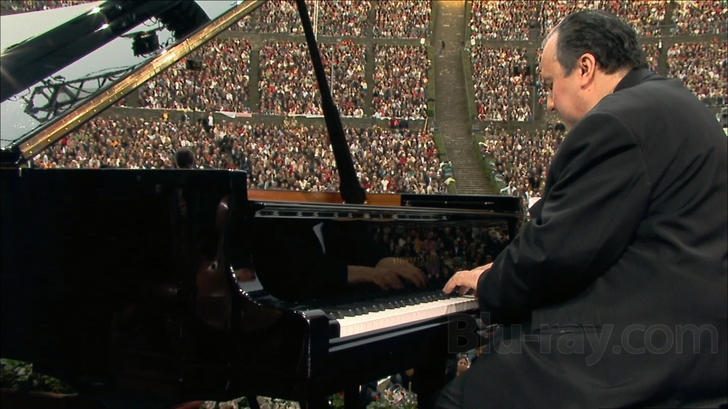
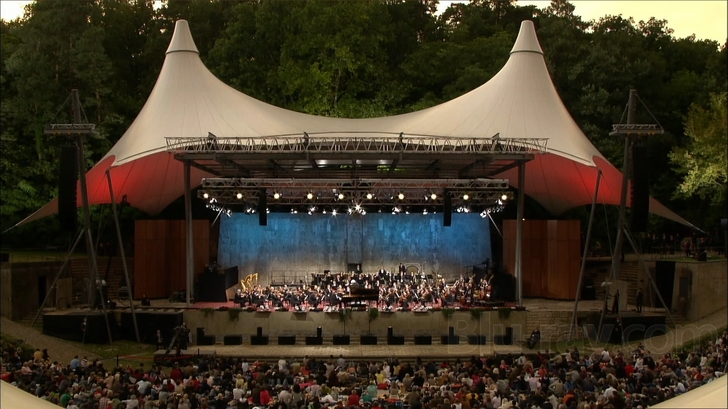
Every year, the Berliner Philharmoniker hold a kind of classical-music fête with a bright, cheerful concert to end the season. In 2009 about 22,000 people had come together at the Berlin Waldbühne to enjoy the traditional summer picnic concert. The theme of the evening was “Russian rhythms”, and star conductor Sir Simon Rattle, the Berliner Philharmoniker and Yefim Bronfman, one of the most famous pianists in the world today, presented a superb selection of Russian music.
| Music | 100% |
Specifications
Video
Video codec: MPEG-4 AVC
Video resolution: 1080i
Aspect ratio: 1.78:1
Original aspect ratio: 1.78:1
Audio
Music: LPCM 2.0
Music: LPCM 5.1
Subtitles
None
Discs
25GB Blu-ray Disc
Single disc (1 BD)
Playback
Region A (B, C untested)
Review
Rating summary
| Movie | | 4.5 |
| Video | | 4.5 |
| Audio |  | 5.0 |
| Extras | | 0.0 |
| Overall | | 4.5 |
Rattle Conducts Tchaikovsky, Stravinsky & Rachmaninov Blu-ray Movie Review
The Russians are coming, the Russians are coming!
Reviewed by Jeffrey Kauffman June 24, 2010Nineteenth century classical orchestral music belonged largely to the Germans, despite protestations to the contrary by a host of competing countries. But, really, when one country can hold up such stalwarts (disparate as they are) as Beethoven, Brahms and Wagner, and then bring in a supporting cast including Schumann, Schubert, Mendelssohn and Bruckner, can there really be any reasonably compelling argument otherwise? One of the few eastern Europeans to enter into this stratospheric company was Russia’s best known 19th century commodity, Pyotr Ilyich Tchaikovsky, a composer who offered the same lush Romanticism as many of his German comrades, but who also pointed the way to a uniquely Russian sound, full of color, spectacle, and, yes, a certain schmaltz, that would soon in fact upend the Germans and assume center stage itself as the twentieth century dawned. It’s more than ironic that the structurally intense German soul shot off into the perhaps bizarre tangent of dodecaphony as the chromatic propensities of Wagner finally pushed tonality over the edge, until all that was left was structure, as completely artificial as it may have been.
Enter the Russians, who managed to rescue more traditional sonorities, while simultaneously exploiting a host of new ideas and incredibly colorful orchestral techniques. While one can certainly see these tendencies developing in nineteenth century Russians like Glinka, Sergei Rachmaninov and (especially) Igor Stravinsky created huge orchestral edifices that stretched the boundaries of diatonicism, often to the breaking point, while introducing a host of innovative rhythmic ideas that catapulted the Russian orchestral ethos rather firmly ahead of the Germans as the twentieth century moved into its early decades. While the Germans turned inward, fretting over tone rows and canzicranz, Russians like Rachmaninov and Stravinksy forged an entirely new language for orchestra that managed to be as forward looking as the Germans while retaining a luscious melodic quality that harkened back to the previous century while being resolutely modern.
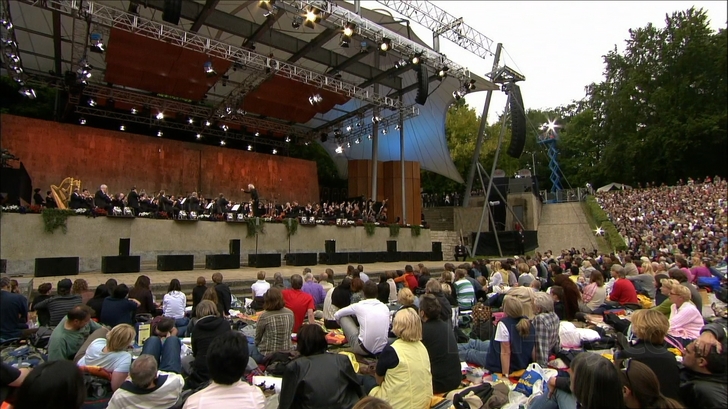
What a lovely day for a picnic and the sacrifice of a pagan virgin. Well, at least for a little while.
It’s somewhat ironic then that this wonderful 2009 live outdoor concert should feature the most iconic of German symphony orchestras, the Berlin Philharmonic, plying the Russian waters with three warhorses from the past century and a half of Russian music. The concert, presented at Berlin’s infamous Waldbühne, an outdoor amphitheater built for the 1936 Olympics and later trashed in an early 1960’s Rolling Stones concert (years before Altamont), is bookended by snippets from Tchaikovsky’s “Nutcracker Suite”, while the bulk of the longish afternoon and evening is given over to energetic readings of Rachmaninov’s exhausting “Concerto for Piano and Orchestra No. 3 in D minor (Op. 30), with guest soloist Yenif Bronfman, as well as the piece that defined the “new” Russian orchestral vocabulary for the early twentieth century, Stravinsky’s epochal “Le Sacre du Printemps.” Sir Simon Rattle, who has been principal conductor of the Berlin Philharmonic for the past several years, and who rescued it from a certain post-Karajan somnambulism into which it had fallen, gingerly moves through the frequently changing time signatures and radically different emotional intents of the Stravinsky piece, belying his background as a professional percussionist. If his readings of the Tchaikovsky and the Rachmaninov are a little more staid, they manage to highlight the ineffable orchestral brilliance that both of these composers brought to their craft, glittering edifices of melodic genius wrapped around huge statements of often overpowering emotion.
What actually inadvertently takes on undue importance in this live outdoor concert is the one thing that the producers of this Blu-ray probably never gave a second thought to, considering the usually balmy climes of Germany in late June, namely the weather. While the opening three snippets from “The Nutcracker” (Overture, The Christmas Tree and March) come off without a weather-related hitch, the cameras start to catch some ominous looking clouds as pianist Yenif Bronfman, often called a force of nature himself, takes the stage to pound his way through a sometimes violent reading of the Rachmaninov. After the interval, when Sir Simon launches into the propulsive rhythms of Stravinsky’s iconic piece, the heavens suddenly open and a torrential thunderstorm ensues. The audience seems mostly nonplussed, perhaps taken away by the often overwhelming sonorities of one of the most important orchestral works of its era. Unfortunately, one can’t ignore the incessant sound of a truly Biblical deluge, nor the low rumble of thunder (or is that the tympani rolls that dot "Le Sacre"?) as it spills across the Ice Age valley which separates Warsaw from Berlin.
In a way, it almost seems perfectly appropriate that the skies should open to the sound of Stravinsky. Has there ever been more fist-shaking music than this amazing piece which manages to be unstoppably propulsive one moment and then achingly lyrical the next with barely a breath in between. Rattle manages the orchestral forces here especially well, all the more incredible due to the surrounding elements, and this “Rite” manages to be the highlight of the evening despite, or perhaps even because of, the weather. While Bronfman is an incredibly able pianist, delicacy is not one of this strengths, and he barrels through Rachmaninov’s filigreed piano writing with inerrant accuracy, but not a lot of nuance. One has to wonder about the odd bookending of snippets from Tchaikovsky’s warhorse, but as this was an open air concert given to the “public at large,” it was probably a good, instantly recognizable invitation into the event, and a suitable closing moment (save for the traditional sing-along--or at least the clap and whistle along--of “Berliner Luft”).
Rattle has reinvigorated the Berlin Philharmonic, making it one of the most supple of European orchestral troupes. This exciting concert doesn’t always present the symphony in the best light, mostly due to the unexpected weather, but it still hints of surprises Rattle has up his conductor’s sleeve. Often thought of as staid and stolid, the Berlin Philharmonic lets their collective hair down a little bit here, to very agreeable effect. Unfortunately, every last strand got soaked, but you can’t have everything when you risk the vagaries of the elements.
Rattle Conducts Tchaikovsky, Stravinsky & Rachmaninov Blu-ray Movie, Video Quality
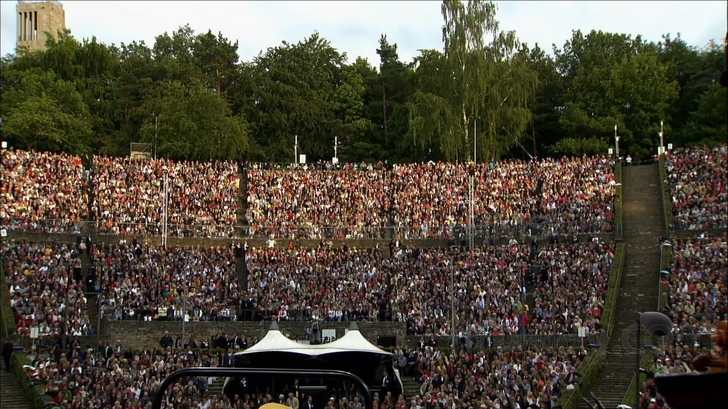
Rattle Conducts Tchaikovsky, Stravinsky and Rachmaninov arrives on Blu-ray with a sterling AVC encoded 1080i "live" transfer with a 1.78:1 aspect ratio. This is one of the sharpest live concert recordings I've seen recently, all the more impressive since it was done out of doors in inclement weather. Colors are very robust, despite the orchestra's all black attire, with brilliant reds, greens and blues spilling out of the audience area. Sharpness here is exceptional, with superb detail. Note the really cool reflections caught in the bell of the tuba, for instance, when the camera comes in for a close-up. Not only can you see the smudges in the brass piece itself, the weirdly reflected scenes of the audience are caught in astonishing detail. Black levels and contrast here are extremely impressive, and for the best example of that just keep your eyes peeled on Rattle once "Le Sacre" starts up. His black shirt and pants never dissolve into the night in back of him, and top of that you can clearly see individual raindrops falling behind him.
Rattle Conducts Tchaikovsky, Stravinsky & Rachmaninov Blu-ray Movie, Audio Quality
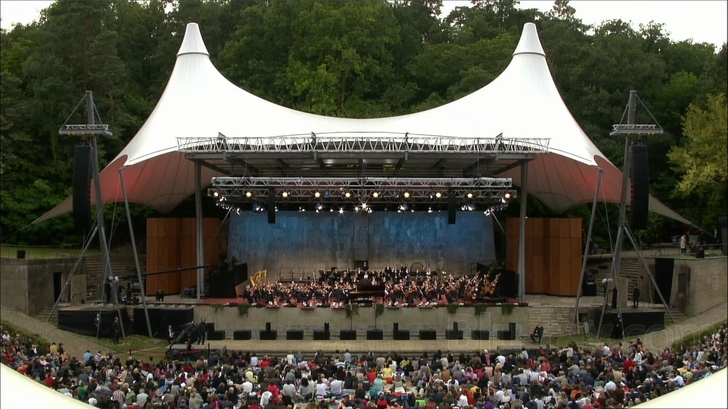
Two excellent lossless audio tracks are provided on this Blu-ray, an LPCM 2.0 stereo track and a very impressively robust LPCM 5.1 track. I opted for the 5.1 track for the bulk of my listening experience. This is an incredibly well recorded concert, again very impressive due to its out of doors setting. There's little ambient noise that creeps into the orchestral performance, though you will clearly hear the pit-a-pat of rain falling as the iconic bassoon solo gets "Le Sacre" off to its deceptively calm start. (Speaking of that bassoon solo, it includes one of the longest held tenuti on the first note I've ever heard in any performance or recording of this epochal piece. Perhaps the player was waiting for the rain to subside). This is a bright and precise recording all around, with great punch in the brass and strings, especially in the Stravinsky piece, but overall there's warmth aplenty in the Tchaikovsky and Rachmaninov outings as well. The piano sounds wonderful, with no tinniness. Low end is especially impressive throughout the evening and really gets into rumble mode around the time the "seven note chord" kicks in in "Le Sacre."
Rattle Conducts Tchaikovsky, Stravinsky & Rachmaninov Blu-ray Movie, Special Features and Extras
No supplements are included. The insert booklet has a rather piquant essay.
Rattle Conducts Tchaikovsky, Stravinsky & Rachmaninov Blu-ray Movie, Overall Score and Recommendation
Rattle has awakened the sleeping giant that was the Berlin Philharmonic, and this mostly superb concert shows the orchestra in full flower, able to handle the sweeping Romanticism of Tchaikovsky, the neo-Romanticism of Rachmaninov, and the idiosyncratic, hyperkinetic genius of Stravinsky. Even a little--well, a lot--of rain can't put a damper on the enthusiasm of this performance and its ardent audience.