Rags & Riches: The Mary Pickford Collection Blu-ray Movie
HomeRags & Riches: The Mary Pickford Collection Blu-ray Movie 
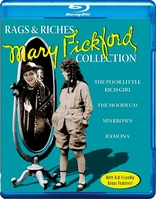
The Poor Little Rich Girl / The Hoodlum + short 'Ramona' / Sparrows Milestone | 1917-1926 | 3 Movies | 274 min | Not rated | Nov 06, 2012

Movie rating
Movie has not been rated yetBlu-ray rating
| Users |  | 0.0 |
| Reviewer |  | 4.0 |
| Overall | | 4.0 |
Overview
Rags & Riches: The Mary Pickford Collection (1917-1926)
| Romance | 100% |
| Drama | 79% |
| Comedy | 6% |
| Family | Insignificant |
| Fantasy | Insignificant |
Specifications
Video
Video codec: MPEG-4 AVC
Video resolution: 1080i
Aspect ratio: 1.33:1
Original aspect ratio: 1.33:1
Audio
Music: LPCM 2.0
English: LPCM 2.0
English intertitles
Subtitles
None
Discs
25GB Blu-ray Disc
Three-disc set (3 BDs)
Playback
Region free
Review
Rating summary
| Movie | | 4.0 |
| Video |  | 3.5 |
| Audio | | 4.0 |
| Extras | | 4.0 |
| Overall | | 4.0 |
Rags & Riches: The Mary Pickford Collection Blu-ray Movie Review
(Re-)Introducing America's Sweetheart
Reviewed by Michael Reuben November 6, 2012In the 1992 bio-pic, Chaplin, an aging Charlie Chaplin reflects on his late friend, Douglas Fairbanks, a silent screen legend and fellow co-founder of United Artists Corporation. Chaplin, who was very close to "Doug", can't believe that people have forgotten what a huge star he was. The same could be said of Mary Pickford, who was also a co-founder of UA and became, with Fairbanks, the first celebrity "power couple" of Hollywood. In her heyday, Pickford was every bit Chaplin's equal in stardom both at home and abroad. She demanded, and received, equal pay with the Little Tramp. Pickford was known as America's Sweetheart on screen, but off camera she was a shrewd businesswoman and a tough negotiator. It's no surprise that she was part of the enterprising group of motion picture artists that went off and formed their own studio, since by that point Pickford, like Chaplin, insisted on control of her own films. She may not have directed herself, as Chaplin did, but she made her directors answer to her. She was only 5' 1", but every inch was formidable. Pickford's most successful roles were as little children. She got away with playing them well into her thirties, and not just because of the conventions of silent film. Her diminutive stature helped, and the effect could be exaggerated by casting supporting parts with unusually tall actors or building sets and props larger than scale. But Pickford's success in portraying children wasn't just a matter of tricks in perspective. Her performances were exceptionally detailed and fully convincing in their evocation of childlike behavior, belying her adult demeanor and life style when she wasn't acting. Pickford once told an interviewer that her delight in playing children resulted from the fact that she'd never had a childhood. Her father died when Pickford was very young, and she'd become the main breadwinner for her mother and two siblings as a child actor traveling the small-time theatrical circuit. It was a treacherous and spartan existence that inevitably causes biographers to invoke the term "Dickensian". The one clear advantage that Pickford received in exchange for her lost childhood was that, by the time she started in "flickers" as a teenager, she was used to negotiating her own deals—and she knew every trick in the book. Milestone Films and the Mary Pickford Foundation are cooperating to reacquaint the general public with Pickford's films and make them available in the best form possible. They've sponsored festivals and educational programs, and now they are releasing three of Pickford's most memorable works (including what many critics and film historians consider her best, Sparrows) on Blu-ray in this collection entitled Rags & Riches. An early short film, Ramona, is also included. The films come with a kind of introductory "wrapper" that may strike some viewers (not without cause) as pandering, but Milestone has thoughtfully mastered each disc so that the "wrapper" can be ignored and, in effect, discarded. What remains are the films themselves, restored by archivists from the Library of Congress and AMPAS using the best known surviving elements and accompanied by newly composed and recorded scores.
The Poor Little Rich Girl (1917) Score: 3.5/5 The Poor Little Rich Girl is often considered the quintessential Mary Pickford film. At age twenty-three, Pickford portrayed Gwendolyn or "Gwen", a girl celebrating her eleventh birthday, and the illusion is remarkable. Like a number of Pickford's most successful films, Rich Girl (with a script by Francis Marion and direction by Maurice Tourneur, with whom Pickford routinely clashed) is told from a child's point of view. The adult world is sketched in the kind of general terms that a child would understand. Young Gwen knows only that her parents don't have time for her. We in the audience are able to glean that the mother and father (Madlaine Traverse and Charles Wellesley) are noveaux riches and attempting to break into society, with little success. Meanwhile their daughter stares wistfully out the window at kids in the street, wishing she could join them to play. The only playmate she's offered is the stuck-up daughter of a fancy lady whom Gwen's mother is having to tea. (They quarrel almost instantly, and Gwen takes the blame.) Much of the action of Rich Girl consists of Gwen getting into one form of mischief after another as she tries to entertain herself. Whether it's inviting an organ grinder into the house, accidentally breaking the bathroom sink and then enjoying the impromptu wading pool she's created in the bathroom, or having a mud pie fight in the garden with some boys from the street (a scene that director Tourneur loathed), Gwen has no regard for decorum or propriety. A more contemporary title for the film might be "Girls Just Want to Have Fun". Rich Girl takes a dark turn in its third act, as Gwen is accidentally poisoned through a minor contrivance and her parents suddenly awaken to the gravity of their daughter's circumstances. One may or may not be moved by the dream sequence that Tourneur has staged for Gwen's coma, but there is no denying Pickford's skill as she portrays Gwen wandering through a ghostly landscape. The film's conclusion may be unrealistic and sentimental, but so are most happy endings. The Hoodlum (1919) Score: 4/5 In one sense, The Hoodlum is a typical Mary Pickford film, because the star plays a child. In another, though, the film departs from the usual Pickford formula, because her character is a dislikeable spoiled brat; indeed, Pickford's Amy Burke is the "hoodlum" of the title, at least in one sense of the word. The granddaughter of a wealthy and ruthless industrialist, Alexander Guthrie (Ralph Lewis), Amy lives a privileged but lonely life on posh Riverside Drive. She fills her time by throwing tantrums and tormenting the servants, but what she really wants, like most children, is love and attention. Grandpa Guthrie, however, is too busy making money by any means necessary, including framing a subordinate to take the fall for his own shady business practices. Amy gets a chance for a different life when her father, John Burke (Dwight Crittenden), comes to town. A writer and scholar preoccupied with social justice, Burke doesn't care about money. When Amy gets angry at her grandfather and insists on living with her father, she doesn't realize that she's just turned down a chance to accompany Alexander Guthrie to Europe and agreed to move into a downtown tenement instead. She has, however, provided The Hoodlum with a rich opportunity to show "how the other half lives" through a child's eyes. Her father's landlady doesn't tolerate Amy's nonsense as a servant would; the other kids treat her as an equal (which turns out to have advantages); and life is both noisier and a lot less lonely in the company of the building's boisterous tenants. When Amy's father gently asks her to try to fit in, she is gradually transformed. These are the film's best sequences, not the least because they are ripe with comic potential that Pickford doesn't hesitate to exploit in scenes that sometimes suggest a female version of Chaplin's tramp. The weakest element of the film is the device used to bridge its two worlds of rich and poor. After returning from Europe, Grandpa Guthrie sneaks into lower Manhattan in disguise, where he takes a room in the same building as Amy and her father so that he can observe his granddaughter. Miraculously, she fails to recognize him. (Hey, it worked for Shakespeare.) As Guthrie observes the changes in his granddaughter, he is initially shocked, and then he too begins to change. He eventually reaches the point where he agrees to exonerate Amy's new boyfriend, who just happens to be the very same subordinate who served as the patsy for Guthrie's corporate misdeeds. By a fortunate coincidence, the young man is also a resident of the tenement where Amy's father has his lodgings, and he and Amy have fallen deeply in love. (Hey, it worked for Dickens.) Sparrows (1926) Score: 5/5
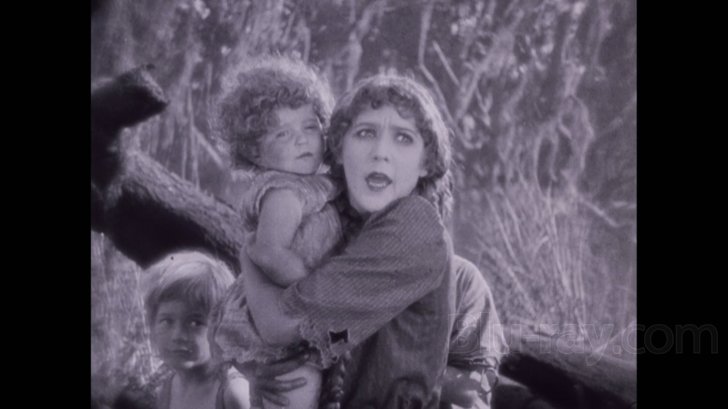
The Devil's share in the creation of the world was a certain southern swampland—a masterpiece of horror. And the Lord appreciating a good job, let it stand. Sparrows, opening intertitleBased on a short story entitled "Scraps", Sparrows is a dark and unsettling tale whose debt to Charles Dickens' depictions of children being abused and exploited is immediately obvious. Less familiar at the time, and more shocking to contemporary audiences, was the visual style heavily influenced by the German filmmaking that had so impressed Pickford and Fairbanks on a 1923 visit to the UFA studio in Berlin, the place where Fritz Lang would soon create Metropolis and where F.W. Murnau was working on The Last Laugh. Murnau in particular seems to have had an impact on Sparrows, because it is impossible to look at the film's icy exploiter of the young and weak, Mr. Grimes, and not spot the resemblance to Murnau's infamous Count Orlok in Nosferatu. "Scraps" dealt with the contemporary problem of "baby farms": rural sweatshops where abandoned and orphaned children were kept as slave labor. In Sparrows, Pickford plays Molly, the oldest of a group of children imprisoned on such a "baby farm" in a Louisiana swamp. The farm is owned by Grimes (Gustav von Seyffertitz), who lives there with his equally hard-hearted wife (Charlotte Mineau) and their bully of a son, Ambrose (Spec O'Donnell). The children are starved, worked for long hours, locked up at night and routinely threatened with death, but they don't flee because they have nowhere to go. Even if they did, the bogs of quicksand that surround the farm are an effective deterrent. Without someone who knows the terrain, the chances of surviving the trek across the swamp to the road are slim. Molly is the de facto leader and natural mother of the group. It is she who cheers up everyone, leads them in prayer, assures them that God is watching, stands up to Grimes on their behalf and even offers to take their punishments. It's an increasingly challenging role for a young girl, as shown in an extraordinary scene involving one of the youngest, a scene that demonstrates the truth in Norma Desmond's famous line that silent film stars didn't need dialogue because they had faces. Sparrows moves from exposé to thriller because of Grimes's other business, which involves kidnapping. (Indeed, there's a suggestion that some children on his "baby farm" were snatched, not abandoned.) A career criminal named Bailey (Lloyd Whitlock) abducts the infant daughter, baby Doris (Mary Louise Miller), of a society man, Dennis Wayne (Roy Stewart). While a ransom demand is made, Bailey warehouses the child with Grimes, who turns over the little girl to Molly for care and maintenance. Molly assumes that baby Doris is just like the rest of her adopted brood, until Ambrose Grimes lets it slip that his father is planning to drown the baby in the swamp. Suddenly the girl feels a heaven-sent call to arms, as she begins organizing her ragged army for an escape attempt. And escape they do, over makeshift paths of plywood and straw, across flimsy branches beneath which hungry alligators snap their jaws, through murky waters that threaten to drown them. The production design is so good that it's hard to believe they never left Los Angeles, and the early examples of effects photography hold up remarkably well. Sparrows was one of Pickford's most successful films, because it gave audiences something they hadn't seen before. It's still effective, because its direction (by William "One Take" Beaudine) is clear and straightforward, and the outcome has the crowd-pleasing simplicity of rewarding the good and punishing the wicked. That never goes out of style.
Rags & Riches: The Mary Pickford Collection Blu-ray Movie, Video Quality
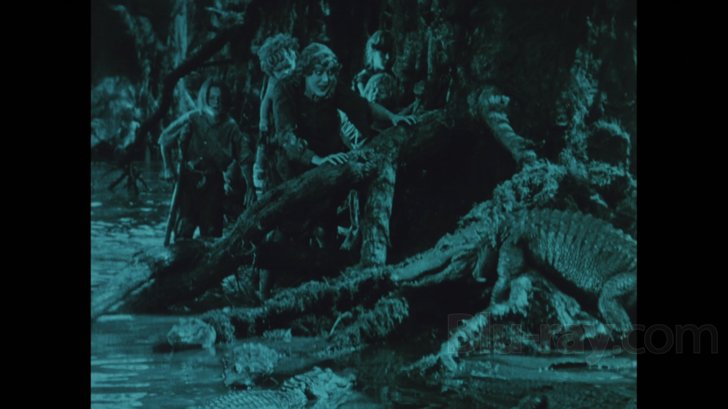
In all of the video evaluations that follow, allowance must be made for the age and condition of the surviving elements. All three films have been tinted in individual scenes, as per conventions of the period. However, with the exception of Sparrows, no archival materials have survived providing specific guidelines for the tints to be used on any particular scene or film. All three films have been encoded at 1080i with the AVC codec. The Poor Little Rich Girl (1917) Score: 3.5/5 The Poor Little Rich Girl has been restored by the Library of Congress archivists, but the source materials appear to be the weakest of the three films in this set. Still, despite numerous small scratches, dust and other marks, the image has retained its integrity and almost no frames are missing. A remarkable amount of detail is visible for a film of this vintage, more than enough to appreciate director Tourneur's meticulous compositions and Pickford's thoroughly realized performance as an eleven-year-old. The tint shifts are effective in establishing changes in mood and tone, especially as the film moves into its darker third act. The Hoodlum (1919) Score: 4/5 A credit at the end of The Hoodlum states that it has been restored by the Academy Film Archive of the Association of Motion Picture Arts and Sciences, with color tints selected by the Mary Pickford Foundation. Though made only two years later than Rich Girl, The Hoodlum survives with a superior image, no doubt due to the preservation of superior elements. With the crisper, more detailed image, the film's stark contrast between Amy's privileged existence on Riverside Drive and the dust and squalor of the tenement neighborhood downtown is placed squarely before the viewer's eyes, just as it appears to Amy. At the same time, the energy and bustle of the crowded streets and back window fire escapes have a visual appeal that the static (indeed, stuffy) compositions of the Guthrie household cannot match. As presented on Blu-ray, the restored elements bring Amy's two worlds to life as she builds a bridge between them. Sparrows (1926) Score: 3.5/5 According to information supplied by Milestone Films, Sparrows has been restored by the Library of Congress using a 35mm dupe negative and an original tinted nitrate release print. Therefore, in this instance, the various choices of tint can claim to be historically accurate. (Note, however, that the tints vary from what is described in the "Intro and Outro" sequences included with the film; see Special Features for further discussion.) The source materials seem to be in substantially better shape than those that the Library of Congress had for The Poor Little Rich Girl, but it appears that someone tried to clean them up even more with digital filtering. Although significant detail remains, the image has a softened, flattened appearance that is immediately obvious in comparison to the other two films included in Rags & Riches. While this loss of detail may not be immediately obvious in earlier portions of the film, where black and white scenes remain predominant, it becomes problematic later when dark tints prevail. With the darker image, any loss of picture information, no matter how small, makes the image less distinct and reduces the impact of the image. You may want to turn up your contrast to compensate (but you shouldn't have to). Restoration of materials from this era is more art than science, and I always hesitate to secondguess archivists when I haven't seen the source from which they started. Nevertheless, it appears to me from the final product that too heavy a hand was applied in smoothing out the image. My philosophy, which I believe is shared by my fellow reviewers at Blu-ray.com, is that it's better to leave in grain, noise and damage, if you can't remove them without subtracting picture information.
Rags & Riches: The Mary Pickford Collection Blu-ray Movie, Audio Quality
All three films have PCM 2.0 tracks with newly recorded orchestral scores, and I have not scored them separately, because they're equally superb. Indeed, one of the glories of Rags & Riches on Blu-ray is its ability to convey, even on a relatively modest home theater system, the full orchestral presence that is such an essential element of the silent film experience. (The term "silent film" has always been a misnomer.) The score for The Poor Little Rich Girl was composed and conducted by Philip Carli and performed by the Flower City Society Orchestra of Rochester, New York, an exceptional group of artists who specialize in recreating music from the era of ragtime. The PCM 2.0 track gives the sense that the orchestra is arrayed across the front of your home theater's soundstage, performing Dr. Carli's score as an orchestra might have done in major venues when the film was first released. The score follows and emphasizes every emotional turn, from the comical mud fight that Pickford's director wanted so badly to cut, to the grim final act where Gwendolyn's circumstances become genuinely dire. The Hoodlum was scored by film composer Bonnie Ruth Janofsky and performed by the Rousse Philharmonic conducted by the Blu-ray's producer, Hugh Munro Neely. Janofsky is a talented composer, but her score sounded somewhat contemporary to my ear, less authentically period and more like a modern reimagining of a ragtime instrumental. Its performance is nevertheless reproduced with fine fidelity and presence. Neely and the Rousse Philharmonic return for Sparrows, with the score now written by film and theater composer Jeffrey Silverman. Like Sparrows itself, Silverman's score mixes elements of both an older tradition and a sensibility that feels entirely contemporary. The PCM 2.0 track delivers the orchestral presence with the same authority as on the other two film soundtracks. As part of the "kid-friendly bonus features" discussed in greater detail in the extras section, each movie has an alternate track in which the intertitles are narrated by a speaker, along with a few randomly chosen actions occurring between the intertitles. (The speaker is James Leedom, the actor who plays "Grandfather" in the "Intro and Outro" extras described below.) Presumably this track could be useful for younger children whose reading skills haven't yet progressed to the point of being able to read the full intertitles, but I do not recommend it. In order to accommodate the narration at an appropriate volume, the orchestral score has been mixed at a lower volume overall. When the narration interjects, the orchestra recedes to the background, and its effect is greatly diminished. Much of the impact of this style of filmmaking derives from letting the music push the viewer's feelings first this way, then that. The effect is ruined when voices are allowed to drown out the music.
Rags & Riches: The Mary Pickford Collection Blu-ray Movie, Special Features and Extras
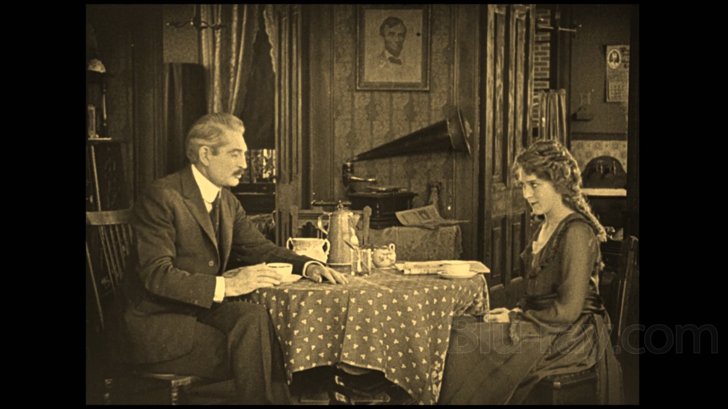
Disc 1: The Poor Little Rich Girl
- Optional Intro and Outro (1080i; 1.33:1; 9:45): Each film in the set comes with this feature, which is part of the "kid-friendly bonus features" promised on the Blu-ray's front cover. In a series of vignettes portrayed by actors, a kindly grandfather who's a film historian teaches a group of kids about the birth of motion pictures and shows them the three films starring Mary Pickford included in the Rags & Riches set. The writing, acting and production values are on a par with an educational film intended to be shown in classrooms. The information presented is relevant, useful and, despite being basic to any understanding of the art of motion pictures, largely missing from the vocabulary and understanding of far too many film enthusiasts today. The "Grandfather" scenes for The Poor Little Rich Girl focus on the basics of early motion picture technology, including the chemistry of film and the lack of ability to include recorded sound. The scenes were shot on video, and the quality appears to be that of standard definition, but upconverted to 1080i. The intro on this disc shows instability and shifting in the bottom half of the frame, but subsequent segments settle down.
- Commentary by Film Historian Scott Eyman: Eyman is an expert on the early days of Hollywood and the author of a book on the birth of "talkies" as well as biographies of John Ford, Ernst Lubitsch, Louis B. Mayer and Cecil B. DeMille. His commentary is dense with information, but it is clearly a prepared lecture that Eyman is reading into a microphone, rather than a spontaneous talk inspired by viewing the film. The best parts are those that deal specifically with the making of The Poor Little Rich Girl, especially Pickford's tensions with her director, Maurice Tourneur.
- Dailies from Home Movies at Pick Fair (480i; 1.33:1; 8:27): These are dailies from a never-finished project that Pickford, Fairbanks and Chaplin began at the home shared by Pickford and Fairbanks. One can only imagine what sort of storyline they had in mind or where Chaplin's irrepressible mugging would have fit in.
- Credits
- Optional Intro and Outro (1080i; 1.33:1; 9:38): Among the highlights of this "kid-friendly" segment is Grandfather's demonstration of an antique zoetrope, one of the earliest devices for turning still images into a moving picture. From there, he shows how a motion picture projector translated the same principles into a mechanism for projecting moving pictures from a sequential series of frames on a strip of plastic. If the word "zoetrope" sounds familiar, it may be because Francis Ford Coppola used it to name his company: American Zoetrope.
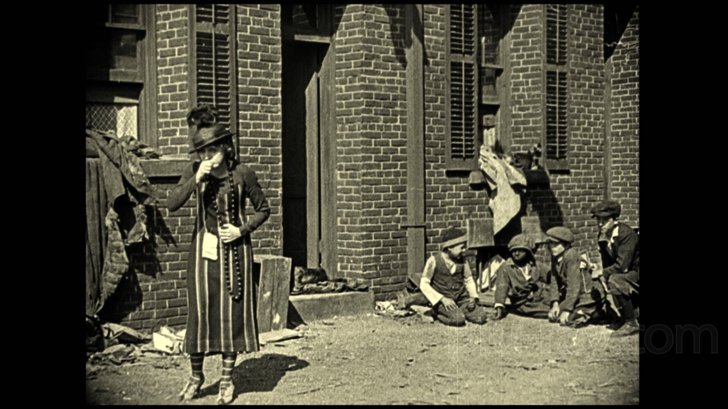
- Ramona (1080i; 1.33:1; 17:00): Several aspects of this 1910 short are significant besides Pickford's presence. Its writer and director was D.W. Griffith, one of the acknowledged founders of cinema as we know it. Ramona is one of several works by Griffith that complicates the summary characterization typically offered today, in which Griffith is branded a racist due to the portrayal of African-Americans in the film for which he's best know, The Birth of a Nation (1915). Ramona was based on a popular novel by author Helen Hunt Jackson, and Griffith had Biograph, his studio at the time, pay Jackson $100 for the privilege of using her title and name. This is believed to be the first such studio deal in history, but Griffith wanted to draw on the instant identification that the title and Jackson's name evoked with the film's protest against the treatment of Native Americans. The movie business had not yet relocated to California, but Griffith filmed there in the novel's original setting, an early example of filming "on location". Pickford plays the title character, a woman of mixed descent, who falls in love with a Native American named Alessandro (Henry B. Walthall). As a result, she rejects the overtures of a prosperous Spaniard named Felipe (Francis J. Grandon) and is disowned by her mother (Kate Bruce). Ramona elopes with Alessandro, only to find that his village has been destroyed by white attackers. The couple manages to eke out an existence among the ruins, until one day they're driven off with their infant child by white settlers who insist that this is "our land". In the wilderness, only tragedy awaits them. Griffith simplified both Jackson's plot and the character relationships, but he kept her essential core, which was an exposé of the harsh treatment of Native Americans by their conquerors. Even in a dark wig and make-up, Pickford's expressive features effectively convey, in human terms, the suffering inflicted by such ethnic and social divisions. Griffith's decision to shoot outdoors in real locations gives Ramona a scale beyond its modest running time and helps offset its heavy-handed intertitles, which were still standard practice at the time, because studios didn't yet trust the new medium to tell a story visually. The video quality of Ramona is almost as good as that of the three main features. I have included a representative capture in the extra screenshots (#40).
- Credits
- Optional Intro and Outro (1080i; 1.78:1; 10:35): This is perhaps the most intriguing of the "kid-friendly bonus features", though not by design. A major topic discussed by "Grandfather" is the tinting of black-and-white sequences before the advent of color film. To provide both entertainment value and visual cues, sequences would be tinted for thematic purposes, e.g., yellow to indicate bright daylight, blue to indicate a dark night sequence, etc. Two of the three films in Rags & Riches have been tinted digitally according to the archivists' best guess as to their original look. Sparrows has been tinted according to a surviving release print—and that's where it gets interesting. "Grandfather" claims that Sparrows' extended sequence of Molly and the children fleeing through the swamp was tinted violet to create an eerie, spooky mood. But on this Blu-ray transfer, the tint in those sequences is a greenish blue. Now, the tint looks fine and is certainly appropriate for what is supposed to be a Louisiana swamp. If one skipped the "Intro and Outro", the inconsistency would never even be noticed. But it doesn't make much sense to prepare such educational features for kids and then have them be wrong. What kind of educational message does that convey?
- Commentary by Film Historians Jeffrey Vance and Tony Maietta: Vance and Maietta are both acknowledged experts on silent film. Both have written works on Fairbanks, and both have contributed material to Turner Classic Movies (TCM). Vance has also been an archivist for MGM/UA and the heirs of Charlie Chaplin, in addition to authoring volumes on Chaplin, Buster Keaton and Harold Lloyd. Their discussion has a practiced feel to it, as they have clearly done this before (probably at festival and film school screenings of Sparrows), but neither man sounds like he's reading from a script. Rather, this is the sound of two polished speakers, each of whom has a wealth of biographical, historical and technical knowledge at his fingertips and deploys it with the confident ease of a true expert. Between them, they cover the entire making of Sparrows, and much of the rest of Pickford's life and career in addition.
- Original Sparrows Trailer (1080i; 1.33:1; 2:37): As is often the case today, the trailer looks worse than the film, but considering its age (1926), it looks remarkable.
- Sparrows Outtakes (1080i; 1.33:1; 4:13): As described on an intertitle at the beginning, these outtakes were discovered and preserved by archivists at the Library of Congress. They are believed to have been shot as alternatives for Molly's dream of Christ, but no definitive information exists.
- The Mary Louise Miller Story (1080i; 1.78:1; 16:30): This is a fascinating biographical sketch of the child actress who played Doris Wayne, the kidnapped baby, and who maintained a life-long association with Pickford, even though she'd ceased acting just a few years after Sparrows. The primary source is Miller's daughter, Louise Paziak, who is interviewed by Hugh Munro Neely, the disc's producer.
- Credits
Rags & Riches: The Mary Pickford Collection Blu-ray Movie, Overall Score and Recommendation
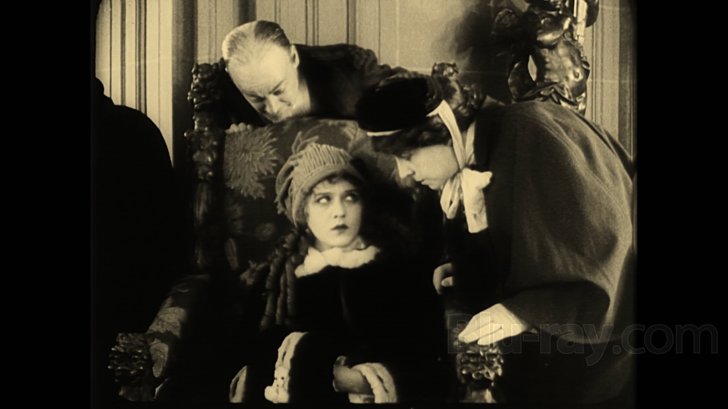
As easy as it is to mock the "Intro and Outro" segments on Rags & Riches, one must concede that watching silents from the earliest days of Hollywood requires a deliberate effort on the part of the modern viewer. Then again, contemporary viewers are accustomed to rapidly switching among genres and formats. After the initial shock, silent films should fit easily into the multimedia carousel that today's technology offers. Mary Pickford's films are certainly first-class examples of the era's output. It seems especially appropriate to revisit them now, when Paramount has just released its excellent restoration of Sunset Boulevard, because Pickford was one of director Billy Wilder's first choices to play faded silent film star Norma Desmond. Pickford declined, fearing that the role would damage her image as America's Sweetheart, and Gloria Swanson went on to make the part indelibly hers. Still, one can't help but wonder what would have happened if Pickford had said yes. She really did have a face like no other. Highly recommended.