Purcell: The Fairy Queen Blu-ray Movie
HomePurcell: The Fairy Queen Blu-ray Movie 
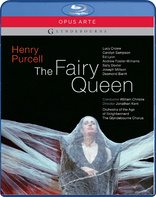
Glyndebourne FestivalOpus Arte | 2009 | 230 min | Jun 29, 2010

Movie rating
Movie has not been rated yetBlu-ray rating
| Users |  | 0.0 |
| Reviewer |  | 5.0 |
| Overall | | 5.0 |
Overview
Purcell: The Fairy Queen (2009)
Starring: Lucy CroweDirector: François Roussillon, Jonathan Kent
| Music | 100% |
Specifications
Video
Video codec: MPEG-4 AVC
Video resolution: 1080i
Aspect ratio: 1.78:1
Audio
English: DTS-HD Master Audio 5.1
English: LPCM 2.0
Subtitles
English, French, Spanish, German
Discs
50GB Blu-ray Disc
Single disc (1 BD)
Playback
Region A (B, C untested)
Review
Rating summary
| Movie | | 5.0 |
| Video |  | 4.5 |
| Audio | | 5.0 |
| Extras |  | 3.5 |
| Overall | | 5.0 |
Purcell: The Fairy Queen Blu-ray Movie Review
Prepare to be wowed by this incredible production of one of the all-time spectaculars in musical theater history.
Reviewed by Jeffrey Kauffman June 23, 2010Mention operatic adaptations of Shakespeare and images of Verdi most probably spring to mind. But two hundred years before Verdi tackled the Bard, Englishman Henry Purcell pulled out all the theatrical stops for what has been somewhat humorously described as a “semi-opera,” The Fairy Queen, rather loosely adapted from Shakespeare’s A Midsummer Night’s Dream. No one is quite sure who wrote the text (it’s not really a traditional libretto) which acts largely as a preamble to Purcell’s music, but consensus is it may have been Thomas Betterton.
One way or the other, this is a stuffed full to overflowing evening of spoken dialogue and incredible set pieces supported by some of the most ravishing music Purcell or anyone else ever wrote, and that very grandeur has led to The Fairy Queen being relegated largely to recordings, with relatively few actual staged productions over the past several decades. (From a historical perspective, the lack of productions can also be attributed to the fact that Purcell’s score was considered lost for several centuries until its discovery a bit over a hundred years ago).
The redoubtable Glyndebourne Festival had in fact never before staged this monumental work, but in 2009 they undertook the gargantuan task in a production helmed by Jonathan Kent, who for better or worse decided to present the piece more or less intact, as well as including a few interpolations from Shakespeare himself. That means you’re in for a Wagner-sized evening of music theater, albeit one without the portentous heaviness that usually accompanies the “Bard of Bayreuth.” In fact Purcell’s piece is, like its eponymous character, lighter than air, a spectacle in the best sense of the word that nonetheless rarely if ever gets weighed down by its own immensity.
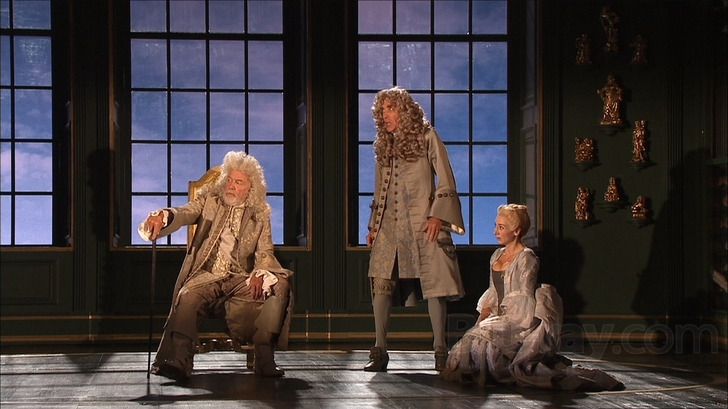
The Restoration era parlor which opens this stunning new 'Fairy Queen'.
Though many characters from Shakespeare’s “faerie” world inhabit The Fairy Queen, the emphasis shifts slightly from the original, with the romantic entanglements of Hermia (Susannah Wise) and Lysander (Oliver Kieran Jones) and Helena (Helen Bradbury) and Demetrius (Oliver Le Seuer) assuming a bit more focus than the marital squabbles of the Fairy King, Oberon (Joseph Millson) and his Queen, Titania (Sally Dexter). The Fairy Queen is an odd sort of bifurcated theatrical experience, with the plot outline of A Midsummer Night’s Dream delivered in the spoken preamble, and then a series of masques and gargantuan set pieces following delivering commentary on the various predicaments which ensue when indiscriminate use of love potions wreak havoc on various couples’ love lives. Jonathan Kent makes some hilariously cogent comments in his incisive notes in this Blu-ray’s insert booklet liner notes, where he cautions the audience not to try to make too much sense of an evening that is really meant to overwhelm the viewer and listener with spectacle. As Kent states, he at least has attempted to instill some sense of narrative sanity to The Fairy Queen, as otherwise, “it runs the risk, no matter how glorious the music of being—as someone once described history—just one damned thing after another.”
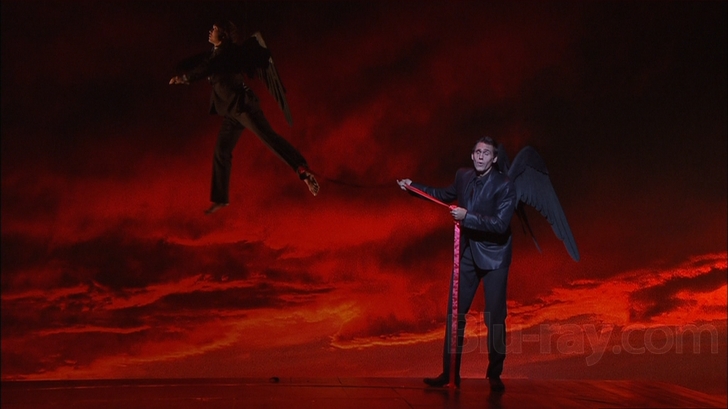
This is certainly one of the most impressively sumptuous productions in the vaunted history of the Glyndebourne Festival. Designer Paul Brown delivers an incredible panoply of visual delights, from gorgeous gossamer costumes to some fanciful sets. Fairies flit about the stage, descending from the “heavens” (read the flies above the proscenium) or, conversely, gushing forth from the underworld (read from trap doors in the stage). The gorgeous music of Purcell is played with élan by the superb Orchestra of the Age of Enlightenment under the, well, enlightened direction of William Christie, who has long been a champion of Purcell’s music. This is luminously effervescent music, and Christie conducts with precision and grace, lending propulsive energy to the evening which, frankly, may indeed go on a bit too long for current members of the ADHD generation.
Kent does try to hedge his bets somewhat by walking a rather dangerous tightrope between a purist recreation of the original Purcell “vision” (in both senses of that word), and a more contemporary approach which will make the piece accessible to today’s audiences. That’s especially interesting when one considers Kent’s insistence that neither he nor Christie are “Purcell purists,” and that they were more than willing to cut, rearrange and tinker with the original to suit their whims. Still and all, we’re presented with a Restoration era setup which magically dissolves into some post-modern touches once the lovers have entered the fairy world of the woods. It actually works surprisingly well, though there is a certain unevenness of tone when visual gags are delivered alongside snippets of Shakespeare’s original text. But of course even the Bard wasn’t above introducing some buffoonery in both his tragedies and comedies, so Kent isn’t that far off the mark by utilizing the same approach.
The Fairy Queen, even in this resplendent a production, does need a little patience from its audience, so forewarned is forearmed. There’s a fair amount of textual setup which may strike some as relatively uninteresting before the theatrical wonderment can begin, but once the “Purcell section” of the evening takes off, even the doubters should be quickly swayed by the unending array of visual splendor and the evocative shimmer of Purcell’s music. The evening may in fact not make a great deal of sense, but that’s what happens when the indiscriminate use of another kind of heady potion—the remarkable theatrical imagination of Henry Purcell—is utilized.
Purcell: The Fairy Queen Blu-ray Movie, Video Quality
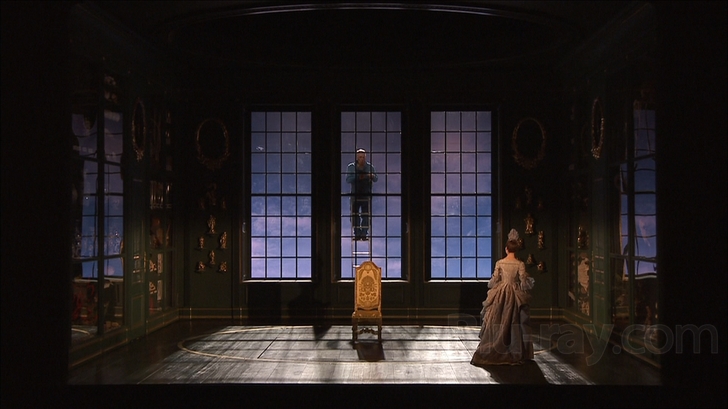
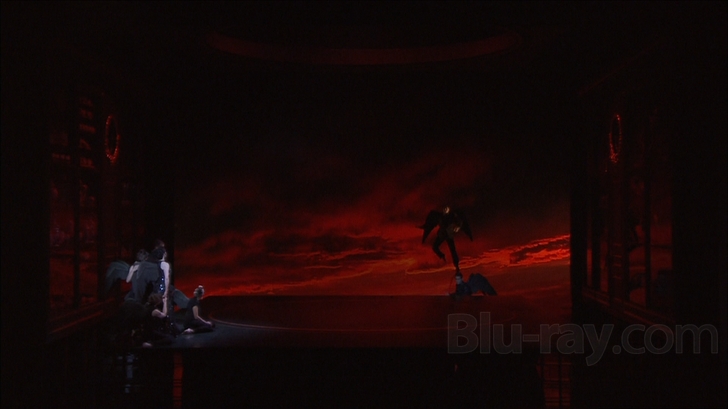
The Fairy Queen wings its way onto Blu-ray with a gorgeous AVC encoded 1080i "live" transfer, in a 1.78:1 aspect ratio. Starting with the Restoration drawing room opening, through the magical world of the fairies themselves, detail throughout this Blu-ray is often astounding, revealing all sorts of wonderful aspects of Paul Brown's incredibly inventive designs. The almost plasticene wings of the fairies glow in the brilliant stage lighting of Mark Henderson, who often illuminates the stage with some gorgeously saturated primary hues of red and blue. Black levels are nicely inky and shadow detail is exceptional throughout the three hours of the piece. No interlacing artifacts were noticeable and this is one of the nicest looking Blu-rays yet from Opus Arte, which has been setting the bar fairly high for live opera in high definition.
Purcell: The Fairy Queen Blu-ray Movie, Audio Quality
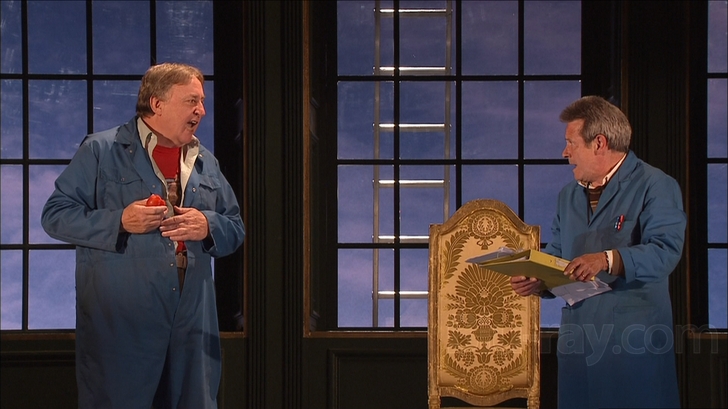
Even better is The Fairy Queen's absolutely brilliant DTS-HD Master Audio 5.1 lossless audio (a lossless LPCM 2.0 option is also available). There is simply no better Purcell conductor than William Christie, and the recording here matches his excellence note for note. Christie and his superb period instrument group The Orchestra of the Age of Enlightenment are one of the few troupes who can make historical instruments sound inerrantly facile, without the grating dry, almost sul ponticello, sound that often haunts the string section. We are greeted with an indelibly warm reading and recording of the score here, with just the right of subtle hall ambience from the "intimate" Glyndebourne hall. Because of the close quarters of the stage, there isn't a lot of overwhelming directionality from the actors and singers, but that's more than compensated for by the incredible clarity and nuance of this recording.
Purcell: The Fairy Queen Blu-ray Movie, Special Features and Extras
Two excellent interview supplements are included on this Blu-ray, a ten minute interview with director Kent, who talks about the challenges of mounting a production this gargantuan, and a 9:14 interview with conductor Christie, who offers some insight into Purcell's magical music.
Purcell: The Fairy Queen Blu-ray Movie, Overall Score and Recommendation
It's not hard to understand why the original 1692 production of The Fairy Queen nearly bankrupted The Dorset Theater. Even had Purcell's score not been lost for centuries, few theaters probably would have undertaken to produce such a humongous spectacle. Luckily Glyndebourne (which itself even required some producing partners) went for broke with this presentation, and the result is one of the most magical evenings of music theater I've experienced in a great while. It may indeed be a tad too long for those with brief attention spans, but if you take a deep breath and simply relax into this "three hour (plus) tour," you'll be rewarded with an incredibly ineffable experience. The Fairy Queen has my highest recommendation.