Puccini: Madama Butterfly Blu-ray Movie
HomePuccini: Madama Butterfly Blu-ray Movie 
C MAJOR | 2010 | 137 min | Rated G | Jun 28, 2011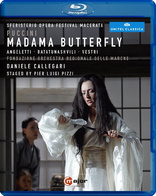

Movie rating
6.7 | / 10 |
Blu-ray rating
| Users |  | 4.0 |
| Reviewer |  | 3.5 |
| Overall | | 3.5 |
Overview
Puccini: Madama Butterfly (2010)
Puccini's iconic opera concerns Cio-Cio-San, nicknamed Butterfly, a young Nagasaki geisha who is abandoned by her American lover after giving birth to his son.
| Music | 100% |
Specifications
Video
Video codec: MPEG-4 AVC
Video resolution: 1080i
Aspect ratio: 1.78:1
Original aspect ratio: 1.78:1
Audio
Italian: DTS-HD Master Audio 5.1
Italian: LPCM 2.0
Subtitles
English, French, German, Italian, Spanish, Korean, Mandarin (Simplified)
Discs
25GB Blu-ray Disc
Single disc (1 BD)
Playback
Region A (B, C untested)
Review
Rating summary
| Movie | | 3.5 |
| Video | | 3.5 |
| Audio | | 4.0 |
| Extras |  | 0.0 |
| Overall | | 3.5 |
Puccini: Madama Butterfly Blu-ray Movie Review
Arena opera.
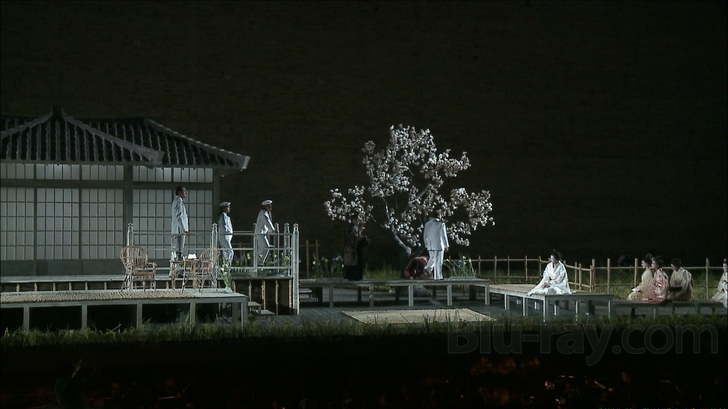
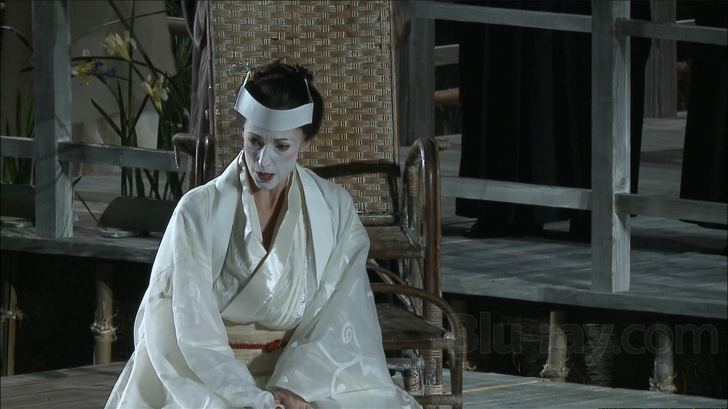
Reviewed by Jeffrey Kauffman July 7, 2011Giacomo Puccini may have been one of the great creative masters of late 19th – early 20th century opera, but he wasn’t above appropriating other artists’ work in order to achieve his own artistic ends. As is recounted in the liner notes to this new Blu-ray release of what is arguably (along with La Bohème) Puccini’s most famous opera, Madama Butterfly, Puccini famously stole the libretti of both La Bohème and Tosca for his operas, and he never waited to formally finalize a deal to adapt David Belasco’s play Madame Butterfly to the operatic medium after he saw the play in London in June 1900. That sort of moral ambiguity may color some audience members’ receptivity to any of these works, but in a way, it also makes a strong case that Puccini understood the shades of gray that often inform his most iconic characters (whether or not he himself actually created them). In Madama Butterfly the moral turpitude is virtually unavoidable as the unseemly behavior of the Americans marauding through a supposedly primitive, yet somehow morally superior, Japan provides the overarching conflict that feeds the central tragic love story of Butterfly (Raffaella Angeletti) and her erstwhile American “husband” Lieutenant Pinkerton (Massimiliano Pisapia). This huge and at times ornate production from 2009’s Sferisterio Opera Festival in Macerata, Italy, is an intriguing mix of the colossal with the intimate. The Sferisterio stage is absolutely immense, an outdoor arena that was originally built for sporting events but which has been used almost exclusively for concretizing since the 1920’s. That very immensity works both for and against this production. Cio-Cio-San (Butterfly’s given name) is a character who must be shown to be increasingly isolated, and in that way the absolutely gargantuan stage area serves the story quite well. However, Madama Butterfly is an incredibly personal story, an epic writ small as it were, and at times the sheer immensity of the space surrounding these characters makes them seem adrift in a formless void that is at cross purposes to the intense, deeply felt emotions which are at the core of this piece.
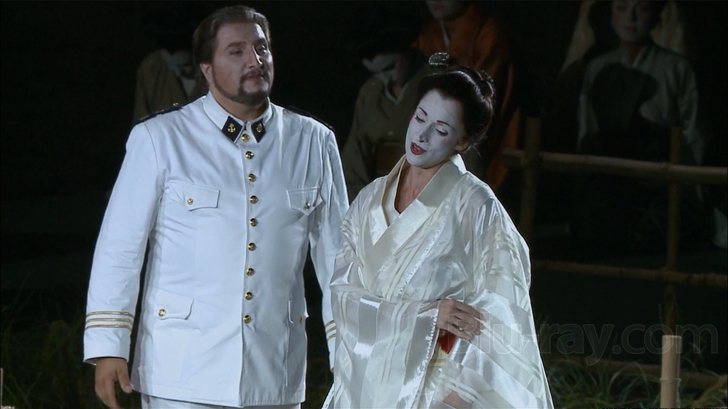
Though the plot of Madama Butterfly is probably seared onto the memories of most readers here, for newcomers the opera concerns an arranged marriage of sorts between a very young (as in 14 or 15 year old) Japanese girl to a visiting American Navy Lieutenant. The officer sees the arrangement as little more than an opportunity for sex, while the girl, nicknamed Butterfly, actually falls in love with the man. She converts to Christianity to win his favor, thereby alienating all of her Japanese friends and family, but soon the Lieutenant himself leaves, not realizing Butterfly has given birth to his son. Madama Butterfly is really rather startlingly prescient in its examination of cross-cultural conflict, and it is especially forward looking (and perhaps not in a good way, at least for Americans) in how it portrays the brutish behavior of at least some Westerners.
Butterfly is one of the most notoriously difficult roles in opera, and one which has created manifold casting problems through the years. As fans of Miss Saigon, the hugely successful West End and Broadway musical based on Madama Butterfly, know, casting Caucasians in Asian roles can raise the hackles not just of audiences and critics, but also of more formal organizations like Actors’ Equity Association. This may be a somewhat ridiculous pseudo-controversy, but it tends to rear its ugly head with relative frequency with regard to productions of Madama Butterfly, and it may again with this production, which features Italian soprano Raffaella Angeletti in the title role. No attempt is made to really disguise her obviously very Italian looks, and that’s probably a good thing. And while Angeletti certainly has the dramatic chops for the part, no mean feat by any stretch, her voice in this production is frequently on the strident side, and early in the evening at least she has the disquieting propensity to sing just a hair sharp a lot of the time.
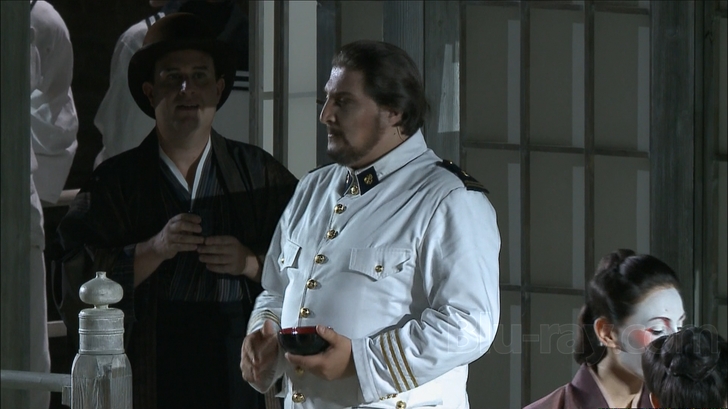
Pinkerton may be an easier role to cast, but it has its own share of pitfalls, mostly due to how completely unsympathetic the character is. Director Pier Luigi Pizzi doesn’t attempt to ameliorate the distaste most audience members will feel for Pinkerton, and indeed this production actually kind of goes out of its way to make him even more reprehensible than usual. It’s to Pisapia’s credit, then, that the character doesn’t seem a cardboard cutout, hiss-worthy villain and indeed retains a good deal of nuance and tragic depth. Also very impressive in this production is baritone Claudio Sgura as Sharpless, the United States Consul at Nagasaki. Sgura, who bears an uncanny resemblance to Brad Garrett at times, offers an incredibly lustrous low end which fills Puccini’s lines with an appropriately shaded ambience.
The central tragedy of a supposed young teenaged Japanese girl more or less sold to an American suitor for his sexual gratification obviously has modern day analogs, as is provable not just in a cursory review of news reports about rampant prostitution in Asian countries, but also with regard to this production itself, whose hosting Festival offered a “meet and greet” focusing on the issue of rampant prostitution and sex slavery of very young girls. Thankfully, though, Pizzi and the rest of the creative crew let the audience do their own analogizing and keep this Madama Butterfly squarely in its proper historical context. While this may not be the most colorful Madama Butterfly ever to make it to the stage, whether or not that stage is as behemoth as the one in Sferisterio, this is an emotionally cohesive production that manages to overcome the vast stage on which it’s set at least some of the time to deliver the up close and personal story that is literally at the heart of Madama Butterfly.
Puccini: Madama Butterfly Blu-ray Movie, Video Quality
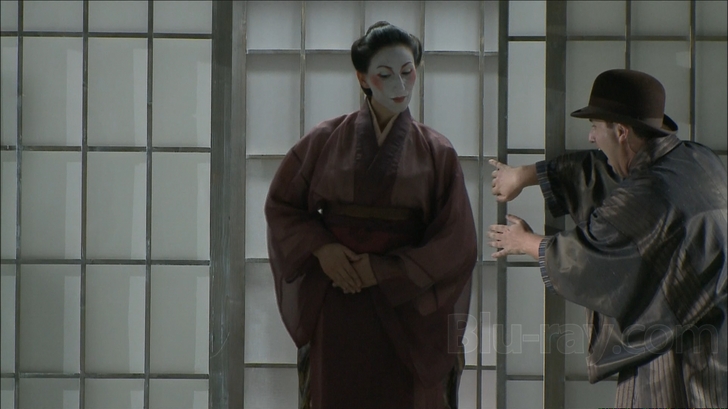
While Madama Butterfly's AVC encoded 1080i transfer in 1.78:1 is decently sharp and detailed, this Blu-ray never really pops the way the best live performance BD's do. Part of that can certainly be attributed to the rather lackluster production design, which is relegated to lots of grays and whites, with only occasional flashes of color to brighten up the proceedings. While that may be a suitable visual analog to the emotional tenor of the piece, it doesn't make for very exciting viewing. This Blu-ray comes fitfully to life with some of the inventive lighting schemes which bathe the immense stage with beautiful hues, including some lush and evocative blues. Unfortunately, these diffused lighting schemes add to an overall softness, making things even gauzier than ever, so the trade off may not be worth it for some viewers. Everything here is at the very least above average, but I personally kept wishing for a more viscerally enjoyable video presentation.
Puccini: Madama Butterfly Blu-ray Movie, Audio Quality
Madama Butterfly is offered with two generally appealing lossless mixes, one a DTS-HD Master Audio 5.1 and an LPCM 2.0. The 5.1 track is perhaps a bit too widely spaced and diffuse, no doubt due to the incredibly huge performance space. What that means is Puccini's intensely focused orchestration tends to splay around the soundfield with a wafting that tends to at least partially work against the emotional impact of this piece. That said, the 5.1 mix offers generally very good to excellent balance, with an apt representation of what the ambience of the huge Italian arena where this performance took place must sound like. Some listeners may actually prefer the LPCM 2.0 mix simply because it is more focused and front-centric, offering a compact representation of this iconic score. Fidelity in both of these tracks is excellent.
Puccini: Madama Butterfly Blu-ray Movie, Special Features and Extras
No supplements, not even a main menu, are offered on this Blu-ray. The insert booklet has a brief essay and synopsis.
Puccini: Madama Butterfly Blu-ray Movie, Overall Score and Recommendation
The good news is we finally have Madama Butterfly on Blu-ray, and taken as a whole, this is an appealing production that has a lot to offer. There are several niggling concerns, however, which make additional high-def Butterfly offerings down the line an attractive alternative. Angeletti has neither the physical presence nor (at least in the early going) the voice for the part, though her acting is superb. And while director Pier Luigi Pizzi is to be commended for his laudable decision to keep this Butterfly historically accurate, even the period décor and costumes can't ultimately compete with the absolutely gargantuan space of Sferisterio, a space which just dwarfs the action and intimate personal moments. And so, ultimately, this is a somewhat mixed bag. If you're a glass half empty sort, you might want to wait this one out and see if another, better realized, production comes along. If you're a bit more optimistic and tend toward the glass half full way of looking at things, there's enough here to warrant this disc being Recommended.