Puccini: La Boheme Blu-ray Movie
HomePuccini: La Boheme Blu-ray Movie 
Kultur | 2010 | 120 min | Not rated | Jun 29, 2010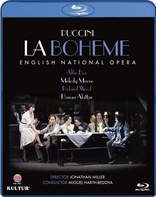

Movie rating
Movie has not been rated yetBlu-ray rating
| Users |  | 0.0 |
| Reviewer |  | 3.0 |
| Overall | | 3.0 |
Overview
Puccini: La Boheme (2010)
Starring: Roland Wood, Alfie Boe, Paul Putnins, Simon Butteriss, Melody MooreDirector: Robin Lough, Jonathan Miller
| Music | 100% |
Specifications
Video
Video codec: VC-1
Video resolution: 1080i
Aspect ratio: 1.78:1
Audio
English: LPCM 2.0
English: Dolby Digital 5.1
Subtitles
English
Discs
25GB Blu-ray Disc
Single disc (1 BD)
Playback
Region A (B, C untested)
Review
Rating summary
| Movie | | 3.0 |
| Video | | 3.0 |
| Audio |  | 4.0 |
| Extras | | 0.0 |
| Overall | | 3.0 |
Puccini: La Boheme Blu-ray Movie Review
Would una rosa in any other language still smell as sweet?
Reviewed by Jeffrey Kauffman June 18, 2010Do certain languages have intrinsic values which lend themselves to various subjects? Is the lilting expressionism of Italian ideally suited to the hyperbolic emotions of grand opera circa the nineteenth century? These may seem like rhetorical questions until one is confronted with an “accurate,” yet oddly stilted and emotionless, English language translation of Puccini’s ineffable La Bohème. How did audiences of yesteryear deal with operas not in their native languages? Were the cultured elite of Europe so multilingual that seeing Puccini one night and Wagner the next wouldn’t throw them for a loop, comprehension wise? The “language problem” has been a much-discussed issue in operatic circles certainly throughout the latter half of the 20th century, when houses started projection “supertitles” above the proscenium arch, or even installed small screens on the back of each chair so that the audience could “read along” in their native languages with what was being sung onstage. There have of course been many translations through the decades of various pieces, but often these attempts fall noticeably short of the mark, and one is left to wonder why. The answer really does seem to be that the original language, even if it is not the composer’s native language, is bound up part and parcel with the musical setting of the libretto, and altering the flow of syllables does something ironically incomprehensible that affects the “natural order” of any given opera. And so on the plus side, this La Bohème doesn’t require any “effort” from its English speaking audience to either read subtitles or glean intuitively what the characters are singing about. But that may or may not be an entirely good thing.
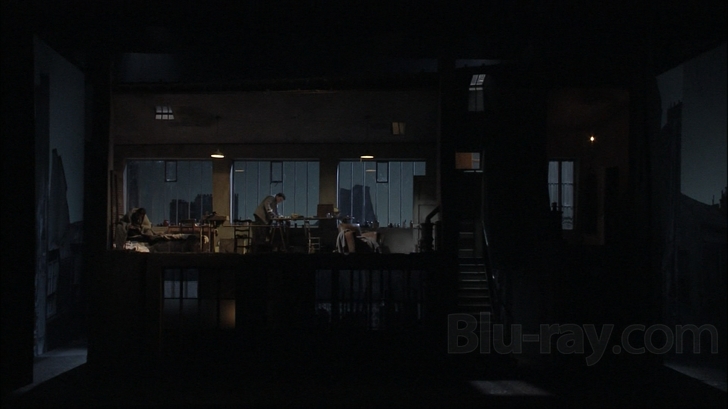
The loft set of this English language version of Puccini's masterpiece.
La Bohème is one of a very few operas which has seen its popularity grow exponentially through the intervening century-plus since its premiere. In fact, this particular piece’s cachet has skyrocketed over the past couple of decades due to Rent, the pop-rock update of its basic plot which took Broadway by storm, augmented perhaps by the suitably tragic Bohemian-esque death of its composer-lyricist Jonathan Larson the night before the show opened on the Great White Way. The heartrending, doomed from the beginning love affair between Rodolfo (Alfie Boe) and Mimi (Melody Moore) is the stuff of operatic legend by this time, and Puccini’s elegant mastery of orchestral accompaniment illuminating his character’s innermost thoughts and feelings probably reached its apex with this towering achievement.
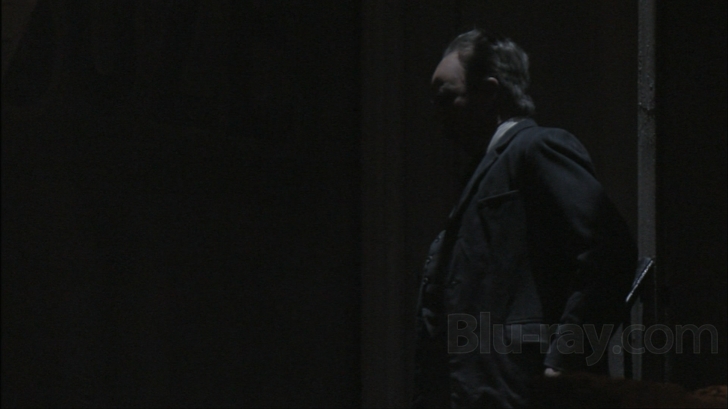
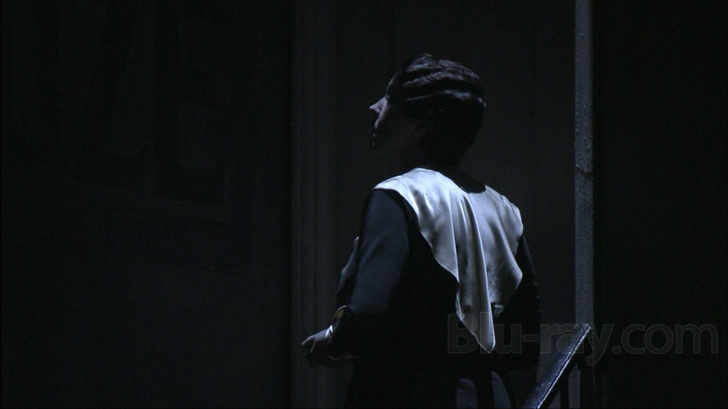
Which brings us to several odd decisions made with regard to this particular production. The English National Opera has always been the somewhat scraggly little sister to the more vaunted Royal Opera, and it has that typical propensity of a second child: it sometimes tries too hard. That would be the charitable explanation for this particular offering, for this Bohème’s heart seems to be in the right place, even if its head is somewhat addled. We have an almost incessantly dark stage throughout this presentation, which makes for a dour enough emotional set up, but which deprives us of a little thing like being able to actually clearly see the performers. There’s a very well done revolving set (by Isabella Bywater) gives us a rather cinematic version of scene changes, as one scene pretty much melts into the next as the set revolves to its next setup. And Miller, who has been a stalwart of ENO for three decades, hasn’t fussed too much with this iconic source material, other than of course to have it sung in English and transported forward in time several decades to the Paris of the 1930’s.
The biggest drawback here is the curiously unaffecting relationship between Rodolfo and Mimi. This is a love affair which must spark instantly and then erupt in a furious flame, only to be quickly doused as the ember of a tragic memory. Unfortunately there is simply no chemistry between Boe and Moore, making this an oddly chaste Bohème. The English press was especially up in arms that an American soprano would be flown to the ENO when there is a glut of capable English divas who could have easily tackled the role, but the problem here is not one of nationality. While Moore sings well enough, physically she’s an inartful choice for Mimi, too zaftig and healthily robust looking. Boe is often buried beneath the orchestra (part of which is due to the odd choice of playing everything extremely far upstage). Better are Hanan Alattar as the coy seductress Musetta and Roland Wood as a vigorous Marcello.
It’s some measure of this production’s odd casting choices that by far the most memorable turn in the four acts is the fidgety cameo by Simon Butteriss as landlord Benoit. He virtually walks away with the show in just a few minutes, while the rest of the cast struts and frets for what seems like hours. Miguel Harth-Bedoya never really fully rises to the occasion conducting the English National Opera Orchestra and Chorus, and the result is a too careful and somewhat tentative reading of one of the most passionate scores in the history of opera.
Puccini: La Boheme Blu-ray Movie, Video Quality
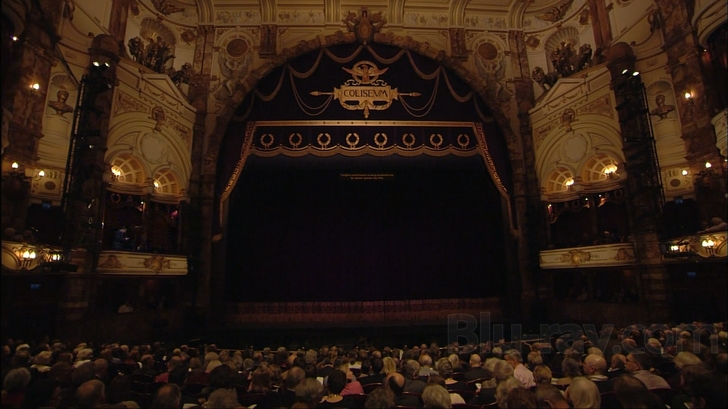
La Bohème is offered on Blu-ray from Kultur and Warner Classics with a VC-1 encoded 1080i "live" image in a 1.78:1 aspect ratio. This is a rather tubercular presentation, so to speak, pallid and often colorless, hampered by director Miller's odd decision to play the bulk of the opera in near darkness. Unfortunately this Blu-ray doesn't offer superior black levels or decisive enough contrast to cut through the murkiness, and the result is a rather soft, muddy image that resembles an upconverted SD-DVD. On the plus side, once we do get a brightly lit scene and are offered medium range shots to close-ups, there's some wonderful detail and nicely variegated color. It's never eye-popping or incredibly robust, but it at least shows that under the proper conditions this is at least a decent, if not stellar, looking BD.
Puccini: La Boheme Blu-ray Movie, Audio Quality
Kultur is still getting its feet wet in the Blu-ray line, and so we're offered a lossless stereo track via LPCM 2.0, but a lossy standard Dolby Digital 5.1. There's a noticeable extension of range in the LPCM 2.0, with Puccini's blistering brass and sumptuous strings sounding much more vibrant than in the strangely narrower sounding DD 5.1 mix. As noted above, Boe sometimes is lost in translation, so to speak, with the orchestra burying his solos. The rest of the singers cut through the orchestral mass quite easily and there are rarely any balance issues to report. The orchestra itself sounds marvelous, if the performance is certainly not going to make anyone's Top Ten lists. The 5.1 mix offers a decent amount of ambient hall reverb (from London's imposing Coliseum), but there's precious little surround activity and no really diverse directionality. If you check out this BD, stick with the LPCM 2.0 track for its more robust rendering of this iconic Puccini score.
Puccini: La Boheme Blu-ray Movie, Special Features and Extras
No supplements are included on this BD.
Puccini: La Boheme Blu-ray Movie, Overall Score and Recommendation

La Bohème needs passion and precision, and unfortunately those two elements are sadly lacking in this production. It's an interesting intellectual exercise to hear the piece sung in English, and the production design here is astoundingly effective, but some missteps in casting and a too subdued orchestra make this one Bohemian tragedy you can experience as a rental if you're interested enough.