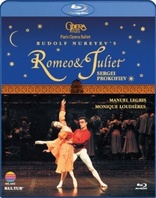
Prokofiev: Romeo & Juliet Blu-ray Movie
HomeProkofiev: Romeo & Juliet Blu-ray Movie 
Paris Opera BalletKultur | 1995 | 150 min | Not rated | Apr 27, 2010

Movie rating
6.6 | / 10 |
Blu-ray rating
| Users |  | 3.0 |
| Reviewer |  | 3.5 |
| Overall | | 3.3 |
Overview
Prokofiev: Romeo & Juliet (1995)
Manuel Legris, Monique Loudieres, Lionel Delanoe
Starring: Manuel Legris, Lionel Delanoe, Charles Jude, Monique Loudieres, Wilfried RomoliDirector: Alexandre Tarta
| Music | 100% |
Specifications
Video
Video codec: VC-1
Video resolution: 1080i
Aspect ratio: 1.78:1
Audio
English: LPCM 2.0
English: Dolby Digital 5.1
Subtitles
None
Discs
25GB Blu-ray Disc
Single disc (1 BD)
Playback
Region free
Review
Rating summary
| Movie | | 3.5 |
| Video | | 3.5 |
| Audio |  | 4.5 |
| Extras |  | 0.0 |
| Overall | | 3.5 |
Prokofiev: Romeo & Juliet Blu-ray Movie Review
Rudolf Nureyev famously danced the role of Romeo with the Royal Ballet. This new Blu-ray offers his own choreographic interpretation of the piece.
Reviewed by Jeffrey Kauffman May 5, 2010Ballet news rarely if ever makes the front pages of the newspaper or the top of the evening newscasts, but that’s pretty much exactly what happened in 1961 when famed Kirov dancer Rudolf Nureyev defected to the West while in Paris. Those were the days of the Cold War, of Nikita Kruschev pounding his shoe at the United Nations as he threatened to “bury” the United States and its allies, of the Berlin Wall and the Cuban Missile Crisis. Though we live in an age of perhaps much greater threats these days, they seem somehow less visceral than the Soviet Union’s menacing attitude did back in what was ostensibly a more quaint, prim and proper time. Nureyev had quickly become a star with the Kirov, and his defection was seen as a personal affront by Kruschev, who in fact ordered the assassination of the dancer. Luckily, those nefarious plans never were realized, and Nureyev became perhaps the biggest dancing star of his generation, soon paired with Margot Fonteyn in a series of iconic performances at London’s Royal Ballet. While there, Nureyev was no doubt quickly introduced to the Royal Ballet’s beautiful version of Romeo and Juliet choreographed by Kenneth MacMillan (recently released on a Decca Blu-ray which I reviewed here), which Nureyev in fact danced with Fonteyn in 1965 in one of the most spectacularly successful productions in that company's long and lauded history. Not content to merely dance, however, Nureyev went on to a halting screen career (including the title role in Ken Russell’s Valentino), and also flexed his own choreographic muscles in a number of pieces, including his own take on Shakespeare’s most famous romantic tragedy.
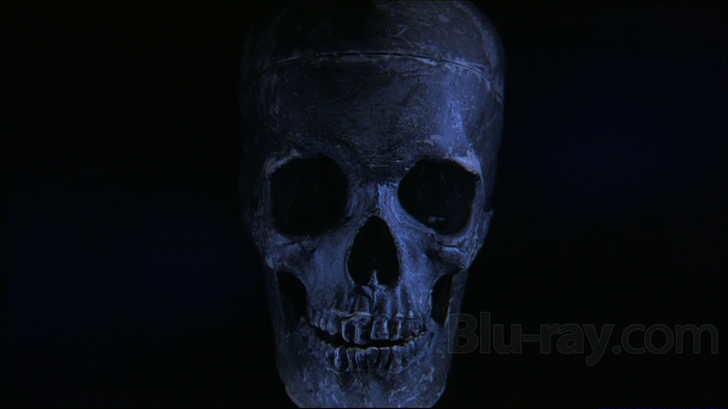
Images of death haunt this production.
Nureyev left the Royal Ballet in the early 1980’s to work for the bulk of the rest of his career with the Paris Opera Ballet, the company which performs on this Blu-ray from Kultur (in conjunction with Warner Classics). Nureyev paints a fairly bleak picture with his Romeo and Juliet, beginning the ballet with a funeral procession and rarely if ever letting up from images of death and destruction for the next two and a half hours. Unlike MacMillan’s take, which is about as classically restrained and balanced, chaste even (considering the subtext), Nureyev’s vision boomerangs between death and sex, perhaps the two biggest bugaboos haunting mankind’s collective Id. While Nureyev himself danced Romeo in his own version, he later became Director of the Paris Opera Ballet, reworking his choreography, and actually cast Monique Lourdières as Juliet as early as 1984, the role which she repeats here in this recording made in July 1995 as a sort of requiem honoring Nureyev’s death from AIDS in 1993. Loudières is not the only direct link to Nureyev in this production, as Nureyev’s own conducting protégé, Vello Pähn, helms the orchestra here.
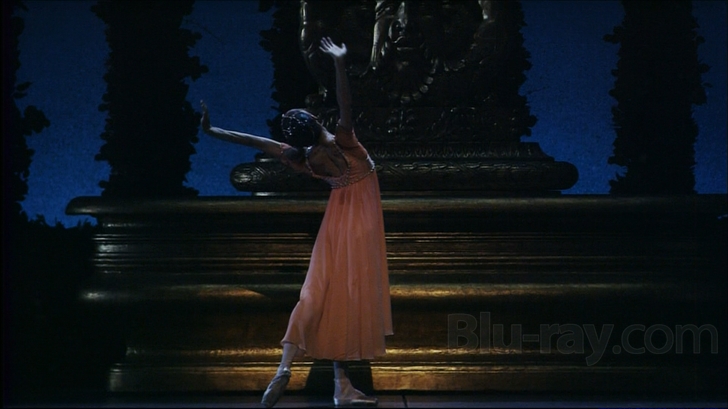
This is a sumptuous production, featuring eye popping sets and costumes by Ezio Frigerio (with assistance on the costumes by Mauro Pagano). Completely redolent of Renaissance Verona, the physical production at least is gorgeous, with an abundance of color and flash. The dancing and orchestral playing is often quite fiery, with a nicely supple Loudières finding her match in the sheer physicality of Manuel Legris’ Romeo. Where this production goes somewhat astray is in the direction for television by Alexandre Tarta, which cuts too often to give coherence to Nureyev’s various mises en scène. Instead there’s a sort of chaotic undercurrent which keeps the piece from becoming organic or achieving the tragic momentum it needs to lead the audience to an expected catharsis by the end of the third act. The stage lighting here is also somewhat lacking, casting an ugly purple tint to a lot of the flesh tones and leaving large areas of the stage swathed in darkness.
Nonetheless, this is an important historical document, memorializing an iconic dancer’s own very unique interpretation of one of the glories of 20th century ballet. As I mentioned in my review of the Decca Blu-ray MacMillan Royal Ballet version, it’s perhaps hard to realize how relatively recently Prokofiev’s adaptation of Shakespeare’s enduring classic has become a classic in its own right. In fact it probably wasn’t until Nureyev and Fonteyn danced the titular roles that the world en masse pricked up their ears and finally realized what a gargantuan achievement Prokofiev’s score really was. If MacMillan’s version is still the one to beat, as it were, Nureyev brings a fiercer, decidedly Russian bent to the piece, perhaps sacrificing some of MacMillan’s nuance but gaining a sort of youthful vigor that is actually reminiscent of the famous Zeffirelli film version of Romeo and Juliet, one which cast age appropriate actors in the role for the first time in cinema history, and a production which evidently was hugely influential on Nureyev himself. If Loudières and Legris are at least a bit longer in tooth than Hussey and Whiting were in 1968 when they made the famous film version, there’s still the aching call of two young lovers being thrust into adult decisions too soon for their own good which runs brilliantly through Nureyev’s version.
There really hasn’t been anyone to pick up Nureyev’s baton since his passing, though of course some might think of Baryshnikov as the likely heir to the mantle. This Romeo and Juliet at the very least captures the vision of one of the iconic dancers of the 20th century and memorializes it for future generations. That may not be front page news, but it’s an important story nonetheless.
Prokofiev: Romeo & Juliet Blu-ray Movie, Video Quality
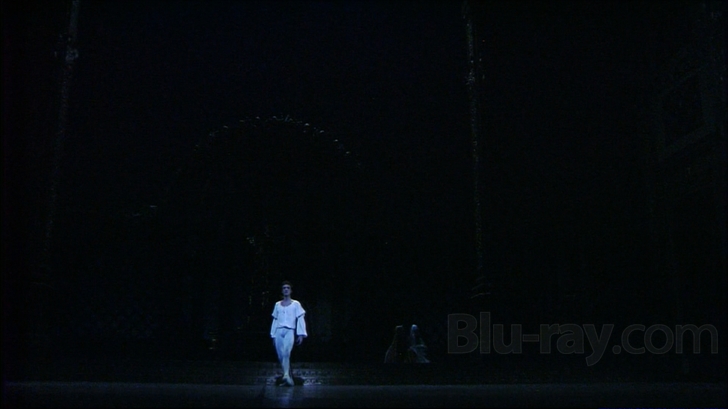
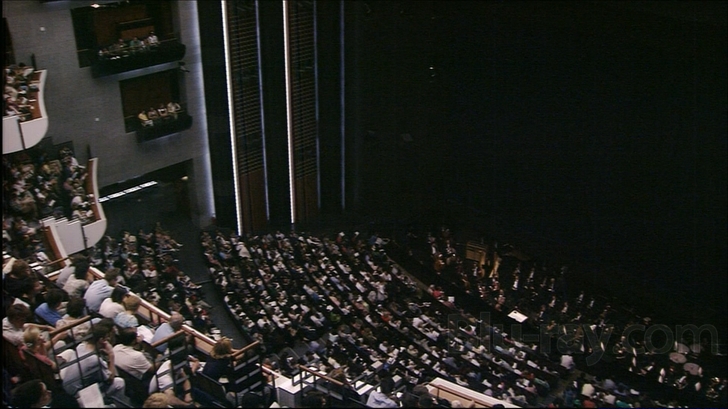
Romeo and Juliet arrives on Blu-ray from Kultur, in conjunction with Warner Classics, in a middling to good "live" 1080i 1.78:1 transfer delivered via a VC-1 codec. Part of the problem with this Blu is the odd and off-putting stage lighting, which too frequently bathes the players in an unnatural and unflattering purple tint. More than that, though, the Blu is plagued by a lot of softness and lack of contrast, especially in the darker segments shot from midrange. In these darker moments, blacks are more often than not crushed, leaving everything awash in a muddy inchoate mess. Faces are hard to distinguish and the gorgeous details of the sumptuous costumes are also lost in the muddle. On the other hand, when we are greeted by a brightly lit sequence, especially those shot closer up, the Blu finally reveals its high def potential, with some excellent fine detail, especially in the sets and costumes. Combing artifacts occasionally crop up in some of the faster dance sequences, but you have to look sharp to catch them.
Prokofiev: Romeo & Juliet Blu-ray Movie, Audio Quality
Two audio options are offered, a lossless LPCM 2.0 and a standard Dolby Digital 5.1 mix. I actually preferred the lossless 2.0 mix, despite its lack of surround channels, simply to experience the lushness of Prokofiev's writing with no veneer coming in between. Despite being "only" stereo, this is a relatively spacious mix that preserves Prokofiev's often dense orchestral palette and delivers sparkling fidelity and excellent range. The DD 5.1 mix is fine, though the admittedly beautiful surround ambience is tempered somewhat by a compressed sounding extreme high and low register. The orchestral performance is first rate here, with a lot of flash and range, and both tracks capture that extremely well.
Prokofiev: Romeo & Juliet Blu-ray Movie, Special Features and Extras
No extras are included on the disc, and there was no insert booklet on the review screener provided to me.
Prokofiev: Romeo & Juliet Blu-ray Movie, Overall Score and Recommendation
I'd probably opt for the Decca MacMillan version if I were to be limited to only one Romeo and Juliet. That said, this is an often scintillating performance, and should be seen by any lover of ballet wanting to experience Nureyev's own idiosyncratic take on one of the most iconic ballets in the 20th century repertoire.