Prime Suspect: The Complete Collection Blu-ray Movie
HomePrime Suspect: The Complete Collection Blu-ray Movie 
Acorn Media | 1991-2006 | 7 Seasons | 1566 min | Not rated | Aug 27, 2013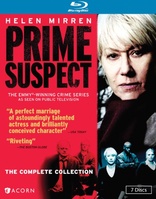

Movie rating
Movie has not been rated yetBlu-ray rating
| Users |  | 4.5 |
| Reviewer |  | 4.0 |
| Overall | | 4.0 |
Overview
Prime Suspect: The Complete Collection (1991-2006)
Detective Jane Tennison rises through the ranks of Britain’s Metropolitan Police, solving horrific crimes while battling office sexism and her own demons.
| Drama | 100% |
| Crime | 30% |
| Mystery | 26% |
Specifications
Video
Video codec: MPEG-4 AVC
Video resolution: 1080p
Aspect ratio: 1.78:1, 1.33:1
Original aspect ratio: 1.78:1, 1.33:1
Audio
English: DTS-HD Master Audio 2.0
Subtitles
English SDH
Discs
50GB Blu-ray Disc
Seven-disc set (7 BDs)
Packaging
Slipcover in original pressing
Playback
Region A (B, C untested)
Review
Rating summary
| Movie | | 4.5 |
| Video | | 4.0 |
| Audio |  | 3.5 |
| Extras |  | 1.0 |
| Overall | | 4.0 |
Prime Suspect: The Complete Collection Blu-ray Movie Review
She's Not the Bloody Queen!
Reviewed by Michael Reuben August 23, 2013Helen Mirren may have won her Oscar for playing Queen Elizabeth II, but it was the role of London police detective Jane Tennison in Prime Suspect that made her a household name in America and an international star. Already a familiar face in the U.K. for stage, TV and film work, Mirren was known abroad in 1991 primarily for roles in Excalibur, 2010 and White Nights. (Arthouse denizens also knew her from such rarefied fare as The Comfort of Strangers and The Cook, The Thief, His Wife and Her Lover.) But when PBS began broadcasting Prime Suspect in January 1993, Mirren became a pop culture icon, and her reputation grew as succeeding chapters of Tennison's exploits appeared over the next four years. Prime Suspect took a seven-year break, but in 2003 Tennison returned to TV screens for two more investigations. Her Final Act was released in 2006, the same year as The Queen. Television had seen its share of female cops, but no one had ever encountered a character like Tennison. Prime Suspect's creator Lynda La Plante was inspired to invent her upon discovering that, as of the early Nineties, only four women had risen to the level of Detective Chief Inspector (or "DCI"). La Plante's meticulous research brought Prime Suspect the acclaim of London's Metropolitan Police, who praised the series for the accuracy of its portrayal of police work. But it was Mirren's vanity-free incarnation of Tennison—without glamorous hair and makeup, in wardrobe that a civil servant could actually afford, with no attempt to sand off the character's rough edges or make her "likable"—that really set Prime Suspect apart. Like the officers under her command, viewers didn't always like Tennison, but there was never any doubt that they respected her. Prime Suspect attracted an impressive array of talent, often before the participants became better known. Supporting players included Ralph Fiennes and Tom Wilkinson (Series 1); Ciarán Hinds, Peter Capaldi and David Thewlis (Series 3); Mark Strong (Series 3 and 6); and Eve Best (Series 7). The show's directors included John Madden (Series 4.1) before he directed the Oscar-winning Shakespeare in Love, and Tom Hooper (Series 6) before he won an Oscar for directing The King's Speech. Acorn Media has previously released each separate "series" of Prime Suspect on DVD, followed by a complete collection. On Blu-ray, they are releasing the complete collection in a seven-disc set. The series has been remastered from the best available elements, and there are issues raised by the remastering that are separately addressed below in the "Video" section.
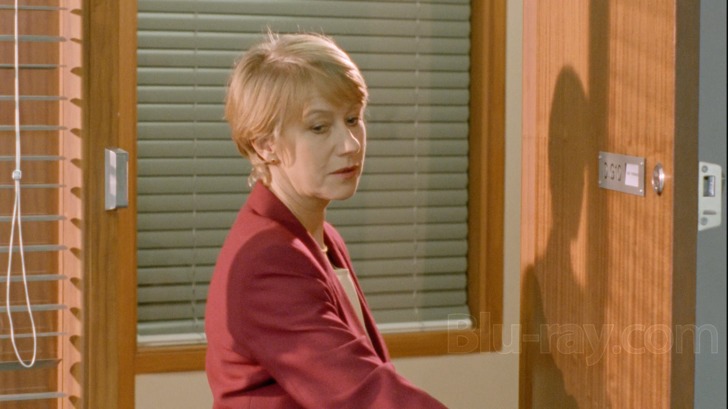
For detailed discussion of Series 1, please see the Series 1 Blu-ray review. For detailed discussion of Series 2, please see the Series 2 Blu-ray review. For detailed discussion of Series 3, please see the Series 3 Blu-ray review. For detailed discussion of Series 4, please see the Series 4 Blu-ray review. For detailed discussion of Series 5, please see the Series 5 Blu-ray review. For detailed discussion of Series 6, please see the Series 6 Blu-ray review. For detailed discussion of Series 7, please see the Series 7 Blu-ray review.
Prime Suspect: The Complete Collection Blu-ray Movie, Video Quality
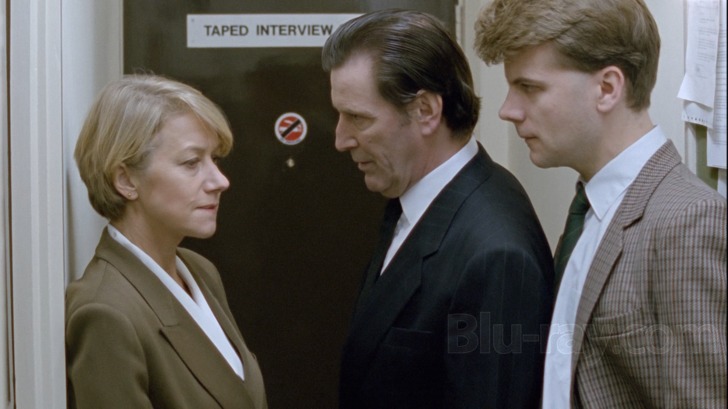
Contrary to the "Technical Specs" at IMDb listing "35mm" as the shooting format for various series of Prime Suspect, the series was shot in Super16, which was the common standard for British television prior to the advent of HD capture. Even the most recent series were shot on film, presumably for continuity. The restoration for this Blu-ray set was performed by British facility JCA, which commented that "the drama was . . . delivered to us in a number of formats that were not suitable for distribution. By hand painting and applying grain treatments in a delicate manner, we managed to get an HD master of a similar quality to a 35mm film production." Each of the seven discs in the Complete Collection opens with the following disclaimer:
This Blu-ray was created from a high-definition transfer and restoration of the original program elements. While it represents a vast improvement in picture quality and level of detail over previous releases or transmissions, viewers may notice variable quality due to the inherent limitations and age of the original elements.Having viewed all seven discs, I would say that the disclaimer is closer to the mark than JCA's assertion of "similar quality" to 35mm film. Nevertheless, anyone who has only experienced Prime Suspect on DVD will find these Blu-ray presentations a quantum leap in image quality, though obviously less than one would expect from a contemporary production shot on hi-def video. Separate video evaluations and screen captures are included with each individual series review (see links below). However, a critical issue equally applies to the first five series of Prime Suspect, which is their aspect ratio. In America, Series 1 through 5 were originally broadcast in the old standard TV format of 1.33:1. For their Blu-ray presentation, production company ITV has had these series transferred to HD at 1.78:1 (with the exception of part 1 of Series 4, "The Lost Child", for which the original film elements were missing). However, the change in aspect ratio involved only minimal cropping at the top and bottom. Instead, substantial—very substantial—picture information was added at the left and right. This is consistent with the use of Super16 photography, which, like Super35, produces a negative that is more rectangular than square. I have included comparative examples from Acorn Media's DVD set of Prime Suspect with each individual review; for ease of reference, several have been copied to this review. The frame matches are not perfect, which is almost impossible to achieve because of the new mastering, but they are close. Note, as well, that the DVD image has been slightly squeezed; this practice was not uncommon on DVD to compensate for television overscan. Did the creators of Prime Suspect anticipate that the first five series would someday be presented in the wider 16:9 frame? It's certainly conceivable, and the cropped framing in many shots of the 1.33:1 presentation suggests that at least some of the directors intended a wider composition. By 1991, when Series 1 premiered, the HDTV standard had already been established, even though no home broadcasts had yet commenced. The fact that the outer edges of the frame were "protected" from intrusions by equipment and crew, thus allowing inclusion of these areas in the HD transfer, suggests that everyone involved with Prime Suspect was aware of the need to ensure the usability of the image's full width. (Note: Since the initial publication of this review, I have been advised that Series 2 through 5 were shown in the U.K. at 14:9, which was the compromise aspect ratio used by some broadcasters during the transition to HDTV.) From a "purist" position, one could simply insist that Prime Suspect be presented in the aspect ratio in which it was originally shown, as Acorn Media has done with the first six series of Poirot and such early productions as Brideshead Revisited and Tinker Tailor Soldier Spy. But Acorn Media does not make these decisions. It is supplied with master tapes by its licensors, and ITV has obviously decided that all seven series should be presented at 1.78:1, utilizing the full width of the Super16 frame (again, with the exception of Series 4, part 1, due to technical limitations). Like it or not, this is the presentation of Prime Suspect that ITV was willing to pay to have restored. (Note that Series 6 and 7 have always been 1.78:1.) Some shots of Series 4 and especially Series 5 appear to be blowups from a source of lower resolution that lacks the full width of the original negative. These shots have been cropped to fit the 1.78:1 frame, blown up and electronically massaged to fit into the hi-def master as best as possible. This was presumably done to replace damaged portions of the negative. The effect is similar to watching a film restoration where portions have been taken from prints, dupes or other lesser sources. It's unfortunate that better sources could not be found for these shots, but after viewing the upconverted Series 4, part 1, I am more than happy to settle for these relatively minor defects in parts 2 and 3 and Series 5. I saw every Prime Suspect on its initial U.S. broadcast, and I have seen several different DVD versions over the years. Except for "The Lost Child", which shows only minor improvement over the DVD presentation, the Blu-ray presentation is such a vastly superior viewing experience that I cannot imagine why any fan of the series would want to watch anything else. The Blu-rays certainly have their issues, but for the most part they are well-framed, reveal more image, are generally better composed, have superior resolution, color, contrast and brightness and are overall easier to watch and understand visually. One additional point needs to be emphasized. Several reviewers new to Prime Suspect have spoken of its having a "film noir" style. This demonstrates the fallacy of using DVD images as a reference. From the very beginning, Prime Suspect was intended—and admired—as a realistic depiction of the daily routine of police work, made dramatic by filtering that routine through the viewpoint of a distinctive character. The subject matter under investigation was dark, but the style was intended to be matter-of-fact. There was nothing "noirish" about the show in its original presentation or its initial broadcast. Any attempt to recast Prime Suspect as "film noir" would constitute a form of revisionism less informed and more insidious than any change in aspect ratio. For further discussion and screenshots of Series 1, please see the Series 1 Blu-ray review. First Broadcast: April 7-8, 1991 (U.K.); January 23, 1992 (U.S.). For further discussion and screenshots of Series 2, please see the Series 2 Blu-ray review. First Broadcast: December 15-16, 1992 (U.K.); February 11, 1993 (U.S.). For further discussion and screenshots of Series 3, please see the Series 3 Blu-ray review. First Broadcast: December 19-20, 1993 (U.K.); April 28, 1994 (U.S.). For further discussion and screenshots of Series 4, please see the Series 4 Blu-ray review. First Broadcast: April 30, May 7, 15, 1995 (U.K.); October 22, 1995, February 11, May 5, 1996 (U.S.). For further discussion and screenshots of Series 5, please see the Series 5 Blu-ray review. First Broadcast: October 20, 1996 (U.K.); February 9, 1997 (U.S.). For further discussion and screenshots of Series 6, please see the Series 6 Blu-ray review. First Broadcast: November 9-10, 2003 (U.K.); April 18, 2004 (U.S.). For further discussion and screenshots of Series 7, please see the Series 7 Blu-ray review. First Broadcast: October 15, 22, 2006, (U.K.); November 12, 19, 2006 (U.S.).
Prime Suspect: The Complete Collection Blu-ray Movie, Audio Quality
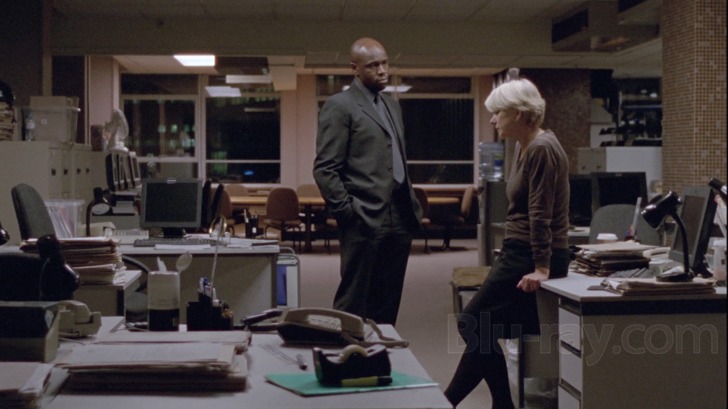
For discussion of Series 1's audio, please see the Series 1 Blu-ray review. For discussion of Series 2's audio, please see the Series 2 Blu-ray review. For discussion of Series 3's audio, please see the Series 3 Blu-ray review. For discussion of Series 4's audio, please see the Series 4 Blu-ray review. For discussion of Series 5's audio, please see the Series 5 Blu-ray review. For discussion of Series 6's audio, please see the Series 6 Blu-ray review. For discussion of Series 7's audio, please see the Series 7 Blu-ray review.
Prime Suspect: The Complete Collection Blu-ray Movie, Special Features and Extras
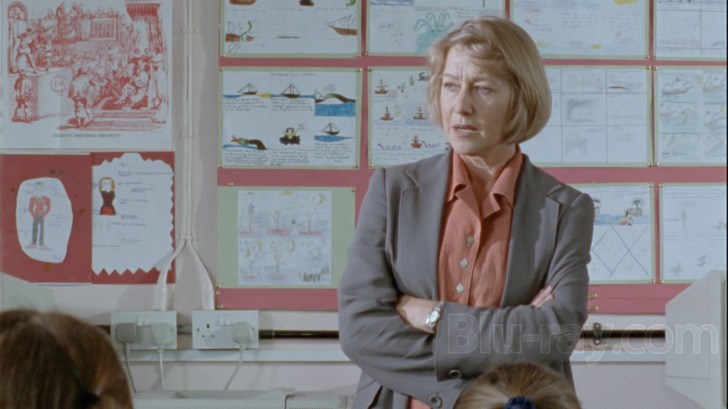
- Behind-the-Scenes Feature (disc 6) (1080i; 1.78:1; 23:15): This promotional featurette was obviously intended to introduce Tennison to a new audience after a seven-year hiatus. It contains interviews with actors Mirren, Miles and Pugh and director Hooper, among many others, and shows the production shooting for Series 6 in and around London and on set. Warning: Spoilers galore!
- Prime Suspect: Behind the Scenes (disc 7) (1080i; 1.78:1; 46:00): This series retrospective was made to be released in conjunction with Series 7, The Final Act. It contains clips, and interviews with participants, from both Series 7 and previous series (and, as a result, contains spoilers for anyone new to Prime Suspect). Probably the most interesting and important participant, other than Mirren herself, is Jackie Malton, the former DCI whose experiences provided the raw material for the character of Jane Tennison and who, as Mirren explains, provided valuable insight into a female DCI's behavior. Notably missing in action is series creator Lynda La Plante.
- Photo Gallery (disc 7) (1080p; various; 3:33): This set of production stills is from The Final Act.
- Introductory Trailers: Each disc plays a different Acorn Media trailer at startup. The presence of a separate trailer on each disc suggests the possibility that they may someday be issued individually.
- Disc 1: Vera
- Disc 2: Miss Fisher's Murder Mysteries
- Disc 3: Falcón
- Disc 4: Jack Taylor
- Disc 5: Case Histories
- Disc 6: Murdoch Mysteries
- Disc 7: Single-Handed
Prime Suspect: The Complete Collection Blu-ray Movie, Overall Score and Recommendation
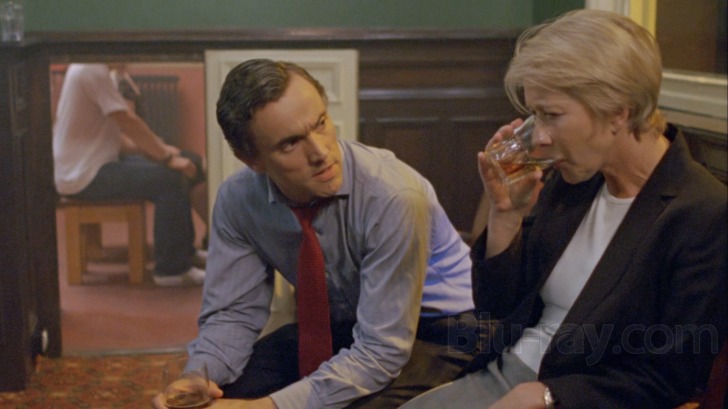
In an oft-noted irony, Tennison routinely objects to being addressed as "ma'am", because "I'm not the bloody Queen!", but Prime Suspect made Mirren show business royalty. It eventually won her two Emmies and three BAFTAs, and it didn't hurt The Queen's Oscar campaign, which was just shifting into high gear as Prime Suspect finished its 15-year run. Jane Tennison's career would go through many phases, and Mirren's fame rocketed to new heights as Prime Suspect circled the globe. As much as she feared typecasting, Mirren kept returning to Tennison, because she couldn't resist either the character or the quality of the scripts—and because of Mirren, first-rate supporting casts and crews followed. Prime Suspect ranks at the top of British TV drama, but until now it has only been available in dark, dingy, sometimes barely visible DVD versions. This new Blu-ray set has its imperfections, but it represents so vast an improvement as to constitute a rediscovery of the show, even for existing fans. It's an expensive set; so feel free to use Blu-ray.com's "price tracking" tool to wait for a bargain. But by all means, put it on your "must buy" list.