Primary Colors 4K Blu-ray Movie
HomePrimary Colors 4K Blu-ray Movie 
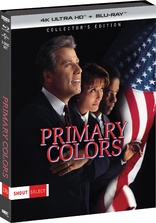
4K Ultra HD + Blu-rayShout Factory | 1998 | 143 min | Rated R | Jul 01, 2025

Movie rating
6.7 | / 10 |
Blu-ray rating
| Users |  | 0.0 |
| Reviewer |  | 4.0 |
| Overall | | 4.0 |
Overview
Primary Colors 4K (1998)
Jack Stanton (Travolta) is a virtually unknown Southern governor on a quest for the White House with his strong, savvy and equally ambitious wife, Susan (Thompson). Running against the odds, the Stantons need all the help they can get from their extremely colorful political team. Together, they take off on a hilarious, heart-wrenching and ultimately history-making roller coaster ride to the top.
Starring: Adrian Lester, John Travolta, Emma Thompson, Billy Bob Thornton, Kathy BatesDirector: Mike Nichols (I)
| Drama | Uncertain |
| Comedy | Uncertain |
Specifications
Video
Video codec: HEVC / H.265
Video resolution: 4K (2160p)
Aspect ratio: 2.39:1
Original aspect ratio: 2.39:1
Audio
English: DTS-HD Master Audio 5.1 (48kHz, 24-bit)
English: DTS-HD Master Audio 2.0 (48kHz, 24-bit)
Subtitles
English SDH
Discs
Blu-ray Disc
Two-disc set (2 BDs)
4K Ultra HD
Packaging
Slipcover in original pressing
Playback
Region A (locked)
Review
Rating summary
| Movie | | 4.0 |
| Video |  | 4.5 |
| Audio | | 4.0 |
| Extras |  | 3.5 |
| Overall | | 4.0 |
Primary Colors 4K Blu-ray Movie Review
Reviewed by Dr. Stephen Larson July 23, 2025Mike Nichols's sixteenth feature Primary Colors (1998) was covered by my colleague Marty Liebman nearly six years ago. To read Marty's views of the film and his evaluation of the old Blu-ray's a/v transfers, please refer to his critique of Universal's 2019 BD-50.
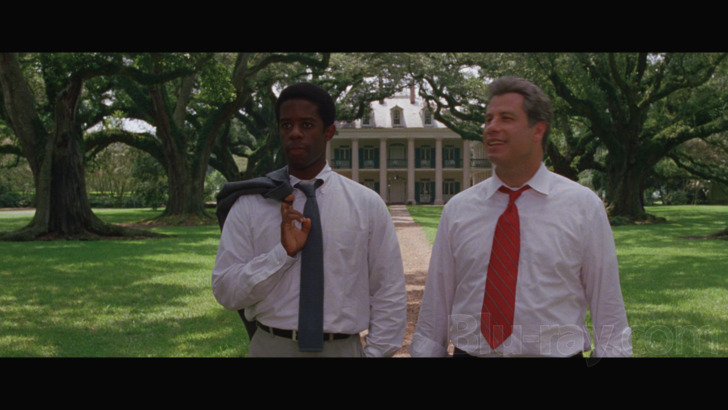
Henry with Gov. Stanton.
Primary Colors 4K Blu-ray Movie, Video Quality
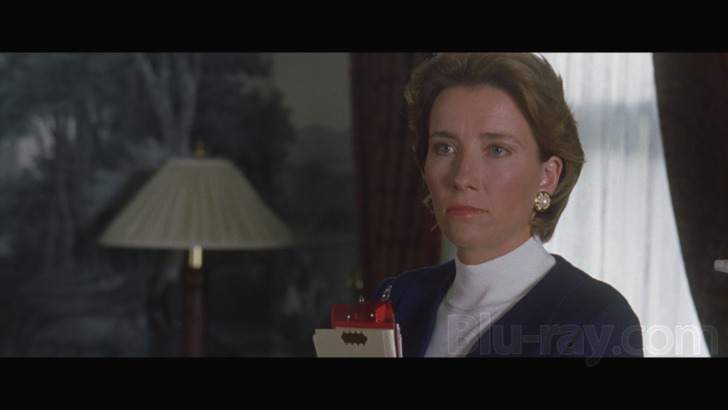
Shout Select's two-disc "Collector's Edition" has arrived as a 4K Ultra HD Blu-ray + standard Blu-ray combo that comes with a slipcover featuring identical artwork as what's in the sleeve. The transfers are based on a 4K restoration made from the original camera negative. The UHD is presented in Dolby Vision (HDR10 compatible). Marty described the 2019 presentation as a DVD-era upscale. Shout's release underwent a meticulous restoration. It appears in its original theatrical exhibition ratio of 2.35:1. The image is clean and sharp. I couldn't spot any speckles, tears, scratches, dirt, or any other debris. I could see grain in the darker scenes and even where whites are present. I also watched MCA/Universal's non-anamorphic LaserDisc. I scrutinized the 4K and most recent Blu-ray transfers. The first half of Primary Colors features a lot of night scenes that are meant to underscore the long and grueling hours a staff puts in for a presidential primary campaign. There are a high number of shots photographed in the evening hours when, for example, lamps in the hotel are the chief sources of light. I feel that SDR on a regular Blu-ray is better able to handle those type of conditions. The D.V. and the HDR on the UHD look fine but the drab colors and dim lights restrict the sense of depth and pop-out effects. The 4K fares better during the second half when there's more daylight scenes. Also, the backdrops and backgrounds behind the characters are attractively presented (see Screenshot #s 1, 21, and 31). You'll notice there are several shots of the campaign watching TV. Close-ups of screens are clear and relatively sharp (see frame grab #11). The picture was shot by the great cinematographer Michael Ballhaus. He makes a nice homage to Edward Hopper when the camera gradually pulls into the exterior of a Krispy Kreme shop (see screen capture #s 38-40).
The UHD uses a triple-layered disc (feature size: 86.0 GB). It sports a mean video bitrate of 77.4 Mbps and an overall bitrate of 85.8 Mbps for the whole disc. The MPEG-4 AVC-encoded BD-50 boasts an average video bitrate of 27995 kbps. My video score for the 4K is 4.25/5.00.
Screenshot #s 1-25, 28, 31, 34, 37, & 40 = Shout Select 2025 4K Ultra HD BD-100 (downscaled to 1080p)
Screenshot #s 26, 29, 32, 35, & 38 = MCA/Universal Home Video 1998 LaserDisc (Widescreen Edition) (upscaled to 720p)
Screenshot #s 27, 30, 33, 36, & 39 = Shout Select 2025 BD-50 (based on 4K restoration)
Shout gives the 143-minute film just eleven chapter stops.
Primary Colors 4K Blu-ray Movie, Audio Quality

Shout supplied a DTS-HD Master Audio 5.1 Surround mix (3407 kbps, 24-bit) and a DTS-HD Master Audio 2.0 Stereo track (1653 kbps, 24-bit). Primary Colors was recorded and mixed in Dolby Digital, DTS, and DTS Stereo. This is probably the same 5.1 track included on Universal's Blu-ray. I concentrated on the 2.0 mix, which I listened to twice. I compared it to the Dolby Surround 2.0 track presented in PCM 2.0 stereo on the LaserDisc. Shout's stereo track is legitimate and not a mix down of the 5.1. The LD's 2.0 and Shout's 2.0 sound similar. Surround channels are only sometime active. For instance, the opening cue "Camptown Races" by Stephen Foster presents a militaristic march that immediately gets the satellite speakers going. But they are only used on occasion thereafter. I could also hear them when "Battle Hymn of the Republic," "On the Road Again," and "Still the One" are performed. Composer Ry Cooder also contributes a lot to the other musical cues. Besides writing them, he plays guitar. I would rate the tracks "Not the Best People" and "Don't Break Our Hearts" on MCA's soundtrack album the best on disc and finest underscore in the film. Cooder's use of piano is affective and touching.
I watched Primary Colors with the optional English SDH switched on. They deliver a complete and thorough transcription of all the dialogue and sound f/x. The only word missing in a line of dialogue was a "that."
Primary Colors 4K Blu-ray Movie, Special Features and Extras
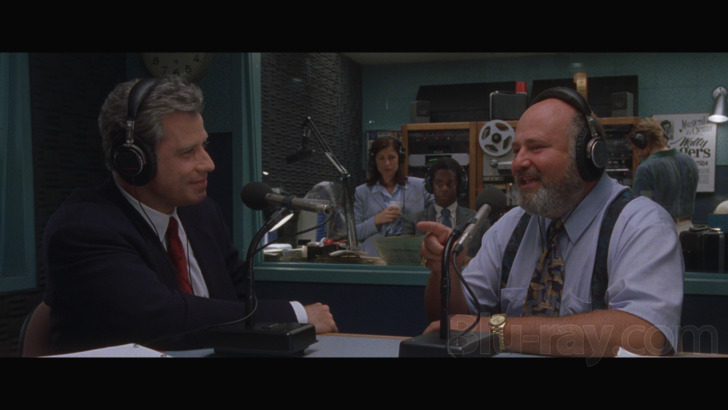
None of Universal's home video releases contained any extras. Shout has recorded a recent commentary track and three new interviews.
DISC ONE: 4K ULTRA HD
- NEW Audio Commentary with Film Critic Drew McWeeny and Elaine May Biographer Carrie Courogen - this feature-length track is dominated by McWeeny, who often acts as a moderator. He and Courogen spend the first and other parts of the commentary discussing figures in the Clinton administration in relation to Primary Colors's ensemble of characters. McWeeny delves into the role technology plays in the film's story. He also compares how American political discourse has changed from the late '90s through the present day. The commentators deliver analysis of some scenes. While one can claim that McWeeny talks too much, he frequently has to cover dead air on the track. Indeed, there are several brief gaps throughout. While Courogen will occasionally tout how a scene is written or a bit of dialogue is classic May, she really doesn't discuss any of her other works. This is very surprising since she recently completed a biography of May last year. So one would assume she'd have a large frame of reference to draw comparisons upon between Primary Colors and May's screenplays, teleplays, and scripts for theatre. Unfortunately, none of that is present here. McWeeny queries her about a scene that was written and later dropped. While Courogen recalls reading about it, she can't remember if it was actually filmed. (McWeeny's memory about this seems more reliable.) More, Courogen will often agree with McWeeny's observations but fails to explain why. Towards the end, he asks her if Nichols and May had any other collaborations planned post-Primary Colors. Courogen responds that they developed "some things" together afterward but doesn't offer any specifics. McWeeny and Courogen speak till halfway thru the closing credits. In English, not subtitled.
DISC TWO: BLU-RAY
- NEW Audio Commentary with Film Critic Drew McWeeny and Elaine May Biographer Carrie Courogen - this feature-length track is dominated by McWeeny, who often acts as a moderator. He and Courogen spend the first and other parts of the commentary discussing figures in the Clinton administration in relation to Primary Colors's ensemble of characters. McWeeny delves into the role technology plays in the film's story. He also compares how American political discourse has changed from the late '90s through the present day. The commentators deliver analysis of some scenes. While one can claim that McWeeny talks too much, he frequently has to cover dead air on the track. Indeed, there are several brief gaps throughout. While Courogen will occasionally tout how a scene is written or a bit of dialogue is classic May, she really doesn't discuss any of her other works. This is very surprising since she recently completed a biography of May last year. So one would assume she'd have a large frame of reference to draw comparisons upon between Primary Colors and May's screenplays, teleplays, and scripts for theatre. Unfortunately, none of that is present here. McWeeny queries her about a scene that was written and later dropped. While Courogen recalls reading about it, she can't remember if it was actually filmed. (McWeeny's memory about this seems more reliable.) More, Courogen will often agree with McWeeny's observations but fails to explain why. Towards the end, he asks her if Nichols and May had any other collaborations planned post-Primary Colors. Courogen responds that they developed "some things" together afterward but doesn't offer any specifics. McWeeny and Courogen speak till halfway thru the closing credits. In English, not subtitled.
- NEW Interview with PRIMARY COLORS Author Joe Klein (23:02, 1080p) - Klein discusses his novel in some detail. He also explains his decision to publish his book anonymously. In addition, he goes into the "game" he played with his wife while writing Primary Colors. He then spends some time on unanticipated decisions that the characters make. Moreover, Klein recalls luncheons he enjoyed with Elaine May and Mike Nichols. He lays out the differences between his novel and the film. Klein shares his observations on Travolta, Adrian Lester, Kathy Bates, and Billy Bob Thornton. He gives a brief recollection of viewing a rough cut, composer Ry Cooder, and his favorite scenes in the movie. Also of note are the anecdotes he makes about the publishing world in the late '90s. Finally, Klein explains what he thinks the audience should take away from this work. In English, not subtitled.
- NEW Interview with Actor Paul Guilfoyle (24:00, 1080p) - Guilfoyle recalls an unnamed play he performed with Elaine May in the early '80s and resumed working on in the following decade. He spends considerable time talking about Mike Nichols and his preparation process (e.g., script read-throughs and open rehearsals). He reminisces about working with Thornton. Guilfoyle shares at least one real-life individual his character of Howard Ferguson is based on. Particularly interesting is his extrapolation on what a "momentum scene" entails and how Nichols would direct it. In English, not subtitled.
- NEW Interview with Actor Adrian Lester (38:21, 1080p) - the British thespian recalls when he first met Mike Nichols and the initial audition he gave for him prior to The Birdcage (1996). Lester details his impressions upon reading the script for Primary Colors. While making the film, he said this was his introduction to how politics is played out in America. Lester reveals the reactions journalists had to a reply Nichols gave to one of their questions at a press junket. Lester also describes what it was like on set and the rehearsal process. He delivers anecdotes about Emma Thompson (i.e., working with her and the different takes she did for one scene), a moment he shared with Diane Ladd at a dinner, and his recollections of a scene he did with Allison Janney. Lester briefly explains how he put on a clean American accent. He offers his favorite scenes in the movie. Finally, he describes his acting career after Primary Colors. In English, not subtitled.
- Theatrical Trailers (4:39 altogether, upconverted to 1080i) - two trailers for Primary Colors, each presented in open-matte 1.33:1.
Primary Colors 4K Blu-ray Movie, Overall Score and Recommendation
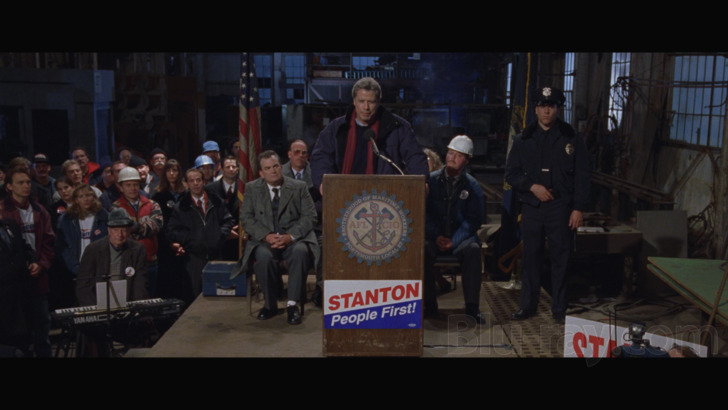
When I was in my master's program, a professor taught a course titled Strategic Communication and showed our class a scene in Primary Colors where Gov. Jack Stanton (John Travolta) addresses a large gathering of maritime workers. My professor screened this clip because she wanted us to see how Stanton embodies philosopher Kenneth Burke's notion of "consubstantiality," which is a concept of identificatory rhetoric. Stanton relates and identifies with the plight and hardships experienced by members of the working class in the film. He also does this with the group of adults enrolled in a literacy and reading program in a school library. Primary Colors is often funny and moving. It improved for me during my second viewing, which indicates it has replay value. One shortcoming is that I felt Nichols and May could have done a better job with the subplot involving Henry Burton (Adrian Lester) and his girlfriend, who writes for The Advocate.
While Universal's Blu-ray appears to remain in print, I am glad that Shout included a 1080p Blu-ray (based on a 4K scan) to go along with its 4K UHD. The picture is frequently dark (especially the first half) and doesn't boast a lot of primaries till later on. The DI used for the transfers is in mint condition. The new commentary track is good but far from great. (Drew McWeeny shoulders much of the workload.) The three recent interviews run longer than what's usually on Shout's releases. A VERY SOLID RECOMMENDATION.

Similar titles
Similar titles you might also like

Man of the Year
2006

The Bonfire of the Vanities
1990

Dick
1999

Salmon Fishing in the Yemen
2011

Meet John Doe
1941

The American President
1995

9 to 5
Nine to Five | Limited Edition to 3000 - SOLD OUT
1980

Storm in a Teacup
The Vivien Leigh Anniversary Collection
1937

Head of State
2003

Big Miracle
2012

Clockwatchers
1997

Guarding Tess
1994

The TV Set
2006

Welcome to Me
2014

The Joneses
2009

Shampoo
1975

Syrup
2013

Long Shot
2019

The Importance of Being Earnest
1952

The Devil Wears Prada
10th Anniversary Edition
2006