Poulenc: Dialogues des Carmélites Blu-ray Movie
HomePoulenc: Dialogues des Carmélites Blu-ray Movie 
Staatsoper HamburgArthaus Musik | 2008 | 166 min | May 25, 2010

Movie rating
6.5 | / 10 |
Blu-ray rating
| Users |  | 0.0 |
| Reviewer |  | 4.0 |
| Overall | | 4.0 |
Overview
Poulenc: Dialogues des Carmélites (2008)
The opera Dialogues of the Carmelites is the only opera the French composer Francis Poulenc has ever written. It is based on the screenplay Die begnadigte Angst by Georges Bernanos. The material for the opera is based on actual historic events.
Starring: Anne Schwanewilms, Alexia Voulgaridou, Kathryn HarriesDirector: Nikolaus Lehnhoff
| Music | 100% |
Specifications
Video
Video codec: MPEG-4 AVC
Video resolution: 1080i
Aspect ratio: 1.78:1
Audio
French: DTS-HD Master Audio 7.1
French: LPCM 2.0
Subtitles
English, French, Spanish, German, Italian
Discs
50GB Blu-ray Disc
Single disc (1 BD)
Playback
Region free
Review
Rating summary
| Movie | | 4.0 |
| Video |  | 4.5 |
| Audio |  | 5.0 |
| Extras |  | 2.0 |
| Overall | | 4.0 |
Poulenc: Dialogues des Carmélites Blu-ray Movie Review
Poulenc's only large scale opera is a challenging piece asking several Big Questions about life, fear and religious faith.
Reviewed by Jeffrey Kauffman May 28, 2010“Don’t ask, don’t tell” is certainly not a new idea, even beyond the confines of the military, where the policy is now more and more seen as an unwanted relic of generations of discriminatory thinking. For centuries, gays and lesbians in far reaching areas and careers have muddled through somehow while keeping their sexual preferences as private as possible. If everyone “knew” anyway, often it was never discussed explicitly. Francis Poulenc was one of the first openly gay composers, at least relatively so. His entire life seemed to be a dialectic between his more libertine proclivities and the Catholic restraint and piety in which he was raised. Dubbed “half monk, half delinquent” fairly late in his life, Poulenc himself probably would not have argued with that description, which adequately sums up the oddly bifurcated nature of his personality. A member of Les Six in his youth, a group which exulted in the anarchistic thinking of the Dadaists, Poulenc’s early writing is filled with an irrepressible joie de vivre coupled with an often astringent subtext that makes his lower opus numbers both wonderfully melodic and structurally inventive while also bristling with intellectuality and even a certain satiric tendency. Whether it was a lifetime spent trying to reconcile his “Parisian sexuality” (as he termed it) with his Catholic upbringing, the horrors of World War II, the deaths of several close friends (and possibly lovers), or a pilgrimage to a famous religious site, Poulenc’s approach turned decidedly more serious from the late 1940’s on. The fact that his only large scale opera is the challenging, discursive and at times incredibly somber Dialogues des Carmélites is testament to the evolution of one man’s thinking and reactions to a world he had personally seen spiral out of control without a moral center to keep it anchored.
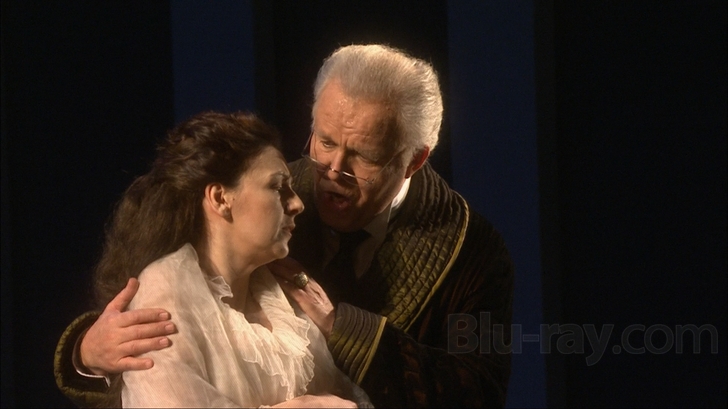
Blanche finds solace in the arms of her father.
The hermitic order of the Carmelites traces its founding back to at least the 12th century. The “second order” of nuns was a cloistered community which spent its spiritual life sequestered in nonstop prayer. Poulenc’s opera is based on an actual historical incident which took place during the French Revolution. This incident had been novelized by German author Gertrud von le Fort in her prescient novella Die Letze am Schafott in 1931, a work which introduced the anxiety ridden heroine Blanche who seeks to join the Carmelite community to escape the horrors of the Jacobins. Writing as she was around the time of the collapse of the Weimar Republic, von le Fort’s fictionalized recreation of another epochal moment in human history can be seen quite correctly as a thinly veiled response to the growing nightmare of National Socialism. In fact once the Nazis took over Germany, they vilified von le Fort as a “fanatic Catholic believer” with a “hostile attitude to life,” as is described in this Blu-ray’s insert booklet. Some sixteen years after von le Fort’s novella was released, French poet Georges Bernanos adapted it into the play Die Begnadete Angst. Bernanos spent his writing career examining elements of existential fear, and his reworking of Sister Blanche into a character paralyzed by a reactive anxiety stemming from having lost her mother in childbirth and then witnessing a series of political upheavals. It was this version of the story that Poulenc adapted as Dialogues des Carmélites, crafting his own libretto along the way.
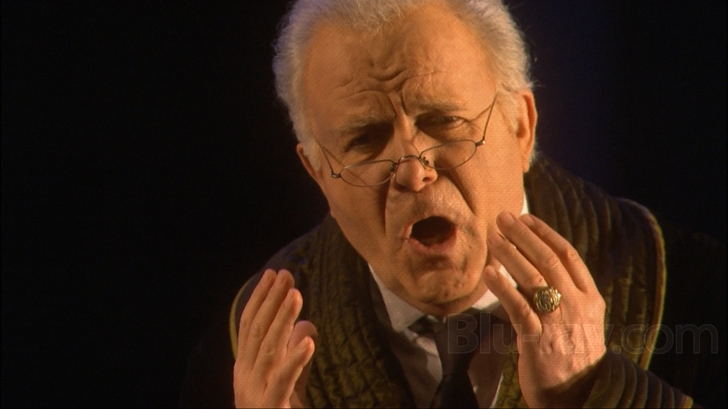
In Poulenc’s formulation of the tale, the ironically named Blanche de la Force (Alexia Voulgaridou) is anything but strong and forceful. Instead she’s a frantic and timid young woman of noble birth seeking to escape the impinging reign of terror resulting from the French Revolution by joining the Carmelite nuns at Compiègne. Blanche’s father, the Marquis de la Force (Wolfgang Schöne) relates to Blanche’s brother, Le Chevalier (Nikolai Schukoff) how Blanche’s mother herself was the victim of an uprising of peasants, whose rioting around the woman’s carriage caused her to deliver Blanche early and led to the mother’s death. Blanche debates with not only her father and brother about her decision to become a nun, but with the Mother Superior (Kathryn Harries) of the order as well. Though the Mother Superior feels Blanche’s motives for joining the Order (largely based on fear) are not what the Mother Superior would wish for, she lets the young woman find refuge within. Soon the Jacobins are not just slaughtering the nobility, they’re demanding that religious orders hand over their assets and that the members of the orders disperse. Blanche, again trembling in fear, runs back to her familial home to hide, pretending to be a maid, to discover the house has been ransacked and her father executed. In the meantime sixteen Carmelite nuns at Compiègne have decided it’s better to die as martyrs than to have their faith “rescinded” by the New World Order of the Revolution. Blanche finds her inner strength and joins her Sisters on the scaffold.
Obviously, this is not the romantic tragedy stuff of a lot of grand opera. Poulenc trods a much more philosophical path than many librettists here, fashioning a piece that is built, as the title of his work suggests, around “dialogues,” conversations, indeed debates as mentioned above, where the characters examine different facets of what maintaining a life of faith in a world filled with turmoil means. In this spare and moving production by Staatsoper Hamburg (from 2008), Blanche’s spiritual quest to find peace is always front and center. The character of Blanche can frankly be somewhat annoying if not approached with the right balance, but director Nikolaus Lehnhoff correctly keeps Blanche from being a maudlin crybaby, and Voulgaridou, though perhaps a bit long of tooth to be playing an ingénue, does excellent work here in both the singing and acting sides of the character.
Through it all, Poulenc’s angular though always melodic music shines, clearly influenced by his countryman Debussy’s Pelleas et Melisande. Poulenc reveals the same shimmering orchestral technique of his perhaps better known French brother, while also bringing an unfailing sense of how to set scenes both musically and dramatically. Conductor Simone Young leads the large orchestra and ensemble in a terse and intense reading of a score and libretto that are by their very nature probing and inquisitive, getting to the very core of what it means to live (and die) by faith. This is one case where asking and telling pay off with very large dividends.
Poulenc: Dialogues des Carmélites Blu-ray Movie, Video Quality
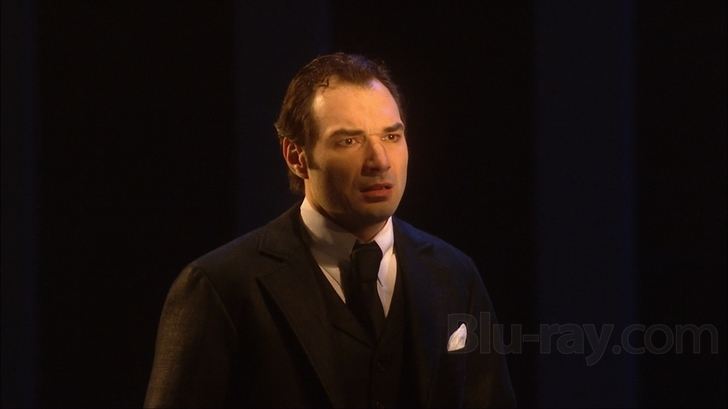
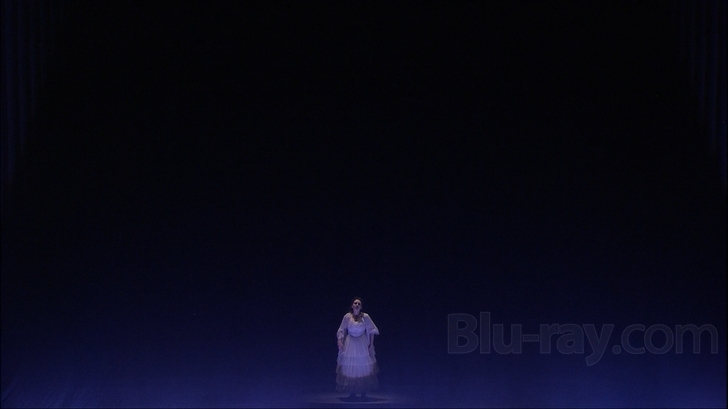
Good and evil, faith and tyranny, black and white--this AVC encoded 1080i image, in an aspect ratio of 1.78:1, of Dialogues is a study in contrasts, and intentionally so. The bulk of the opera plays out on a spare set of vertical lines that can imply both windows and jail bars. The opening act is lit in shades of translucent blue, and the Blu-ray sparkles with color and detail. Once we move into the refuge of the Carmelite Order, things literally turn to a black and white world, with the nuns' habits and the set design itself a study in an extremely muted and oppositive palette. This ArtHaus Musik Blu-ray does a good job of delineating this duotone approach, with whites bristling without blooming, and blacks delivering nicely deep and inky tones while still providing adequate if not overwhelming shadow detail. This is obviously a very somber piece, and as such it doesn't provide opportunity for kaleidoscopic colors. If approached on its own literally black and white terms, this is a very sharp and well detailed Blu-ray.
Poulenc: Dialogues des Carmélites Blu-ray Movie, Audio Quality
All of the Naxos distributed labels have been doing an overall splendid job delivering lossless audio on their opera and ballet releases, but Dialogues ups the ante even further with a remarkable DTS-HD Master Audio 7.1 track that fully captures Poulenc's incredibly colorful musical language. From shimmering string tremolos to the incisive comments of reeds and brass, this DTS track sports spot on fidelity, an awesome dynamic range, and superb clarity. While a lot of the individual singers tend to be massed in the front channels, the orchestra and the large choruses (some of whom perform offstage) fill the surrounds with a wonderfully immersive sound, helping to spread the often dense textures of Poulenc's writing around enough that many individual lines can be heard simultaneously. Balance between the orchestra and singers is always top notch, and the orchestra itself sounds warm and inviting throughout. The LPCM 2.0 folddown is completely clear, though I found it simply too narrow to adequately reproduce the full wonder of Poulenc's soundworld.
Poulenc: Dialogues des Carmélites Blu-ray Movie, Special Features and Extras
The Blu-ray itself sports no supplements. There are several excellent pieces in the insert booklet, including notes by Poulenc himself as well as director Lehnhoff, as well as a synopsis and some history on the Carmelite nuns who inspired the story.
Poulenc: Dialogues des Carmélites Blu-ray Movie, Overall Score and Recommendation

Most Francophiles default to Pelleas et Melisande as the towering achievement of 20th century French opera, but Poulenc's awe inspiring creation is certainly equal to Debussy's achievement. This spare but moving production highlights the "deep thoughts" that haunted Poulenc for at least the second half of his life. Anyone who has questioned why we're here or what faith means in a disjunctive world should spend some time with Sister Blanche and the other Carmelite nuns.