Post Mortem Blu-ray Movie
HomePost Mortem Blu-ray Movie 
Kino Lorber | 2010 | 98 min | Not rated | Aug 21, 2012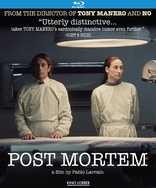
Price
List price:Listed on Amazon marketplace

Movie rating
6.4 | / 10 |
Blu-ray rating
| Users |  | 0.0 |
| Reviewer |  | 3.0 |
| Overall | | 3.0 |
Overview
Post Mortem (2010)
In Chile, 1973, during the last days of Salvador Allende's presidency, an employee at a Morgue's recording office falls for a burlesque dancer who mysteriously disappears.
Starring: Alfredo Castro, Antonia Zegers, Amparo Noguera, Jaime Vadell, Marcelo AlonsoDirector: Pablo Larraín
| Foreign | Uncertain |
| Drama | Uncertain |
Specifications
Video
Video codec: MPEG-4 AVC
Video resolution: 1080p
Aspect ratio: 2.72:1
Original aspect ratio: 2.75:1
Audio
Spanish: DTS-HD Master Audio 5.1
Subtitles
English
Discs
25GB Blu-ray Disc
Single disc (1 BD)
Playback
Region A, B (C untested)
Review
Rating summary
| Movie | | 3.0 |
| Video | | 3.0 |
| Audio |  | 4.0 |
| Extras |  | 0.5 |
| Overall | | 3.0 |
Post Mortem Blu-ray Movie Review
Infatuation during wartime.
Reviewed by Casey Broadwater August 23, 2012Directed by Chilean filmmaker Pablo Larraín, Post Mortem is the second film in a series of three period pieces—
following 2008's Tony Manero, and preceding this year's No—concerning life in Chile during the reign of the
fascist dictator General Augusto Pinochet, who took control with a military coup in 1973, unseating the socialist President
Salvador Allende. Like most political power struggles of the time, the situation in Chile was a microcosm of the Cold War, with
the U.S.S.R. backing Allende and the C.I.A. covertly supporting Pinochet's nascent junta government, which eventually came
to be known for its human rights abuses, deep-seated corruption, and—until its dissolution in 1990—the squelching of
democracy. Go U.S.A.!
While it certainly helps, a full understanding of the historical context isn't necessary to appreciate Post Mortem, which
gives us only a narrow view of the conflict, focusing instead on two weary souls who have a short-lived fling in the days
surrounding the coup. The film is slow and sometimes frustratingly understated—there are times when Larraín seems intent
on alienating his audience—but it's also strangely compelling, laced through with black-as-death humor and building to a
disturbing conclusion.
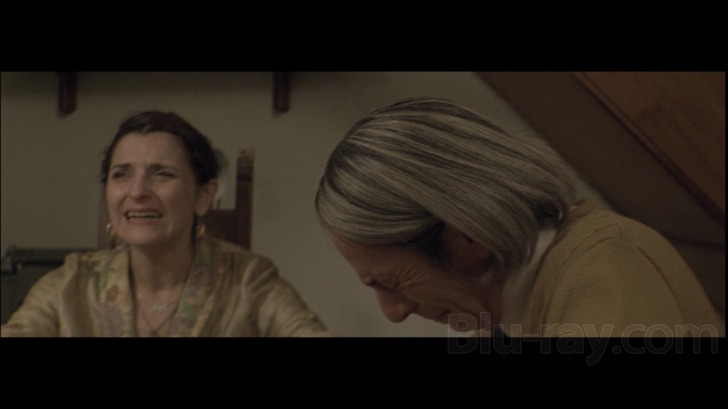
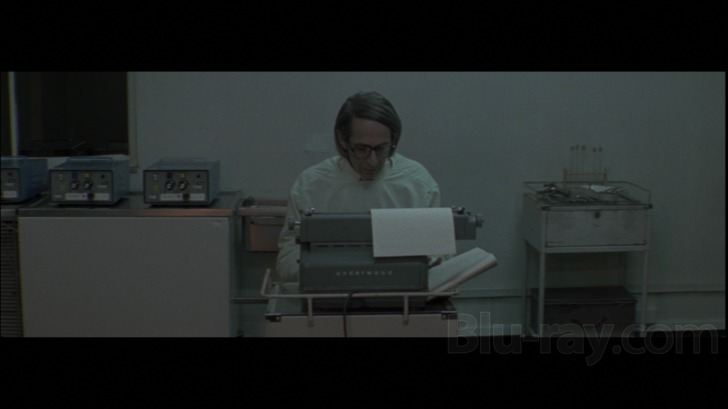
Alfredo Castro—who played the Saturday Night Fever-obsessed crook in Tony Manero—is cast here as Mario, a gaunt civil servant with stringy gray hair, deep-set eyes, and the lugubrious bearing of a cartoon mortician. Considering his job, this makes sense; Mario is a coroner's assistant, tasked with taking notes during autopsies and compiling reports on the deceased. His personal life is no less depressing. He lives in a drab little house in Santiago, across the street from the wilted anorexic cancan dancer, Nancy (Antonia Zegers), for whom he harbors an unrequited crush. In an unusual move, Larraín shows Mario annotating a dead Nancy's autopsy during a flash-forward in the first act, but leaves the how and why of her death a mystery until the final scene.
At the beginning of the film, Mario sneaks backstage at the run-down burlesque theater where Nancy works, only to witness the manager firing her for being rail-thin and past her prime. When Mario offers to drive her home, they turn down a street and are overrun by Communist Youth Party protestors marching in the opposite direction. Tellingly, Nancy gets out and joins the crowd—at the insistence of a man we assume to be a lover—and Mario drives off against the tide. It turns out that Nancy, though seemingly apolitical herself, lives with a band of communist sympathizers. The next night, to get out of the house while they're scheming, she slips over to Mario's with a bottle of rum. He fixes her an egg, they both begin sobbing uncontrollably at the kitchen table—it's unclear whether this is supposed to be funny or not—and they go upstairs for some of the most joyless sex ever caught on film.
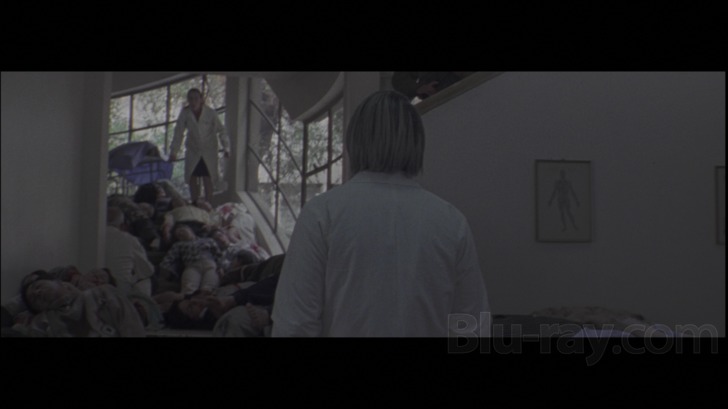
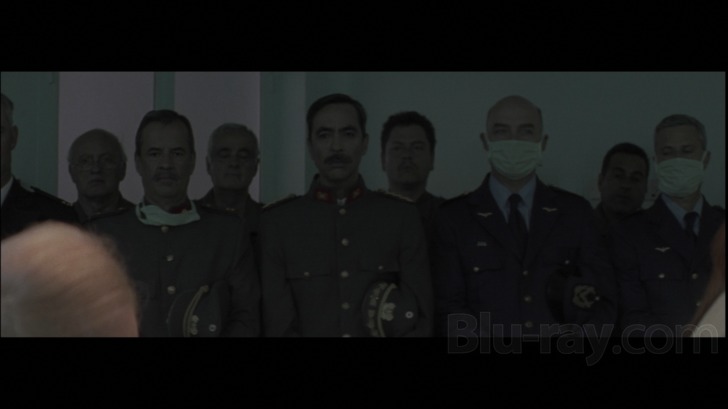
The coup cuts their affair short. Nancy's house is attacked and ransacked by Pinochet's troops, and since she's presumably wanted for associating with communists, Mario helps her hide in a closet in the bombed-out basement, occasionally bringing her food and cigarettes. Meanwhile, his job at the mortuary is growing out of hand, with dead protestors and members of Allende's government filling every gurney. As the violence spikes—and it all occurs offscreen—the bodies literally pile up everywhere. In one of the film's most effective scenes, Mario assists in the autopsy of Allende himself, while nearly a dozen military officers crowd in the room, a silent threat to ensure the coroner rules the deposed leader's death a suicide. (To this day, it's uncertain whether he killed himself or was assassinated.) In another chilling sequence, Mario and a female aide discretely rescue an injured-but-living woman who's been brought in atop a heap of corpses. Later, despite their efforts, they find her bullet-riddled body back among the dead. Larraín clearly has no sympathies for Pinochet and his military cronies.
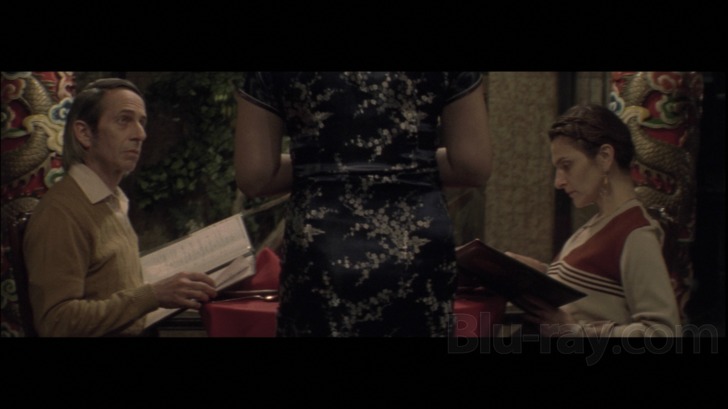
As for our own sympathies, we're never quite sure where to place them. Both Mario and Nancy are rather unlikeable characters, not because they're despicable—which they occasionally are—but because they're dour and uninteresting and depressive. The acting, the dialogue, the characterizations—everything feels so distanced and somber. Even when it depicts strong emotion, Post Mortem has a dispassionately aloof quality, with Larraín showing so much restraint that his withholding becomes more noticeable than the story itself. The director puts us ill-at-ease in every slow-burning scene. The film's color palette is flat and exceedingly dim, the humor is uneasy—see the scene where Mario and Nancy try to order food at a posh Chinese restaurant—and the ultra-wide 2.66:1 aspect ratio cramps the frame, claustrophobically squashing everything into the narrow center. This is very much intentional, and while it's certainly successful at generating an oppressive mood, the stylistic bleakness risks pushing away the audience entirely. Thankfully, it doesn't quite come to that. The film may not be enjoyable, but it is unsettling and uncomfortable, gripping our attention in an entirely different way.
Post Mortem Blu-ray Movie, Video Quality
Post Mortem arrives on Blu-ray courtesy of Kino, with a 1080p/AVC-encoded transfer framed in the intended and ridiculously wide 2.72:1 aspect ratio. The film is in 16mm, which normally has a 1.37:1, so I'm assuming Post Mortem was shot with anamorphic lenses, which would account for the nearly 2X squeeze down to 2.72:1. (Cinematographers, feel free to PM me with corrections or any other possibilities.) Regardless, and as usual with features shot in 16mm, the picture is quite soft and exceptionally grainy throughout. With the exception of a few tight closeups—where you can actually make out facial textures—truly fine detail is absent from the image. This is unavoidable, but from a normal viewing distance the film doesn't look bad. It's certainly clear that you're watching 16mm footage that's been transferred in high definition, anyway. As mentioned above, the film's color palette is intentionally drab—with a preponderance of beiges and dim yellows and dirty grays —so don't expect any eye-popping vividness here. As for contrast, black levels are as deep as they need to be, but highlights— although I'm sure this was also a conscious decision—could stand to be a bit brighter. The print itself is in great condition, with no specks or scratches, and I didn't spot any worrying compression issues.
Post Mortem Blu-ray Movie, Audio Quality
If the visuals are decidedly low-budget, Post Mortem's lossless DTS-HD Master Audio 5.1 surround track is surprisingly adept and engaging. The film opens with a view from under the chassis of a tank, and we're immersed from the first frames, with the rumble of the tracks all around us. By and large, this is a very quiet film, but the mix is potent when necessary, with effects and ambience emerging from all sides. Cheering at the burlesque show. The chants of the student protesters. Rain pouring. The hum of fluorescent lights at the morgue. The swoosh and subsequent explosion of a rocket that we don't see but only hear as it destroys the communist hideout. And then there's the somber score by Juan Christóbal Meza, with it's dark, minor key strings. The mix has a good sense of presence, with clear highs and a low-end that doesn't call attention to itself but still grounds the track. The Spanish dialogue is all cleanly recorded and clearly reproduced, and for those who understand the language, the default English subtitles can be turned on or off.
Post Mortem Blu-ray Movie, Special Features and Extras
- Trailers: Includes high definition trailers for Post Mortem, Elles, The Fairy, Film Socialisme, and The Robber.
- Stills: A gallery with sixteen production stills.
Post Mortem Blu-ray Movie, Overall Score and Recommendation
I'm still not entirely sure how I feel about Post Mortem. Its slowness and uncomfortable tone may put off some, but it has a hypnotic quality for the exact same reasons. Pablo Larraín has made a supremely awkward film about infatuation during wartime, and I suspect it'll fall under the love it/hate it dichotomy. Those who fell for Tony Manero should feel comfortable making a purchase, but for all others, I'd advise a rental.
Similar titles
Similar titles you might also like
(Still not reliable for this title)

No
2012

Casanova '70
1965

Peppermint Candy
박하사탕 | 4K Restoration
1999

Cría Cuervos
1976

Zama
2017

Woyzeck
1979

Cemetery of Splendor
2015

Aquarius
2016

Twenty-Four Eyes
二十四の瞳 / Nijûshi no hitomi
1954

Out 1
Out 1, noli me tangere
1971

Loveless
Нелюбовь / Nelyubov
2017

An Autumn Afternoon
秋刀魚の味 / Sanma no aji
1962

Muriel, or the Time of Return
Muriel ou le temps d'un retour
1963

Horse Money
Cavalo Dinheiro
2014

Babette's Feast
Babettes gæstebud
1987
Gate of Flesh
肉体の門 / Nikutai no mon
1964
The Rocket
2013

Fairy in a Cage
檻の中の妖精 / Ori no naka no yôsei / The Nikkatsu Erotic Films Collection
1977

The Official Story
La Historia Oficial
1985

I Knew Her Well
Io la conoscevo bene
1965