Portrait of Jason Blu-ray Movie
HomePortrait of Jason Blu-ray Movie 
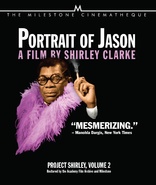
Project Shirley, Volume 2Milestone | 1967 | 107 min | Not rated | Nov 11, 2014

Price
List price:Amazon: $21.33 (Save 47%)
Third party: $21.33 (Save 47%)
Only 4 left in stock (more on the way).

Movie rating
6.2 | / 10 |
Blu-ray rating
| Users |  | 0.0 |
| Reviewer |  | 4.0 |
| Overall | | 4.0 |
Overview
Portrait of Jason (1967)
Jason Holliday, gay hustler, sometime houseboy and aspiring cabaret performer, spins tales, sings, dons costumes and reminisces about good times and bad behavior in a documentary portrait filmed in one marathon 12-hour session in 1967. The result is a mesmerizing portrait of a remarkable, charming, manipulative and tortured man -- and also a unique view into an America not so far distant.
Starring: Jason HollidayDirector: Shirley Clarke
| Documentary | Uncertain |
| Biography | Uncertain |
Specifications
Video
Video codec: MPEG-4 AVC
Video resolution: 1080p
Aspect ratio: 1.34:1
Original aspect ratio: 1.37:1
Audio
English: LPCM 2.0 Mono (48kHz, 16-bit)
Subtitles
English SDH
Discs
50GB Blu-ray Disc
Single disc (1 BD)
Playback
Region A (B, C untested)
Review
Rating summary
| Movie | | 4.0 |
| Video | | 4.0 |
| Audio | | 4.0 |
| Extras | | 4.0 |
| Overall | | 4.0 |
Portrait of Jason Blu-ray Movie Review
Mona Lisa Tears
Reviewed by Michael Reuben January 23, 2015Shirley Clarke was an Academy Award-winning documentary filmmaker in an era when documentaries were so little seen that their makers were not widely known. Clarke began as a dancer and choreographer, and her first films were about dancing. When she turned her attention to other subjects, she brought to them the same fascination with the abstract interplay of light, shadow and color that is characteristic of many forms of modern dance. The 1958 short Skyscraper chronicled the construction of a building on New York's Fifth Avenue; it was Clarke's first Oscar nomination. In 1961, she released what would become her best-known film, The Connection, which appeared to be a cinema verité documentary about a group of jazz musician junkies waiting for their dealer. In fact, it was a scripted drama based on a play by writer Jack Gelber. Clarke's 1963 film, Robert Frost: A Lover's Quarrel with the World, won the Oscar for Best Documentary. As both a filmmaker and a professor of film, Clarke remained active until her retirement in 1985, but her reputation has gradually faded as the work became unavailable and ceased to be shown. (Clarke died in 1997, after a long battle with Alzheimer's.) Dennis Doros and Amy Heller, the indefatigable founders of Milestone Films, have created "Project Shirley" to rescue, restore and exhibit Clarke's work to a new generation. Due to various considerations, the release of Volume 1 of "Project Shirley", The Connection, was postponed until February 2015. Volumes 2 and 3 were released in November 2014. Volume 2 contains Clarke's 1967 film Portrait of Jason, which is 107 minutes culled from a twelve-hour interview session shot in Clarke's apartment on December 2, 1966 with a man known as Jason Holliday (which isn't his real name). Jason is the only person we see during the entire film, but one of the many questions that Clarke raises is whether we ever really see him. Under the guise of cinema verité, which Clarke enhances by making her film look like raw, unedited footage, the filmmaker sows doubt about the camera's ability to capture the truth, especially when its subject is someone whose life has been devoted to evasion and deception. Later documentary makers like Erol Morris and Joshua Oppenheimer explore similar themes by more elaborate methods, but Clarke did it simply by finding the right subject and asking him to be himself (which turns out to be a challenge).
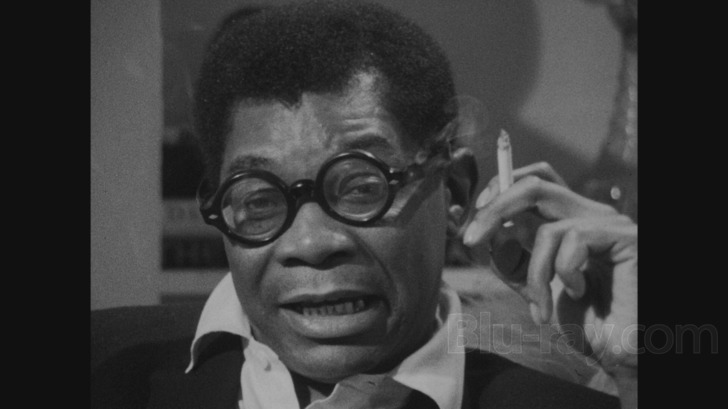
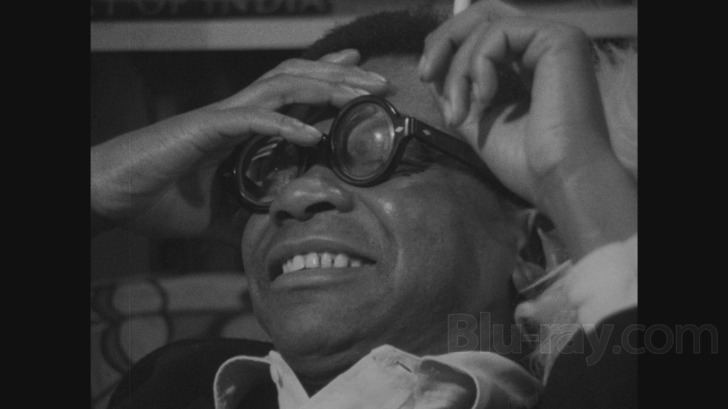
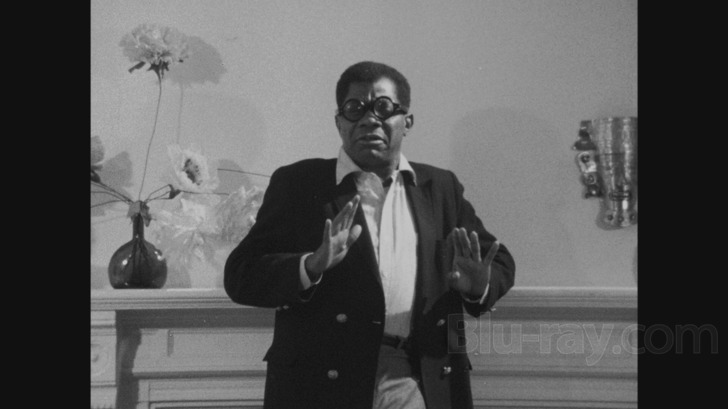
Describing Portrait of Jason is an exercise in futility, because the point of the film is to create an extended encounter between the viewer and Clarke's subject. The entire film consists of Jason Holliday talking, laughing, singing, smoking, drinking, telling stories from his life, or possibly that he's made up entirely (one never knows). Off-camera, we occasionally hear the voices of Clarke and of Carl Lee, Jason's long-time friend, prompting him to tell a specific tale or, as the evening wears on, berating him for some past misdeed. The entire film is an act of self-revelation, but as Clarke has repeatedly said in interviews, not everyone can reveal themselves before a camera. A special talent is required. And even the most honest revelations can be just as deceiving as deliberate lies. Clarke even warns the viewer at the outset by having Jason state and restate his name, until he admits that his true name is "Aaron Payne", and then explains how he came to be called "Jason Holliday". As Clarke comments in one of the extras, a person who has renamed himself from "Payne" (or "pain") to "Holliday" (or "holiday") has already told you a lot about himself. Articulate and dandyish, with thick glasses in heavy frames, Jason is never at a loss for words. Likeable or not (and Jason elicits conflicting reactions, often within the same viewer), Jason is obviously intelligent. He gestures and speaks in the exaggerated manner of a drag queen, although he is wearing men's clothing, and he laughs continually at the ridiculous behavior of both "whites" and "coloreds", although the laughter sounds increasingly painful and forced as the evening wears on. Because he is openly gay, he is as much an outsider in the African-American community as any black person in segregated white America (remember that the film was made less than a year before Martin Luther King's assassination). Jason's very survival has been a daily act of self-reinvention, of living by his wits, and this appears to have been the case ever since childhood. His stories of harsh treatment by his father, who was known as "Brother Tough", are made even more harrowing by the comic tone with which Jason tells them. When Jason earnestly informs the camera that he is an evil person, it's unclear whether he is expressing an honest self-evaluation or simply relating what many people think of him. Some of Jason's most outrageous stories are about serving as a "houseboy" to rich white couples (or widows) whose odd behavior he describes with relish. Relaxing at home, and frequently worse the wear for alcohol, they treat Jason as a part of the furniture and express their racism openly. At other times, Jason talks about his efforts to start a career as a nightclub entertainer, although it's never clear how much of this is real. Jason claims he could have accomplished more if he hadn't expended so much time and energy on sex, but one of the unanswered questions is whether he is referring to sex for pleasure or sex for money. He repeatedly describes himself as a "hustler", but as his presentation continues, it's evident that everything in Jason's world is some form of hustle—even this movie. Jason's laughter is wild and extreme, but it's rarely infectious. If one were in the same room with him, it would probably be frightening. By the end of the evening, it has cracked into tears, but there is always the suspicion that everything, including the tears, is, at least in part, a performance for the camera. When one has spent one's entire life wearing a variety of masks, when does the masquerade end? Clarke's photographic style is disconcerting for contemporary sensibilities; it screams "experimental cinema". Although she was a professional filmmaker, she went out of her way to make Portrait of Jason look like the work of an amateur, almost as if it were the Sixties equivalent of "found footage". The film has no opening or closing titles—an omission that caused the film's 16mm interpositive to be miscatalogued for decades as "outtakes". Jason routinely goes out of focus for long stretches and the screen goes to black periodically. Part of the reason is that Clarke had much more audio than video, and the blurs and blanks allowed her to edit Jason's "performance" seamlessly without synch issues, but another part was simply that she liked the abstract shapes made by his face and glasses as they dissolve into blobs of gray. To Clarke, this was the visual equivalent of Jason's constant self-reinvention, as well as a reminder that what's seen through a camera is not reality. With all due respect to Jean-Luc Godard, it may not even be truth.
Portrait of Jason Blu-ray Movie, Video Quality
Portrait of Jason has been restored from a newly discovered 16mm fine-grain interpositive found by Milestone Films at the Wisconsin Center for Film and Theater Research. A 35mm print borrowed from the Swedish Film Institute was used as a reference, because the fine-grain IP did not reflect the final editing changes made by Clarke and editor Gloria Hawkins. Milestone has provided the following description of the restoration performed by Modern VideoFilm under supervision of the Academy Film Archive:
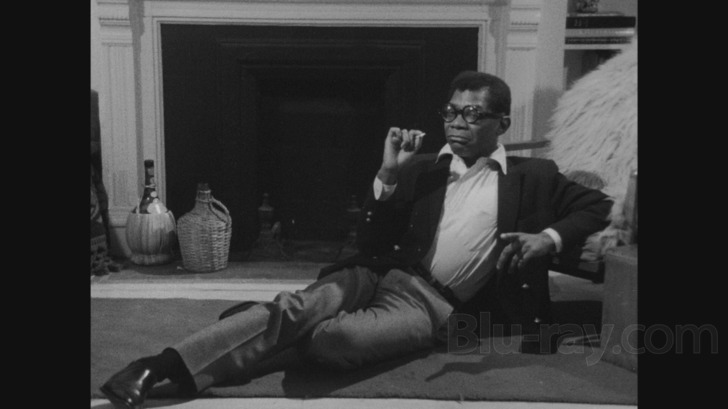
At Modern VideoFilm, colorist Kathy Thomson and the Academy's Joe Lindner scanned the 16mm interpositive at 2K. Modern Videofilm's Vincent Pirrozi supervised and assisted on the work including the proofing of the 2K transfer, the 35mm negative and the 35mm prints. Modern VideoFilm created a one-light scan and a digital audio track of the 35mm print from the Svenska Filminstitutet (Swedish Film Institute), which were used in conforming and creating the final restoration. Because Shirley Clarke and Gloria Hawkins had done additional editing after the fine grain was created, Modern VideoFilm's editor Roger Berger used the Quantel IQ platform to piece together the film using . . . Sweden's print as a guide. He discovered that with the exception of one optical effect (footage of Jason smoking was used and then repeated in reverse), the 16mm material was complete. The team at Modern recreated all the optical and transition effects in the print and removed flaws in the 16mm, including pen markings and tape which were placed as optical and printing cues. They then created a B&W LUT (Lookup Table) for output to 35mm, matching the exact composition and sizing of the 35mm print; a DCP (digital cinema package); and a HDSR (high definition) video master. Over 6 terrabytes of information have been recorded to hard drive and tape formats to preserve the various digital formations.The 1080p, AVC-encoded Blu-ray that has resulted from this painstaking work is a remarkable achievement. One cannot expect a black-and-white 16mm source from an informal 1967 shoot to arrive in pristine condition, but the source materials are free of any major damage, revealing small scratches, blotches and an occasional vertical streak. Detail is impressive, revealing shifts in Jason's expression, the texture of his skin, hair and clothing, and the surroundings in Clarke's apartment. Perhaps most important, the densities and contrast are vastly superior to previous sources (see screenshot 18, which is taken from "Jason Before and After" in described in "Extras" ) so that the film's subject appears to be sitting and talking in an ordinary well-lighted room. This setting only serves to accentuate the extraordinary nature of the personality and presentation that are the film's central subject. Having taken such care in the restoration, Milestone has encoded Portrait of Jason at an average bitrate of 32.97 Mbps, which is essential for a film where both the subject and the film's grain are in constant motion. Please note that the film's high score takes account of the nature of both the source and the film itself.
Portrait of Jason Blu-ray Movie, Audio Quality
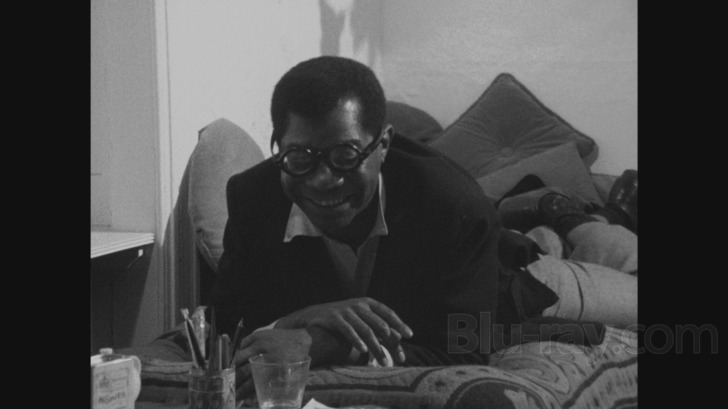
The film's mono soundtrack is presented in PCM 2.0, with identical left and right tracks. It's a straightforward vocal recording dominated by Jason's voice, with those of Clarke and Carl Lee heard distantly in the background along with the sound of equipment being moved and camera magazines being loaded. There is no popping, hiss or distortion.
Portrait of Jason Blu-ray Movie, Special Features and Extras
- The Lost Confrontation (1080p; 1.78:1; 6:01): Clarke discusses a sequence she removed from the film in an audio interview set against still photographs. Audio from the deleted sequence follows, some of it accompanied by unsynchronized video.
- Where's Shirley? (1080p; 1.78:1; 25.31): This is the video for the Kickstarter campaign that raised the fund to restore Portrait of Jason, but it's not just a matter of historical interest. As Dennis Doros and Amy Heller recount their painstaking search for the source materials for Clarke's film, they provide an incomparable education in the demanding and difficult task of being a film archivist.
- Jason in Color! (480i; 1.34:1; 2:12): A short home movie in color, with a soundtrack excerpt from Portait of Jason.
- Jason Unleashed (1080p; 1.78:1; 34:34): "Thanks to the Wisconsin Center for Film and Theater Research, the audio outtakes were saved for Portrait of Jason. Along with a couple stories that help explain some obscure references in the film, it also shows how Shirley Clarke planned parts of the film to be spontaneous in order to play with the rules of cinema verité."
- Portrait of Jason Trailer (1080p; 1.34:1; 1:29): This trailer was created by Milestone for its restoration.
- Jason Before and After (1080p; 1.34:1; 1:14): This revealing comparison demonstrates the improvement achieved as a result of Milestone's detective work in locating the 16mm fine-grain interpositive mistakenly labeled as "outtakes" at the Wisconsin Center for Film and Theater Research. Side by side with the 35mm blow-up maintained at the Museum of Modern Art, the superiority of the 16mm source (which is several generations closer to the original camera negative) is obvious.
- Butterfly (1080p; 1.34:1; 3:51): A short film made by Clarke and her daughter, Wendy, in 1967 to be shown at NYU's Loeb Student Center as part of a program of anti-war films.
- Shirley Clarke in Underground New York (480i; 1.34:1; 9:52): This documentary short records Clarke at home and on the streets of New York in 1967. She also welcomes Michelangelo Antonioni to a film festival. If you didn't know it was real, you might think it was a parody of the Sixties arthouse scene.
- Audio-Only Extras
- Pacifica Radio Interview (52:45): This interview with Clarke occurred shortly after a screening of Portrait of Jason and provides extensive information about the making of the film, what she meant to convey by it and early reactions by critics (many of which were unfavorable).
- Jason Holliday Comedy Album (49:13): This unreleased album was produced by a songwriter and record producer in 1967, probably after seeing Portrait of Jason.
Portrait of Jason Blu-ray Movie, Overall Score and Recommendation
Just as Jason Holliday could be a difficult person to know, Portrait of Jason can be a challenging film to watch. Even if one finds Jason entertaining at the outset (some viewers will and some won't), a point comes about midway through the film when the viewer begins to feel trapped by something in his insistent need to keep talking. Modern technology allows the disc to be paused for a break, and it may then be difficult to return to the film. Clarke herself knew Jason Holliday, but she didn't particularly like him until after she made Portrait of Jason. What she sensed in Jason was the same potential that prompts some film directors (e.g., Stanley Kubrick and David Fincher) to make actors do take after take: a multi-layered potential that could only be realized through a lengthy and often tortured process. The fact that Clarke's subject existed at the intersection of so many powerful forces that were exploding just outside her window in the streets of America as she and Jason filmed makes her film all the more relevant. Milestone's restoration is a service to both history and cinema. Recommended, but not for a light-hearted evening's diversion.
Similar titles
Similar titles you might also like
Buster Keaton Rides Again
1965

The Salt of the Earth
Le Sel de la Terre
2014

Varda by Agnès
Varda par Agnès
2019

The Beaches of Agnès
Les plages d'Agnès
2008
My Best Fiend
Mein liebster Feind - Klaus Kinski
1999

Burroughs: The Movie
Theatrical Version and Experimental Edit
1983

A Bigger Splash
1973

Ingrid Bergman: In Her Own Words
Jag är Ingrid
2015

A Brief History of Time
1991

Burden of Dreams 4K
1982

Mur Murs
Mural Murals
1981

Soundtrack to a Coup d'Etat
2024

The American Dreamer
1971

David Lynch: The Art Life
2016

Scala!!!
Or, The Incredibly Strange Rise And Fall Of The World's Wildest Cinema And How It Influenced A Mixed-up Generation Of Weirdos And Misfits
2023

Kanehsatake: 270 Years of Resistance
Slipcover in Original Pressing
1993

Leviathan
2012

Hollywood Chinese
2007
Respectable: The Mary Millington Story
2016

Notfilm
2015