Pleasantville 4K Blu-ray Movie
HomePleasantville 4K Blu-ray Movie 
Collector's Edition / 4K Ultra HD + Blu-rayShout Factory | 1998 | 125 min | Rated PG-13 | Jul 21, 2026
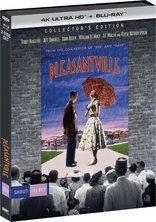

Movie rating
7.5 | / 10 |
Blu-ray rating
| Users |  | 0.0 |
| Reviewer |  | 2.5 |
| Overall | | 2.5 |
Overview
Pleasantville 4K (1998)
Pleasantville is a 1950s sitcom enjoying cult status on a contemporary cable channel. David loves it, but his sister Jennifer is too hip. When a mysterious TV repairman gives them a new remote control, the pair are transported into the world of Pleasantville, like it or not. They find themselves trapped in an alternate reality where the town exists in black and white—in a white-bread world without passion or violence. But the teenagers have also brought an unexpected—and double-edged—gift to Pleasantville: a sense of possibility that spreads like wildfire throughout the town. There can be no turning back once the citizens begin experiencing such strange wonders as sex, art, rain... and ideas.
Starring: Tobey Maguire, Jeff Daniels, Joan Allen, William H. Macy, J.T. WalshDirector: Gary Ross
| Comedy | Uncertain |
| Teen | Uncertain |
| Coming of age | Uncertain |
| Imaginary | Uncertain |
| Drama | Uncertain |
Specifications
Video
Video codec: HEVC / H.265
Video resolution: 4K (2160p)
Aspect ratio: 1.85:1
Original aspect ratio: 1.85:1
Audio
English: DTS-HD Master Audio 5.1 (48kHz, 24-bit)
English: DTS-HD Master Audio 2.0 (48kHz, 24-bit)
Subtitles
English SDH
Discs
Blu-ray Disc
Two-disc set (2 BDs)
4K Ultra HD
Packaging
Slipcover in original pressing
Playback
Region A (B, C untested)
Review
Rating summary
| Movie |  | 4.0 |
| Video |  | 4.5 |
| Audio |  | 3.5 |
| Extras | | 2.5 |
| Overall | | 2.5 |
Pleasantville 4K Blu-ray Movie Review
Reviewed by Dr. Stephen Larson August 15, 2026Gary Ross's feature directorial debut Pleasantville (1998) was reviewed by my colleague Kenneth Brown over fifteen years ago. Ken published a critique of the Warner Bros. BD-50. To read his thoughts on the movie and his evaluation of the a/v presentations and extras, please refer to the linked review.
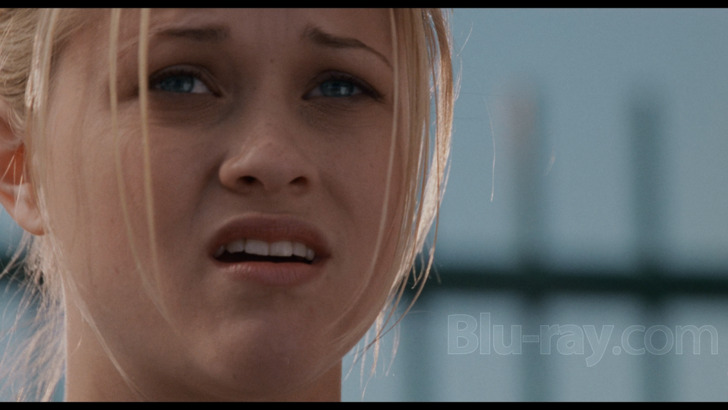
Pleasantville 4K Blu-ray Movie, Video Quality
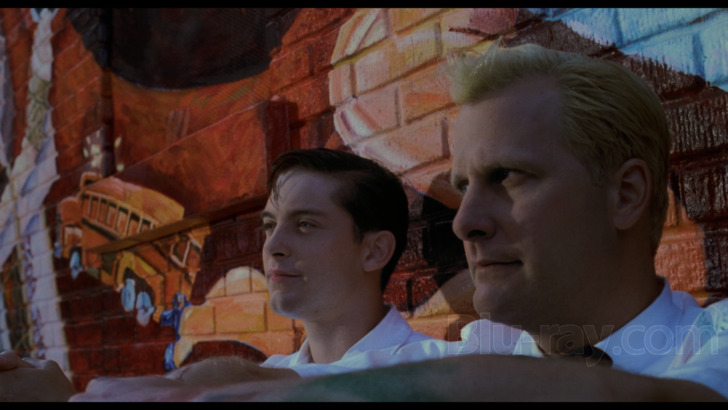
Shout Select's recent two-disc 4K Ultra HD Blu-ray and standard Blu-ray set of Pleasantville comes with a slipcover. Before delving into technical aspects of the presentations, I need to address a significant controversy that has filled many pages of this release's thread on our forum. Late in the film, there's a line spoken by Jennifer (Reese Witherspoon) to her brother David (Tobey Maguire) that has been excised from the UHD and remastered Blu-ray. The line contains a noun that was uttered in adjective form by Jennifer earlier in the film that has been preserved on both discs. I watched New Line's Platinum Series DVD and the line containing "slut" is intact as it is on WB's 2011 Blu-ray. Neither Shout nor writer/director Gary Ross has provided any explanation or reasoning why this piece of dialogue (totally at least three seconds) was deleted from this release. When one reads the text on the slip or on the sleeve, one would assume s/he is watching the original theatrical version. But sadly, this is not the case. There has been no official word yet from Ross on his socials (or Shout, for that matter) why this change was made. Shout needed to be transparent in its press release and on its packaging that this is an altered version with a "Director's Edit". However small a change, the boutique label needed to be upfront that this is not the exact way Pleasantville was exhibited. I accessed Ross's full original screenplay on New Line's DVD-ROM contents and, not surprisingly, found the line that has been taken out. Fans deserve to see the film in its purest, unadulterated form. I feel the line goes well with the arc and progression of Witherspoon's character (when she reflects on her past behavior), and should have been left in.
The omission is highly lamentable and I understand it has spoiled (or even ruined) the opportunity to experience the untouched theatrical cut in 4K. The line's absence is truly a shame because Shout delivers a pretty sterling transfer on both discs. Ross approved a 4K scan from the movie's original camera negative. The UHD is encoded with Dolby Vision (HDR10 compatible). I consulted three primary sources on Pleasantville's cinematographic and visual effects work: a detailed print article by Bob Fisher published in the November 1998 issue of American Cinematographer, an in-depth article on v/f shots penned by Matthew J. MacDonald in the January 1999 issue of CineFex, and, rather surprisingly, liner notes film music historian Tim Greiving contributed to Varèse Sarabande Records' 2023 "Deluxe Edition" CD of Randy Newman's original score. According to AC, Malibu, California served as the principal location for the Pleasantville town setting. Some interiors were filmed in Long Beach. Also, the crew built sets on the stages at Warner Bros. in Burbank. Cinematographer John Lindley and Ross reached a joint agreement to film in 1.85:1 because they felt the spherical ratio was best suited to capturing the 1950s on celluloid. A majority of scenes were shot with two Panaflex cameras that provided coverage of the same scene from a similar angle. Live-action shots were initially photographed with Eastman EXR 5248 and 5298 color negative films. Interestingly, Lindley told Fisher he conducted research on the most commonly used lens from '50s movies and ultimately selected a 40 mm lens due to its frequent use over that period. (He also employed 100 mm and 150 mm lenses.)
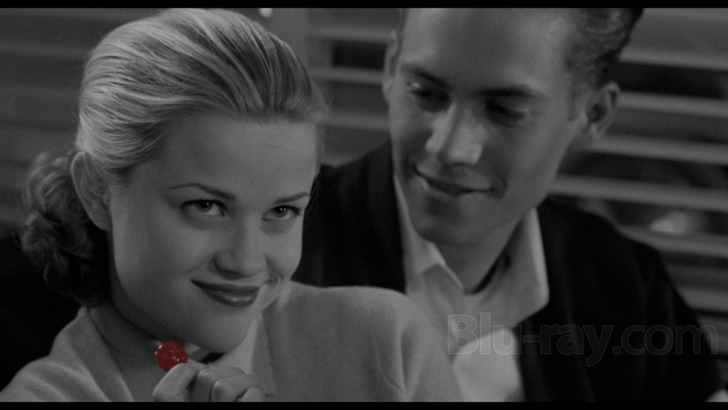
Pleasantville's color production photography was converted to black-and-white and then, as MacDonald describes it well in his CineFex piece, color elements are selectively reintroduced. Moreover, according to Fisher, the digital effects software firm Nothing Real utilized a compositing toolset known as Shake to implement color corrections. Approximately 163,000 frames of 35 mm film were digitized for the purpose of taking out most the colors and tweaking others. Grieving explains in the Pleasantville album booklet that color was then reinserted back to isolated objects and characters in the film's different locations. "The driving factor was that every frame of the movie was going to be scanned, digitally manipulated and recorded back onto color intermediate film at 2,000 lines of resolution," Lindley explained to AC's Fisher. "Modern color films have multiple T-grain layers and therefore record much sharper and cleaner images." Fisher reported that many of the mixed-scene (color and black-and-white) images in the film are actually 70 percent black-and-white. Lindley prepared for the eventual conversion by incorporating hard light that yields solid separations in scenes with monochromatic attributes. I compared the DVD, WB BD, and Shout BD with the UHD and you'll notice crisp black levels are in, for example, an exterior of the diner managed by Mr. Johnson (Jeff Daniels). Cf. screenshot #s 33-35 with #36 (a downsampled capture from the 4K).
While the Spirit DataCine had been developed in Europe as a telecine and scanner, it had not really been used (at least in the US) to scan digital intermediate (DI) film. Pleasantville's DI is known to be the first. MacDonald chronicled how the DataCine was used to produce digital files for on-station animation. The CineFex writer interviewed visual effects supervisor Chris Watts, who revealed his team scanned in full 10-bit Cineon color space prior to all the color corrections being output through a Lightning recorder. The crew worked with 1,700 v/f shots that made up 100 minutes of screen time, which had not been done before. AC's features writer Bob Fisher specified that color effects designer Michael Southard supervised color timing during transfer of the original negative into digital data files. Southhard also colorized the images. He worked with senior colorist Richard Cassel. In fact, Southard and Cassel previewed the color-timing of the OCN on a video monitor before it was converted to data. "We were scanning at 2K resolution — 1,920 pixels by 1,440 lines [like FHD+]," Cassel described the process to Fisher. "That's about 11 megs per frame. In the beginning, we were transferring two frames per second. At the end we got it up to four after getting new software from Phillips [which had collaborated with Kodak on the project]." Watts also was preferential to the DataCine since it could color correct on the fly and transfer them to tape at a speed of four frames per second. (An average scanner in 1998 could only process one frame every ten to thirty seconds.) CineFex reported that the crew used EFILM's laser recording system.
Greiving's writing on Pleasantville is valuable because he divulged something important about the scanning process that neither AC nor CineFex did in the late '90s. Greiving apparently interviewed Ross and did quite a bit of research on the film himself. He writes in the booklet: "Because the movie only made sense with these effects, Ross and company first scanned and manipulated it in 2K video resolution in order to prove and preview the concept, then did it all over again in 4K. Post production look a year and a half". So in other words, the physical film frames were originally scanned in 4K. But it should be pointed out that all of the computer rendering work in 1998 were likely processed at only 2K. So elements of the frames on Shout's UHD are probably uprezzed to 4K. Greiving did the interview with the writer/director ca. 2023 so still a few years before the recent 4K scan. The opening of Pleasantville does feature TV footage that resembles standard definition video. This will be especially evident if you view the UHD with one of the HDR options, of course.
I upscaled the US DVD to 720p on one of my Sony Blu-ray players and for a 1999 transfer, it still look looks remarkably sharp. Where the viewer will discover remarkable gains is the amount of depth in shots that display any kind of background locales. Dolby Vision and HDR10 help to bring out scenic backdrops and the Pleasantville townspeople in the medium or distant backgrounds. One aspect that I particularly liked on the DVD is the TV footage of the show that David watches on the CRT at his mother's home (and that's blown up for the cinema audience) contains some dirt and artifacts. Ross has cleaned all of that up on the 4K and Blu-ray. There are similar artifacts in additional scenes (when David and Jennifer are transported back in time) on the DVD. But I would argue that they help give the pure B&W shots that David is observing a dated and nostalgic quality. Ken noted the presence of uneven grain on the WB Blu, but this isn't an issue on either Shout disc. Grain is distributed well across shots. It appears healthy and organic to my eyes. (No faux grain!)
The UHD has been placed on a BD-100 (actual file size: 85.8 GB). The feature boasts a rough average video bitrate of 85.5 Mbps and a total bitrate of 98.3 Mbps for the triple-layered disc. The regular Blu-ray employs the MPEG-4 AVC encode and delivers a mean video bitrate of 32000 kbps. The Warner BD-50 is more like a BD-25 since the feature size takes up 24.7 GB of space. It employs the same encode as Shout but at a much lower standard bitrate: 20539 kbps.
Screenshot #s 1-20, 24, 28, 32, 36, & 40 = Shout Select 2026 4K Ultra HD BD-100 (downscaled to 1080p)
Screenshot #s 21, 25, 29, 33, & 37 = New Line Platinum Series 1999 DVD (resized to 720p)
Screenshot #s 22, 26, 30, 34, & 38 = Warner Bros. 2011 BD-50
Screenshot #s 23, 27, 31, 35, & 39 = Shout Select 2026 BD-50 (from a 4K restoration)
Nine chapter breaks accompany the feature on Shout's discs, which run 2:04:28 apiece. The total disc runtime for the WB BD is 2:04:31.
Pleasantville 4K Blu-ray Movie, Audio Quality
Shout has supplied a DTS-HD Master Audio 5.1 Surround track (1902, 16-bit) and a DTS-HD Master Audio 2.0 Stereo mix (1557, 16-bit). Pleasantville received not only DTS 5.1 and Dolby Digital theatrical presentations in the late '90s, but DTS Stereo and Dolby Stereo SR mixes were heard by patrons as well. (I have researched newspaper adverts.) It's too bad that Shout has not been placing that high of an emphasis on audio encoding of late because while this is basically the same lossless 5.1 track heard on the WB Blu-ray, Warners' authoring work is superior. The studio offered a DTS-HD Master Audio 5.1 Surround mix (4053 kbps, 24-bit). I listened to the track and it delivers better dynamic amplitude. Dialogue is sometimes hard to hear on the 5.1 but is audible if you boost the volume a bit. The 5.1 mix generally produces some fine discrete f/x along the satellite speakers. I compared the DVD's Dolby Digital 2.0 track with Shout's DTS-HD MA 2.0, which is thankfully not a fold-down of the 5.1. The split surrounds are delivered with aplomb and sound well balanced. Fidelity is noticeably better on the Shout discs compared to the New Line disc. Dialogue did sound a tad softer during the second half of Pleasantville when I listened to the 2.0 on the Shouts, though. Randy Newman's score sounds warm and often buoyant on both lossless tracks. My overall audio score is 3.75/5.00.
I sampled many scenes with the optional English SDH turned on. They appear at least 98 percent complete and accurate. I didn't catch any typographical errors.
Pleasantville 4K Blu-ray Movie, Special Features and Extras
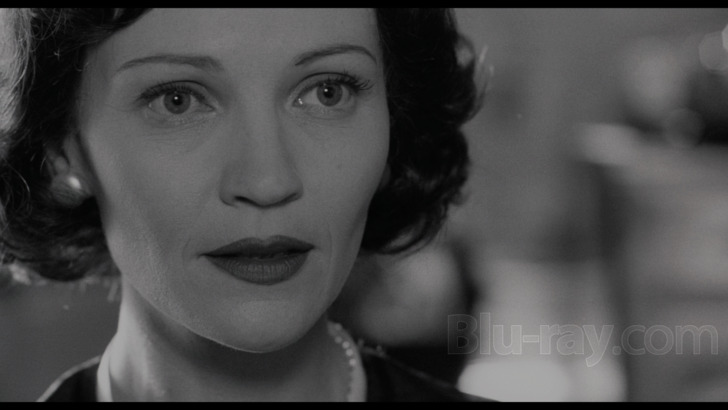
Shout has recorded a brief video introduction and recent interview with Gary Ross. A few extras are missing from the maiden New Line DVD. Paul Thomas Anderson's music video with Fiona Apple singing "Across the Universe" has been dropped, probably because Shout was unable to license it. It needs to be noted that the music video does appear on the WB Blu-ray.
DISC ONE: 4K UHD
- Audio Commentary with Writer/Director Gary Ross - Ross explains the "video wasteland" domain he explores throughout the first reel of Pleasantville and the clash of values between citizens in the Fifties and Nineties. He also shares his experiences making Dave and the process of writing Pleasantville. Ross briefly describes how his directorial debut was inspired by the films of Tati, De Sica, Lelouch, and Truffaut. He also spends some time describing how he and his crew layered the colors and later made contrast adjustments to. Ross goes into frame rates and camera movements as well. He quits talking midway through the end titles. Note: the commentary has been tweaked a little compared to prior DVD and WB Blu-ray editions to work around the line of dialogue omitted in this release's modified cut. In English, not subtitled.
- Isolated Score Track with Audio Commentary by Composer Randy Newman - Between extracts from the recording sessions of Pleasantville's score, which are interspersed on this track, Newman gives fairly detailed remarks on the cues he wrote and his chosen instruments. (He refers to much of his score as "musical wallpaper".) Newman also talks about uncle Alfred Newman's scoring endeavors in Hollywood and what he learned from them. Newman shares his conversations with Gary Ross about the placement of music and a disagreement the two had about an original cue Newman wanted to use. In addition, the composer speaks about his then-contemporaries in the industry (some of whom are sadly no longer with us). The music is presented with a DTS-HD MA 5.1 mix (1714 kbps, 16-bit).
DISC TWO: Blu-ray
- NEW Introduction by Writer and Director Gary Ross (0:41, 1080p) - in this very brief intro, Ross summarizes Pleasantville's themes and offers a few words about the 4K remaster. In English, not subtitled.
- Audio Commentary with Writer/Director Gary Ross - Ross explains the "video wasteland" domain he explores throughout the first reel of Pleasantville and the clash of values between citizens in the Fifties and Nineties. He also shares his experiences making Dave and the process of writing Pleasantville. Ross briefly describes how his directorial debut was inspired by the films of Tati, De Sica, Lelouch, and Truffaut. He also spends some time describing how he and his crew layered the colors and later made contrast adjustments to. Ross goes into frame rates and camera movements as well. He quits talking midway through the end titles. Note: the commentary has been tweaked a little compared to prior DVD and WB Blu-ray editions to work around the line of dialogue omitted in this release's modified cut. In English, not subtitled.
- Isolated Score Track with Audio Commentary by Composer Randy Newman - Between extracts from the recording sessions of Pleasantville's score, which are interspersed on this track, Newman gives fairly detailed remarks on the cues he wrote and his chosen instruments. (He refers to much of his score as "musical wallpaper".) Newman also talks about uncle Alfred Newman's scoring endeavors in Hollywood and what he learned from them. Newman shares his conversations with Gary Ross about the placement of music and a disagreement the two had about an original cue Newman wanted to use. In addition, the composer speaks about his then-contemporaries in the industry (some of whom are sadly no longer with us). The music is presented with a DTS-HD MA 5.1 mix (1714 kbps, 16-bit).
- NEW The Colors of Change: Making Pleasantville (36:38, 1080p) - Gary Ross delivers lots of descriptions about the movie's various tones, how he hatched early ideas for Pleasantville, writing the script, and pitching it to New Line. He also talks about Joan Allen's character (who's partially based on Ross's mother) as well as the arcs of Maguire and Witherspoon's characters. Ross additionally covers themes of social repression, edenic tropes, and use of satire in the film. Ironically, Ross mentions the music video that PTA directed, which is nowhere to be found on either disc.
- The Art of Pleasantville (32:27, upconverted to 1080i) - this 1999 featurette originates from New Line's R1 DVD, which had individual segments that the viewer could select: (1) The Special effects; (2) Shooting the film, Printing the film, and The Storyboards; (3) The mural. Shout doesn't provide any options. The user can advance to the next program via the chapter search button, though. Producer Bob Degus and color effects designer Michael Southard speak about v/f and makeup designs (including the initial green makeup tested on Joan Allen). Degus discusses a visual effects facility that the crew employed. (The movie took up 7,000 GB of information.) In the next section, cinematographer John Lindley briefly explains how the B&W and color photography were processed. He also shows viewers a thick hardcover book gifted to him by Ross containing storyboards and props for scenes that didn't end up in the movie. The following segment features Chicano artist Frank Romero, who created a mural for the film. Lastly, the camera holds on a lot of the completed storyboards and a large mural, which are set to the accompaniment of Randy Newman's score. All participants speak in English, not subtitled.
- Theatrical Trailer (2:31, upconverted to 1080p) - New Line's official trailer for Pleasantville. It has not been fully restored, and while presented in widescreen, it looks zoomed in.
New Line Home Entertainment Platinum Series 1998 Exclusive Extras
- Fiona Apple - "Across the Universe" Music Video (4:28, 480i)
- Storyboard Gallery - this is a small stills gallery that includes a total of 21 individual storyboards.
- DVD-ROM: Complete Script
Pleasantville 4K Blu-ray Movie, Overall Score and Recommendation
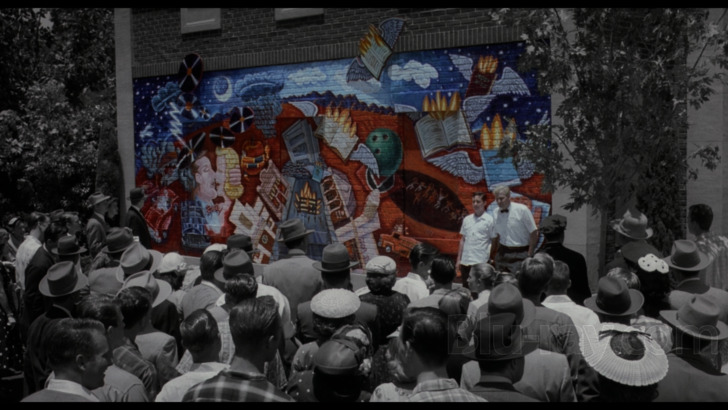
Pleasantville effectively shows how a typical 1950s family sitcom's lives are roughly the same as their off-screen lives too...and how they need to be shaken up! I wish that Gary Ross had gone bolder and taken more risks in deconstructing the societal values and mores that he's both commenting on and trying to uproot. Performances by both the leads and supporting actors are delightful. Randy Newman's score is terrific and close to the sublime musical heights he reached with The Natural (1984) and Avalon (1990).
I fully realize why Shout Select's release has caused a great deal of consternation among the Blu-ray.com community. Ross fully approved it and unfortunately eliminated a line of dialogue that can be considered a form of censorship. So while the UHD and BD look and sound quite good (the video is stronger than the audio tracks), this package cannot be considered definitive because the film has an incomplete presentation. (Even if the excision seems small, it is still significant because it's missing footage that was there in the theatrical and home video releases.) If you're not sensitive to the change, then you might want to pick up this set.

Similar titles
Similar titles you might also like

Whip It
2009

The Family That Preys
2008

Porky's
1981

Some Kind of Wonderful
1987

Fried Green Tomatoes
Extended Version
1991

But I'm a Cheerleader
Director's Cut
1999

Away We Go
2009

Elizabethtown
Paramount Presents #14
2005

Crazy in Alabama
1999

The Breakfast Club
Pop Art | 30th Anniversary Edition Disc
1985

Winter Passing
2005

The Wackness
2008

Arthur Newman
2012

Women in Trouble
2009

Ferris Bueller's Day Off
Bueller... Bueller... Edition
1986

The Longest Week
2014

Mother's Day
2016

Saved!
2004

A Very Brady Sequel
1996

Fun Size
2012