Playing for Time Blu-ray Movie
HomePlaying for Time Blu-ray Movie 
Blu-rayOlive Films | 1980 | 150 min | Not rated | Sep 24, 2013

Movie rating
7.5 | / 10 |
Blu-ray rating
| Users |  | 0.0 |
| Reviewer |  | 4.0 |
| Overall | | 4.0 |
Overview
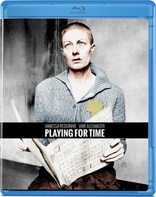
Playing for Time (1980)
Female prisoners in a Nazi concentration camp (Auschwitz) are spared from death in return for performing music for their captors.
Starring: Vanessa Redgrave, Jane Alexander, Maud Adams, Christine Baranski, Robin BartlettDirector: Daniel Mann
| Drama | Insignificant |
| Music | Insignificant |
Specifications
Video
Video codec: MPEG-4 AVC
Video resolution: 1080p
Aspect ratio: 1.34:1
Original aspect ratio: 1.37:1
Audio
English: DTS-HD Master Audio Mono
Subtitles
None
Discs
25GB Blu-ray Disc
Single disc (1 BD)
DVD copy
Playback
Region A (B, C untested)
Review
Rating summary
| Movie | | 4.0 |
| Video |  | 3.5 |
| Audio | | 4.0 |
| Extras |  | 2.5 |
| Overall | | 4.0 |
Playing for Time Blu-ray Movie Review
Music of the fears.
Reviewed by Jeffrey Kauffman October 1, 2013Vanessa Redgrave could hardly be considered a shrinking violet, as her now infamous acceptance speech at the 1978 Academy Awards, where she was fêted with a Best Supporting Actress Oscar for Julia, ably proves. Redgrave denounced what she termed “a small bunch of Zionist hoodlums”, drawing gasps from the audience and provoking an equally well remembered retort from Paddy Chayefsky later in the evening. While Redgrave’s complete speech that night also included a context of fighting against fascism, and while she averred that she would continue her personal fight against anti-semitism, she was already “branded” as a pro-Palestinian activist with little regard for the epochal historical forces which forged the State of Israel. It seems positively odd, then, that Redgrave would have been chosen just a couple of years later to portray one of the more celebrated Jewish survivors of the Holocaust, Fania Fénelon, a noted Parisian chanteuse and cabaret star who, despite being only half Jewish (but having worked with the French Resistance), was rounded up and sent to Auschwitz. After nearly perishing in a maelstrom of physical abuse, hard labor, disease and starvation rations, Fénelon found salvation—in a manner of speaking—when she was made a part of the Women’s Orchestra of Auschwitz. The real Fénelon was in fact aghast that Redgrave had been cast in the role, and apparently told Redgrave so to her face. Despite the outcry this choice raised, Redgrave found one of her most well remembered roles in a 1981 made for television film based on Fénelon’s autobiography Playing for Time which was also notable for having been adapted by legendary playwright Arthur Miller.
In comments that might strike some as ironic, Fénelon derided Miller and producer Linda Yellen for having supposedly “sanitized” her memoirs, making the horrors Fénelon and her fellow prisoners suffered seem less than totally soul shattering. That may seem incredible to those watching the film today, for it certainly does not shirk from the outright sadism deployed by the Nazis. From the very first sequence, where Fénelon and a horde of other Jews are crammed onto a stifling rail car and forced to endure indignities such as revealing themselves in a hopeless small (and overflowing) bucket in the corner (a bucket which tips over in one of the film’s early unsettling moments), we’re thrust into a nightmare world where formerly quite well to do people, respected people, are thrown headlong into a series of overwhelming circumstances—if, in fact, they were “lucky” enough to even survive.
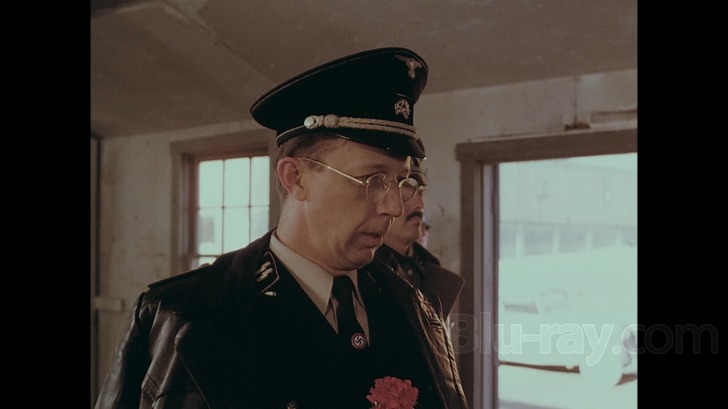
Fénelon’s criticisms seem especially strange when one considers the manifest differences between Playing for Time and Holocaust, another “event” television outing which had aired only three years or so prior to this presentation. Holocaust, which admittedly offered some fantastic performances from the likes of Meryl Streep and Michael Moriarty, still roused considerable ire from concentration camp survivors for what they at least perceived to be its almost cavalier treatment of this weighty subject. Playing for Time, on the other hand, seems tonally much more profound, to the point that it’s actually a difficult film to sit through at times. The suffering of the women—despite their “privileged” status as orchestra members —is palpable, and the despicable behavior of the Nazis is also rather shockingly portrayed.
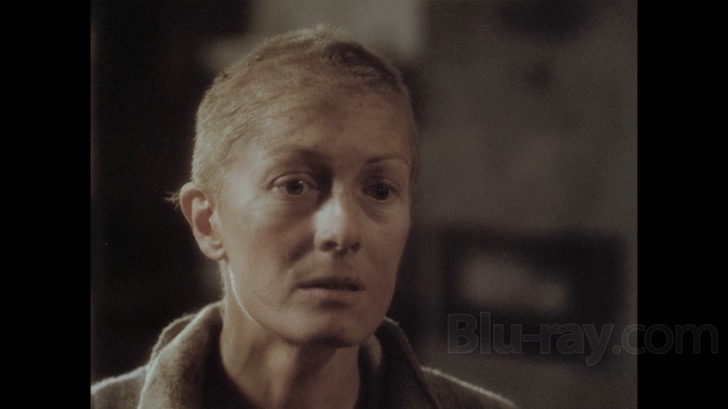
Redgrave may in fact have been physically unsuited to play the small and compact Fénelon, but she brings a searing emotionalism to the role that is hard to forget after it’s been experienced. She is forced to appear emotionally distraught (to say the least) in many major scenes throughout the film, and Redgrave brings a palpable intensity to these scenes. She’s matched by Jane Alexander in a wonderfully nuanced portrayal of Alma Rose, the real life niece of Gustav Mahler who became the group’s conductor. A huge supporting cast, including nice turns from the very young Melanie Mayron and Christine Baranski, also turns in heartbreaking vignettes.
What’s fascinating about Playing for Time’s thesis is how it works against the commonly formulated idea of “survivor’s guilt”. That phenomenon has tended to manifest in post traumatic stress disorders, after the calamity of whatever horror has been experienced has passed and the conscious mind begins to process what it’s been through. Here, however, the women of the orchestra are experiencing a weird combination of guilt and despair, simultaneous to the horrors unfolding before their eyes. Their guilt stems from their “special status”, however dubious that may be. Their despair stems from the fact that they are still subject to horrible abuse, even as they’re trotted out as “show ponies” (so to speak) for various Nazi dignitaries.
According to several online sources, director Joseph Sargent was replaced partway through filming, succeeded by Daniel Mann (who retains sole credit). While there is no noticeable difference in performances or overall style in Playing for Time, some of the directorial decisions (one would assume by Mann, since he was there when the film was being cut) may strike modern day eyes as distracting. The most notable of these is the weirdly filtered use of archival footage. Perhaps this was done to make old black and white elements blend in with a “modern” color film, but it’s odd looking, to say the least, to see a Nazi convoy traipsing into Paris, all shrouded in blue or some other color. The irony here is that this kind of footage, the actual reality of what happened, ends up looking decidedly more fake than the staged elements, which retain a gut busting verisimilitude despite having been dramatically enhanced.
Playing for Time Blu-ray Movie, Video Quality

Playing for Time is presented on Blu-ray courtesy of Olive Films with an AVC encoded 1080p transfer in 1.34:1. The elements utilized here are in decent but sometimes problematic shape, with quite a bit of minor damage in the form of scratches, specks and flecks fairly consistently on display. Colors also have faded quite a bit, though it should be stated outright that Mann has opted for a desaturated palette here cast mostly in browns and greys, which emphasizes the drab, depressing environment of Auschwitz. That said, a quick review of that iconic "Nazi red" shows things skewing slightly toward the orange-brown side of the spectrum, and flesh tones also edge toward brown quite a bit of the time. Intrestingly, saturation and color accuracy improve markedly at around the 1:30:00 mark, only to retreat to the more faded appearance a while later. There's also one brief problematic scene at around 46:00 where mosquito noise spikes during a very dark moment. Fine detail is acceptable, but never overwhelmingly strong, and while this transfer boasts a natural appearance, it's often quite soft looking. Contrast is highly variable, but my hunch is at least some of this was done intentionally. A recurrent motif in the film has the bright outdoor environments blinding the prisoners, and that seems to have informed the actual approach toward contrast, where doors opening up to reveal the outdoors will bring with it a flood of blooming white light.
Playing for Time Blu-ray Movie, Audio Quality
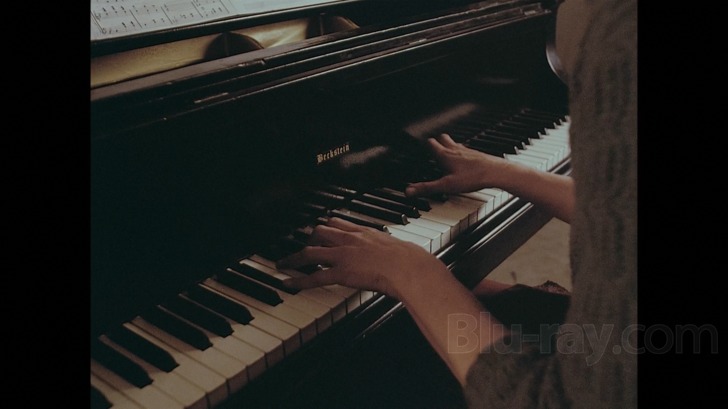
Playing for Time features a lossless DTS-HD Master Audio Mono track (presented via DTS-HD Master Audio 2.0), which accurately recreates the film's dialogue and music. The out of tune, tinny sounds of the Auschwitz orchestra may grate on some ears, but that's testament to the accuracy of the track, which is quite bright though never brittle. Everything is well prioritized, though the film traffics in lots of simultaneously spoken dialogue at times, making things sound a bit crowded now and then.
Playing for Time Blu-ray Movie, Special Features and Extras
While there are no on disc supplements, this is the rare Olive release with a fairly hefty insert booklet which features a fascinating essay called Playing For Time: Vanessa Redgrave and the Labor of Performance by Terri Ginsberg, Ph.D. Ginsberg, the author of Holocaust Film, gets into the whole sordid history of Redgrave's Oscar speech, her pro- Palestinian activism and the uproar her casting in this film caused, but she also devotes time to the film itself as well as to other performers like Jane Alexander. This is a compelling read and comes highly recommended. While I typically only score non-disc supplements if the disc also has supplements, in this case the excellence of the essay deserves an exception.
Playing for Time Blu-ray Movie, Overall Score and Recommendation
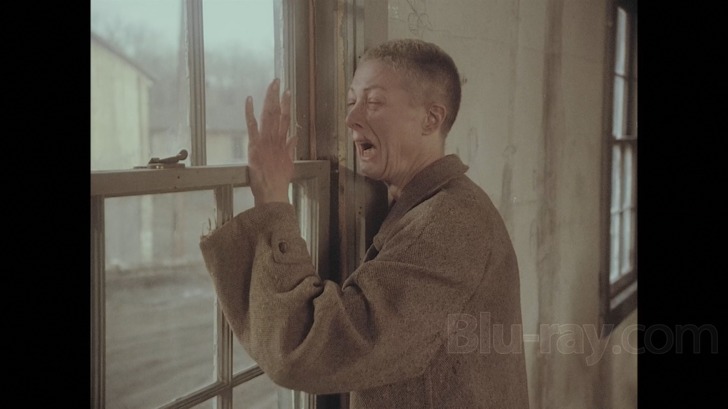
Make no mistake about it, Playing for Time is not an easy film to watch, even if has (in Fénelon's words) "sanitized" what actually went on. The film is a devastating analysis of the horrible choices camp prisoners had to make on a virtually moment by moment basis. While Redgrave's casting caused incredible angst among many Jews and Holocaust survivors back when this made for television film first aired, from the vantage point of hindsight, and removed from any extra-curricular context (so to speak), her performance is amazingly visceral and incredibly well modulated, given that she spends so much of the film at or near the breaking point. Alexander is also pitch perfect as the hard nosed conductor who has seen the handwriting on the wall and who has decided there's only one way to make it through the madness alive. This Blu-ray has occasionally problematic video, but it still comes Highly recommended.
Similar titles
Similar titles you might also like
(Still not reliable for this title)

The War Is Over
La guerre est finie
1966

Captain Fantastic
2016

The Handmaid's Tale: Season Three
2019

Love 3D
2015

Land
2021

Breathe In
2013

Supernova
2020

Plenty
1985

Sweet Movie
1974

The Image
1975

Tommaso
2019

I, Daniel Blake
2016

The Mortal Storm
Warner Archive Collection
1940

Promised Land
2012

Won't Back Down
2012

Woman Walks Ahead
2017

The Girlfriend Experience
2009

Rust Creek
2019

Teachers
1984

The Accidental Tourist
Warner Archive Collection
1988