Piotr Anderszewski: Unquiet Traveller Blu-ray Movie
HomePiotr Anderszewski: Unquiet Traveller Blu-ray Movie 
EUROARTS | 2010 | 83 min | Not rated | Jun 29, 2010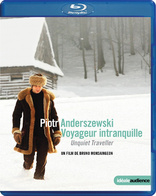

Movie rating
Movie has not been rated yetBlu-ray rating
| Users |  | 0.0 |
| Reviewer |  | 4.0 |
| Overall | | 4.0 |
Overview
Piotr Anderszewski: Unquiet Traveller (2010)
Everything about Piotr Anderszewski is extraordinary: his talent, his repertoire, his constant questioning of his work as a performer. Any film about this highly unconventional pianist owes it to itself to depart from the beaten path: On the borderline between documentary and fiction, this “road movie” is set against the backdrop of a winter journey by train across Poland with a piano installed on board... Punctuated by Piotr’s highly personal reflections, the repertoire consists of essential pages by Bach, Mozart, Chopin, Beethoven, Schumann and Szymanowski. Nominee of the 2010 Midem Classical Awards.
Starring: Dorota AnderszewskaDirector: Bruno Monsaingeon
| Music | 100% |
Specifications
Video
Video codec: MPEG-4 AVC
Video resolution: 1080i
Aspect ratio: 1.78:1
Original aspect ratio: 1.78:1
Audio
English: LPCM 2.0
English: LPCM 5.1
Polish: LPCM 2.0
French: LPCM 2.0
German: LPCM 2.0
Subtitles
English, French, German, Polish
Discs
25GB Blu-ray Disc
Single disc (1 BD)
Playback
Region A (B, C untested)
Review
Rating summary
| Movie | | 4.0 |
| Video | | 4.0 |
| Audio |  | 4.5 |
| Extras | | 0.0 |
| Overall | | 4.0 |
Piotr Anderszewski: Unquiet Traveller Blu-ray Movie Review
Polish pianist Piotr Anderszewski is profiled in this interesting piece by famed documentarian Bruno Monsaingeon.
Reviewed by Jeffrey Kauffman June 17, 2010Bruno Monsaingeon likes pianists, no doubt about it. His long association with Glenn Gould resulted in a number of very interesting documentaries during that keyboard master’s life, and in September 2009 I reviewed the fascinating post-mortem documentary Monsaingeon helmed about Gould, Glenn Gould: Hereafter. Piotr Anderszewski may not yet (yet) be in the same league of renown that Gould achieved, but he is a Polish pianist of formidable skill who has been amassing an impressive array of awards and recordings now for the past several years. Anderszewski, like Gould, is a hyper-analytical soul, prone to singing along with his playing, with unkempt good looks that have made him something of a matinee idol among classical piano groupies. Piotr Anderszewski: Voyageur intranquille (Unquiet Traveller) is an interesting, if at times annoyingly over mannered, peek inside Anderszewski’s private ruminations about life and art as he tours Europe aboard a private train complete with grand piano.
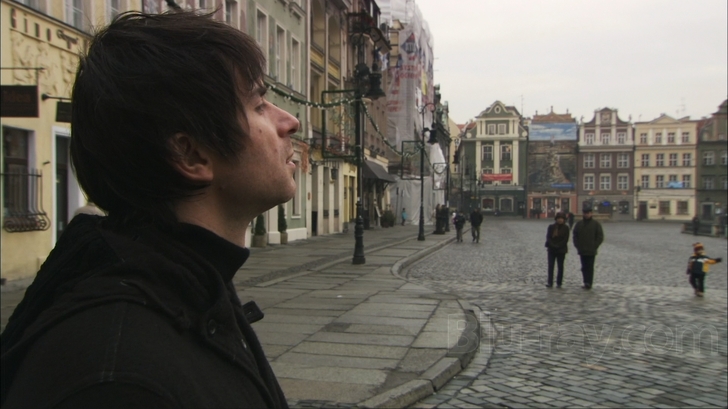
Piotr takes in the sights before a performance.
Though Anderszewski was born in 1969, he seems inordinately haunted by the destruction of Warsaw during World War II, perhaps due to the influence of his Grandmother, a spry woman who evidently remembers both the World Wars and has passed those memories down to her grandson. Anderszewski’s persona, then, is that somewhat unique Eastern European mélange of sophistication and melancholy, something that comes out quite clearly not only in his playing, as febrile as it often is, but also in his offhanded comments about various composers and the works of theirs he’s tackling.
The pianist is probably spot on with his analysis of Mozart, commenting on that composer’s “delightful impertinence,” and Anderszewski’s summary of his fellow countryman Chopin is both poetic and completely appropriate: “He’s a Slavic soul all dressed up in an impeccable French suit.” He’s also quite forthright about another Polish composer, Karol Szymanowski, and how that man’s music brought Anderszewski through some times of trial and turbulence (rather ironic, considering the stingingly brittle harmonies Szymanowski often utilizes). But there are other times when Anderszewski’s nonstop analyses seem odd, to say the least, and perhaps outright outré.
One can almost understand his insistence that “everything in Chopin is too fast,” but when Anderszewski takes Brahms to task, lovers of one of the titans of classical music may be left scratching their heads. Anderszewski mentions that once Brahms was his favorite composer, but that he’s since decided there are drawbacks to the great German master’s oeuvre because “the problem with Brahms is you feel he’s already an interpreter—of Bach, of Beethoven,” thereby, one supposes, robbing a keyboard artist of his intrinsic “right” to interpret a musical work himself. Anderszewski perhaps realizes he’s overstepped the bounds of classical music decorum and quickly adds that Brahms is “a perfect composer, but that determination to be perfect is what bothers me,” since the pianist feels that same quest for perfection is a symptom of his own malaise.
Voyageur intranquille is not a concert documentary by any means, and in fact there remarkably few complete performances contained within it. Instead we tag along with Anderszewski on his deluxe touring train as he travels the bucolic byways of Europe to get to his next major metropolis where he’ll concertize. As a result, we get a nice array of scenery, either passing by the windows of the brightly colored train, or brief travelogue like moments after Anderszewski as alighted at his various destinations. Along the way we meet two members of his family, his sister, the concert violinist Dorota, who joins him in some Szymanowski sonatas, and his aforementioned Grandmother, whom he meets in Budapest. In one of the funnier and more pointed moments of the documentary, Grandma scolds Piotr to look at her when he’s talking, as he is only too aware of the camera at times.
In fact it’s that slightly narcissistic quality to the proceedings that may be off putting to some viewers of this documentary. Anderszewski is so relentlessly self-reflective that some more jaded souls may be tempted to reach through the television screen and give him a quick slap, echoing Cher’s famous line from Moonstruck, “Snap out of it!” This self-involved aspect plays out in Anderszewski’s insistence on singing along with his playing, which becomes overbearing at times. Unlike Gould, Anderszewski doesn’t seem rhapsodically carried away by the music, singing almost intuitively and uncontrollably as the great Canadian pianist did. Instead, our Polish keyboard wizard seems to think he’s actually elucidating hidden elements of pieces by declaiming them vocally, when instead all he’s accomplishing is covering up his own facile piano playing.
As with his Gould pieces, Monsaingeon crafts a careful and deliberate portrait of an artist as a middle-aged man, questioning his own accomplishments and trying to place his life in the context of epochal events that affected his home country and his ancestors, some of whom are still living. Monsaingeon is a very smart filmmaker, and gives us a variety of monologue segments intercut with brief snippets of performances. There’s also some very intelligent editing and segues here, including my personal favorite, when Anderszewski, in talking about his twin nightmares of the early death of Mozart and the destruction of Warsaw during World War II, pounds out a cadence of a Mozart piece which Monsaingeon intercuts with two blasts of artillery fire from an old archival film of the bombing of the Polish capital in the 1940’s.
Anderszewski hasn’t quite attained the world wide renown that Gould enjoyed, perhaps, as chauvinistic as it may sound, due to his Polish heritage. This film helps highlight the pianist’s effortlessly fiery qualities at the keyboard while also illuminating an unusually introspective and analytical mind. In fact, that very analytical aspect is probably both a blessing and a curse for Anderszewski. It allows him to peer into the depths of music, helping to elucidate its mysteries for appreciative audiences. It also demands that he look into the depths of his own soul, where even he is unable to fully fathom the enigmas he finds.
Piotr Anderszewski: Unquiet Traveller Blu-ray Movie, Video Quality
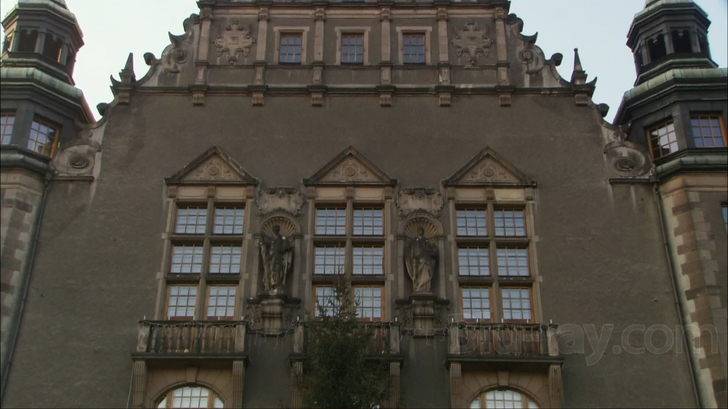
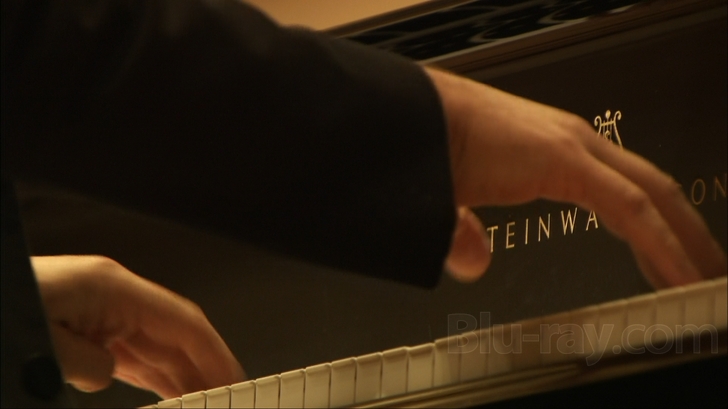
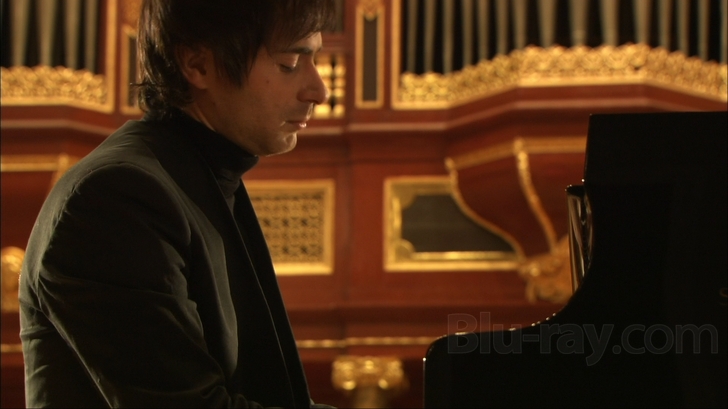
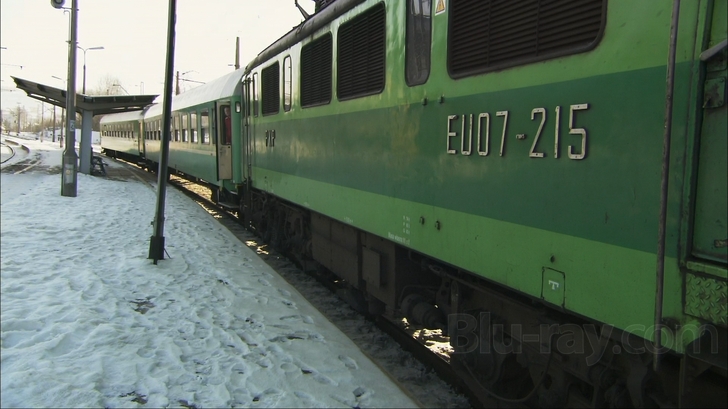
Piotr Anderszewski: Voyageur intranquille (Unquiet Traveller) arrives on Blu-ray from Idéale Audience with a good, if occasionally problematic, AVC encoded 1080i "live" transfer, with an aspect ratio of 1.78:1. This is an unusually scenic documentary which is not confined to performance halls. We therefore get everything from the snow strewn railroad tracks of Poland to the sparkling nightlife of the City of Lights, Paris. All of this is presented with good to excellent clarity and some remarkably well saturated colors. Look, for example, at the brilliantly green painted train that Anderszewski tours in. As with a lot of interlaced videos, there are moments when fine detail can't resolve properly and we get some noticeable shimmer. When the camera pans around an Eastern European village square, for example, windows at the far end of the frame shimmer rather badly. On the plus side, close-ups reveal a wealth of detail, including Piotr's fly-away hair and virtually every hair on the back of his hands as he plays the piano.
Piotr Anderszewski: Unquiet Traveller Blu-ray Movie, Audio Quality
There are a coterie of lossless audio tracks included on this Blu-ray, including two in English (LPCM 5.1 and 2.0), as well as LPCM 2.0 tracks in French, Polish and German. The really interesting thing is it sounds like Anderszewski himself not only on the English tracks, but the Polish (which is to be expected, considering his ethnic heritage) and the French. Only the German seems to be dubbed. All of these tracks are excellently clear. Some audiophiles may be disappointed that there isn't more actual unadulterated performance footage here. Instead we get a lot of talking, which is always front and center, intercut with some snippets of piano and orchestral music. Therefore, the 5.1 track is a little anemic in surround activity, though some ambient noise does creep into the surround channels, and the brief segments with orchestras do involve all the channels. There's really not a huge difference here between the English 2.0 and 5.1 tracks, but considering the dialogue heavy emphasis of this documentary, I sincerely doubt too many people will be radically disappointed with the results.
Piotr Anderszewski: Unquiet Traveller Blu-ray Movie, Special Features and Extras
No on disc supplements (other than trailers) are included. The insert booklet contains a nice essay by Monsaingeon.
Piotr Anderszewski: Unquiet Traveller Blu-ray Movie, Overall Score and Recommendation
Even if you're a classical music fan, you may not be overly familiar with Anderszewski. You still may want to spend an hour and a half or so with the man, as Monsaingeon's documentary is both insightful and very, very scenic. If the artist occasionally seems a bit too self-absorbed for his own good, isn't that typical of great masters? And Anderszewski is inarguably one of the greatest pianists working today, as "unquiet" as he may be in his private life.