Pink Floyd: At Pompeii MCMLXXII Blu-ray Movie
HomePink Floyd: At Pompeii MCMLXXII Blu-ray Movie 
Legacy Recordings | 1972 | 1 Movie, 2 Cuts | 147 min | Not rated | May 02, 2025

Movie rating
8.2 | / 10 |
Blu-ray rating
| Users |  | 4.8 |
| Reviewer |  | 4.5 |
| Overall | | 4.5 |
Overview
Pink Floyd: At Pompeii MCMLXXII (1972)
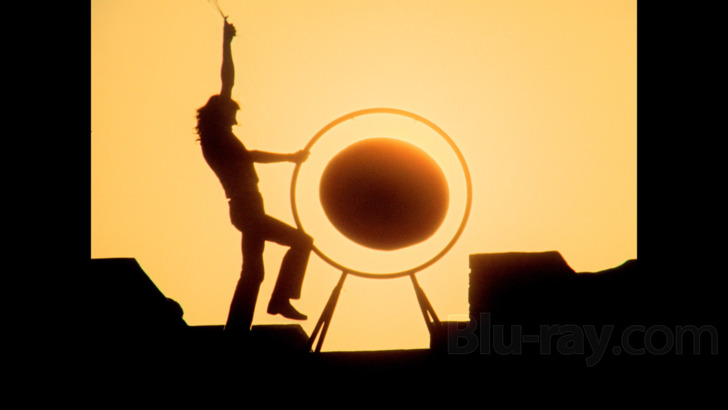
Live versions of the songs, filmed in an old Pompeii amphitheater. Songs included are Echoes (split into 2 parts), Careful with that axe, Eugene, A saucerful of secrets, One of those days, Set the controls for the heart of the sun, Mademoiselle nobbs (Seamus, but with Rick's dog on vocals). "Careful" and "Set the controls" are shot at night with minimal lighting, setting a beautiful mood. And the live Saucerful just has to be seen, with Waters jumping around in the sunlight banging the huge gong. The 80-minute version features studio footage from the recordings of Dark side of the Moon, with alternate versions of Us and them, On the run and Brain Damage, as well as hilarious interviews with the band.
Starring: Roger Waters, David Gilmour, Richard Wright (II), Nick Mason, Pink FloydDirector: Adrian Maben
| Music | Uncertain |
| Documentary | Uncertain |
Specifications
Video
Video codec: MPEG-4 AVC
Video resolution: 1080p
Aspect ratio: 1.37:1
Original aspect ratio: 1.37:1
Audio
English: LPCM 2.0 (96kHz, 24-bit)
English: Dolby TrueHD 5.1 (96kHz, 24-bit)
English: Dolby Atmos
English: Dolby TrueHD 7.1 (48kHz, 24-bit)
Subtitles
None
Discs
Blu-ray Disc
Single disc (1 BD)
Playback
Region free
Review
Rating summary
| Movie |  | 4.0 |
| Video | | 4.0 |
| Audio | | 5.0 |
| Extras |  | 1.0 |
| Overall | | 4.5 |
Pink Floyd: At Pompeii MCMLXXII Blu-ray Movie Review
Reviewed by Justin Dekker May 7, 2025Recorded from October 4th through the 7th of 1971 in Pompeii's Roman Amphitheater, 'Pink Floyd at Pompeii MCMLXXII' arrives on Blu-ray
courtesy of Legacy Recordings. This release offers viewers two different viewing experiences: one being the feature film, which includes the full track
list intercut with candid moments, interviews, and studio footage; and the other being the concert, which removes all of the other elements and
simply focuses on the music. This release sees its 1080p presentation as the product of a Remastering from the original 35mm elements and includes
two new (2025) audio mixes by Steven Wilson. A 10-page booklet is also included.
Concert films can sometimes be a risky proposition. The best spend the bulk of their time with the band, capturing the critical moments from each
musician in any given song and providing just enough audience-related material to provide a sense of scale for the venue and document the crowd's
reaction. Others skew too far in that direction, leaving viewers wondering when the cameras will turn back to the people making the music instead of
focusing so diligently on those listening to it. When Director Adrain Maben (Chit Chat With Oysters (2013), All Hell Let Loose: The Demonic World
of Hieronymus Bosch (2003)) approached Pink Floyd about doing something a bit different, they took some convincing. But the idea of an
audienceless concert filmed in an utterly unique and memorable location eventually took hold, resulting in a recording of a set list that includes some
of the band's strongest and most enduring early work. David Gilmour (guitar, vocals), Nick Mason (drums), Roger Waters (bass, vocals, percussion),
and Richard Wright (keys, vocals) hold the vast majority of the camera's attention throughout, with the only real deviations being brief investigations
of the historic location of the shoot.
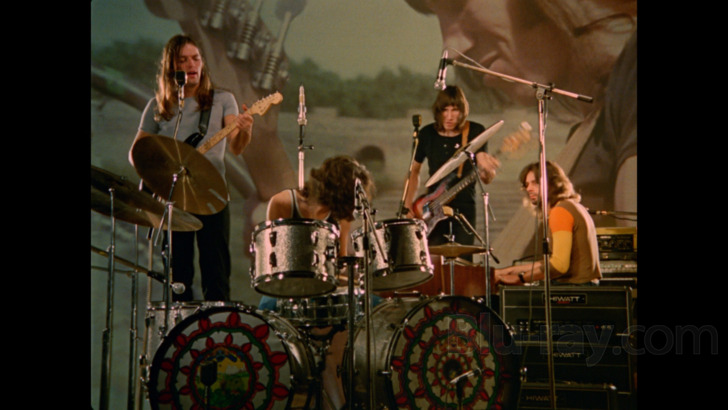
After the intro, the setlist begins in earnest with Echoes - Part 1; Echoes being the 23-minute track that consumes the entirety of Meddle (1971) 's second side. Here, the expansive track is split and serves as the concert's bookends. Waters has an opportunity to provide lead vocals on "Set The Controls for the Heart of the Sun" and turns in some percussion work later on, where his silhouetted body is seen energetically playing the gong as the sun sets behind him. Meddle's "One of These Days", a decided musical and sonic highlight of the setlist, appears in the approximate middle, before Wright does some animal wrangling on "Mademoiselle Nobs" and "Echoes - Part 2" circles back around to close out the show. The band is confident, and the individual performances are remarkable, with each musician afforded opportunities to explore and improvise in ways that serve the song without feeling self-indulgent. While the stagecraft on display in Pompeii may not match that to which most modern audiences have grown accustomed, the band lets the music be the focus and the main attraction, and it does not disappoint.
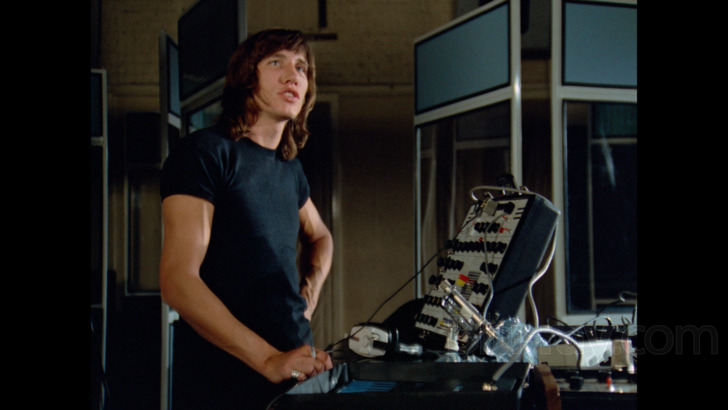
In between songs, the camera spends time with the band in a variety of settings - initially during some candid moments where the band grabs a bite to eat, discusses a number of subjects, including music, and Nick Mason labors unsuccessfully to obtain a piece of crustless apple pie with some ice cream. In short interview segments, the various members individually discuss the band's financial success and their continued musical evolution, both in terms of sound and musical identity, and their willingness and desire to experiment with new and emerging technologies to which they have access. Waters' comments and opinions typically seem to have some degree of an edge to them, while Gilmore seems more focused on crafting funny responses. Both men, however, are markedly different when the camera catches them in the studio, with each demonstrating incredible focus on the music they're creating.
The track listing for the two cuts is as follows:
Feature Film
- Pompeii Intro
- Echoes - Part 1
- Careful With That Axe Eugene
- A Saucerful of Secrets
- Us and Them
- One of These Days
- Set the Controls for the Heart of the Sun
- Brain Damage
- Mademoiselle Nibs
- Echoes - Part 2
- Pompeii Intro
- Echoes - Part 1
- Careful With That Axe Eugene
- A Saucerful of Secrets
- Us and Them
- One of These Days
- Set the Controls for the Heart of the Sun
- Echoes - Part 2
Pink Floyd: At Pompeii MCMLXXII Blu-ray Movie, Video Quality
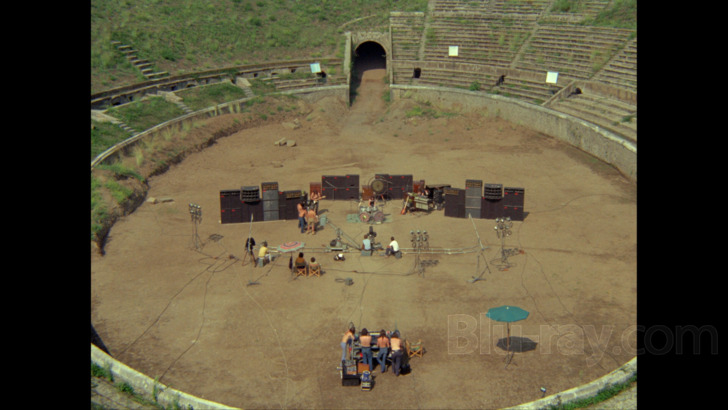
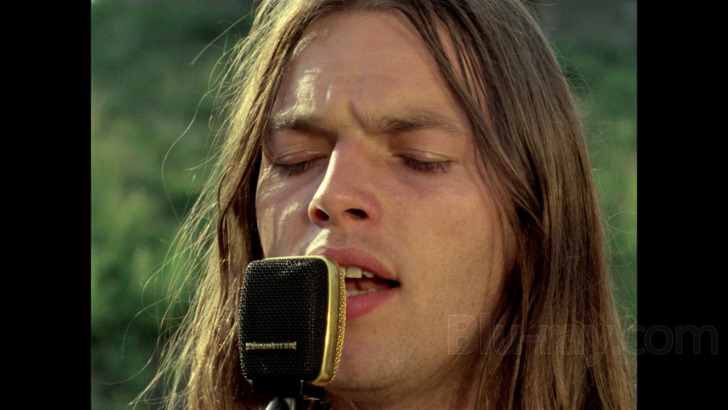
To prepare the 1080p presentation on display here, the original 35mm film negatives were scanned at 4K before work was performed with regard to color timing and removing dirt, debris, and damage. The film looks impressive, and Pink Floyd fans should be extremely pleased with the final product on display here. Wonderfully filmic in appearance, colors are richly saturated within the film's naturally realistic color palette. Fine detail is typically high. Close-ups from the studio-bound interview segments as well as those shot in Pompeii reveal amazing amounts of information, from Gilmore's fly-away hairs to facial hair stubble and fine lines and wrinkles. Various particulars on the instruments are also easily observable, from Mason's much- abused drumheads to scuffing and wear on Gilmore's guitar, beverage rings on Wright's organ, and signs of wear on the gong that Waters enthusiastically smashes from time to time. Midrange shots of the quartet performing fare favorably as well, again with significant amounts of fine detail for fans to explore. Shots from Pompeii's crumbling ruins are likewise solid, with various textural details of the varied surfaces presenting with a tactile presence. Long-range shots can sometimes veer toward softness, and were the most prominent issue I noticed, other than sporadic black crush. Fine grain is persistently present and, on the whole, resolves well enough without generating distracting noise or significant amounts of clumping or chunkiness. It's worth a mention, though, that for all that work that was done in crafting this image, there are a few, "blink and you'll miss it" moments of damage or debris that haven't quite been eradicated, with one such instance resulting in me rewinding several times to make sure I saw what I saw before I finally was reduced to proceeding frame-by-frame to investigate what the source of the brief and small anomalie was. This is not an indictment by any means, it's rather a reinforcement of how few instances of damage or debris remain and how relatively negligible they are. All of that said, the overall image on display is quite wonderful.
Pink Floyd: At Pompeii MCMLXXII Blu-ray Movie, Audio Quality
Steven Wilson, who has remixed a sizeable number of rock albums for a wide range of artists, was tasked with creating the new 5.1 TrueHD and
Dolby Atmos mixes for this latest release of Pink Floyd at Pompeii MCMLXXII. To do so, he used the original source material crafted by
Charles Rauchet
and Peter Watts
which is described as four mono tracks, one for each instrument. Time was spent removing tape hiss and other audio issues to produce the clean-
sounding tracks that allow the focus to remain on the musicianship of the group without any unnecessary or unfortunate distractions. While a 2.0
Stereo mix is available, and those looking for a more authentic or vintage listening experience will likely be drawn to that option, for the purposes of
this review, I spent the bulk of my time with the Dolby TrueHD 5.1 and Dolby Atmos mixes.
The first thing I noticed about the new Dolby TrueHD 5.1 mix is how punchy and muscular it is, and yet it still offers incredible balance. Every
instrument is given its
space, with none truly conspiring to overpower another unless it's purely by virtue of how the song is crafted and/or where the group is relative to
their musical exploration. Gilmore's guitars frequently shine, as they so often do and should, but additional heft and power are added to Waters' bass
work and Manson's drums. Waters' efforts seem more propulsive here than they've sounded previously, and the camera often lingers on Mason for
extended periods of time, allowing the viewer to truly focus on and enjoy his playing. The new 5.1 mix makes this a definite highlight, sweeping the
viewer/listener up in his energy, marveling as he loses his grip on a drumstick and seamlessly grabs a replacement without missing a beat.
The Dolby Atmos mix, strangely an option for the feature film but not the concert experience, seems bent more on nuance and subtlety to craft a
more complex listening experience. Here, I felt there was greater clarity and sound separation, both of which were relatively instantly and
consistently detectable. Various musical elements and effects moved more freely and fluidly through the sound stage, crafting a more interesting and
layered
concert. While the height speakers weren't as detectably pressed into service as often as I might have liked, again, the balance achieved here is
spectacular.
The choices made make the track a more than appropriate partner to the video image on display, which, while it so loudly visually proclaims its 1970s
origins, never feels out of place or anachronistic. It simply and effectively supports the musical exploration we're witnessing.
After toggling back and forth between these two audio tracks, I'm forced to admit that I would be hard pressed to endorse a clear "winner", as I
believe there is much to recommend them both. Ultimately, the choice, I believe, is going to boil down to personal preference. Some may find
themselves drawn to the more powerful 5.1 mix, while others will opt for the greater clarity and precision offered by the Dolby Atmos track. Those
who prefer the 5.1 track have the freedom to select between the two cuts offered here, while those squarely on team Dolby Atmos are confined to
the Feature Film option.
Pink Floyd: At Pompeii MCMLXXII Blu-ray Movie, Special Features and Extras
The sole element of supplemental material included with this release is a 10-page booklet that begins with relatively standard liner notes and credit information. However, curiously, no specific information about the work performed to generate this release's audio or video presentation is found inside. The bulk of the booklet is comprised of photographs. There's a black-and-white centerfold depicting the filming set-up, several photos of murals found at the location, a number of candid shots of the band performing, as well as a two-page publicity shot of the four gentlemen sitting atop a wall. This release does not have any on-disc extras.
Pink Floyd: At Pompeii MCMLXXII Blu-ray Movie, Overall Score and Recommendation
Pink Floyd at Pompeii MCMLXXII captures the influential band in one of their more interesting periods between the departure of Syd Barrett and before the more well-known (at least to more modern rock fans) and commercially successful releases of "Wish You Were Here", "The Dark Side of the Moon", and "The Wall". Each member of the band is given their moment in the spotlight among the various songs performed here, with, in my opinion, Gilmour's expressive guitarwork and Mason's impressive drumming being particularly captivating. The images in and around Pompeii that are intermixed with the performance are fascinating. While almost otherworldly, they enhance rather than overshadow the experience. Graced with an impressive 1080p video presentation and two excellent audio options, Pink Floyd at Pompeii MCMLXXII comes very highly recommended.

Similar titles
Similar titles you might also like

Pink Floyd: The Wall
1982

The Song Remains the Same
Led Zeppelin
1976

Pink Floyd: The Story of Wish You Were Here
2011

Pink Floyd: Classic Albums - The Making of The Dark Side of the Moon
2001

Pink Floyd: Delicate Sound of Thunder
1988

The Who: The Kids Are Alright
1978

The Who: Live at the Isle of Wight Festival 1970
1970

Springsteen & I
Bruce Springsteen
2013

Sound City
2013

Stop Making Sense
1984

Score: A Film Music Documentary
2016

Oasis: Supersonic
2016

Oasis: Knebworth 1996
2021

Linda Ronstadt: The Sound of My Voice
2019

Searching for Sugar Man
2012

All Things Must Pass: The Rise and Fall of Tower Records
2015

David Gilmour - Remember That Night - Live At The Royal Albert Hall
2007

Pink Floyd: Animals
Atmos Remix / Blu-ray Audio
1977

The Last Waltz
1978

Rush in Rio
2003