Philip Glass: Einstein on the Beach Blu-ray Movie
HomePhilip Glass: Einstein on the Beach Blu-ray Movie 
Opus Arte | 2014 | 264 min | Not rated | Oct 28, 2016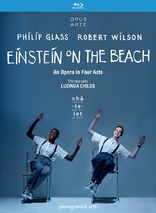
Price
List price:Listed on Amazon marketplace

Movie rating
6.5 | / 10 |
Blu-ray rating
| Users |  | 0.0 |
| Reviewer |  | 3.5 |
| Overall | | 3.5 |
Overview
Philip Glass: Einstein on the Beach (2014)
| Music | 100% |
Specifications
Video
Video codec: MPEG-4 AVC
Video resolution: 1080i
Aspect ratio: 1.78:1
Original aspect ratio: 1.78:1
Audio
English: DTS-HD Master Audio 5.1
English: LPCM 2.0
Subtitles
None
Discs
Blu-ray Disc
Two-disc set (2 BDs)
Packaging
Slipcover in original pressing
Playback
Region A (B, C untested)
Review
Rating summary
| Movie | | 3.5 |
| Video | | 3.5 |
| Audio |  | 4.0 |
| Extras |  | 2.5 |
| Overall | | 3.5 |
Philip Glass: Einstein on the Beach Blu-ray Movie Review
Reviewed by Jeffrey Kauffman January 16, 2017It’s perhaps debatable as to whether audiences are getting stupider, but if social media and personal experience are any indication, they’re almost certainly getting ruder. My Facebook feed has been filled with all sorts of complaints, including links to various articles, about loud popcorn munchers in various movie houses, many of which argue the time honored tradition of chomping down an incredibly overpriced bag of “butter flavoring” slathered kernels should be completely eliminated. A few months ago my wife and I attended a concert by a large choir where the choir’s Board President came out beforehand and specifically reminded the audience to turn off their cellphones, since the concert was being recorded. You can probably guess what happened next, even if you can’t guess the absolute dunderheadedness involved—a man in the front row had his cell phone go off, and he then proceeded to have a conversation during one piece. Incredibly, not once but twice more his phone rang during the concert, and he just answered it and spoke to the other party as if he were in an isolation booth. The conductor, who is a friend of mine, showed incredible restraint (I told him I would have stopped the choir dead in their tracks at the first incident and turned around and told the guy to shut the you know what up), but at least another audience member read the guy the riot act after the concert had ended. This is all to say that there is a rather unbelievable, and unbelievably long, example of audience stupidity and/or rudeness at the head of this performance of Einstein on the Beach, probably an “opera” in name only, given its rather abstract and some might argue abstruse proclivities. But even given the “performance art” aspects of the piece, it boggles the mind that the audience in this Théâtre du Châtelet production seems to be completely (or at least largely) unaware that the damn show has started (for crying out loud) until virtually 20 minutes into the thing. That means that despite performers already being on stage, and an increasing number of them arriving in the pit (where they’re easily visible to the audience), people just keep yacking as if there’s nothing going on, and an incredible number of audience members are even standing around having little tête-à-têtes despite the fact that there’s music being played and action both onstage and in the pit has more than obviously begun.
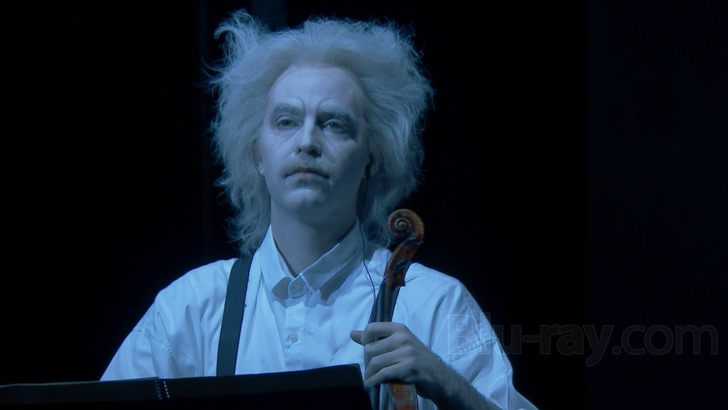
There are pull quotes from the creative team behind Einstein on the Beach printed (as excerpts) on the slipcover of this release but in fuller forms inside the DigiBook which some may find illuminating, since this is such a seemingly intentionally obfuscatory work at times. Director and designer Robert Wilson offers this:
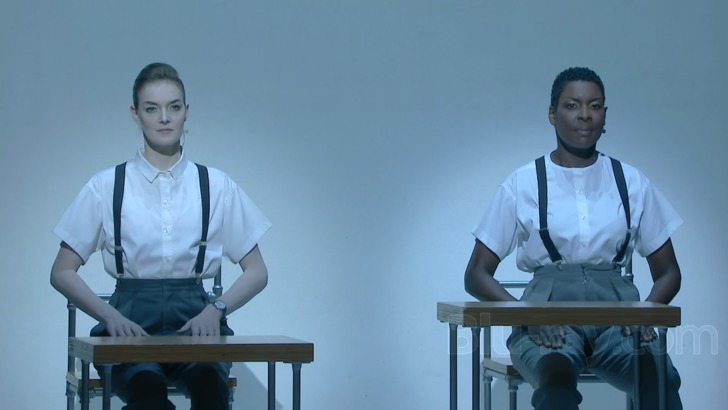
In 1976, I created an opera with Philip Glass called Einstein on the Beach. I began with this photo of Einstein in his study at Princeton. All of the performers were dressed in the same way: baggy gray pants, starched white t shirts and suspenders. They wore tennis shoes and a wrist watch. I looked at many photos of Einstein. Photos of him when he was two years old, 20 years old, 40, 60, 70 years old, and in all standing portraits of him, he held his hand in the same position as in the photo. The little space between his thumb and the next finger is always the same. I started the opera with this gesture. And continued. I thought about this space: between his two fingers he held his chalk with which he made his calculations. He held the bow for the violin which he loved to play. And he pulled the ropes of the sailboat that was his favorite pastime.Meanwhile, composer Philip Glass is quoted as saying:
I don’t care about music theory. I’m only interested in listening to music. I begin by listening. Like images emerging from the mist and becoming visible.(For those who do care about music theory, or are at least curious, I get into some of the "nuts and bolts" and/or dominants and tonics of Glass' music in my Visitors Blu-ray review as well as my interview with Godrey Reggio, that film's director.)
While those two quotes may give some idea as to the artistic genesis and ethos of the project, choreographer Lucinda Childs contributes this:
It was the time of pop art and minimalism, often one set against the other. Pop art is a proclamation of the end of the world. The minimal movement is a new beginning. The desire to re-envisage the world and things in a more serious fashion, and a more formal fashion, too. I wanted to translate it into a mathematics of dance: to explore and attempt to exhaust all the possible variations arising from a simple choreographic phrase. Solely by changes in direction, the position of some dancers in relation to others. . .The structure underlying each dance is not arbitrary or created from mathematical systems. I select linked sequences of movements using improvisation techniques to be able to present specific variations according to a logic inherent in each dance. Initially, I began making notations once the dances were finished, so that the dancers did not have to remember their part in the event of any changes within the group. Each notation is a schematic map made specifically for each dance. The notation maps out the path of each dancer within the space, but not the actual movement sequence, and each configuration represents a specific segment of the dance in time and space.I’m no rocket scientist, let alone an Einstein, and so I can’t really speak as to what if anything Einstein on the Beach “means”, other than that it’s a fascinating and near trance inducing piece, with Childs’ dance movements often weirdly repetitive in the same way Glass’ music tends to be. There are odd vignettes sprinkled through the piece, some of which are tied at least tangentially to imagery associated with Einstein. The vaunted physicist appears downstage right, playing the violin, as various other activities unfold on stage.
This is a piece that some may accuse (perhaps understandably) of being pretentious and almost willfully opaque, but for those who love the ebb and flow of minimalist music, the “opera” (which I’d actually liken to more of a performance art piece crossed with balletic elements) offers a visual analog to Glass’ music which is quite different from Reggio’s cinematic collaborations, but which often evokes the same hypnotic fervor.
Philip Glass: Einstein on the Beach Blu-ray Movie, Video Quality
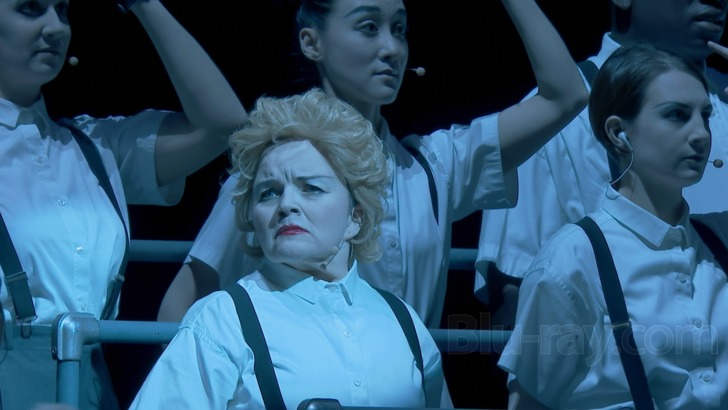
Einstein on the Beach is presented on Blu-ray courtesy of Opus Arte with an AVC encoded 1080i transfer in 1.78:1. Wilson's design aesthetic is appropriately minimalist, and a lot of the opera plays out on a bare (or nearly bare) stage, though Act III ups the ante with a kind of framework set that is oddly similar to Boris Aronson's original design for Stephen Sondheim's musical Company. The palette is fairly bland a lot of the time, playing out in tones of cool blues, slate grays, whites and occasional pops of red. Detail levels are good to very good in close-ups, but some rather alarmingly low bitrates (like at the 4-5 Mbps level) may contribute to what are prevalent signs of banding and macroblocking, especially when elements like sprays of mist or cloud like projections are utilized.
Philip Glass: Einstein on the Beach Blu-ray Movie, Audio Quality
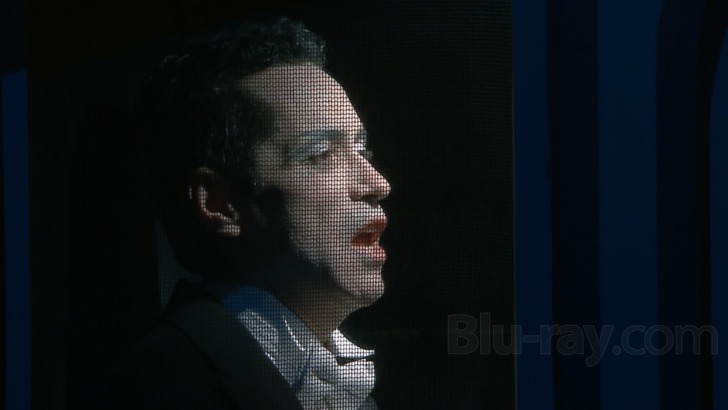
Einstein on the Beach features DTS-HD Master Audio 5.1 and LPCM 2.0 tracks. This is not a traditional opera with arias and recitatives, and instead a lot of the singing is almost like "backups" as spoken elements are simultaneously intoned onstage. I personally wish this release had included subtitles, for I often found it hard to hear what exactly was being spoken, though that subliminal aspect may be part and parcel of Wilson's intent. The music itself sounds fresh and natural, with some additional breathing room in the surround track that's quite inviting (though the surround track tends to mask the spoken elements even more than the stereo track). The idiotic audience noise that competes with the actual opera for the first 20 minutes or so is also more obvious on the surround track. There are a couple of audio anomalies that seem to be either the result of the exigencies of live performance or in one case some inartful editing where there's about a second of dead time (during a blackout between scenes).
Philip Glass: Einstein on the Beach Blu-ray Movie, Special Features and Extras
While there are no on disc supplements, this is an unusually handsomely packaged release, with a DVD case sized DigiBook containing the two Blu-ray discs, and a number of extremely interesting articles and essays contained inside.
Philip Glass: Einstein on the Beach Blu-ray Movie, Overall Score and Recommendation
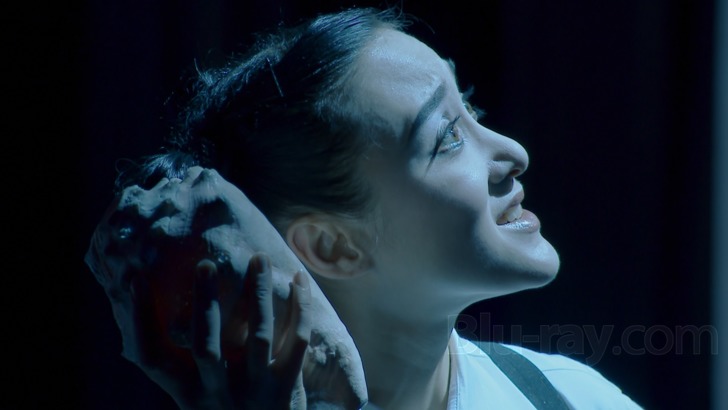
If you're a fan of Philip Glass, you are probably already at least somewhat acquainted with Einstein on the Beach, at least in its recorded form. This 2014 Paris production is arresting, though I'd be hard pressed to offer any substantial thoughts as to what it all means. For those willing to get past some unbelievably oblivious audience behavior for the first 20 minutes of the piece, and for those willing to overlook some deficiencies in the video presentation, this production of Einstein on the Beach comes Recommended.
Similar titles
Similar titles you might also like
(Still not reliable for this title)

Soundies: The Ultimate Collection
1940
Hard Core Logo
1996

Squaring the Circle
The Story of Hipgnosis / Slipcover in Original Pressing
2022

Soul Power
2008

The Decline of Western Civilization Part II: The Metal Years
1988
The Other Side of the Mirror: Bob Dylan
Live at The Newport Folk Festival 1963-1965
2007

A Poem Is a Naked Person
1974

The Big T.N.T. Show
1966

Ziggy Stardust and the Spiders from Mars: The Motion Picture
50th Anniversary Edition
1979

Blank Generation
1980

Dig!
2004

The Decline of Western Civilization
1981

Björk: Biophilia Live
2013

The Decline of Western Civilization Part III
1998

Get Crazy
Flip Out
1983

One More Time with Feeling
2016

The Velvet Underground
2021

Always for Pleasure
1978
Hard Core Logo 2
2011

Meet Me in the Bathroom
Slipcover in Original Pressing
2022