Peter Pan Blu-ray Movie
HomePeter Pan Blu-ray Movie 
Video Artists International | 1955-1956 | 2 Movies | 105 min | Not rated | Sep 04, 2015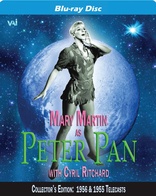
Price
List price:Listed on Amazon marketplace

Movie rating
Movie has not been rated yetBlu-ray rating
| Users |  | 0.0 |
| Reviewer |  | 3.0 |
| Overall | | 3.0 |
Overview
Peter Pan (1955-1956)
| Family | 100% |
| Musical | 98% |
| Fantasy | 33% |
| Imaginary | 11% |
| Adventure | 2% |
Specifications
Video
Video codec: MPEG-4 AVC
Video resolution: 1080p
Aspect ratio: 1.34:1
Original aspect ratio: 1.33:1
Audio
English: LPCM 2.0 Mono
Subtitles
None
Discs
Blu-ray Disc
Single disc (1 BD)
Playback
Region free
Review
Rating summary
| Movie |  | 4.0 |
| Video |  | 1.5 |
| Audio |  | 3.5 |
| Extras | | 3.5 |
| Overall | | 3.0 |
Peter Pan Blu-ray Movie Review
Reviewed by Jeffrey Kauffman August 11, 2022It's a rare child in either the United States or the United Kingdom who hasn't had some "contact" with Peter Pan in any of his (her? its?) incarnations, either as a book, several different stage adaptations and/or the animated Disney version, and that doesn't even take into account somewhat tangentially related pieces like Hook and/or Finding Neverland. For Baby Boomers, though, the list narrows somewhat considerably, at least for many, confined to either that Disney adaptation or any of the television broadcasts starring Mary Martin. In that regard, this Blu-ray aggregates the first two broadcasts from 1955 and 1956, which were something of a sensation at the time by offering a rare live performance in color (the first one in particular attracted a record setting viewership for the then still relatively nascent medium of color television). It's somewhat ironic then, especially given a supplement offering a closed circuit feed that "starred" Robert Sarnoff almost nervously discussing the live color broadcast, that only black and white kinescopes of the performances remain. It would not be until 1960 and the advent of "newfangled" videotape that a color version of the musical was able to be archived, and in that regard I did a bit of online sleuthing and found a cool Smithsonian article which mentions the first "commercially available" videotape system didn't come out until 1956 and cost a princely $50,000.00 (and that's in 1956 dollars).
Kind of interestingly given how well known and beloved this musical version of Peter Pan is, it was actually beaten to the boards by another musical version by none other than Leonard Bernstein, kind of ironically (given their later careers and interactions) pulling a "Stephen Sondheim" (so to speak) and providing both music and lyrics for a production that starred Jean Arthur and Boris Karloff. That version actually had much of its score jettisoned along the way (a reconstruction was done decades later and those interested can find a CD of the more or less complete score), and while it ran for a goodly while (over 300 performances), it's weirdly largely forgotten these days, subsumed by this later iteration.
This version had its own "gestational" issues, as anyone familiar with the kind of odd combo platter of composers and lyricists involved may have figured out. Again ironically, given the wide awareness of this version, its original Broadway incarnation was not as successful (in terms of length of run) as the Bernstein piece, but that evidently didn't have anything to do with the first television broadcast, which evidently took place a couple of weeks after the original Broadway mounting had closed (despite the breathless announcement in the Sarnoff supplement where he mentions how unprecedented it is for a television audience to be able to watch a "smash hit Broadway musical", where he conveniently doesn't mention that it's shuttered).
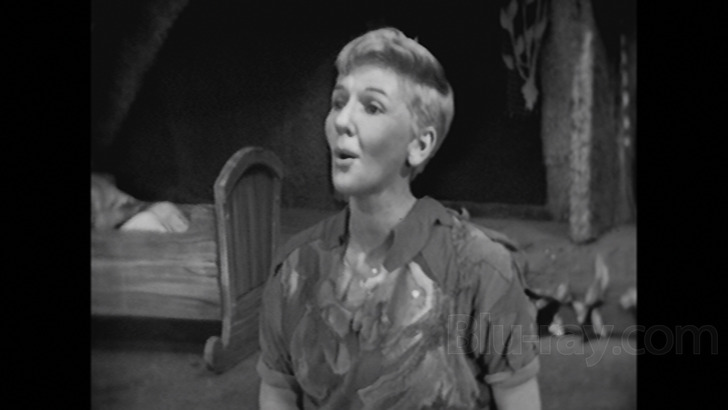
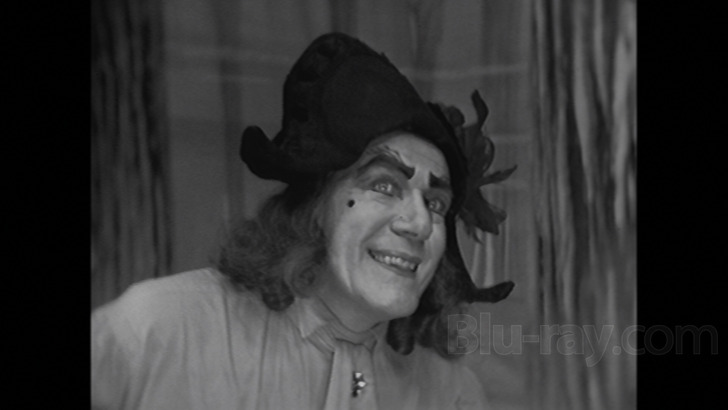
Anyone even passingly familiar with J.M. Barrie's original fanciful tale will know at least the broad outlines of the story, wherein the Darling parental units (Cyril Ritchard and Margalo Gillmore) take off for an evening out, leaving their three children behind to be babysat by lovable dog Nana. Peter Pan (Mary Martin, who won both a Tony and an Emmy for this, getting her halfway to an EGOT) flies in unexpectedly in search of "his" shadow, and soon enough the Darling kids are off toward "the second star on the right, straight on 'til morning", ultimately arriving in Neverland, where they encounter the nefarious Captain Hook (Ritchard again, per "tradition").
I won't bother with any "metaphysical" musings that are inherent in the Barrie piece, and instead simply comment on the charm, as "old fashioned" as it probably will seem to younger eyes, of these live television broadcasts. You can clearly see the rigging making the characters fly, there are occasional lapses in line readings and some minor technical mishaps, though nothing quite at the level of the hilarious Peter Pan Goes Wrong, which used to be available on YouTube, but which now looks like it needs to be streamed (after paying, of course), but which I highly recommend for fans of this version who haven't already seen the BBC parody. The obvious strengths of this version are the wonderfully committed performances of both Martin and Ritchard, as well as a tuneful, nostalgic and ultimately quite moving score that has contributions from a rather large assortment of folks, including "Moose" Charlap (jazz fans are encouraged to check out the work of Moose's son Bill), Carolyn Leigh, Jule Styne, Adolph Green, Betty Comden and Elmer Bernstein.
Peter Pan Blu-ray Movie, Video Quality
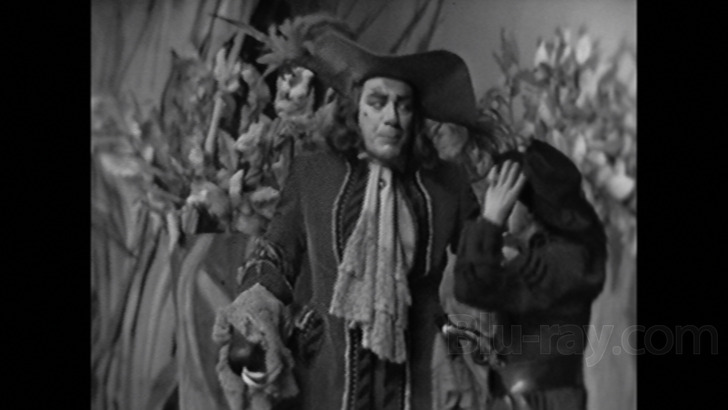
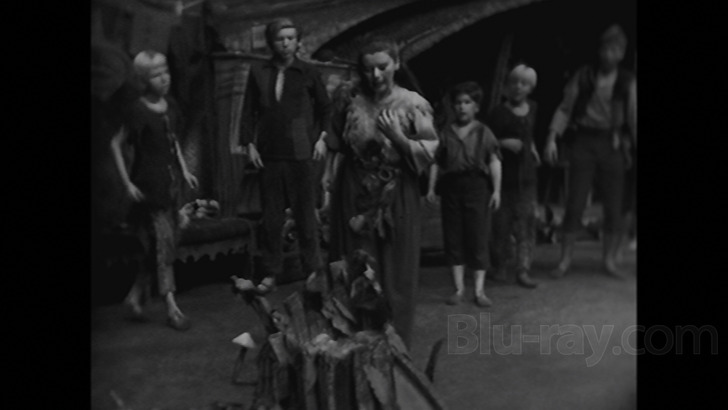
Peter Pan is presented on Blu-ray (BD-R) courtesy of Video Artists International with an AVC encoded 1080p transfer in 1.34:1. This is a
typically pretty fuzzy and undetailed looking set of kinescopes, further exacerbated by a number of baked in deficiencies, including clear examples of
ghosting, pixellation and video artifacts like "echoes" of information in one part of the frame appearing in another. As such, this simply needs to be
accepted as the historical curio it is while also not being naive about any restoration process (since there obviously was none). There are some typical
bugaboos you often see in kinescopes, including a slightly warped, fisheyed look, but rather interestingly these do not have the "curved
edges" at frame corners that are often seen in kinescopes from this period. Because of the kind of odd quasi-anamorphic weirdnesses (a technical
term) that are introduced by the kinescope process, some fleeting shots can look momentarily squeezed or alternatively stretched, but on the whole,
given the age and source elements, things can at least be discerned. Kind of. Both the 1955 and 1956 video presentations are actually rather similar
on the whole, though kind of interestingly there are moments in the 1955 that look better than the 1956, and vice versa.
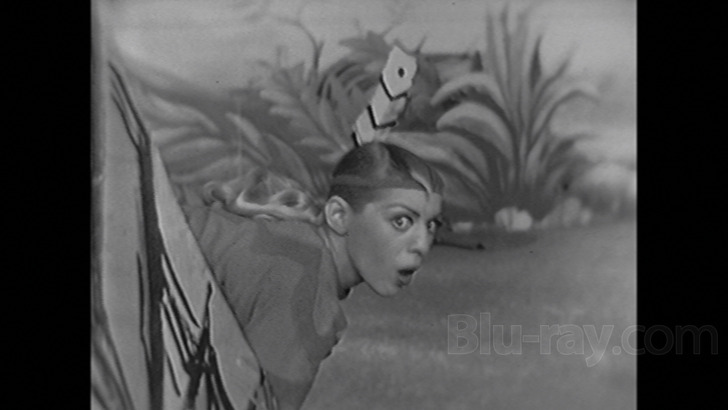
Screenshots 1 - 14 are from 1956, screenshots 15 - 19 are from 1955.
Peter Pan Blu-ray Movie, Audio Quality
Things are at least a bit better with regard to the LPCM 2.0 Mono tracks on the two broadcasts. Yes, things are obviously aged, and the live component leads to a few odd moments in the overall mix, but given those constraints, I found both tracks to be surprisingly full bodied, with a nice warm sound in the musical sequences, if again a sound that is undeniably boxy and without much dynamic range. Dialogue is rendered cleanly and clearly for the most part. There are no subtitles available.
Peter Pan Blu-ray Movie, Special Features and Extras
- 1955 Telecast (HD; 1:41:34) has some fun differences in both performances and staging.
- NBC Telesales Promo (HD; 20:37) is an incredibly sweet piece with Robert Sarnoff touting the "miracle" of live color television.
- Heller Halliday (HD; 5:49) is a nice interview with Mary Martin's daughter and who also plays Liza in Peter Pan.
Peter Pan Blu-ray Movie, Overall Score and Recommendation
Many years ago I was the rehearsal pianist and then later the "voice of Tinkerbell" (i.e., synth player) in the pit orchestra for a gargantuan production of Peter Pan that utilized the Cathy Rigby sets and costumes and which hired a former employee of Cirque du Soleil (if I'm remembering correctly) to do Peter's rigging, which resulted in the truly spectacular sight (from the pit, mind you) of Peter being able to fly out over the audience, something I had never seen happen before in any production I personally attended. Aside from the technical marvels of this production, what really struck me was seeing the wide eyed wonder in young children's eyes after the show, as if they had seen something really magical and unforgettable. Those who grew up with any of the Mary Martin broadcasts will probably feel the same watching these, despite whatever technical deficiencies they may have (and they do). The supplements are very enjoyable, for anyone who may be considering making a purchase.