Peking Opera Blues 4K Blu-ray Movie
HomePeking Opera Blues 4K Blu-ray Movie 
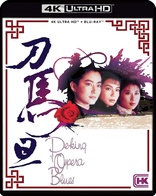
Do ma daan / Dao ma dan / 刀馬旦 / Hong Kong Cinema Classics #7 / 4K Ultra HD + Blu-rayShout Factory | 1986 | 105 min | Not rated | Sep 23, 2025

Movie rating
7.4 | / 10 |
Blu-ray rating
| Users |  | 0.0 |
| Reviewer |  | 4.0 |
| Overall | | 4.0 |
Overview
Peking Opera Blues 4K (1986)
An unlikely trio of women--a greedy goldigger, a hapless Peking Opera novice, and a general's western-educated daughter--are thrown together in the chaos of pre-revolution Shanghai.
Starring: Brigitte Lin, Sally Yeh, Cherie Chung, Kenneth Tsang, Mark Ho-nam ChengDirector: Tsui Hark
| Foreign | Uncertain |
| Comedy | Uncertain |
| Action | Uncertain |
Specifications
Video
Video codec: HEVC / H.265
Video resolution: 4K (2160p)
Aspect ratio: 1.85:1
Original aspect ratio: 1.85:1
Audio
Cantonese: DTS-HD Master Audio 2.0 Mono (48kHz, 24-bit)
English: DTS-HD Master Audio 2.0 Mono (48kHz, 24-bit)
Subtitles
English
Discs
Blu-ray Disc
Two-disc set (2 BDs)
4K Ultra HD
Packaging
Slipcover in original pressing
Playback
Region A (locked)
Review
Rating summary
| Movie |  | 3.5 |
| Video |  | 4.5 |
| Audio | | 4.5 |
| Extras | | 4.5 |
| Overall | | 4.0 |
Peking Opera Blues 4K Blu-ray Movie Review
Reviewed by Dr. Stephen Larson October 7, 2025Since the beginning of the 1980s, Tsui Hark made a name for himself as a significant director at Cinema City where he worked in the action comedy, gangster film, and period rom-com genres. When Tsui helmed Peking Opera Blues in 1986, he melded these genres into a hybrid while adding performative, operatic, and film noir styles into the mix. The result is largely successful even if the film doesn't fire on all cylinders.
Peking Opera Blues opens with the fall of the Qing dynasty in 1912. General Tun (Ha Huang) is forced out of town after deciding to recoup his gambling losses rather than pay his troops. General Tsao (Kenneth Tsang), a military warlord who replaces Tun, signs a secret document with a cabal of foreigners and conceals it in a wall safe. Tao Wan (Lin Ch'ing-hsia), Tsao's daughter, is working as a covert agent for revolutionaries who want to get rid of the warlords and transform Peking into a city of democratic ideals. While obtaining this document is one of the keys to spurring that change, Tao is torn between the love she has for her father and the loyalty she feels to the guerillas. Two stars of a local opera production become entangled in the plot. Sheung Hung (Cherrie Chung Chor-hung) is a mercenary singer who wants to leave China for America where she hopes to make it big. She also chases after a purloined jewelry box. Pat Neil (Sally Yeh), daughter of the owner of a local opera house, works as a stagehand and also has larger aspirations. Both Sheung and Pat struggle because they're trying to make it in a male-dominated profession. As the complicated plot thickens, local mobsters and the secret police also get in on the action.
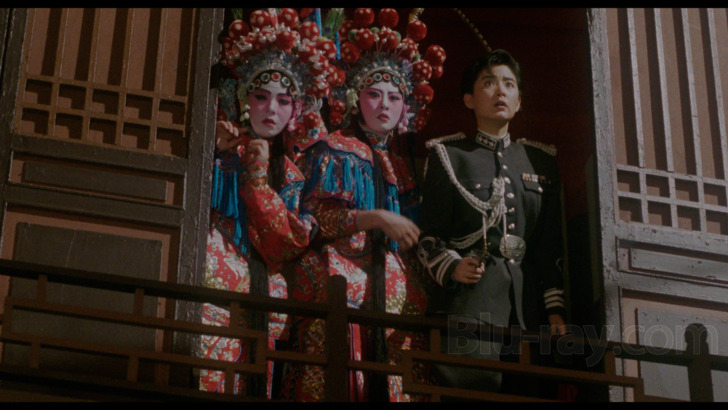
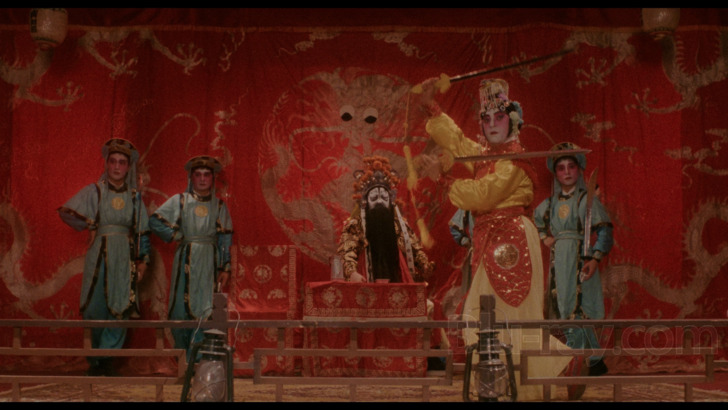
Screenwriter To Kwok Wai does a fine job explaining a lot of the plot machinations through dialogue and exposition during the second half of Peking Opera Blues. This is both needed and necessary because it can be difficult to keep up with the rapid-fire speech and quick cuts between scenes even after multiple viewings. The opera scenes are handsomely mounted and expertly staged with pantomime and acrobatics. The picture also works well as a spy film. (Chiaroscuro lighting is particularly effective at times.) The viewer is kept in suspense by not knowing which characters will figure out the true identity of the others. The movie is less successful, though, when it switches to slapstick comedy and sight gags. The writing falters when some of the characters, who are seemingly strong, turn out to be nebulous with their lack of social awareness. For example, there were moments where I thought: "Can they be that absentminded?" In addition, I felt that Tsui and his scribe could have had better segues into scenes when there are abrupt changes in tone. Some of the discs' extras mentioned that completing the film was a bit rushed. But no one can deny that Peking Opera Blues has lofty ambitions.
Peking Opera Blues 4K Blu-ray Movie, Video Quality
This release of Peking Opera Blues is #7 in the Hong Kong Cinema Classics line from Shout! Studios. The boutique label's 4K Ultra HD Blu-ray + standard Blu-ray combo is housed with a slipcover featuring vintage and identical theatrical poster art. The 1.85:1 presentation is encoded with Dolby Vision (HDR10 compatible). A 4K scan was performed of the original camera negative.
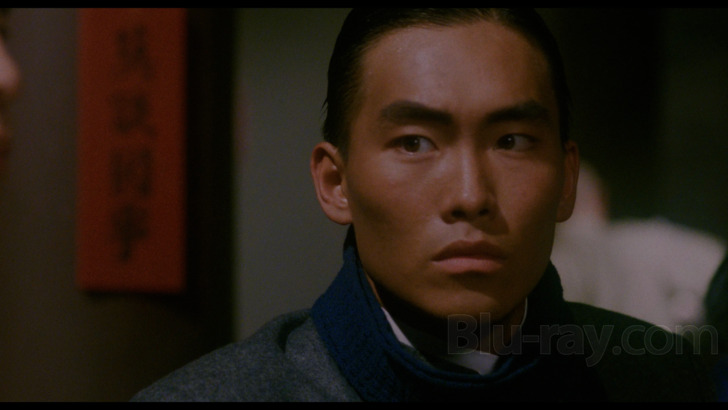
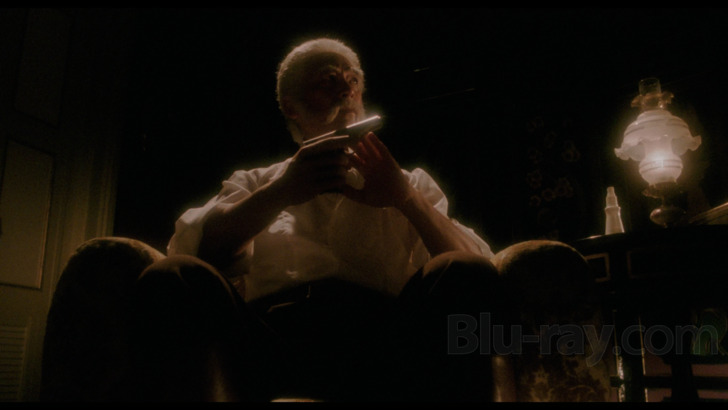
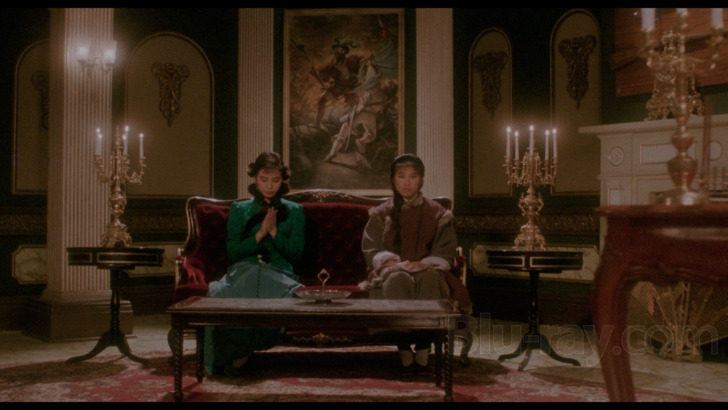
Both the UHD and regular Blu-ray impress in their rendering of primary colors during the opera's performance scenes and backstage moments. The set designs and costumes look outstanding. Shadow detail in darkly lit shots also stands out well. As you can see from my screen captures, Hang-Sang Poon's cinematography makes use of a lot of candles, lanterns, and carbon arc lamps. In certain shots, the lighting makes the image appear soft and more diffuse. Some of the exteriors have a flat and static look. For instance, I could tell that the exterior in Screenshot #25 features a matte painting.
When I watched the 1080p Blu-ray, grain definitely emerges as more pronounced following the first hour. On the 4K UHD, grain is prominent all the way through, owing to the higher resolution and DV/HDR grade. There are times on the latter where grain spikes but resolves itself before popping out too much. There are few blemishes on the restored OCN.
Disc One occupies a triple-layered disc (feature size: 72.4 GB). The film boasts a mean video bitrate of 89.0 Mbps while the whole disc reaches an overall bitrate of 98.4 Mbps. The standard Blu-ray employs the MPEG-4 AVC encode and sports a standard video bitrate of 27997 kbps.
Screenshot #s 1-30, 32, 34, 36, 38, & 40 = Shout! Studios 2025 4K Ultra HD (downscaled to 1080p)
Screenshot #s 31, 33, 35, 37, & 39 = Shout! Studios 2025 Blu-ray BD-50 (from a 4K restoration)
Shout! has given the 105-minute feature ten chapter stops, which you can only access by skipping to them on your remote control.
Peking Opera Blues 4K Blu-ray Movie, Audio Quality
Shout! has provided the original Cantonese track, which is encoded as a DTS-HD Master Audio Dual Mono (1597 kbps, 24-bit). It has also included an English dubbed track with the same audio codec, a DTS-HD MA 2.0 Mono (1607 kbps, 24-bit). Both the native mix and dub are mixed high. I would strongly recommend decreasing the number of decibels that you regularly listen at on your receivers by about five. When I listened to the Cantonese track at my receiver's normal level, the upper range showed a wee bit of distortion. Dialogue demonstrated terrific range across my front speakers to the sweet spot on my couch. There's a Cantonese pop song that combines vocals with traditional instrumentals from Peking Opera ballads. This bookends the film and sounds fairly rich and dynamic (even for a monaural mix). The English dub only has a handful (or less) moments where the original actors' lips and the voice actors' words are not precisely in sync. The overall impression I got while listening to the English track is that it makes the film even sillier than Tsui and his collaborators intended.
Peking Opera Blues has had an infamous and dubious subtitling history. Co-authors Stefan Hammond and Mike Wilkins reported in their book Sex and Zen & A Bullet in the Head: The Essential Guide to Hong Kong's Mind-bending Films (Touchstone, 1996) that Tsui Hark claimed subtitling for the export prints was done in two days for less than a hundred dollars. The haphazard work resulted in an assortment of egregious and laughable errors, according to film critics who saw prints of the film in the US in the late '80s and early '90s. For example, the Miami Herald's Bill Cosford, who saw the film at the Miami Film Festival, classified the subtitles as "rudimentary" and "so bad as to generate a comic subtext all their own. There's not a moment in Peking Opera Blues when the non-Chinese speaker can be expected to know what's going on..." Cosford's fellow Florida film critic Scott Eyman at rival paper The Miami News described the subs as adding "a certain baroque confusion to the proceedings." Some reviewers deemed the subtitles as deliberate to mesh with the film's comical moments. The Tulsa (OK) World's Dennis King observed: "The movie's bungled subtitles alone are worth a barrel of belly laughs...It's all part of the fun, and this movie is great fun." This hampered Dave DeNeui's overall evaluation of the film. He only awarded Peking Opera Blues one star in his review in The Bellingham (WA) Herald, writing "...there are so many misspellings and wrongly used words and phrases in the English subtitles, they have to have been done on purpose for a humorous effect. It's funny at first but the tactic soon wears out its welcome, especially when there's barely enough time allowed to read some of them."
Fortunately, Shout! has greatly improved upon this past debacle with a new-and-improved subtitle translation. I didn't spot any grammatical errors. Shout! has provided a regular font for dialogue (frame grab #29) and italicized subs for singing (#30).
Peking Opera Blues 4K Blu-ray Movie, Special Features and Extras
Shout! has delivered a new audio commentary, two interviews with filmmakers from Peking Opera Blues, and three programs with experts of Hong Kong cinema. These recent extras have come courtesy of Subway Cinema and High Rising Productions. On its website, Shout! lists archival interviews with actor Sally Yeh (7:43) and composer James Wong (8:08) as appearing on disc two. However, they're nowhere to be found on either disc. Their exclusions could be due to a rights issue. The older interviews were initially included on the 2007 Fortune Star/Joy Sales "Region All" Hong Kong DVD. Each were subtitled in English.
DISC ONE: 4K Ultra HD
- NEW Audio Commentary with Film Critic James Mudge - it can be difficult to say a mouthful for any length of time but James Mudge accomplishes this task across nearly 104 minutes. Mudge covers an enormous range of topics in this feature-length track. He provides an extended précis of the Hong Kong film industry in the 1980s, its major directors, and actors. His talk is only occasionally screen specific. He discusses the binary theme of reality versus illusion in Peking Opera Blues and the film's special effects. He also supplies some interesting information about the recent restoration of Tsui Hark's Shanghai Blues (1984) and a screening he attended. If you're seeking a commentary that delivers interpretive scene-by-scene analysis, this isn't your track. Mudge's talk isn't organizational as he shifts his talking points around different topics, but the commentary track overall is highly informative. In English, not subtitled.
DISC TWO: Blu-ray
- NEW Audio Commentary with Film Critic James Mudge - it can be difficult to say a mouthful for any length of time but James Mudge accomplishes this task across nearly 104 minutes. Mudge covers an enormous range of topics in this feature-length track. He provides an extended précis of the Hong Kong film industry in the 1980s, its major directors, and actors. His talk is only occasionally screen specific. He discusses the binary theme of reality versus illusion in Peking Opera Blues and the film's special effects. He also supplies some interesting information about the recent restoration of Tsui Hark's Shanghai Blues (1984) and a screening he attended. If you're seeking a commentary that delivers interpretive scene-by-scene analysis, this isn't your track. Mudge's talk isn't organizational as he shifts his talking points around different topics, but the commentary track overall is highly informative. In English, not subtitled.
- NEW An Opus for Peking: Starring in a Tsui Hark Classic – An Interview with Actor Mark Cheng (21:58, 1080p) - Mark Cheng portrays Ling Pak-Hoi in Peking Opera Blues. This is arguably the best extra in this set. The veteran actor discusses his time as a contract player for Cinema City and his working partnerships with directors Ringo Lam, Tsui Hark, Dennis Yu, and Kirk Wong. He shares several memories of acting in Peking Opera Blues. Topics he addresses related to this film include table reads, filming locales, his female co-stars, the martial arts choreographer who trained him, and director Wu Ma, who has a supporting role in the movie. In addition, Mark Cheng explains how he handled comparisons early in his career with fellow HK actor Chow Yun-Fat, their similarities and differences, and a twist of fate that occurred in the mid 1980s which impacted the two actors. In Cantonese, with English subtitles.
- NEW An Operatic Achievement – An Interview with Cinematographer Ray Wong (11:11, 1080p) - soft-spoken Ray Wong was the focus puller for the primary director of photography on Peking Opera Blues. He describes his interactions with the film's three lead actresses and gives his recollections of an amazing sequence with high-wired stunts. In Cantonese, with English subtitles.
- Hong Kong Confidential – Inside Peking Opera Blues with Author Grady Hendrix (14:22, 1080p) - this TCM-style featurette with Hendrix was filmed at the Plaza Theatre in Atlanta. The author summarizes the original critical reception of Peking Opera Blues and the "New Wave" of Hong Kong cinema. Additionally, Hendrix covers Tsui Hark's career in commercials, TV, and film. He briefly explains how Tsui became the "King of Comedy" at Cinema City. Hendrix also explains the differences between southern and northern Chinese opera. He spends the last section of his piece on this picture's three female leads. In English, not subtitled.
- NEW Peking Provocations – An Interview with Author and Critic David West on The Cinema of Tsui Hark (25:02, 1080p) - soft-spoken David West covers several of Tsui's movies prior to Peking Opera Blues in some detail. He also analyzes several of the characters from the 1986 film. Moreover, West briefly delves into other opera films from previous decades and how gender roles are represented. He additionally describes a few of the historical characters who are depicted in the film. A lucid presentation! In English, not subtitled.
- NEW Peking History Blues – Professor Lars Laamann on the Setting and Time of a Tsui Hark Masterpiece (23:42, 1080p) - this sit-down interview with Laamann is more on the scholarly side. He goes into considerable detail about the significance of the film's original title. His coverage of the real historical personages portrayed in Peking Opera Blues is more extensive and in depth compared to David West's interview. Laamann also devotes his attention to several subtopics pertaining to this film. This is quite an informative and detailed program. In English, not subtitled.
- Theatrical Trailer (2:27, 1080p) - Media Asia Distribution/Cinema City's official trailer (16x9 enhanced) for Peking Opera Blues. It's more of a teaser with a compilation of scene extracts set to a song. This is an unrestored trailer rife with source-related artifacts.
- Image Gallery (10:57, 1080p) - a moving slide show with scores of storyboards and photographs from the production of Peking Opera Blues.
Peking Opera Blues 4K Blu-ray Movie, Overall Score and Recommendation
In my research about Peking Opera Blues, I found a 1993 advert for the San Francisco-based Mill Valley Film Festival with the blurb, "the Citizen Kane of Hong Kong films." I wouldn't go as far to proclaim it reaches Wellesian heights. It's hugely ambitious and consistently entertaining even if it's sometimes hard to follow. Tsui Hark tries to meld too many genres into one film, though.
Peking Opera Blues is the type of movie tailor-made for 4K UHD (even if it predates the format by nearly three decades). The garish colors on the costumes and opera sets truly benefit from the Dolby Vision and HDR treatment (as do the black levels in the noirish scenes). The native Cantonese mix is doubtlessly the best way to listen to the film. Extras are pretty bountiful even if this set is missing a couple interviews from a HK DVD. A VERY SOLID RECOMMENDATION for a complex film that's worth seeing three or more times.
Similar titles
Similar titles you might also like

Let The Bullets Fly
Rang Zi Dan Fei
2010

Skiptrace
2016

Ip Man 3 4K
2015
Drunken Master
Zui quan
1978

Twin Dragons
Shuang long hui
1992
Hitman
The Contract Killer / Sat sau ji wong / Sha shou zhi wang / 殺手之王
1998

Winners & Sinners
5 Lucky Stars / Kei mau miu gai: Ng fok sing / Qí móu miào jì: wǔ fú xīng / 奇謀妙計五福星
1983
The Master
Wong Fei Hung 92 ji Lung hang tin ha / Huang Fei hung 92 zhi Long xing tian xia / 黃飛鴻92之龍行天下
1992

Enter the Fat Dragon
肥龍過江 / Fei lung gwoh gong
2020

In Order of Disappearance
Kraftidioten
2014

Long Arm of the Law
省港旗兵 / Shěng gǎng qí bīng
1984

The Good, the Bad, the Weird 4K
Limited Edition
2008

The Beast Stalker
証人
2008

Hero
Ma Yong Zhen / Ma Wing Jing / 馬永貞
1997

The Taking of Tiger Mountain
Zhì qu weihu shan / 智取威虎山
2014

The Adventurers
2017

Operation Condor 2
The Armour of God / Lung hing foo dai
1986

The Blood Brothers
Ci Ma / 刺馬
1973

Kung Fu Yoga
2017

Big Brother
Taai si hing
2018