One Hundred Steps Blu-ray Movie
HomeOne Hundred Steps Blu-ray Movie 
RaroVideo U.S. | 2000 | 114 min | Not rated | Dec 27, 2022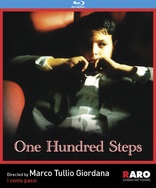
Price
List price:Listed on Amazon marketplace

Movie rating
7.2 | / 10 |
Blu-ray rating
| Users |  | 0.0 |
| Reviewer |  | 3.5 |
| Overall | | 3.5 |
Overview
One Hundred Steps (2000)
"I cento passi" (one hundred steps) was the distance between the Impastatos' house and the house of Tano Badalamenti, an important Mafia boss, in the small Sicilian town of Cinisi. The movie is the story of Peppino Impastato, a young left-wing activist who in the late seventies (when almost nobody dared to speak about the Mafia, and several politicians maintained that the Mafia did not even exist) repeatedly denounced Badalamenti's criminal activities and the whole Mafia system, by using a small local radio station to broadcast his political pronouncements in the form of ironic humour. In 1978 Peppino (30 years old) was killed by an explosion. The police archived the case as an accident or a suicide, but his friends never accepted this conclusion. Note: This is a true story. More than twenty years after Peppino's death, the case has been re-opened. Tano Badalamenti, meanwhile, has been convicted in the USA for drug trafficking.
Director: Marco Tullio Giordana| Foreign | 100% |
| Crime | Insignificant |
| Drama | Insignificant |
| Biography | Insignificant |
Specifications
Video
Video codec: MPEG-4 AVC
Video resolution: 1080p
Aspect ratio: 1.85:1
Original aspect ratio: 1.85:1
Audio
Italian: DTS-HD Master Audio 2.0
Subtitles
English
Discs
Blu-ray Disc
Single disc (1 BD)
Playback
Region free
Review
Rating summary
| Movie | | 3.5 |
| Video |  | 4.0 |
| Audio |  | 4.5 |
| Extras |  | 1.0 |
| Overall | | 3.5 |
One Hundred Steps Blu-ray Movie Review
Reviewed by Dr. Svet Atanasov April 3, 2023Marco Tullio Giordana's "One Hundred Steps" (2000) arrives on Blu-ray courtesy of Raro Video. The only supplemental feature on the release is an audio commentary recorded by actor Andrea Purgatori. In Italian, with optional English subtitles for the main feature. Region-Free.
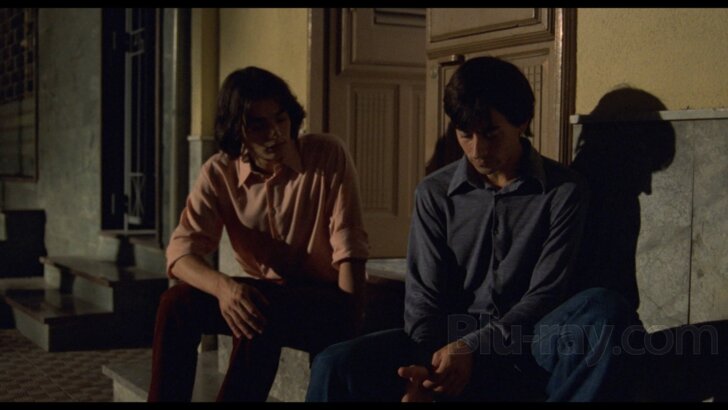
All American films and virtually all Italian films portray the mafia as a form of societal cancer. Also, they tend to highlight the fact that a strong mafia cannot coexist with a strong legal system. Regardless of the location, the existence of a strong mafia guarantees the presence of a weak, seriously corrupt legal system. Obviously, the opposite is true as well. Regardless of the location, the stronger the legal system becomes, the weaker the mafia gets. But this form of societal cancer is the contemporary reincarnation of the mafia, which is not what the mafia was supposed to be when it was created.
In Italy, the consensus is that the original concept that would give birth to the mafia matured during the 19th century. When did it emerge? Well, no one knows for sure, but most likely it was a century or two earlier. It was somewhere in the rural South, almost certainly in Sicily. Why here? Because for centuries the rural South was exploited by the wealthier North where the fate of the country was decided. Also, because the rural South needed a protective force to counter the enormous power of the wealthier North. In other words, at least in the very beginning, the mafia was supposed to be something very, very different.
How did the mafia evolve into what it is today? Contrary to what you will see in mainstream films, it took a long time because in the South -- and not only the rural South -- the mafia’s historic roots were never forgotten. In fact, long after the mafia was corrupted by criminal elements, in the South powerful mafia leaders continued to protect some of the area’s socio-economic interests. Of course, they exploited the area as much as they could too, but their awareness of the mafia’s historic roots never faded. This is why when after the end of WWII, and particularly during the 1960s and 1970s, Rome initiated an all-out war on the mafia in the South, many Southerners went on the streets and marched in solidarity with it. (A great film to see about this phenomenon is Marco Bellocchio’s The Traitor). For many of these people, the presence of the mafia in the South was synonymous with protecting the South’s right to exist without being in the shadow of the North. Also, as odd as it may sound, unlike their leaders in the North, the mafia cared about their economic status.
What does all of this information about the birth of the mafia and the South’s relationship with the North have to do with Marco Tullio Giordana’s film One Hundred Steps?
If your understanding of the mafia is shaped only by its portrayal as societal cancer in mainstream films, then your understanding of the drama that fuels the conflicts that are depicted in One Hundred Steps would be severely skewed. While it pretends to accurately reconstruct a true event, this is a film that does a fair amount of manipulative work, too.
The true event is the execution of Peppino Impastato (Luigi Lo Cascio), a young communist, on the outskirts of a small town in Sicily, which remained unsolved for nearly two decades. Apparently, Impastato was set on fire and left to die on May 9, 1978. On the same day, Italian Prime Minister Aldo Moro, leader of the Christian Democrats, who had been kidnapped, was also executed by left-wing terrorists and members of the Red Brigades. Because the national media focused on Moro’s execution, Impastato’s death remained in its shadow.
In One Hundred Steps, Giordana reconstructs Impastato’s life in uneven episodes that promote him as an outspoken mafia critic and leftist idealist who seeks to reset the status quo in his hometown while running an amateur radio station. Initially, it is Impastato’s past experiences with the mafia and one of its leaders that charge his leftist activism, but as time passes by both are replaced by his detestation of his father’s association with the mafia and philosophy of life.
A crucial point that is effectively ignored by Giordana is this: Impastato’s father, who is the owner of a modest ristorante, is not a criminal element, but a traditionalist. His association with the mafia -- which in his town is only a group of elder traditionalists that control virtually its entire economy, the legal and illegal parts of it, without external interference -- is an extension of his support for tradition. When Impastato becomes radicalized and challenges the mafia, the two clash because Impastato’s comprehension of his father’s philosophy of life is flawed. Impastato's rapidly evolving idealism then makes it impossible for him to realize that replacing the mafia, which is the elder traditionalists, with a communist government guarantees that his town loses its ability to govern itself. In other words, the mafia in his town gets replaced by a state mafia calling the shots from Rome. (This is one of the key reasons the mafia remains exceptionally strong in the South, and why the division between the South and North is still a fact of life in Italy).
One Hundred Steps deserves to be seen because it exposes several very interesting Italian socio-political phenomena while bringing awareness to Impastato’s tragic death, but its unabashed sympathy for Impastato’s political views is manipulative. The mafia’s corrosive influence in Italy is indefensible. However, understanding why the mafia emerged and why the South has protected it for centuries requires an honest deconstruction of the South’s history. In One Hundred Steps, Giordana does not bother to produce one and instead chooses to tell Impastato’s story a bit like a fairy tale for naïve adults.
*A good film about the tension between the South and North, the local politics that influenced its dynamic, and the rise of the mafia and its role in the South is Salvatore Giuliano. Another outstanding film about the kidnapping and execution of Prime Minister Moro is Good Morning, Night.
One Hundred Steps Blu-ray Movie, Video Quality
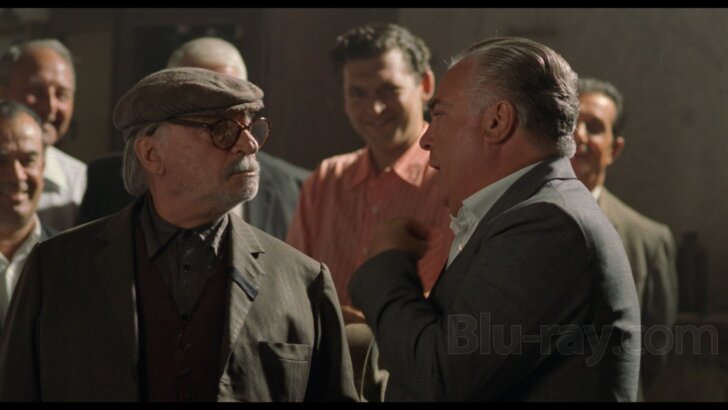
Presented in its original aspect ratio of 1.85:1, encoded with MPEG-4 AVC and granted a 1080p transfer, One Hundred Steps arrives on Blu-ray courtesy of Raro Video.
The master that was used to produce this release is old. I do not know when it was prepared, but on this Blu-ray release the film looks very similar to how it does on an R2 DVD release that I imported from Italy a long time ago. Regardless, I like the presentation a lot. Generally speaking, delineation, clarity, and depth are very good. From time to time a bit of extremely light black crush can be spotted, but darker nuances tend to be very nice. In fact, I was quite surprised to see how good the darker indoor and nighttime footage looked on my system. There are no traces of problematic digital tinkering. However, a brand new master will make the surface of the visuals more attractive. At the moment, grain does not have that consistently solid organic appearance. Color balance is good. However, you need to keep in mind that there is a bit of stylizing that gives the visuals a warmer appearance. (This is how the film looks on the R2 DVD release that I have as well). There are no large debris, cuts, spots, stains, or other similar anomalies to report in our review. My score is 4.25/5.00. (Note: This is a Region-Free Blu-ray release. Therefore, you will be able to play it on your player regardless of your geographical location).
One Hundred Steps Blu-ray Movie, Audio Quality
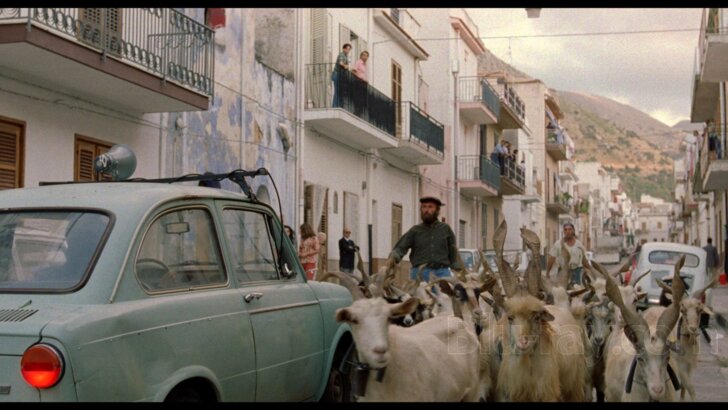
There is only one standard audio track on this Blu-ray release: Italian DTS-HD Master Audio 2.0. Optional English subtitles are provided for the main feature.
My DVD release has only a 2.0 track as well, but I am quite certain that One Hundred Steps should have a 5.1 track. On the other hand, the 2.0 track is fine and serves the film well, but I have to admit that I do not know what the theatrical mix ought to be because I never saw the film on the big screen. The dialog is clear, sharp, and stable. The English translation is excellent.
One Hundred Steps Blu-ray Movie, Special Features and Extras
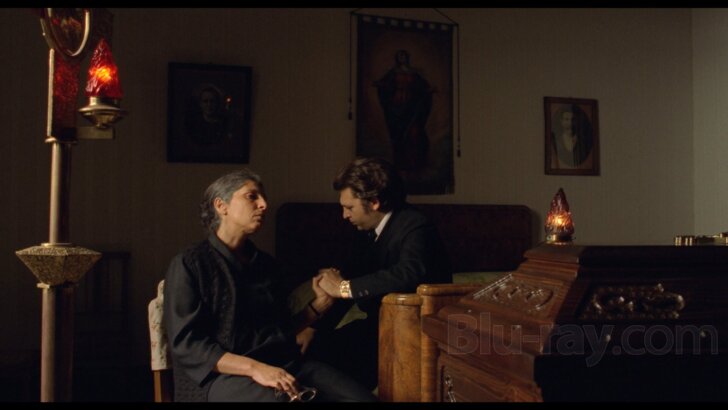
- Commentary - this audio commentary was recorded by writer and actor Andrea Purgatori.
One Hundred Steps Blu-ray Movie, Overall Score and Recommendation
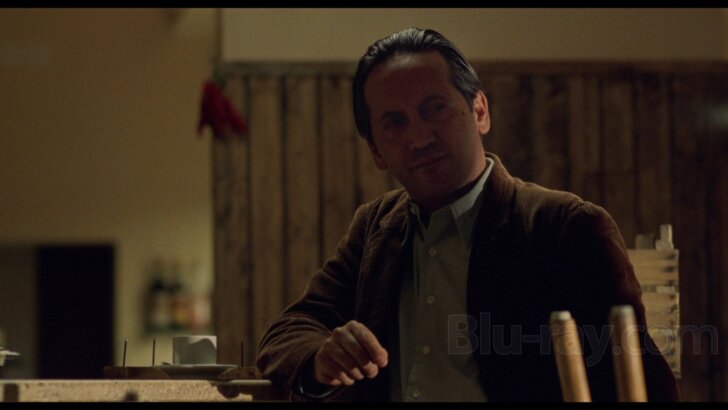
Some years ago, after I fell in love with Marco Tullio Giordana's The Best of Youth, I imported One Hundred Steps on DVD not knowing that it reconstructs a real event. I think that One Hundred Steps deserves to be seen because it reveals several very interesting Italian socio-political phenomena. However, while it does so, it chooses a side and misses a terrific opportunity to tell a much bigger and more illuminating story about the mafia and its complex relationship with the South. Raro Video's Blu-ray release is sourced from an older but solid organic master. It is Region-Free. RECOMMENDED.
Similar titles
Similar titles you might also like
(Still not reliable for this title)

Navajeros
1980

The Frenchman's Garden
El Huerto del Francés | Standard Edition
1978

Bluebeard
Landru
1963

The Sea Inside
2004

Christiane F. 4K
Christiane F. - Wir Kinder vom Bahnhof Zoo
1981

Eros + Massacre
エロス+虐殺
1969

Amen.
Der Stellvertreter
2002

Van Gogh: The Films of Maurice Pialat: Volume 3
1991

Jacquot de Nantes
1991

Tom of Finland
2017

Bandit Queen
Limited Edition to 3000
1994

Padre Padrone
Father and Master
1977

Madame DuBarry
1919
Les Amants de Montparnasse
1958

Mishima: A Life in Four Chapters
Director's Cut
1985

Heli
2013

Sacco & Vanzetti
Sacco e Vanzetti
1971

Close-Up
کلوزآپ ، نمای نزدیک / Nema-ye Nazdik
1990

The Traitor
Il traditore
2019

Carandiru
Carandirú
2003