On the Bowery Blu-ray Movie
HomeOn the Bowery Blu-ray Movie 
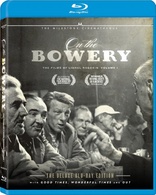
The Films of Lionel Rogosin, Vol. 1Milestone | 1956-1966 | 2 Movies | 135 min | Not rated | Feb 21, 2012
Price
List price:Listed on Amazon marketplace

Movie rating
Movie has not been rated yetBlu-ray rating
| Users |  | 0.0 |
| Reviewer |  | 4.5 |
| Overall | | 4.5 |
Overview
On the Bowery (1956-1966)
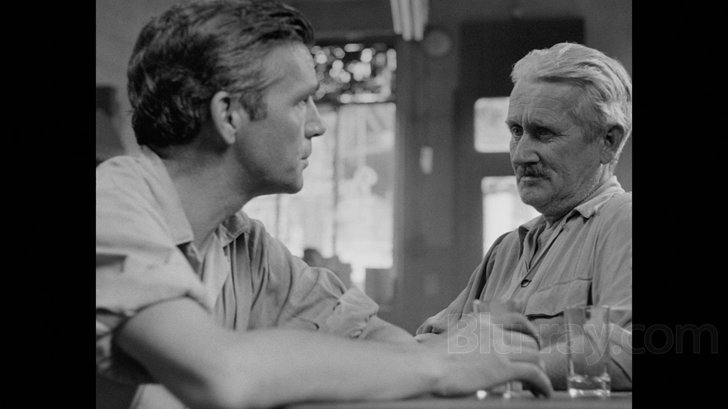
In 1956, Ray, a younger man, arrives on New York City's skid row, enters a bar and buys a few drinks. He meets Gorman, who, when Ray passes out, steals his suitcase. Over the next two days, Ray and Gorman keep crossing paths on the Bowery, a street of lost souls.
| Documentary | 100% |
| Other | 15% |
Specifications
Video
Video codec: MPEG-4 AVC
Video resolution: 1080p
Aspect ratio: 1.31:1
Original aspect ratio: 1.37:1
Audio
English: LPCM 2.0
Subtitles
None
Discs
25GB Blu-ray Disc
Two-disc set (2 BDs)
Playback
Region free
Review
Rating summary
| Movie | | 4.5 |
| Video | | 4.5 |
| Audio |  | 3.0 |
| Extras | | 4.5 |
| Overall | | 4.5 |
On the Bowery Blu-ray Movie Review
A Documentary of Observation from a Filmmaker Who Wanted to Do More
Reviewed by Michael Reuben February 21, 2012The title of this Blu-ray set is slightly misleading, because it contains more than On the Bowery. The two-disc set is subtitled The Films of Lionel Rogosin, Volume 1, and it begins what will hopefully be a complete release of the work of one of cinema's most influential documentarians by Milestone Films, an independent distributor committed to film preservation. The second major film in this volume is Rogosin's 1966 anti-war polemic, Good Times, Wonderful Times, which had to be made in England, because attempts to find backing in America elicited charges that the project was "treasonous". (Sound familiar?) Even today, documentaries don't generally enjoy wide distribution, but they're blockbusters compared to Rogosin's era, when he literally had to open his own theater, the Bleeker Street Cinema, to get his films shown. But Rogosin's influence far outweighs the modest audience he drew during his life, because that audience included future filmmakers like John Cassavetes and Martin Scorsese, who were hugely influenced by what they saw and, through their work and word of mouth, influenced many more. On the Bowery is where it all began. (I find it impossible to watch the film without being reminded of certain scenes in Mean Streets.) Like most artists, Rogosin was something of a square peg in a round hole. The son of a wealthy textile industrialist, he earned a degree in chemical engineering to join his father's business, but was transformed by his experiences serving in the U.S. Navy during World War II and touring Europe, Israel and Africa after the war. Rogosin emerged from these travels determined to combat oppression in all its forms. After participating in creating a short U.N. film about Hungarian refugees called Out (included in this set's extras), he decided to use film as his weapon of choice. His initial target was apartheid in South Africa, which would eventually lead to the film Come Back, Africa. But first he needed to teach himself how to make a documentary. On the Bowery was the result, and in that sense it may be the most accomplished "student film" ever made.
Ray and Gorman
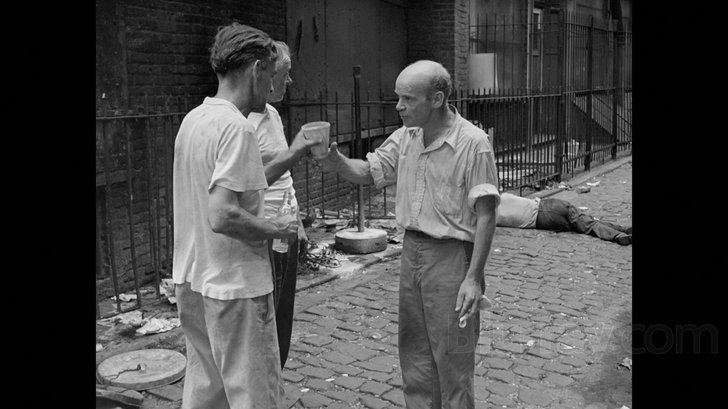
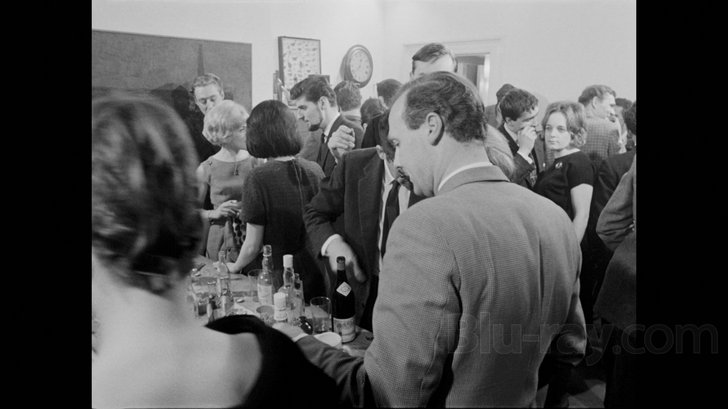
On the Bowery (1:05) In 1956, The Bowery was New York City's skid row. (Today the neighborhood has changed considerably.) Rogosin spent weeks walking the area and getting acquainted with its bars, flop houses and regular inhabitants. He didn't bring a camera or a crew until he'd won the trust of the people he intended to photograph. Initially, Rogosin tried shooting without a script, but he gave up that notion after a single day's filming. However, the script that he and his cameraman, Richard Bagley, roughed out was little more than an outline. It was a simple narrative substantially based on the lives of the Bowery inhabitants who'd been "cast" as themselves, and it left plenty of room for improvisation. Ray (Ray Salyer) arrives on the Bowery fresh from temporary work on the railroad in New Jersey. He carries his suitcase into the nearest bar, where he uses his scant pocket money to buy a few drinks for himself and the locals, including Gorman (Gorman Hendricks). But Ray needs day work so that he can earn money for a place to sleep. In the meantime, Gorman takes Ray to a rag man who buys old clothes, but Ray can't raise much for the contents of his suitcase. Gorman notices a pocket watch among Ray's belongings, but Ray refuses to sell it. Later that night, Ray passes out on the sidewalk, and Gorman steals his suitcase, which he uses as collateral to get a room for the night on credit. When Ray awakens the next morning, he joins the huddle of men seeking day work as laborers hauling crates and makes enough to get himself cleaned up. He swears, as he will several times during the course of the film, that he's done drinking and goes to the local mission for a meal and a place to sleep. But he can only stand it for so long, and while the night is still young, Ray rejoins Gorman and the usual suspects for an intense session of drunken carousing. Before the night is over, Ray has been mugged. Over the next few days, as Ray and Gorman keep crossing paths, Ray never suspects (and Gorman never reveals) that it was Gorman who took his suitcase. To a casual observer they appear to be friends, but the familiarity among denizens of the Bowery is deceptive. It's every man for himself, which is something that Frank (Frank Matthews), an older and long-time "resident" truly understands. At the conclusion of the film, when Gorman gives Ray money to help him leave town, the act of generosity is a fraud, because the money came from pawning Ray's watch, even if Ray doesn't know it. What does it matter anyway? As Frank says, Ray will be back. It's difficult to describe the distinctive quality that has made On the Bowery such an inspirational touchstone for other filmmakers, but I would call it a lack of distance. One expects a portrait of such degradation and squalor to come packaged in either moral condemnation (blame the individual) or social exposé (blame the system). Both approaches keep the viewer safely at arm's length by explaining away these men (and a few women) and making them a "problem". Rogosin does something different. He shows you people—grizzled, hollow-eyed, barely functioning, but people nonetheless—and refuses to explain them away. Then he uses unobtrusive camera angles and clever editing rhythms (devised by professional editor Carl Lerner, who would go on to do The Swimmer and Klute) to keep you looking until, all of a sudden, you find yourself grudgingly accepting these derelicts as people, which may be the most subversive and unsettling effect that a film about the Bowery could achieve. The film is dedicated to Gorman Hendricks, who died shortly after it was completed. Gorman had been warned that his severely damaged liver couldn't survive continued heavy drinking, and he'd kept a promise to Rogosin to remain sober during filming. As soon as the film wrapped, though, Gorman went back to the bottle, and the medical predictions proved all too accurate. Ray Salyer let Rogosin clean him up for appearances on television and at local events to promote the film, and his boyish good looks attracted enough attention to elicit an offer of a movie contract. But Ray was very much as he appears in the film, and one day he announced he'd had enough, hopped a freight train and was never seen again. Good Times, Wonderful Times (1:10) Rogosin's anti-war polemic employs what its chief editor calls a "crude" but "effective" device: Extended scenes of a cocktail party, with comfortable and educated people trading glib gibes about society and war, are intercut with intense and often grisly footage from Nazi war rallies, concentration camps, the Nazi siege of Stalingrad, the Warsaw Ghetto, the aftermath of Hiroshima, the Korean War, Japanese demonstrations against U.S. airforce bases, World War I trench warfare and nuclear detonation test footage. Rogosin is equal-opportunity in his sentiments, attacking all forms of warfare and reflecting the extreme pacificist view that coalesced into an international movement during the Cold War. As articulated by one of its most visible spokespeople, Bertrand Russell, who supported Rogosin's film, the movement argued that humanity's development of the capacity for self-annihilation required a radical break with all previous approaches to relations among nations. As easy as it may seem to scoff at the notion, the intractable problem of nuclear proliferation since the Cold War raises a legitimate question of whether this group might have been onto something. The film's title comes from an intriguing sequence that straddles the film's two worlds, where Rogosin's camera leaves the cocktail party to visit a present-day scene with military connections. The locale is the Chelsea Hospital, and the occasion is a dinner for local veterans of English military service. Though many still bear the scars, the air is thick with nostalgia. "Good times, wonderful times!" exclaims one of them, but Rogosin has already tainted the remark with all of the dire footage with which he's preceded it. Crude, but effective.
On the Bowery Blu-ray Movie, Video Quality
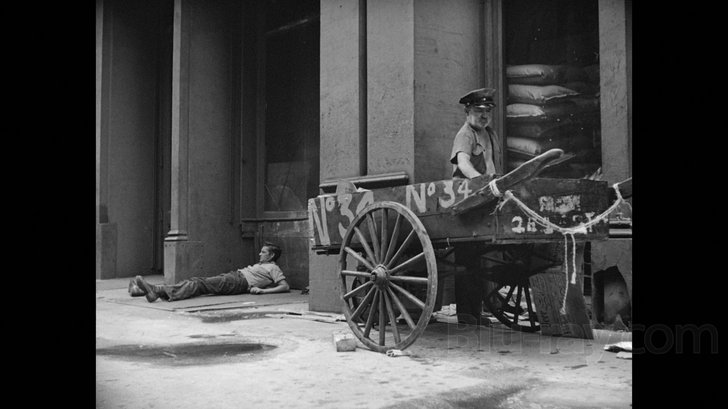
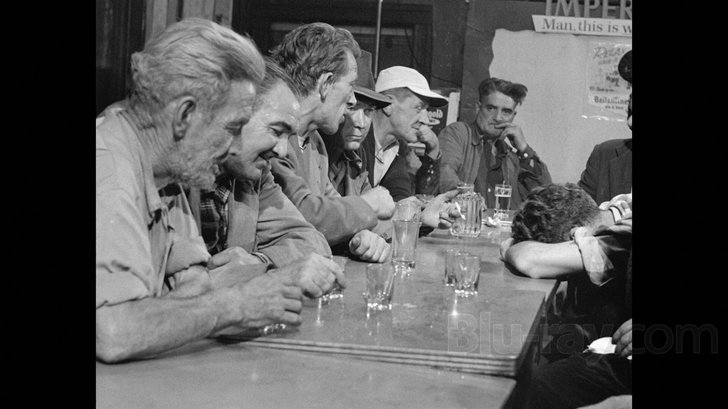
Restored by the Cineteca di Bologna, On the Bowery arrives in a 1080p, AVC-encoded presentation with deep blacks and such extraordinary clarity that it's almost painful to look at. The fine delineations of grays, whites and black provide depth to the image in a way that makes the film seem almost new, even as it's clear from the vehicles, streets and clothing that the scenes are from a bygone era. Here and there, a vertical scratch betrays the age of the negative, but most such flaws have been removed in the restoration. Film grain is present if you look for it, but it's extremely fine; this was still an era when cameramen knew how to shoot in black-and-white, and labs knew how to process it. In this presentation, there is no escaping the battered faces of the men and women depicted in On the Bowery. If you watch the film, you will see them up close and personal. A similar evaluation applies to the contemporary portions of Good Times, Wonderful Times, which was also restored by the Cineteca di Bologna and is also presented in a 1080p, AVC-encoded Blu-ray. The Sixties clothing and hairstyles (both the good and the bad) are fully on display, and the quality of the presentation creates a sharp visual contrast with the battered and often blurry newsreel-quality of the war footage. (But not blurry enough; the post-Hiroshima images could easily give someone nightmares.) Rogosin spent several years traveling around the world gathering this footage, and presumably the restoration team made the best of it they could.
On the Bowery Blu-ray Movie, Audio Quality
Both films feature their original mono tracks presented as PCM 2.0. Both tracks have acceptable fidelity, considering their age and budget, but neither has a wide dynamic range. Dialogue is clear in both of them. The distinctive score composed by Charles Mills for On the Bowery plays with haunting clarity. The sound editing for Good Times, Wonderful Times (by Stephen Dalby, who also worked on Alfie and Repulsion) is more elaborate, contrasting a cheesy party tune with ominous percussion to underscore the war footage. The PCM track's bass extension was sufficient to engage my subwoofer when the percussion kicked in, which made the effect that much more unsettling.
On the Bowery Blu-ray Movie, Special Features and Extras
On the Bowery (disc 1)
- Introduction by Martin Scorsese (HD, 1080p; 1.78:1; 3:11): Scorsese's introduction can be optionally played before On the Bowery. It's informative both as a matter of film history and as a personal recollection by someone who grew up in the neighborhood and era depicted in the film.
- Street of Forgotten Men (1933) (SD; 1.33:1; 2:28): A Depression-era newsreel short, complete with sensationalistic narration whose tone and style are the polar opposite of Rogosin's approach.
- Bowery Men's Shelter (1972) (HD, 1080p; 1.33:1; 10:34): A portrait of the New York City Men's Shelter and its inhabitants, made as the City was heading toward economic collapse. Directed by Rhoden Streeter and Tony Ganz.
- The Perfect Team (2009) (SD; 1.78:1, enhanced; 46:33): This documentary by Rogosin's son, Michael, provides a comprehensive account of the making of On the Bowery and its reception, using contemporary sources (including an NBC interview with Rogosin in which Dave Garroway pronounces the film "depressing", then admits he hasn't seen it), Rogosin's journals, video interviews with Rogosin (in the 1990s) and an array of scholars and other informed sources. Of particular note is the film's popularity abroad and the hostility with which it was regarded by some elements in America; when the film won the documentary award at the Venice Film Festival, the American ambassador to Italy, Clare Boothe Luce, turned and walked away rather than present the award to Rogosin. She and other establishment figures objected, because he'd shown a side of U.S. society they considered unflattering. (It's called "shooting the messenger", and it remains a popular pursuit.)
- A Walk Through the Bowery (2009) (SD; 1.78:1, enhanced; 11:05): Produced and directed by Michael Rogosin, this documentary short contrasts the Bowery today with images from On the Bowery. Interviewees included Bowery residents as well as film historian Peter van Bagh and urban historian Peter Hollander.
- On the Bowery Theatrical Trailer (2010) (SD; 1.78:1, enhanced; 2:13): Even at standard definition, the restored image looks exceptional.
- Credits
- Out (SD; 1.33:1; 25:37): Rogosin's documentary short, produced for the United Nations, depicting the plight of refugees fleeing the Soviet repression of the Hungarian uprising in 1956.
- Man's Peril: The Making of Good Times, Wonderful Times (SD; 1.78:1, enhanced; 24:17). Also produced and directed by Michael Rogosin, this documentary provides essential background on the creation of Good Times, Wonderful Times. Again, video interviews with Rogosin made in the 1990s are a valuable source. Also interviewed extensively is Brian Smedley-Aston, who was the film's chief editor and tells entertaining stories about the colorful characters with whom Rogosin worked. Molly Parkin, who played one of the principal party guests, is another interviewee; her current occupation is listed as "painter/writer", and when Rogosin cast her, she considered herself a rebel. When she saw herself in the film, she cringed at how naturally she seemed to fit into the mainstream milieu in which Rogosin had asked her to appear. The title of the documentary is taken from a 1954 address by Betrand Russell, with whom Rogosin became associated and who appears in vintage interview footage.
- Credits
On the Bowery Blu-ray Movie, Overall Score and Recommendation
It's ironic that the film of Rogosin's which has had the greatest influence may also be his least characteristic. Rogosin wanted to use his camera to change the world, but On the Bowery wasn't created with the goal of changing skid row or anyone on it. Rogosin made it to teach himself film technique before embarking on the projects that were dear to his heart, and yet it's precisely the film's lack of agenda that seems to strike such a responsive chord in so many viewers. This aspect of Rogosin's work is worth considering more closely as Milestone continues with its fine project in bringing his films to Blu-ray. Highly recommended.