Nina Blu-ray Movie
HomeNina Blu-ray Movie 
RLJ Entertainment | 2016 | 90 min | Not rated | Sep 06, 2016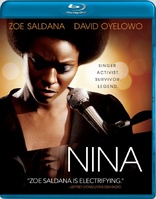
Price
List price:Listed on Amazon marketplace

Buy it from YesAsia:
Movie rating
5.9 | / 10 |
Blu-ray rating
| Users |  | 0.0 |
| Reviewer |  | 2.5 |
| Overall | | 2.5 |
Overview
Nina (2016)
The later years of jazz musician and classical pianist Nina Simone, including her relationship with manager and assistant Clifton Henderson.
Starring: Zoe Saldaña, David Oyelowo, Mike Epps, Ella Thomas, Ronald GuttmanDirector: Cynthia Mort
| Drama | Uncertain |
| Biography | Uncertain |
| Music | Uncertain |
Specifications
Video
Video codec: MPEG-4 AVC
Video resolution: 1080p
Aspect ratio: 2.40:1
Original aspect ratio: 2.39:1
Audio
English: DTS-HD Master Audio 5.1 (48kHz, 24-bit)
Subtitles
English SDH, French
Discs
Blu-ray Disc
Single disc (1 BD)
Playback
Region A (B, C untested)
Review
Rating summary
| Movie |  | 2.0 |
| Video |  | 4.0 |
| Audio | | 4.0 |
| Extras | | 0.0 |
| Overall | | 2.5 |
Nina Blu-ray Movie Review
Look Back in Anger
Reviewed by Michael Reuben September 16, 2016Screenwriter Cynthia Mort's directorial debut, Nina, arrives with enough excess baggage to sink
an ocean liner. Shot in 2012, Mort's portrait of singer, musician and activist Nina Simone was
attacked before a single frame was exposed, when it was announced that light-skinned Zoe Saldana
had been cast as the much darker Simone. Protests intensified after pre-release photos revealed
Saldana in makeup and prosthetics, and also when rumors circulated that the film would portray
a romantic relationship between Simone and her assistant and manager, Clifton Henderson, who
was gay. (For the record, no such romance appears in the film as released, and Clifton's sexual
orientation remains unstated.) During post-production, disputes between Mort and production
company Ealing Studios led to the director's removal from the project; editing was
completed without Mort's participation, and she has disavowed the result. When RLJ
Entertainment acquired the film two years later, it reportedly undertook further editing, so that
the version given a limited release in April 2016 (and now being issued on Blu-ray) was even further removed from Mort's original intentions.
Nina was largely ignored by critics, but those who did review it were savage in their criticism
(including my Blu-ray.com colleague, Brian Orndorf). The film currently holds a
3% rating at
Rotten Tomatoes, based on forty reviews. Given the accumulated negativity, I was expecting to
find a disaster when I loaded RLJ's Blu-ray into my player, but I didn't. While far from a
definitive portrait of Nina Simone (assuming one is even possible), Nina still manages to offer
intriguing glimpses of a talented and complex individual and her turbulent life and times.
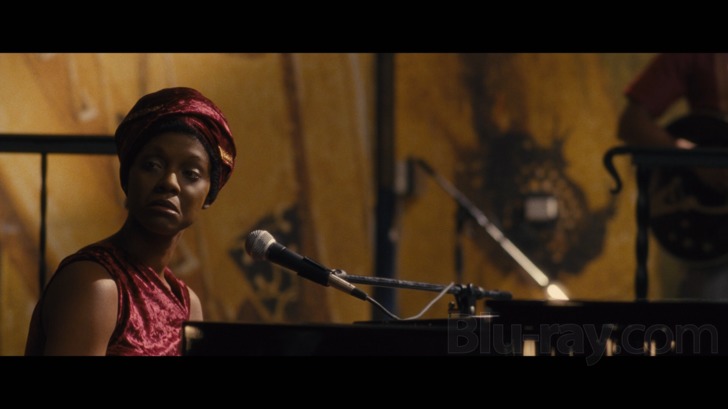
Artistic bio-pics usually trace a familiar arc. We get the origin and early struggles, followed by a triumphant breakthrough and then the aftermath, when the artist discovers that success doesn't chase away whatever personal demons have been driving him or her. A recent example is Taylor Hackford's Ray, which followed this template so closely that it was sometimes criticized for being cliched.
Nina takes a different approach. It attempts to survey the singer's career from a late vantage point, after she has resettled in France and her reputation, at least at home, has gone into eclipse for a variety of reasons, including her own erratic behavior. The film's structure poses, and then tries to answer, the question famously asked by poet Maya Angelou (and used by Liz Garbus as the title of her recent documentary): "What happened, Miss Simone?"
A pre-credit scene shows the child piano prodigy performing classical music in her hometown in North Carolina—and already causing a stir when she insists that her parents be seated up front with the white audience. A montage of album covers and press coverage during the credit sequence establishes her meteoric rise as a jazz and blues performer in the Sixties, but immediately after, the film fast-forwards to 1995 when, during a trip to L.A. with her then-manager Henri Edwards (Ronald Guttman), a violent altercation with a record company executive lands Nina in a mental hospital for a 24-hour observation. There she meets Clifton Henderson (David Oyelowo), a male nurse who so impresses her with his kindness that she asks him to return to France and become her new manager. Much of what follows is presented from the perspective of this much younger man, who grew up listening to his mother play Nina Simone records and is alternately fascinated and repelled by the aging diva's mercurial behavior. Still, Clifton throws himself into providing Miss Simone whatever she wants, along with what Clifton thinks she needs, including exercise, balanced nutrition, medication for her bipolar disorder and, eventually, treatment for the cancer that she is trying to ignore. Clifton's life with the musical legend becomes a steady stream of arguing, cajoling and shrugging off the star's frequent outbursts of temper.
Nina intercuts this tempestuous relationship with numerous flashbacks, including excerpts from a 1968 radio interview with a French journalist (Michael Vartan) that provides essential exposition—and it is here, I suspect, that the film suffered most at the hands of studio editing. The excursions into the past are meant to counterpoint and illuminate the singer's present-day turmoil, demonstrating how even her considerable achievements were undercut by a troubled private life, bad business management and pervasive racism. Unfortunately, many of these sequences feel truncated, as if someone decided to rush through them, so that they are deprived of the development and dramatic weight needed to explain and counterbalance the singer's frequently unhinged behavior in the film's present day. Nina touches on such critical elements of Simone's biography as her close friendship with playwright Lorraine Hansberry (Ella Thomas), who died tragically young; her troubled marriage to former manager Andrew Stroud (Chuma Gault), who was both physically and psychologically abusive; and her extensive involvement in the civil rights movement, writing and recording protest songs that included "Mississippi Goddamn" and "Old Jim Crow". But the film deals with these critical subjects in such a cursory manner that Stroud isn't even identified by name, and Hansberry, who inspired Nina's song "Young, Gifted and Black", barely registers. Even the assassination of Martin Luther King, which was a defining moment in both the nation's history and Simone's life, is hurried over.
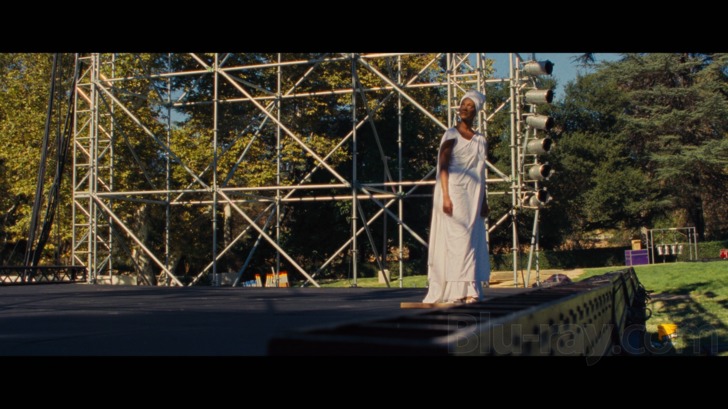
A memorable example of Nina's undeveloped possibilities is the scene in which she telephones comedian Richard Pryor (Mike Epps) to commiserate over their respective ills. Pryor, who by this point was crippled with MS, speaks of how much he misses performing onstage, and a brief flashback reveals the manic energy that characterized his standup persona, which Epps mimics convincingly. Nina is suffering some of the same performance withdrawal, although her wounds are largely self-inflicted due to erratic behavior that has made promoters reluctant to book her. When she asks Clifton to get her a concert in Central Park, her appearance before an enthusiastic crowd provides Nina with the semblance of a happy ending, as the singer reconnects with both her audience and herself, but the event would have resonated more strongly if the film had taken the time to develop and explore scenes like the Pryor conversation in greater depth.
Zoe Saldana might not have been ideal casting (the original choice was Mary J. Blige), but she effectively mimics Nina Simone's gestures and demeanor and captures her distinctive accent and cadence. Performing Simone's standards in her own voice, the actress acquits herself without embarrassment, but some vocalists are so distinctive as to defy imitation. Still, Diana Ross received an Oscar nomination for Lady Sings the Blues, even though she sounded nothing like Billie Holiday. If the rest of the film is fully realized, one can overlook such substitutions—but Nina never had a chance.
Nina Blu-ray Movie, Video Quality
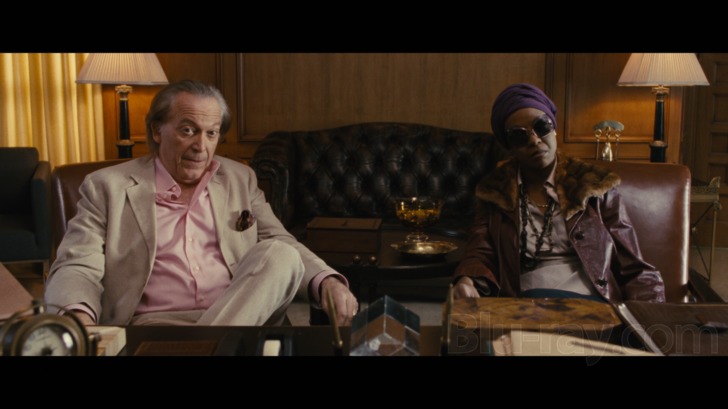
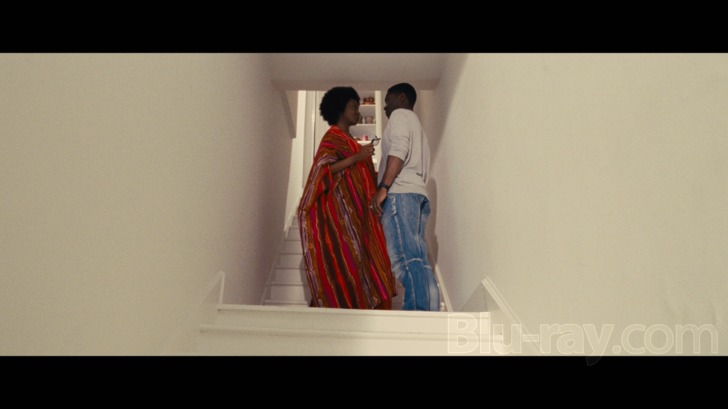
Nina was shot by Romanian cinematographer Mihai Malaimare Jr., whose stylish work ranges from the 65mm photography of The Master to the digital trickery of Francis Ford Coppola's Tetro. Specific information about the shooting format was not available, but judging by the credits and the image, Nina appears to have been shot on film, with post-production on a digital intermediate. RLJ/Image's 1080p, AVC-encoded Blu-ray features an elegantly film-like image, with deep blacks (essential for scenes of performance in darkened night clubs), superior detail and a rich and warm palette of saturated colors that bring out the best in the star's many elaborate costumes, both on stage and off. (David Oyelowo's wardrobe, by contrast is dominated by cooler shades, especially whites and blues.) Some flashback sequences have been deliberately "aged" in post-production, e.g., Nina's interview with a French journalist, but their lesser quality is intentional and part of the film's visual design. RLJ/Image has mastered the 90-minute film on a BD-25 with an average bitrate of 23.98 Mbps.
Nina Blu-ray Movie, Audio Quality
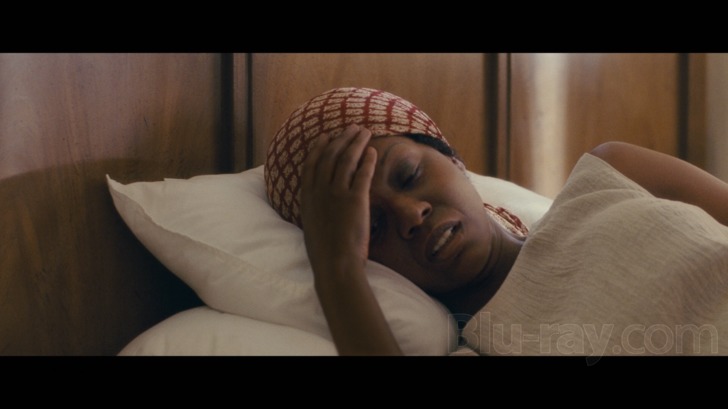
Nina's 5.1 soundtrack, encoded in lossless DTS-HD MA, effectively reproduces the musical performances with good fidelity and wide dynamic range. The surrounds immerse the listener in the crowded audience at clubs and concerts but are otherwise limited to environmental ambiance. The dialogue is clearly rendered and correctly prioritized. Incidental scoring is credited to Ruy Folguera (The Man Who Shook the Hand of Vicente Fernandez), but the main component of the score comes from Nina Simone's songbook, either in instrumental versions or sung by Zoe Saldana.
Nina Blu-ray Movie, Special Features and Extras
The disc has no extras. At startup, it plays trailers for Breaking a Monster, The Phenom and The Sin Seer.
Nina Blu-ray Movie, Overall Score and Recommendation
In its current form, Nina's shortcomings are too numerous and too glaring to merit a
recommendation, but anyone curious to learn what all the fuss was about can buy or rent RLJ's
Blu-ray with confidence that the presentation is solid. The film isn't what its writer/director
intended, but enough fragments of her design have survived to provide an outline of what she
was trying to achieve. Within the limitations of the truncated version in which Nina finally was
released, Saldana and Oyelowo give worthy performances, and they make an interesting pair.
Similar titles
Similar titles you might also like
(Still not reliable for this title)

Get on Up
2014

At Eternity's Gate
2018

Her Smell
2018

The Irishman
2019

La Vie en Rose
La Môme / Warner Archive Collection
2007

The Last of Robin Hood
2013

Rebel in the Rye
2017

'Round Midnight
1986

Colette
2018
Churchill
2017

Thirty Two Short Films About Glenn Gould
1993

Inside Llewyn Davis
2013

The Pianist
2002

Gainsbourg: A Heroic Life
Gainsbourg: Vie héroïque
2010

J. Edgar
2011

The Soloist
2009

Judy
2019

Lee Daniels' The Butler
2013

Sweet Dreams
1985

Cesar Chavez
2014