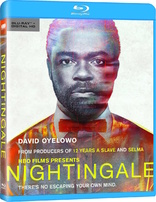
Nightingale Blu-ray Movie
HomeNightingale Blu-ray Movie 
Blu-ray + UV Digital CopyHBO | 2014 | 82 min | Rated TV-MA | Sep 15, 2015

Movie rating
6.8 | / 10 |
Blu-ray rating
| Users |  | 0.0 |
| Reviewer |  | 3.5 |
| Overall | | 3.5 |
Overview
Nightingale (2014)
A lonely military veteran psychologically unravels ahead of an old friend's impending visit.
Starring: David Oyelowo, Heather Storm, Barlow JacobsDirector: Elliott Lester (II)
| Drama | 100% |
Specifications
Video
Video codec: MPEG-4 AVC
Video resolution: 1080p
Aspect ratio: 1.78:1
Original aspect ratio: 1.85:1
Audio
English: DTS-HD Master Audio 5.1 (48kHz, 24-bit)
French: DTS 5.1
Spanish: DTS 2.0
Subtitles
English SDH, French, Spanish
Discs
25GB Blu-ray Disc
Single disc (1 BD)
UV digital copy
Playback
Region A (B, C untested)
Review
Rating summary
| Movie |  | 3.0 |
| Video |  | 4.0 |
| Audio | | 4.0 |
| Extras | | 0.0 |
| Overall | | 3.5 |
Nightingale Blu-ray Movie Review
Sad and Lonely Song
Reviewed by Michael Reuben September 15, 2015It's easy to imagine Nightingale as an intimate one-man play performed on a bare stage with a few props. In fact, though, writer Frederick Mensch wrote it as a film script (his first to be made), and director Elliott Lester (Blitz) has used the intimacy of cinema to intensify Mensch's account of a mind in its final stages of disintegration. But in whatever form it is presented, Nightingale stands or falls on its central (and sole) performance, and the film is blessed with a tour de force by David Oyelowo, who is utterly unrecognizable here compared to his Oscar-nominated turn as Dr. Martin Luther King, Jr. in last year's Selma. Alternately pitiful and terrifying, Oyelowo's Peter Snowden is an unforgettable character. Whether viewers will enjoy the experience of getting to know him is a different question. Produced independently, Nightingale premiered in June 2014 at the Los Angeles Film Festival. It was subsequently acquired by HBO, which first broadcast the film on May 29, 2015 and is now releasing it on Blu-ray.
Nightingale Blu-ray Movie, Video Quality

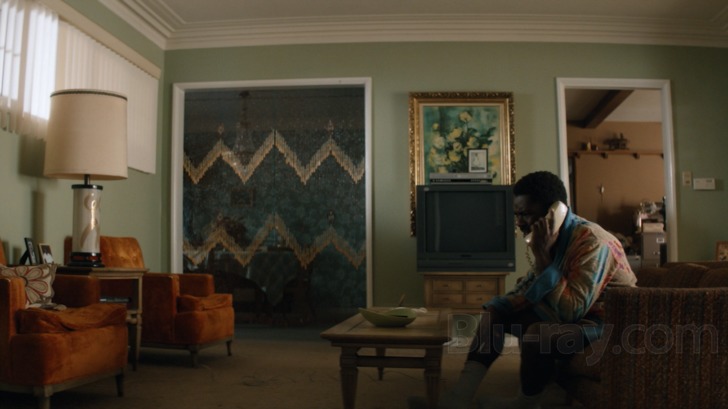
Nightingale is the first feature shot by Pieter Vermeer as a cinematographer, although Vermeer's experience dates back to 1989, when he worked as an electrician on Peter Greenaway's The Cook, the Thief, His Wife and Her Lover. Although specific information was not available, it appears that the film was captured with different types of HD digital cameras, mostly professional but some possibly of consumer grade. The film's opening, which establishes the video diary motif, features the kind of blocky backgrounds and rough overall texture that one often encounters (and overlooks) in home DV. Since this could have been adjusted on the digital intermediate in post-production, one must assume that it was deliberately left that way. Having demonstrated that we are dealing with a do-it-yourself video diarist, Vermeer and director Lester do not use the effect again. HBO's 1080p, AVC-encoded Blu-ray, which was presumably sourced directly from digital files, is excellent. Images in daylight and well-lit interiors are sharp, detailed and colorful. Images at night and in darkened areas of the house have the naturally dark quality that Hollywood films rarely get right, because the studios want their stars to be seen. Blacks are solid, and contrast is very good. Except for the opening sequence described above, there are no artifacts. HBO has mastered Nightingale with an average bitrate of 29.99 Mbps, which is very good, especially with the many fast cuts and Peter Snowden's rapid movements.
Nightingale Blu-ray Movie, Audio Quality
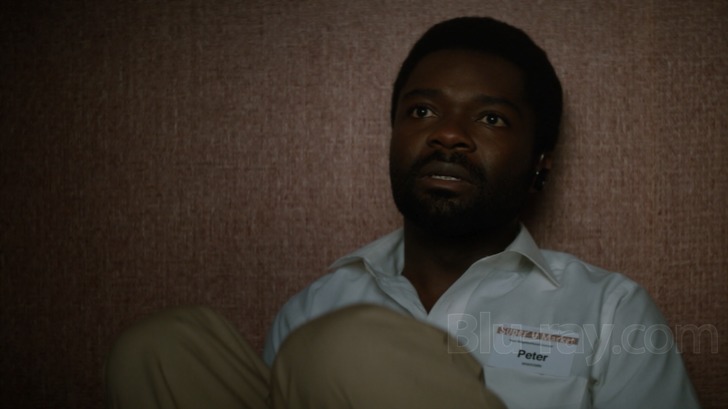
The key element in Nightingale's 5.1 sound mix, encoded on Blu-ray in lossless DTS-HD MA, is David Oyelowo's protean voice, as Peter Snowden reports, justifies, sings, complains, reproaches, cajoles, repeatedly loses his temper and (sometimes) apologizes for it. The Blu-ray's audio track captures all of the subtle inflections that Oyelowo has worked into the performance. A few other voices are heard briefly off-camera, either from TV broadcasts or from outside the front door when someone from the Snowden family's church comes knocking. The remainder of the sound design has a variety of specific effects, most of which relate to objects or events onscreen (e.g., the bubbling of the large aquarium that Peter acquires), but some of which are oddly disembodied (notably the sound of old phonograph record scratches, which is a recurrent motif). The original score is credited to director Lester's regular collaborator, Mark D. Todd. Several vintage selections are heard, of which the most important is Matt Monro's cover of "The Good Life", which plays over the closing credits.
Nightingale Blu-ray Movie, Special Features and Extras
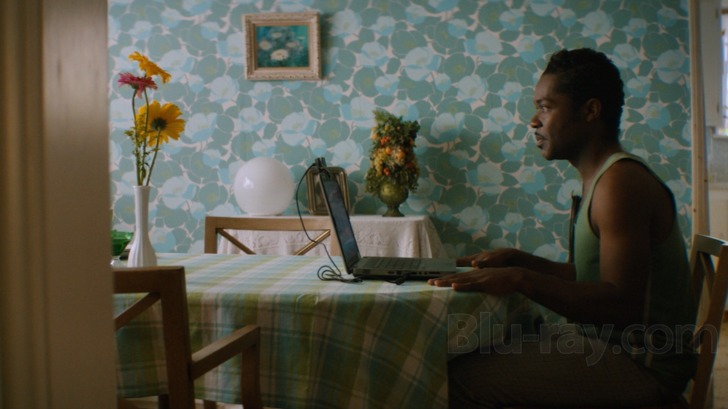
The disc has no extras.
Nightingale Blu-ray Movie, Overall Score and Recommendation
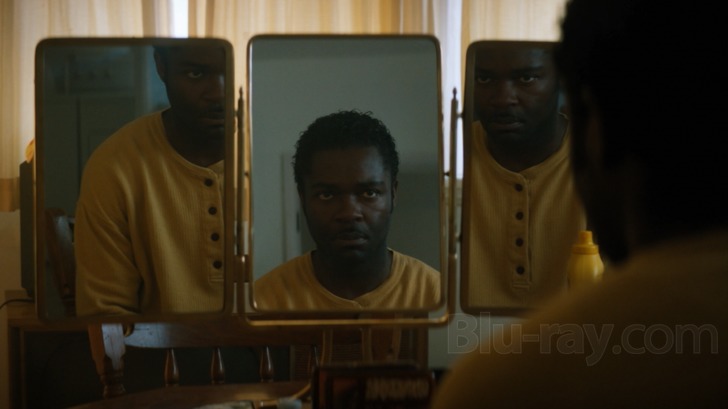
Every time a horrifying incident of mass public carnage makes headlines, certain positions are advanced with the predictability of Christmas catalogs arriving in fall. One of them is that we need to do a better job of identifying and treating those with a history of mental problems, so that they can helped before they turn violent. Nightingale is a timely reminder of just how difficult that simple-sounding prescription really is. When Peter Snowden's sister, Vicki, moved away, leaving her mother and brother in the house where she grew up, Peter probably seemed troubled but otherwise fine. To his neighbors and co-workers (if he had any), he no doubt seemed eccentric but not necessarily dangerous. Peter managed, until he no longer could. Then, as he himself puts it, something snapped. Among its many difficult questions, Nightingale asks whether anyone could have seen that coming. Recommended for artistry, though not necessarily for enjoyment.
Similar titles
Similar titles you might also like
(Still not reliable for this title)

Leave No Trace
2018
Christine
2016

Snowden 4K
Collector's Edition
2016

Megan Leavey
2017

Camp X-Ray
2014

Truth
2015

Shock and Awe
2017

At Eternity's Gate
2018

Same Kind of Different as Me
2017

Breaking
2022

The Good Liar
2019

Demolition
2015

The End of the Tour
2015

The Mercy
2018

Pawn Sacrifice
2014

Captain Fantastic
2016

True Story
2015

The Soloist
2009

Always Shine
2016

Foxcatcher
2014