Nightcrawler 4K Blu-ray Movie
HomeNightcrawler 4K Blu-ray Movie 
4K Ultra HD + Blu-rayShout Factory | 2014 | 117 min | Rated R | Feb 17, 2026

Movie rating
8.2 | / 10 |
Blu-ray rating
| Users |  | 5.0 |
| Reviewer |  | 4.5 |
| Overall | | 4.5 |
Overview
Nightcrawler 4K (2014)
A young man stumbles upon the underground world of L.A. freelance crime journalism.
Starring: Jake Gyllenhaal, Rene Russo, Riz Ahmed, Bill Paxton, Kevin RahmDirector: Dan Gilroy
| Drama | Uncertain |
| Crime | Uncertain |
| Film-Noir | Uncertain |
| Thriller | Uncertain |
Specifications
Video
Video codec: HEVC / H.265
Video resolution: 4K (2160p)
Aspect ratio: 2.39:1
Original aspect ratio: 2.39:1
Audio
English: Dolby Atmos
English: Dolby TrueHD 7.1 (48kHz, 24-bit)
English: DTS-HD Master Audio 5.1 (48kHz, 24-bit)
English: DTS-HD Master Audio 2.0 (48kHz, 24-bit)
Subtitles
English SDH
Discs
Blu-ray Disc
Two-disc set (2 BDs)
4K Ultra HD
Playback
Region A (C untested)
Review
Rating summary
| Movie | | 5.0 |
| Video | | 4.5 |
| Audio | | 5.0 |
| Extras |  | 3.5 |
| Overall | | 4.5 |
Nightcrawler 4K Blu-ray Movie Review
Reviewed by Dr. Stephen Larson February 20, 2026Dan Gilroy's directorial debut Nightcrawler (2014) was reviewed by my colleagues Brian Orndorf and Kenneth Brown more than eleven years ago. Brian published a theatrical review while Ken wrote about Universal Studios' BD-50. To read their thoughts on the film, please refer to the linked reviews.
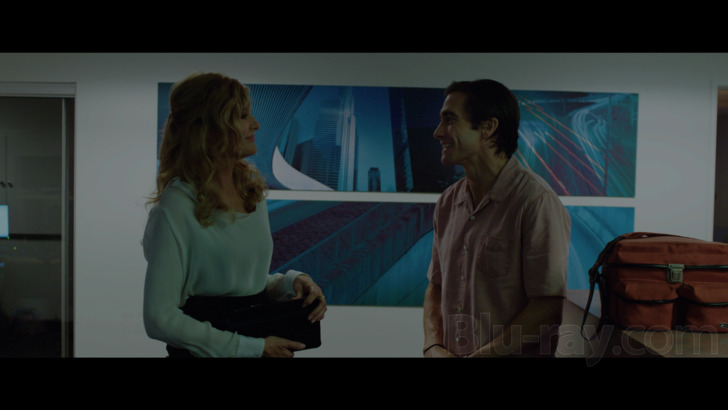
Nina Romina and Louis Bloom enjoy each other's company.
Nightcrawler 4K Blu-ray Movie, Video Quality
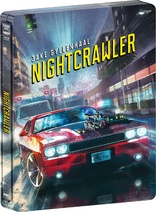
Shout Select's two-disc 4K Ultra HD Blu-ray + standard Blu-ray set is a limited edition SteelBook featuring new artwork of a red Challenger 392 SRT, the second vehicle that Louis Bloom (Jake Gyllenhaal) drives in the film. It also contains an overhead shot of Lou with his camera as the inner print. The UHD transfer and source for the regular Blu-ray come from a 4K scan of the original DI film negative. Jon Witmer reported in a November 2014 issue of American Cinematographer (AC) that Paul Thomas Anderson's frequent cinematographer Robert Elswit helped to complete Nightcrawler's 2K digital grade at Company 3 in Santa Monica, California. Stefan Sonnenfeld supervised colorist Sofie Borup's grading, which was processed with Blackmagic Design's DaVinci Resolve.
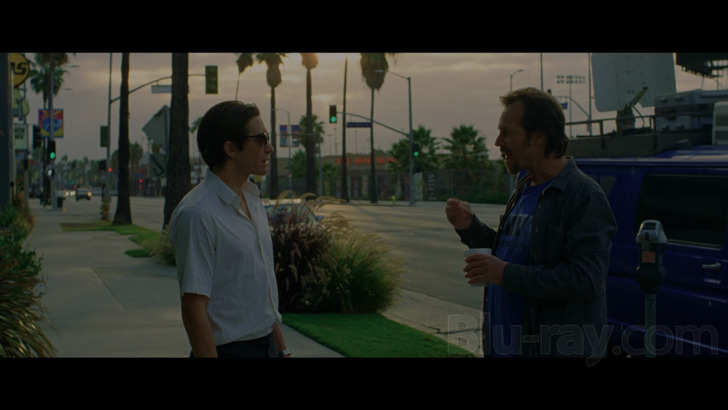
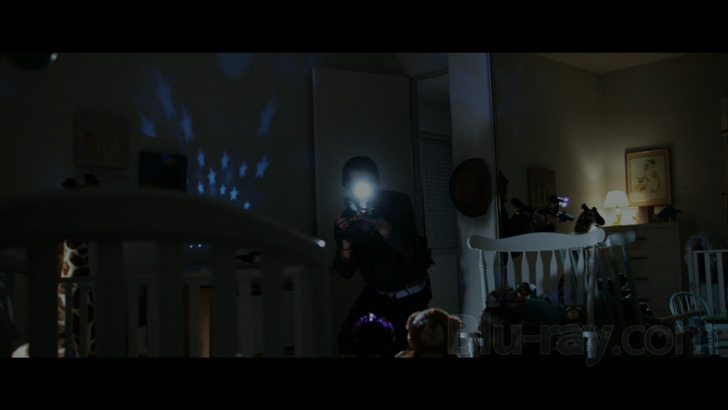
According to Elswit, the shoot for Nightcrawler comprised 26 days, 24 of which were nights. The camera crew filmed in 44 different locations throughout Los Angeles and the San Fernando Valley. The picture was shot with a combination of film and digital cameras. Elswit filmed daytime interiors and daytime exteriors on Super 35 mm with a Kodak Vision3 200T 5213 camera. (The DP shared this information with AC, Scott Marks of the San Diego Reader, and Robert Goldrich of the e-zine SHOOT.) See Screenshot #s 3, 18, 20, 21, 32-34, and 35-37 for several of the daylight scenes. For scenes set within Lou's apartment, Elswit says the production crew built a wall outside the set's window. Elswit told Witmer that he placed Arri M40 and M18 HMIs outside the window to simulate some light coming through. (See frame grab #s 5 and 21.)
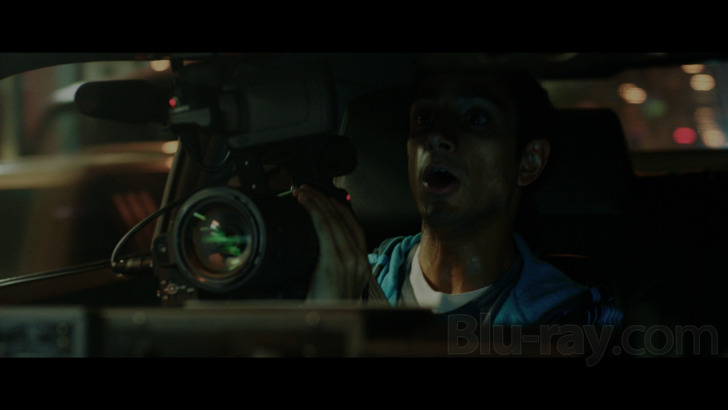
All nighttime scenes were shot with the ARRI ALEXA XT Camera in the aspect ratio of 2.40:1. Elswit stated to Witmer that the ALEXA not only provided a little more grain, but also a little more noise, too. This is why the 4K reveals a bit more grain and noise on the image during those nighttime shots. For instance, check out the grain, noise, and gradient detail present on a close shot of Lou in #9. Andrew Rowlands utilized a Angenieux [Optimo 15-40 mm T2.6] camera for some handheld and Steadicam shots. Elswit and his crew also used a Panavision Primo 11:1 [24-275 mm T2.8] camera for some long-lens shots. Elswit confided to Goodrich that his camera often used practical lighting for the evening scenes. More specifically, ambient night lighting, storefronts, and what the city's Department of Water and Power utility supplied in the area. Also, Elswit told Witmer that the crew deployed various light fixtures for night exteriors. They placed Cineo TruColor HS and LS units above the frame line to backlight the area where they were filming. They lit a majority of KTLA's newsroom with fluorescent lights. The scenes inside the control room are dark. Graphics on the monitors appear super clear on the 4K and Blu-ray. The news set and anchor desk display a nice visual sheen.
For shots captured inside Lou's Challenger, Elswit revealed to AC that a Biscuit rig courtesy of Allan Padelford Camera Cars was used. Profile shots were done with Pursuit Systems, which is a Porsche Cayenne Turbo camera car rigged with a Filmotechnic Flight Head V. For car interiors and evening shots, a lot faces are lit with half shadows. With the modicum of available light, I could still see fine texture on Lou and Rick's (Riz Ahmed) cheeks (see #s 11-14, 17) on the UHD.
I own Universal's 2015 BD and in direct comparison to the 4K, it boasts a generally brighter image with more video noise. The UHD has been placed on a triple-layered disc (feature size: 79.1 GB). It delivers an average video bitrate of 81.8 Mbps and an overall bitrate of 96.2 Mbps for the whole disc. Shout's MPEG-4 AVC-encoded BD-50 carries a mean video bitrate of 28000 kbps. Universal's encode is a little better. That disc sports a standard bitrate of 31995 kbps for the feature. My video score for Shout's 1080p transfer is 4.75/5.00.
Screenshot #s 1-25, 28, 31, 34, 37, & 40 = Shout Select 2026 4K Ultra HD BD-100 (downscaled to 1080p)
Screenshot #s 26, 29, 32, 35, & 38 = Universal Studios 2015 BD-50
Screenshot #s 27, 30, 33, 36, & 39 = Shout Select 2026 BD-50 (from a 4K restoration)
There are twelve chapter breaks for the 118-minute film. (Universal's disc has twenty scene selections.)
Nightcrawler 4K Blu-ray Movie, Audio Quality
Shout has supplied three audio track options to watch Nightcrawler with on UHD and Blu-ray (in addition to an archival commentary and a recent commentary): a new Dolby Atmos mix (Dolby TrueHD 7.1 compatible with a standard bitrate of 3246 kbps) encoded at an average bitrate of 3886 kbps and a maximum bitrate of 5253 kbps; a DTS-HD Master Audio 5.1 Surround track (1799 kbps, 16-bit); and a DTS-HD Master Audio 2.0 Stereo downmix (1562 kbps, 16-bit). Universal's encode of the DTS-HD MA 5.1 is superior with a rough average audio bitrate of 3515 kbps and a bit depth of 24. For the purpose of this review, I focused on the Atmos. (For an analysis of the 5.1, please see Ken's review.) Dialogue is generally intelligible. I turned up my receiver a few decibels during the first reel to hear all of the spoken words. But overall, I could hear all that was said. Audio objects were heard across and all throughout my home theater. Discrete sound effects are effectively placed along the surrounds. Separation is excellent. Depending on your multichannel setup, you'll probably be able to hear the gunshots fired and vehicle noises during the third act along the height speakers.
It took me three viewings of Nightcrawler and many listens of the soundtrack album to fully appreciate James Newton Howard's score. The composer's performing ensemble consists of violins, celli, viola, two guitarists, one clarinetist, electric bass, drums, percussion, and synths. Howard's theme for Lou features strings and later keyboard strokes that underscore the cool, calculating, and cunning manner that he manipulates people with. There are orchestrations that remind me pretty strongly of the electronic sounds heard in the track "Typing" and other cues in Howard's score for Snow Falling on Cedars (1999).
The optional English SDH don't contain any spelling or typographical errors.
Nightcrawler 4K Blu-ray Movie, Special Features and Extras
Shout! has recorded a recent audio commentary with a film critic and an interview with this movie's composer. The boutique label has licensed a vintage commentary track with the filmmakers and a vintage EPK piece from Universal's Blu-ray. Australian label Madman has a few additional extras on its Blu-ray releases: about twenty minutes of interview footage with Dan Gilroy, Gyllenhaal, and Russo as well as a two-minute featurette not found on other editions.
DISC ONE: 4K Ultra HD Blu-ray
- NEW Audio Commentary with Film Historian Joe von Appen - von Appen is co-host of the podcast, Adjust Your Tracking. This is an average commentary. Von Appen delivers several salient descriptions about Nightcrawler but not much in the way of analysis. He compares Louis Bloom to Travis Bickle and one of the teen characters from Weird Science to give the viewer a detailed portrait of the main character. Von Appen hails from LA and attended an early screening of Nightcrawler at a local festival, which he recalls in some detail here. He dances around some of his content points. For example, he claims that some of Bloom's actions and the film's themes are a critique of late capitalism but delays any explication only to return briefly to this point towards the end. Von Appen is conversational in his speaking style, which is fine, but filler words such as "Ya know..." and "Sort of like..." are repeated from time to time. There are some gaps where he watches scenes and comments on them at a later juncture. In English, not subtitled.
- Audio Commentary with Writer/Director Dan Gilroy, Producer Tony Gilroy, and Editor John Gilroy - the Gilroys deliver a great commentary track together. It holds the viewer's interest and doesn't contain any gaps. All three talk in English, not subtitled. For a summary of their running chat, please consult Ken's review.
DISC TWO: Standard Blu-ray — Feature + Bonus Features
- NEW Audio Commentary with Film Historian Joe von Appen - von Appen is co-host of the podcast, Adjust Your Tracking. This is an average commentary. Von Appen delivers several salient descriptions about Nightcrawler but not much in the way of analysis. He compares Louis Bloom to Travis Bickle and one of the teen characters from Weird Science to give the viewer a detailed portrait of the main character. Von Appen hails from LA and attended an early screening of Nightcrawler at a local festival, which he recalls in some detail here. He dances around some of his content points. For example, he claims that some of Bloom's actions and the film's themes are a critique of late capitalism but delays any explication only to return briefly to this point towards the end. Von Appen is conversational in his speaking style, which is fine, but filler words such as "Ya know..." and "Sort of like..." are repeated from time to time. There are some gaps where he watches scenes and comments on them at a later juncture. In English, not subtitled.
- Audio Commentary with Writer/Director Dan Gilroy, Producer Tony Gilroy, and Editor John Gilroy - the Gilroys deliver a great commentary track together. It holds the viewer's interest and doesn't contain any gaps. All three talk in English, not subtitled. For a summary of their running chat, please consult Ken's review.
- NEW Making the News: Scoring NIGHTCRAWLER — An Interview with Composer James Newton Howard (14:17, 1080p) - in this interview conducted remotely with the composer, Howard shares advice he received from Dan Gilroy after the latter listened to the first sketches of the score. Howard talks about improvising with lots of different sounds and harmonic ideas he generates for his scores. He describes Nightcrawler's tone and what Los Angeles is like. He also comments on a theme he came up with after conferring with Gilroy. Howard additionally discusses in brief Joe Trapanese's programming of the score and the creative musical application Ableton. The featurette plays some extracts from Howard's score isolated from the film's sound track (i.e., it's free from dialogue and f/x). In English, not subtitled.
- If It Bleeds, It Leads: Making NIGHTCRAWLER Featurette (5:16, 1080p) - a vintage promotional piece featuring interviews with the director and his cast members. We hear from writer/director Dan Gilroy as well as actors Jake Gyllenhaal, Rene Russo, and Riz Ahmed. Also appearing on camera are stringer consultants Austin Raishbrook and Howard Raishbrook of the Raishbrook Media Group. Spoiler alert: This EPK program gives away a major story event from an excerpted clip so don't watch this until you've seen Nightcrawler! All interviewees speak in English, not subtitled.
- NEW Trailer (1:31, 1080p) - Shout!'s official trailer for Nightcrawler presented in 2.39:1 anamorphic widescreen (average bitrate: 27978 kbps) and accompanied by a DTS-HD Master Audio 2.0 Stereo track (1566 kbps, 16-bit).
Nightcrawler 4K Blu-ray Movie, Overall Score and Recommendation
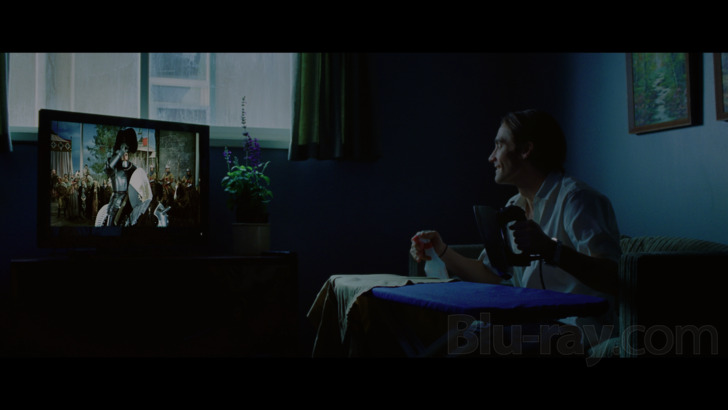
Nightcrawler is now a neo-noir classic that holds up more than well since my theater viewing in the autumn of 2014. Jake Gyllenhaal delivers arguably his greatest performance to date. He imbues Lou with a reptilian quality that meshes with his narcissism and counterbalances his character's vulnerabilities and acts of desperation. The Dolby Vision and HDR grade look splendid on Shout's 4K UHD with inky blacks and ultra-solid colors. I thought that the HDR really brought out the red on Lou's Challenger as well as the figural outlines and shapes of the actors within the frame. The new Dolby Atmos mix is consistently omnipresent and occasionally immersive when accenting f/x and Howard's score. The new commentary track is alright. The interview with Howard is better. VERY HIGHLY RECOMMENDED.

