Night Moves 4K Blu-ray Movie
HomeNight Moves 4K Blu-ray Movie 
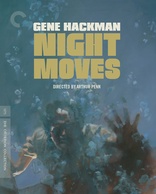
4K Ultra HD + Blu-rayCriterion | 1975 | 100 min | Rated R | Mar 25, 2025

Movie rating
7.5 | / 10 |
Blu-ray rating
| Users |  | 4.0 |
| Reviewer |  | 3.0 |
| Overall | | 3.1 |
Overview
Night Moves 4K (1975)
Cut-rate private eye Harry Moseby finds himself caught in a labyrinth of mendacity and murder. Hired to locate the runaway daughter of faded Hollywood actress Arlene Iverson, Harry heads to the Florida Keys, where what he considered a run-of-the-mill case turns into something much more. Meanwhile, his marriage is slowly disintegrating.
Starring: Gene Hackman, Jennifer Warren, Edward Binns, Harris Yulin, Kenneth MarsDirector: Arthur Penn
| Film-Noir | Uncertain |
| Crime | Uncertain |
| Mystery | Uncertain |
| Thriller | Uncertain |
Specifications
Video
Video codec: HEVC / H.265
Video resolution: 4K (2160p)
Aspect ratio: 1.85:1
Original aspect ratio: 1.85:1
Audio
English: LPCM Mono (48kHz, 24-bit)
Subtitles
English SDH
Discs
Blu-ray Disc
Two-disc set (2 BDs)
4K Ultra HD
Playback
Region A (locked)
Review
Rating summary
| Movie | | 4.0 |
| Video | | 3.0 |
| Audio |  | 5.0 |
| Extras |  | 3.5 |
| Overall | | 3.0 |
Night Moves 4K Blu-ray Movie Review
Reviewed by Dr. Svet Atanasov March 21, 2025Arthur Penn's "Night Moves" (1975) arrives on 4K Blu-ray courtesy of Criterion. The supplemental features on the release include new audio program with actress Jennifer Warren; new audio commentary by author Matthew Asprey Gear; archival programs with Arthur Penn; and vintage trailer. In English, with optional English SDH subtitles for the main feature. Region-Free.
The man from the West Coast
The key theme in Night Moves is an old investigative credo -- the deeper you dig, the more you will uncover. However, the very best investigators tend to ignore this old credo. When they go to work, their main objective is not to dig as deep as possible, but to get as close to the truth as possible. They recognize, and rightfully so, that the former is not synonymous with the latter.
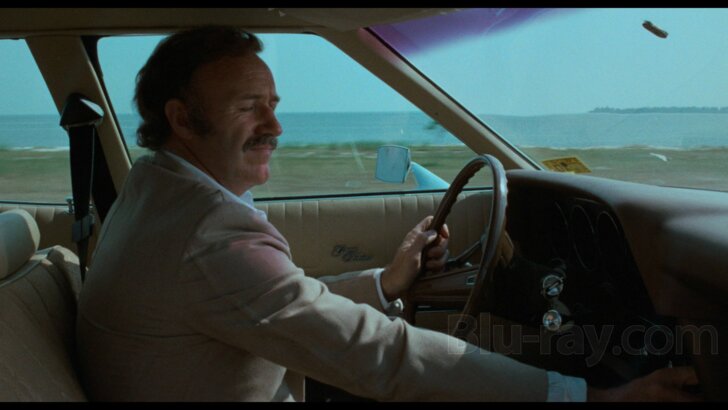
In Night Moves, the main protagonist, Harry Moseby (Gene Hackman), is a Los Angeles-based former NFL player-turned-private detective who is not a great investigator. He is smart, but his working methods are flawed because he operates like a hound. He trusts his instincts more than anything else, and while searching for the truth, he allows his feelings to dictate how to choose the correct path that would get him to it. For this very reason, after failed aging actress Arlene Iverson (Janet Ward) hires him to locate her missing teenage daughter, Delly Grastner (Melanie Griffith), Moseby quickly begins following several loose leads that dramatically expand the scope of his work. One of the leads provides him with evidence that Grastner has been hanging with some pretty shady characters, a few of whom have helped her make various bad decisions. The most important of these characters is her former boyfriend, Quentin (James Woods), an experienced car mechanic with a short fuse, who has done stunt work for several Hollywood directors. After Moseby tracks him down, he is redirected to stunt professionals Marv Ellman (Anthony Costello) and Joey Ziegler (Ed Binn), who help him figure out that his next destination must be South Florida, where Grastner is quietly living with her stepfather, Tom Iverson (John Crawford), and his mistress, Paula (Jennifer Warren). However, before reaching South Florida, Moseby accidentally discovers that his wife, Ellen (Susan Clark), is cheating on him with a crippled stranger, Marty Heller (Harris Yulin), who somehow has a far more accurate understanding of her life and needs than him. While trying to come to terms with the shocking discovery, Moseby then allows a wide range of contrasting feelings to expand and complicate even more an already pretty confusing case involving a girl who had never truly gone missing.
Directed by Arthur Penn, Night Moves has often been described as one of the most difficult to deconstruct crime films from the 1970s. There are valid reasons for this, virtually all of which can be linked to its awkwardly structured narrative. Interestingly, but perhaps not surprisingly, Night Moves becomes very easy to deconstruct if seen from a slightly different angle and with the awareness that the case Moseby is hired to work on is part of something bigger.
The case is a litmus test revealing a complex web of performances executed by various performers -- some good, some bad, some fully aware of the consequences of their actions, some only partially or not at all. As Moseby launches his flawed investigation, the dynamic of this giant human kabuki theater quickly overshadows the case he is hired to solve, and in the process, he becomes aware of his role in it as well. At that point, Moseby also begins undergoing a massive, permanent transformation that alters his relationship with and grasp of the case.
This unorthodox concept for a film noir, which technically Night Moves is, may seem quite strange, but it should not. It is just a variation of the genre bending that began a couple of decades earlier. For example, in the late 1950s, Don Siegel started shooting film noirs that were drenched in sunlight (The Lineup), and by the mid-1960s the ‘new’ film noirs (Warning Shot, P.J.), now shot in color too, already promoted a vastly different atmosphere than the one the classic film noirs are remembered for. In Night Moves, the genre bending bypasses its atmosphere and occurs elsewhere.
Penn chose to work with director of photography Bruce Surtees, who lensed such cult gems as Dirty Harry, The Outfit, Escape From Alcatraz, and Risky Business.
Night Moves 4K Blu-ray Movie, Video Quality
Criterion's release of Night Moves is a 4K Blu-ray/Blu-ray combo pack. The 4K Blu-ray is Region-Free. However, the Blu-ray is Region-A "locked".
Please note that some of the screencaptures included with this article are taken from the 4K Blu-ray and downscaled to 1080p. Therefore, they do not accurately reflect the quality of the 4K content on the 4K Blu-ray disc.
Screencaptures #1-27 are from the Blu-ray.
Screencaptures #29-37 are from the 4K Blu-ray.
The following text appears inside the leaflet provided with this release:
"This new 4K restoration was created from the 35mm original camera negative. A vintage 35mm Technicolor dye-transfer print was used as a color reference. The original monaural soundtrack was remastered from the 35m DME magnetic track."
Mastering supervisors: Lee Kline, Giles Sherwood.
Colorist: Rory Gordon/Keep Me Posted, Burbank, CA.
Image restoration: Prasad Corporation.
Audio restoration: The Criterion Collection."
In native 4K, the new 4K makeover of Night Moves can be viewed with Dolby Vision and HDR grades. I chose to view it with Dolby Vision. Later, I also spent quite a bit of time with the 1080p presentation of it on the Blu-ray.
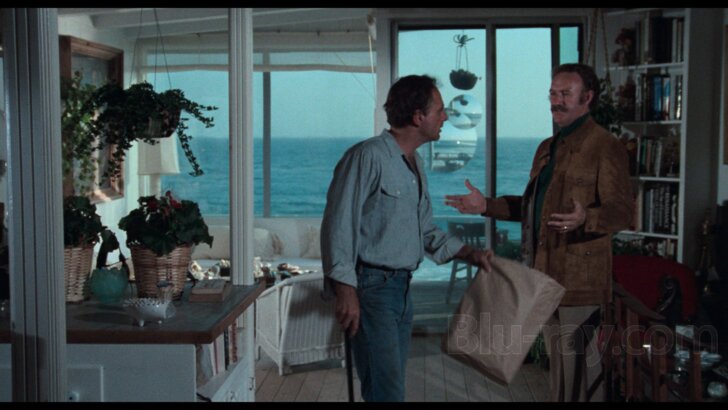
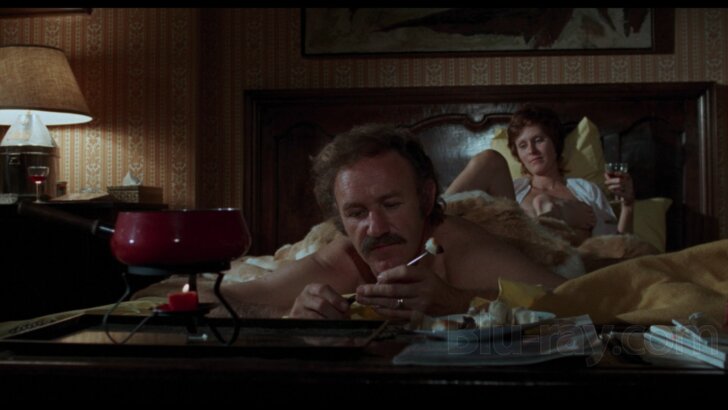
The new 4K makeover of Night Moves is disappointing. While it boasts very healthy and wonderfully detailed visuals, all with terrific density levels, it introduces some pretty dramatic color adjustments that effectively alter the film's native period appearance. I have Warner Archive's original Blu-ray release, which offers a very solid and accurate presentation of the film, and did not even feel the need to do extensive comparisons with it. In some areas of the new 4K makeover, there are entire ranges of primaries and supporting nuances that are eliminated and replaced by variations of turquoise/cyan, creating pretty striking anomalies. To be clear, these anomalies are of the kind that also appear on the recent 4K makeovers of The Hitcher and Mean Streets, adding harsh neon-esque qualities to skies and interiors that destabilize even some background nuances. On this 4K makeover, they are simply significantly exaggerated, doing a lot more to alter the native color temperature of the visuals. Needless to say, this is very unfortunate. I also sampled a lot of these problematic areas in 1080p on the Blu-ray. I think that in 1080p, some look marginally worse. I suspect that the expanded color gamut of the Dolby Vision manages some tiny nuances a little better, but the harsh collapses of the native primaries and supporting nuances are still unmissable. Grain exposure looks terrific. Image stability is great. The entire film looks immaculate as well.
Night Moves 4K Blu-ray Movie, Audio Quality
There is only one standard audio track on this release: English LPCM 1.0. Optional English SDH subtitles are provided for the main feature.
Night Moves is complemented by an interesting, delicate soundtrack created by Michael Small. I think that in some areas of the film, the music is very effective. However, the dynamic contrasts that emerge are not of the kind that may impress audiophiles. During action material, like the one from the finale, there is not much to praise either. The dialog is always clear, sharp, and easy to follow. While viewing the film, I did not encounter any anomalies to report in our review.
Night Moves 4K Blu-ray Movie, Special Features and Extras

4K BLU-RAY DISC
- Commentary - in this exclusive new audio commentary, Matthew Asprey Gear, author of Moseby Confidential: Arthur Penn's "Night Moves" and the Rise of Neo-Noir, provides a detailed analysis of the narrative construction and characterizations that Night Moves produces, some big and small differences between the character Alan Sharp created and the one Gene Hackman played, the visual style of the film, and its flexible identity. The commentary was recorded in 2024.
- Commentary - in this exclusive new audio commentary, Matthew Asprey Gear, author of Moseby Confidential: Arthur Penn's "Night Moves" and the Rise of Neo-Noir, provides a detailed analysis of the narrative construction and characterizations that Night Moves produces, some big and small differences between the character Alan Sharp created and the one Gene Hackman played, the visual style of the film, and its flexible identity. The commentary was recorded in 2024.
- Arthur Penn, 1975 - in this archival program, Arthur Penn explains what inspired him to direct Night Moves, and discusses the complex developments in the seemingly straightforward case Gene Hackman is hired to work on, and investigator's transformation, and the film's style and mood. There are some interesting comments about the casting choices that were made, one of which brought a very young Melanie Griffith to the film. The program was produced for the television series Cinema Showcase in 1975. In English, not subtitled. (20 min).
- Arthur Penn, 1995 - in this archival program, Arthur Penn discusses the socio-political environment in which Night Moves was conceived and shot, as well as the significance of the film's dramatic finale. The program is an extract from the 1995 documentary Arthur Penn: A Love Affair with Film, made by Lars-Olav Beier and Robert Muller. In English, not subtitled. (6 min).
- Jennifer Warren - in this new audio program, Jennifer Warren explains how she was cast to play her character in Night Moves, what it was like to interact and work with Gene Hackman and Arthur Penn, and the shooting process in Los Angeles. Warren also discusses Alan Sharp's screenplay and mentions the fears she had to overcome while shooting the supposedly very complex underwater footage. In English, not subtitled. (18 min).
- The Day of the Director - this archival program documents the production of Night Moves. Included in it is raw footage from the shooting of the film, most of which shows Arthur Penn directing and giving instructions from afar. In English, not subtitled. (9 min).
- Trailer - presented here is a vintage trailer for Night Moves. In English, not subtitled. (3 min).
- Leaflet - an illustrated leaflet featuring Mark Harris' essay "Losing Ground" and technical credits.
Night Moves 4K Blu-ray Movie, Overall Score and Recommendation
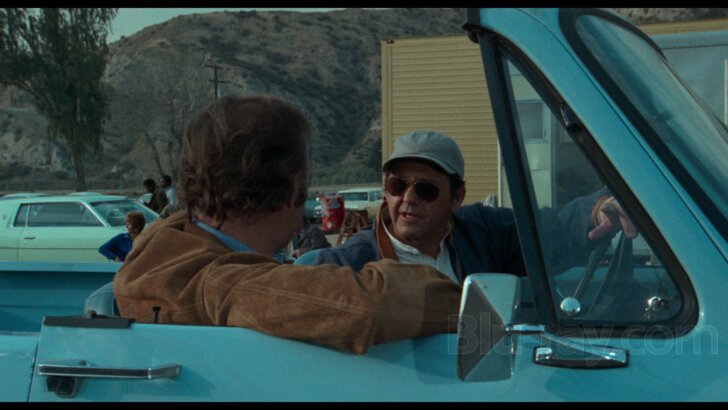
The genre bending that occurs in Night Moves may seem a bit strange, and for several legitimate reasons, but it is part of a trend that began in the late 1950s, when some directors started experimenting and discovered that film noir can be made to look different. By the late 1960s, the same directors had inspired a whole new group of directors to shoot even more diverse film noirs, and they were doing it with a great deal of enthusiasm. In Night Moves, the bending does not affect the visual style or atmosphere, it is in the narrative construction, which is most unusual. Criterion's upcoming combo pack introduces an exclusive new 4K restoration of Night Moves. I found the 4K restoration unconvincing, so before you grab the combo pack for your library, it is best to find a way to test it first.


Similar titles
Similar titles you might also like

Kiss Me Deadly
1955

The Long Goodbye
4K Restoration
1973

Klute
1971

In the Heat of the Night 4K
1967
The Two Jakes 4K
1990

Under the Silver Lake
2018

Cutter's Way
Limited Edition to 3000
1981

The Black Dahlia
2006

Gone Baby Gone
2007

The Crimson Kimono
Limited Edition to 3000
1959

Twilight
1998

Gone Girl
2014

The Maltese Falcon 4K
1941

The Big Sleep
Warner Archive Collection
1946

Wild Horses
2015

Double Indemnity 4K
1944

The Killers
1946

Devil in a Blue Dress 4K
1995

The Big Heat 4K
1953

In the Electric Mist
2008