Narco Cultura Blu-ray Movie
HomeNarco Cultura Blu-ray Movie 
Cinedigm | 2013 | 103 min | Rated R | Feb 25, 2014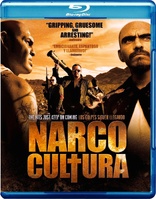

Movie rating
6.4 | / 10 |
Blu-ray rating
| Users |  | 0.0 |
| Reviewer |  | 4.0 |
| Overall | | 4.0 |
Overview
Narco Cultura (2013)
For Mexicans and Latinos in the Americas, there is no music more popular today than narcocorridos. These bloodthirsty and explicit odes to the exploits of narco traffickers and drug lords of Mexico openly glorify violence, narcotics and money. Like gangsta rap in the nineties, "Narco" is a movement threatening to burst into the mainstream.
Director: Shaul Schwarz| Documentary | 100% |
Specifications
Video
Video codec: MPEG-4 AVC
Video resolution: 1080p
Aspect ratio: 1.78:1
Original aspect ratio: 1.85:1
Audio
Spanish: DTS-HD Master Audio 5.1
Subtitles
English, Spanish
Discs
25GB Blu-ray Disc
Single disc (1 BD)
Playback
Region A (B, C untested)
Review
Rating summary
| Movie | | 4.0 |
| Video |  | 4.5 |
| Audio | | 4.0 |
| Extras |  | 1.0 |
| Overall | | 4.0 |
Narco Cultura Blu-ray Movie Review
This is your country on drugs.
Reviewed by Jeffrey Kauffman April 2, 2014Despite occasional punditry that insists the wealthy are being pilloried for their achievements, most people in the United States still tend to lionize those who have amassed great personal fortunes. After all, isn’t part of the American Dream to have enough money to do whatever you want? Our whole celebrity culture is based at least in part on the idolization of money and fame—can “talent” alone adequately explain the public's fascination with someone like Justin Bieber or Miley Cyrus? (That’s a joke—save your private messages.) And so in a way perhaps it’s perfectly understandable that a new class of entrepreneur has become such a cultural flashpoint in Mexico. These people are self-made millionaires—and in some cases, allegedly billionaires—who often came from backgrounds of extreme poverty and who have risen to the highest ranks of influence and power. So why should anyone be upset? Because these people are drug traffickers, and their illegal activities have spilled into Mexico’s society in sometimes appalling ways. Narco Cultura is an absolutely riveting, if also very disturbing, examination of both the havoc the drug culture wreaks as well as the bizarre allure it continues to have for a certain segment of the population. The recent arrest of so-called drug kingpin “El Chapo” (also known as Joaquin Guzman) made international headlines and even spawned a segment with Jon Stewart on The Daily Show. Narco Cultura gives a little background on El Chapo (the documentary was made before this latest turn of events, but is incredibly prescient by focusing on Guzman at various points) while detailing a wider streak of conduct that has devastated large swaths of Mexico. Narco Cultura is the brainchild of Shaul Schwarz, a former war photographer who brings a visceral intensity to an almost dialectical approach that focuses on an overworked Juarez crime scene investigator and a perhaps “wannabe” gang-banger who works as a musician in Los Angeles churning out so-called narco corrido ballads that lionize various drug traffickers, including some kids relatively far down the food chain who want their own “signature tune” to relate their personal life stories.

Juarez, Mexico and El Paso, Texas are literally right next door to each other, and yet the differences between the two cities could hardly be starker. El Paso is one of the safest cities in the United States—the film cites it as the safest, with only five murders in the year prior to the documentary’s filming. Contrast that generally positive state of affairs with the sad record in Juarez. As one of the two chief focal characters in the film, Mexican CSI officer Richi Soto, relates, the influx of the drug cartels into Juarez has seen an almost incomprehensible spike in the murder rates. Just a few years ago there were only a handful of such crimes, and Juarez was seen as a beautiful, if still rather poor, community. As Soto relates the almost geometric accretion of murders—from tens, to hundreds, to literally thousands—over the course of just a few years, Schwarz delivers a chilling montage of crime scene footage as well as equally gruesome snapshots of victims being delivered to the morgue.
Just one sign of how incredibly desperate things are in Juarez is shown by how the police need to show up to crime scenes. Almost all of them wear ski masks, so that they cannot be readily identified and targeted. Soto seems only too aware of how precarious his safety is, and mentions that at any given crime scene an ostensible “witness” may in fact be a perpetrator trying to ferret out exactly how much the authorities know. Soto drives through more or less deserted streets in Juarez, stating that people are simply too afraid to go out in the open any more. His police van suffers from a cracked windshield in a perhaps telling indictment of the lack of funds afforded law enforcement in the region.
There are some chilling—and heart breaking—moments with kids literally caught in the crossfire. Two little boys stare through the grillwork of one of two fences separating Juarez from El Paso, dreaming of being able to get to “the other side”, where murder isn’t a daily phenomenon. Later, at the site of a gangland killing, three little boys sit around chatting about the shootout and various weapons used. One of them casually mentions that his uncle, an innocent bystander, was caught in a similar melée previously, got shot and died by choking on his own blood. The “matter of fact” tone of voice these kids have about this carnage is truly unsettling.
Schwarz contrasts this “up close and personal” view of the chaos inflicted by the drug “industry” with more distant but perhaps just as disturbing trends in popular culture which seek to romanticize and make heroic the players in these kinds of dramas. The documentary shows us the efforts of musician Edgar Quintero, a narco-corrido artist who actually takes notes from his clients on things like what kinds of weapons they use, so that he can incorporate “factual” data in the songs he writes to publicize their exploits. Even Quintero seems to be aware he’s dealing with danger, something that his young children perhaps make more relevant.
But Schwarz also shows that this is a Mexican issue, as well, one that’s deeply ingrained in a popular culture that lionizes such figures in mass media like telenovelas. It’s of course perhaps worthwhile to think back on the gangster films that studios like Warner Brothers churned out in the 1930s. While there was an effort made to provide a “crime doesn’t pay” subtext to many of these films, there’s also no denying that much of the public’s fascination with these outings was due to the visceral excitement of seeing bad guys do bad things. Now close to a century later, much the same thing is happening in Mexico, though the stakes seem considerably higher, at least when judged by the increasing body count.
Narco Cultura Blu-ray Movie, Video Quality
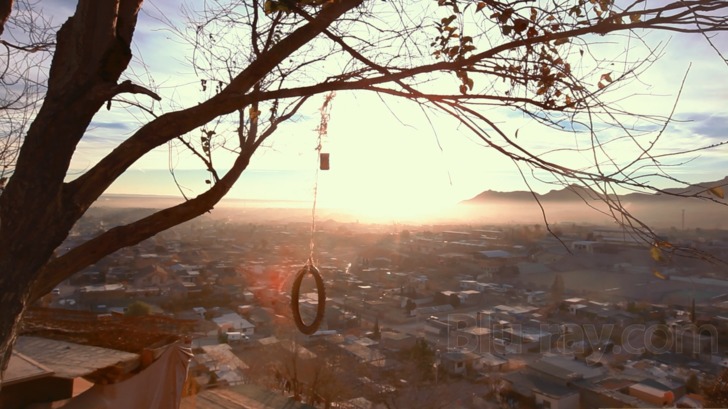
Narco Cultura is presented on Blu-ray courtesy of Cinedigm with an AVC encoded 1080p transfer in 1.78:1. This digitally shot feature is really rather incredibly sharp and well defined looking most of the time, something that's especially impressive given the rigors of the on location shoot. Establishing shots of Juarez and El Paso deliver some great depth of field, and fine detail is excellent in close-ups. Occasionally the hand held camera has moments of instability, as in several sequences shot in moving cars, something that can add the appearance of softness and imprecision to certain scenes. There is also a perhaps unavoidable uptick in slight noise in the darkest sequences. A lot of this film is fairly gruesome, with many scenes of actual murder victims, and so those with squeamish stomachs may want to have their hands at the ready to cover their eyes at the most troublesome imagery.
Narco Cultura Blu-ray Movie, Audio Quality
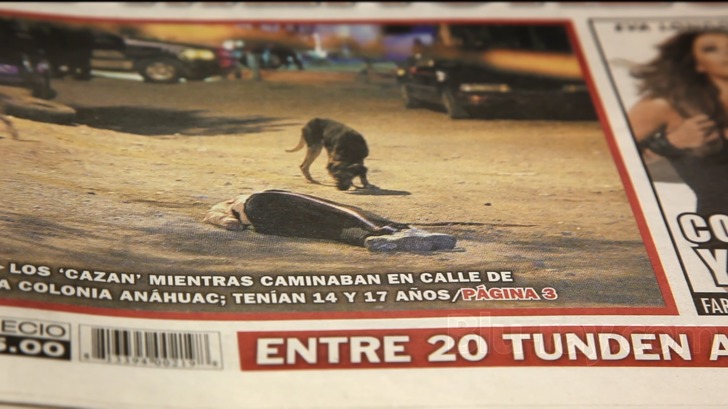
Narco Cultura features a lossless DTS-HD Master Audio 5.1 mix that segues back and forth rather seamlessly (at times mid-sentence, in fact) between English and Spanish. A lot of the film features voiceover or first person confessionals, so there's not a lot of depth or immersion, but several outdoor scenes provide a wealth of ambient environmental sounds, and the documentary's music also spills through the surrounds. Fidelity is excellent throughout the track, and there are no issues of any kind to report.
Narco Cultura Blu-ray Movie, Special Features and Extras

- Deleted Scenes (1080p; 10:41)
- Trailer (1080p; 2:16)
Narco Cultura Blu-ray Movie, Overall Score and Recommendation

Schwarz repeatedly uses the Mexican holiday of the Day of the Dead as a trope throughout Narco Cultura. What's depressingly obvious after a while is that in this state of affairs, every day in Juarez, and perhaps Mexico as a whole, is a day of the dead. Turning a blind eye doesn't stop the carnage, as Schwarz makes abundantly clear. This documentary isn't easy to sit through, but it's an absolutely unforgettable experience. Highly recommended.
Similar titles
Similar titles you might also like
(Still not reliable for this title)

America: Imagine the World Without Her
2014

Jodorowsky's Dune
2013

Freakonomics
2010

Roger & Me
1989

Stephen Fry in America
2007

The American Dreamer
1971

Nudist Life
10 Days in a Nudist Camp / Shangri-La Forbidden Fruit: The Golden Age of the Exploitation Picture, Vol. 14
1961

You Don't Nomi
2019

The Devil at Your Heels
Slipcover in Original Pressing
1981

I Think We're Alone Now
Slipcover in Original Pressing
2008

Lost Soul: The Doomed Journey of Richard Stanley's Island of Dr. Moreau
2014

Chariots of the Gods
1970
The First VCR
2019

The Queen
1968

We Kill for Love
Slipcover in Original Pressing
2023

The Salt of the Earth
Le Sel de la Terre
2014

Bettie Page Reveals All
2012

The Go-Go Boys: The Inside Story of Cannon Films
2014

De Palma
2015

For Madmen Only
For Madmen Only: The Stories of Del Close
2020