NOVA: Becoming Human Blu-ray Movie
HomeNOVA: Becoming Human Blu-ray Movie 
PBS | 2009 | 180 min | Not rated | Feb 09, 2010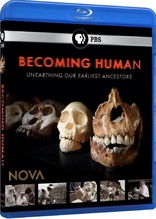

Movie rating
Movie has not been rated yetBlu-ray rating
| Users |  | 0.0 |
| Reviewer |  | 3.5 |
| Overall | | 3.5 |
Overview
NOVA: Becoming Human (2009)
Nothing is more fascinating to us than, well, us. NOVA's groundbreaking investigation explores how new discoveries are transforming views of our earliest ancestors. Featuring interviews with renowned scientists, footage shot as fossils were unearthed, and stunning computer-generated animation, Becoming Human brings early hominids to life, examining how they lived and how we became the creative and adaptable modern humans of today.
| Documentary | 100% |
Specifications
Video
Video codec: MPEG-4 AVC
Video resolution: 1080i
Aspect ratio: 1.78:1
Audio
English: Dolby Digital 2.0
Subtitles
English
Discs
50GB Blu-ray Disc
Single disc (1 BD)
Playback
Region A, B (C untested)
Review
Rating summary
| Movie | | 3.5 |
| Video | | 3.5 |
| Audio |  | 3.0 |
| Extras | | 0.0 |
| Overall | | 3.5 |
NOVA: Becoming Human Blu-ray Movie Review
An evolution in NOVA programming?
Reviewed by Casey Broadwater April 16, 2010I’m deeply, truly, almost existentially scared and fascinated by three things: the vastness of the universe, the uncharted depths of the oceans, and the lives of pre-humans on the plains of Africa millions of years ago. The first two are self-explanatory; I’m dwarfed and awed by the infinitude of space—the thought of barren, windswept planets royally freaks me out for some reason—and the idea of large aquatic creatures swimming around in the inky blackness below me is the stuff of sheet-drenching nightmares. As for our evolutionary ancestors, I get this geeky scientific thrill thinking about how my DNA has been passed down through the eons, slowly mutating and adapting, but I’m also chilled when I think about these human antecedents as people—not just excavated skull fragments—hunched around a fire, noshing on meat, and monosyllabically grunting in some primitive prototype of language. How we got from there to here is mind-boggling, and it’s the topic of Becoming Human: Unearthing Our Earliest Ancestors, a three-part NOVA series that aired on PBS in November 2009.
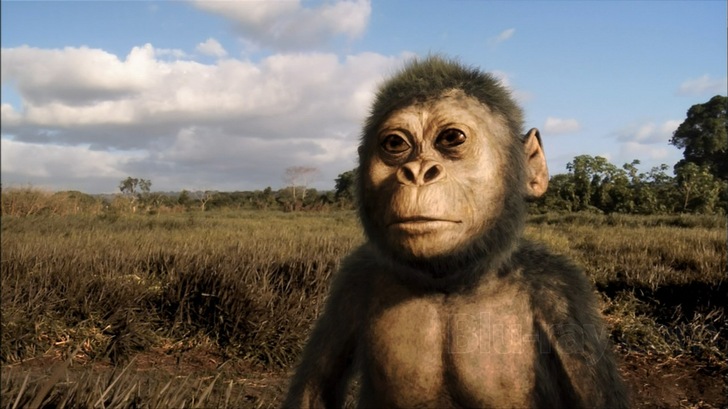
Australopithecus afarensis
Part one, First Steps, looks way, way back in time, six million years ago—a mere second on the clock of the universe, but epochs in terms of human evolution—when the ape-like creature that loped across the African plains on all fours first started standing up on his hirsute hind legs. How and why bipedalism developed is the main question posed here, and for answers we turn to a skull, nicknamed “Toumai,” that was found by French anthropologist Michel Brunet in 2001. The way the skull connected to the spine—on the bottom, as opposed to the back— confirmed that Toumai walked upright, making his species, Sahelanthropus tchadensis, a good candidate for the earliest to branch off of the ape’s evolutionary line. Scientists now speculate that the reason Toumai’s kind began ambling along on two feet—a rare occurrence in the natural world—has to do with climate change.
Yes, the same inconvenient truth that hangs now over humanity’s head was possibly the catalyst that jumpstarted our genes, inflated the size of our brains, and sent us jogging down the path to lunar landings, modern medicine, the iPad and high definition 3D TV. (Oh, and atomic weaponry, congested freeways, and Walmart Supercenters, but I guess we have to take the bad with the good.) As Africa morphed from a wet, tropical, jungle-like environment to one of drier plains, our ancestors—no longer in need of their tree-climber physiques—began to stand up. The most widely accepted hypothesis for this is that it helped them to conserve energy, and we can see that modern humans spend four times less energy walking on two legs than chimpanzees do on all fours.
Parts two and three continue the saga of humankind’s emergence as several different types of hominids eventually died out, leaving only Homo sapiens. In Birth of Humanity, we follow Homo erectus as he leaves the African continent and spreads throughout Europe and Asia, creating the first semblances of “culture” along the way, a communal mode of living centered around the campfire, which was both a defense against wild animals—humans weren’t quite at the top of the food chain yet—as well as the place where characteristically human group dynamics were born. This episode also contains a candid discussion of pubic lice, as scientists have figured out a way to determine when we began to lose our body hair, based on the genetic divergence between the gorilla louse and the human pubic louse. Gross, yes, but oddly compelling. In the final episode, Last Human Standing, we look at the emergence of symbolic consciousness and decorative art, while plumbing the mystery of why the Neanderthals in northern Europe—who survived hardily for over 200,000 years—disappeared some 25,000 years ago.
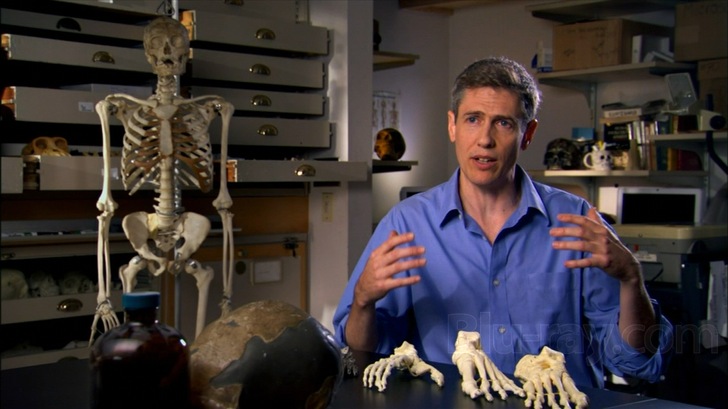
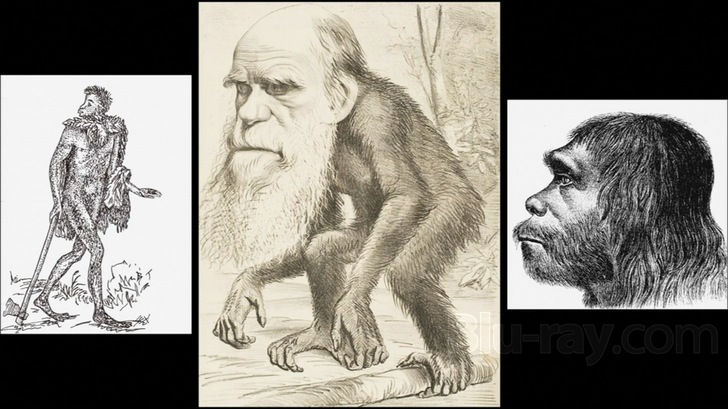
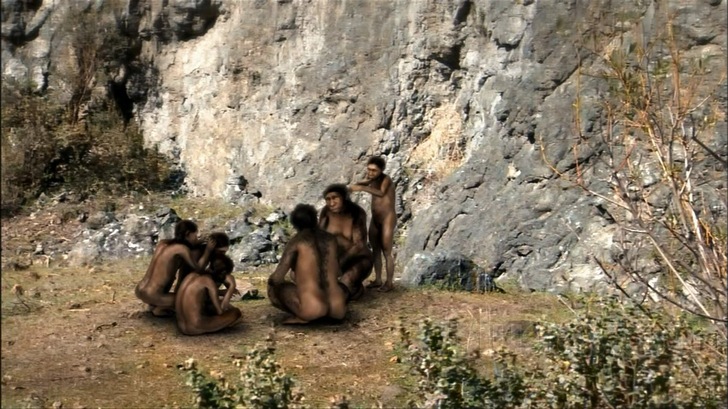
These kinds of documentaries can often be as dry as the fossilized bones they’re discussing, but Becoming Human puts a literal face on the skeletal remains that tell the story of our evolution. Bipedal proto-humans like Australopithecus afarensis—who roamed Africa 3.5 million years ago—are brought to life via motion capture and CGI, giving us an approximation of how they might have looked and moved. “Paleo-artist” and sculptor Vicktor Deak, using his studies of cadavers and modern anatomy, even fleshes out ancient skulls by adding clay layers of muscle, fat, and skin, giving us a glimpse at the visages of our collective ancestors. (Spoiler alert: They don’t look very bright, even by Cro-Magnon standards.) The episodes move at a brisk pace, propelled by in-the-field footage of anthro-paleontologists doing their thing and some extremely knowledgeable talking heads who parse out the scientific particulars into layman’s terms. Fittingly for a series so concerned with brain capacity and cognitive acceleration, the information is coherently and elegantly arranged, each new topic building upon the last.
NOVA: Becoming Human Blu-ray Movie, Video Quality
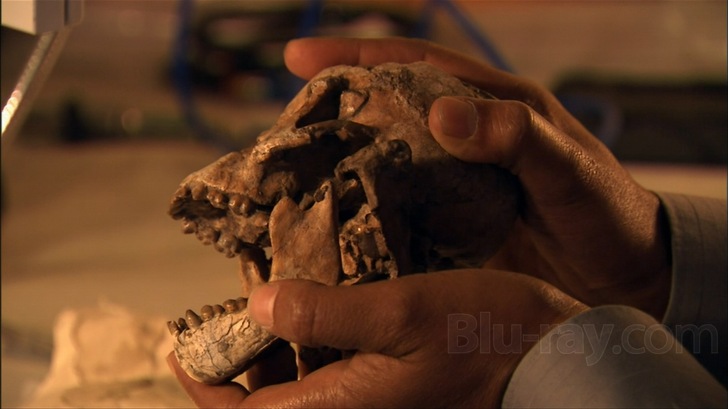
Cobbled together from a variety of sources, mostly high definition video but also some film and a
few instances of obviously upscaled footage, Becoming Human isn't about to raise the
bar for television documentary picture quality, but it does look more than adequate for what it is.
Presented in 1.78:1 with a 1080i/AVC encode, the three episodes have a generally crisp and
naturally colored look, with only a few non-distracting compression-related hiccups here and
there. Clarity is nicely refined during the talking head interview segments—fine detail is visible, if
never exactly wowing—and the "in the field" shots are fairly sharp too, especially when we zoom
in to archeological close-ups of bones jutting out of the desert sand. Black levels are strong and
level, colors are bright, and skin tones are balanced and warm. The CGI isn't the greatest—this is
NOVA, not Pixar—but it illustrates the various talking points well, and gives a good approximation
of what these proto-humans would've looked like. The encode is prone to chunky noise on
occasion, and there is some slight banding and aliasing if you really want to look for it, but
nothing worth fussing over. All in all, Becoming Human looks exactly as you'd expect
from a NOVA production of this caliber.
Do note that as it was difficult to capture workable screenshots in 1080i, all of the screens
included in this review were captured in 720p and do not represent the full visual quality of the
image.
NOVA: Becoming Human Blu-ray Movie, Audio Quality
Would Becoming Human benefit from a lossless 5.1 surround mix? Sure, marginally, but there's really nothing wrong with the included Dolby Digital 2.0 stereo track. After all, 90% of the documentary is narration, with the remaining 10% given to driving—but quiet—music used to underscore the magnificence of the scientific discoveries. The voiceovers and interview conversations are perfectly clear, and I didn't hear any odd mufflings, crackles, or drop-outs. There does seem to be a nice spread through the front channels, with plenty of differentiation between the various musical instruments and effects.
NOVA: Becoming Human Blu-ray Movie, Special Features and Extras
Unfortunately, there are no bonus materials at all on this disc.
NOVA: Becoming Human Blu-ray Movie, Overall Score and Recommendation
For the scientifically minded, or anyone interested in the origins of the human species and culture, Becoming Human is an excellent entryway into the fields of evolution and anthropology, and would serve as a perfect teaching aid for the few Blu-ray equipped classrooms out there. Casually recommended.