My Son John Blu-ray Movie
HomeMy Son John Blu-ray Movie 
Olive Films | 1952 | 122 min | Not rated | Aug 21, 2012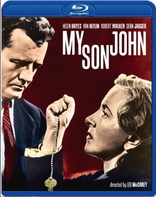

Movie rating
6.5 | / 10 |
Blu-ray rating
| Users |  | 0.0 |
| Reviewer |  | 3.0 |
| Overall | | 3.0 |
Overview
My Son John (1952)
John Jefferson comes home from a trip overseas a strangely changed man. His already nervous wreck of a mother is distraught by the way he seems to be feigning feelings for her and his father that he no longer has. Plus, his odd refusal to accompany the family to church on Sunday not only disturbs her but their priest as well. He also seems to be making fun of and smirking at his father's jubilant expressions of patriotism. His poor mother cannot imagine what could have caused such a change in her favorite son, who used to be loving and church-going and now seems remote from both. He also gets strange calls and goes off to strange "meetings" with no explanation. He is also being watched by an FBI agent who comes to the home and greatly disturbs John's mother with his odd questions about him.
Starring: Helen Hayes, Van Heflin, Dean Jagger, Robert Walker (I), Richard JaeckelDirector: Leo McCarey
| Drama | 100% |
Specifications
Video
Video codec: MPEG-4 AVC
Video resolution: 1080p
Aspect ratio: 1.33:1
Original aspect ratio: 1.37:1
Audio
English: DTS-HD Master Audio Mono
Subtitles
None
Discs
25GB Blu-ray Disc
Single disc (1 BD)
Playback
Region A (B, C untested)
Review
Rating summary
| Movie | | 3.0 |
| Video | | 3.0 |
| Audio |  | 2.5 |
| Extras | | 0.0 |
| Overall | | 3.0 |
My Son John Blu-ray Movie Review
Is that the Communist Manifesto in your pocket, or are you just glad to see me?
Reviewed by Jeffrey Kauffman August 19, 2012The so-called “Red Scare” reached out and touched my family in ways that colored two generations of interrelationships in sometimes unexpected ways. As I’ve mentioned in a couple of other reviews, my late father was a much decorated U.S. Army General whose exploits in World War II were covered by such famed war correspondents as A.J. Liebling, featured both in books and in several issues of The New Yorker during wartime. Both of my father’s younger brothers, however, tended to be more on the “leftist” side of the political spectrum, and one of those brothers was in fact a card carrying American Communist, a rabble rousing union organizer who ended up fighting with the largely Communist Abraham Lincoln Brigade against the fascist forces of Franco during the Spanish Civil War. This particular Uncle was taken captive as a prisoner of war in Spain, ultimately released when my father was able to get a United States Senator to work some private diplomacy on my Uncle’s behalf, and while my Uncle’s actual Communist affiliations fell by the wayside after World War II, he continued to work on a variety of left leaning causes, ultimately leading to him being called before the Dies Committee during the height of the Red Scare. Almost a decade later, my other Uncle was arrested for supposedly being a Soviet spy (a trumped up accusation), right at the height of the Cold War and Berlin Wall crisis, and one of the most salient pieces of “evidence” lobbied against him was that his older brother had been such an infamous American Communist in the 1930s. Needless to say, this put a chink in my father’s military armor, and he was forced to give private testimony before a closed door Senate hearing that he was in no way affiliated with “Red” issues. Our phones were tapped, my elder sisters were followed to and from school by the FBI (lest any “agents” attempt to pass information to them, it was surmised), and our entire family dynamic was seriously upended due to the publicity surrounding the spy case (Walter Winchell described it as the biggest spy scandal since Alger Hiss). And so the unabashedly right leaning efforts of films like My Son John always strike me with a profound sense of irony and even dare I say a certain degree of disgust. My Son John has become one of the most infamous cinematic screeds of its era, a so called “dramatized documentary” look at the evils of Communism which may in fact highlight more about xenophobic and chauvinistic (in the original sense of that word) attitudes of Americans circa the early 1950s than it reveals any inherent problems with a competing ideological system.
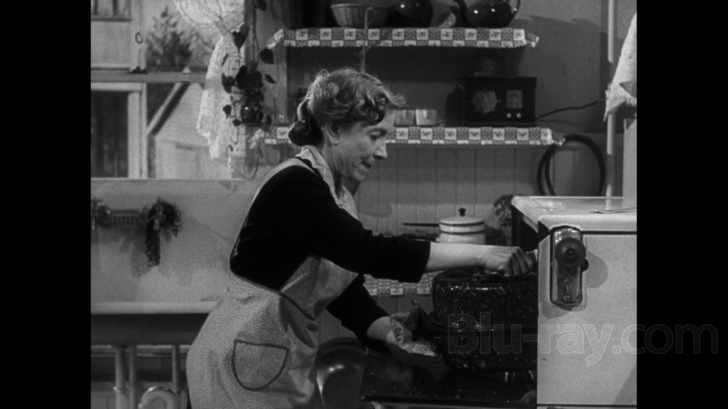
Director Leo McCarey is probably best remembered for two somewhat similar films, as well as an “odd duck” third item. The two linked films are the sweetly saccharine, overtly religious Going My Way and The Bells of St. Mary's, while the third film is McCarey’s big swan song as a top tier director, An Affair to Remember. McCarey’s oeuvre is filled with any number of classics however, films as varied as Duck Soup and The Awful Truth, as well as fascinating curios like Make Way for Tomorrow. But McCarey had become something of a right wing zealot by the time the early fifties rolled around, and My Son John was meant to be his filmic call to arms about the perceived Communist menace. The film is decidedly weird, even surreal, some of which can be attributed to the unexpected death of co-star Robert Walker (the John of the film’s title), which necessitated almost Plan 9 From Outer Space-esque editing and use of doubles to cover Walker’s absence, a la the “genius” moves of Ed Wood vis a vis Bela Lugosi in Wood’s magnum opus.
Even without the sudden “departure” of Walker, however, My Son John certainly belongs among the oddest films ever helmed (and co-written, no less) by a major American director. Helen Hayes and Dean Jagger play the middle aged Jefferson parents, whose two strangely blonde and almost Aryan youth looking sons (one of whom is played by a very young Richard Jaeckel) are leaving to fight in Korea as the film starts. The Jefferson’s third son, John, is absent from the goodbye dinner, and one can tell that there is a certain degree of dysfunction with regard to this “intellectual” progeny. When Walker shows up a week later (looking swarthy and brown haired—did Mrs. Jefferson sleep around?), tensions are immediately increased, especially between Mr. Jefferson and his errant boy. Soon a genial but obviously deadly serious FBI agent (Van Heflin) shows up, poking his nose around the Jefferson's business, and things take a provocative turn.
It soon becomes apparent that John, college educated and all, has indeed fallen under the evidently hypnotic spell of Communism, sending his American Legion attending father and his well meaning but addle-pated mother off the emotional deep end. The film is an unintentional laugh riot at times, with such throwaway lines as “See you in the bomb shelter” or Mrs. Jefferson’s comment about the local priest’s old stove being so beat up they had to pay someone to “throw it in the ravine” provoking giggles that immediately undercut the tone of reverent hysteria that McCarey so deeply wants to convey. This is a film where the Bible is linked to Mom and apple pie (literally) and is later used as an actual weapon when Pa Jefferson gets a bit out of sorts. Modern day jaws will probably drop agape throughout large swaths of this film, so patently melodramatic is the general tenor of the Jefferson family dynamic.
It’s fascinating to contrast My Son John with The Stranger, a decidedly more subtle (and hence much more effective) film which explores many of the same issues. The Stranger plays like a kind of darker analog to Hitchcock’s Shadow of a Doubt, where the main villain’s “sin” is his political persuasion rather than any murderous tendencies, and where his very villainy is only slowly brought to light over the course of the film. The Stranger is a wonderfully wrought exercise in people slowly becoming aware of a menace existing in their bucolic little town, and it’s anchored by a frighteningly effective performance by Orson Welles where his villainy is palpable but never hyperbolic. In My Son John, however, Walker actually is in many ways more sympathetic than his straight arrow parents: he’s certainly smarter, more articulate, funnier and seemingly more aware about the “grays” in a supposedly black and white world. Mr. Jefferson comes off as someone (to paraphrase the film itself) addicted to bromides, a sort of early fifties Glenn Beck insisting that we face certain doom and gloom should those evil Commies take over. Mrs. Jefferson is left to look on helplessly, worrying about whether she should take the tranquilizers the local doctor has kindly dropped off for her to make sure she won’t suddenly go crazy.
Any film which surnames its family Jefferson and then attempts to explore the dialectic between a “free” people and an “enslaved” one is obviously not trying to win any arguments via subliminal suggestion. What’s so very, very odd about My Son John is how weirdly dissociative it is in the early going, a “separate” quality which then veers awfully close to Grand Guignol as the film stumbles toward its cobbled together climax (without spoiling too much, eagle eyed viewers will no doubt recognize certain inserts of Walker culled from Strangers on a Train). Another interesting thing about this film, at least within the context of an early fifties drama (melodrama?), is its quasi-improvisatory feeling. Watch Hayes’ bizarre little mannerisms throughout the film, especially when she’s pretending to be crazy in a supposedly light hearted moment (yes, there’s nothing like feigned schizophrenia to put everyone in a party mood). Later, in the first extended scene between Hayes and Heflin, both actors seem to be kind of stumbling through their dialogue, as if they’re making it up as they go along. The film also has numerous moments of “stepped on” interaction between the actors, something that might indicate first takes had to be utilized since there just wasn’t enough coverage after Walker’s untimely demise.
This is certainly among the most unusual offerings yet from Olive Films, a label which seems intent on uncovering all sorts of “treasures” that most aficionados would probably never have expected to see released at all, let alone in high definition. My Son John isn’t exactly camp—it’s far too self-important and actually kind of scarily ardent for that— but it is an unbelievably captivating film nonetheless, probably for all the wrong reasons. The film wanted to warn sanguine Americans about the Red Menace supposedly breathing down our collective necks, but instead it highlighted an almost hysterical (in both senses of the word) sensibility on the part of ultra-right leaning types who were so intent on dealing with a perceived external threat they couldn’t recognize their own failings and paranoia. For a film so wrapped up in God and the Bible, it’s ironic that a famous verse from the Gospel of Matthew didn't occur to McCarey:
-
Thou hypocrite, first cast out the beam out of thine own eye; and then shalt thou see clearly to cast out the mote
out of thy brother's eye.
My Son John Blu-ray Movie, Video Quality
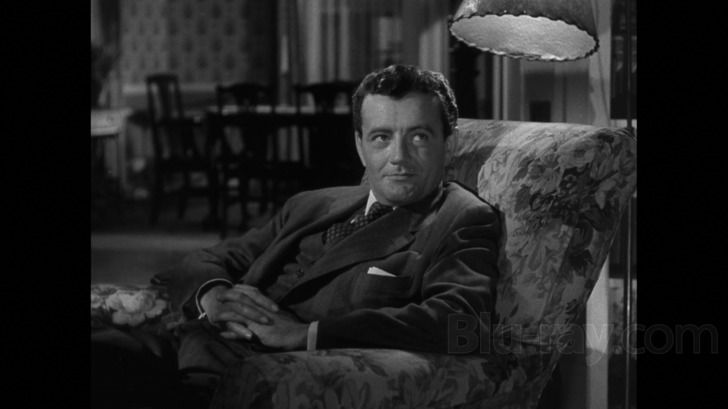
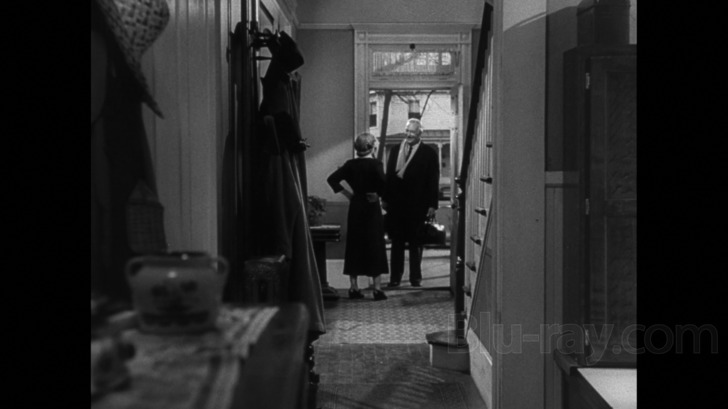
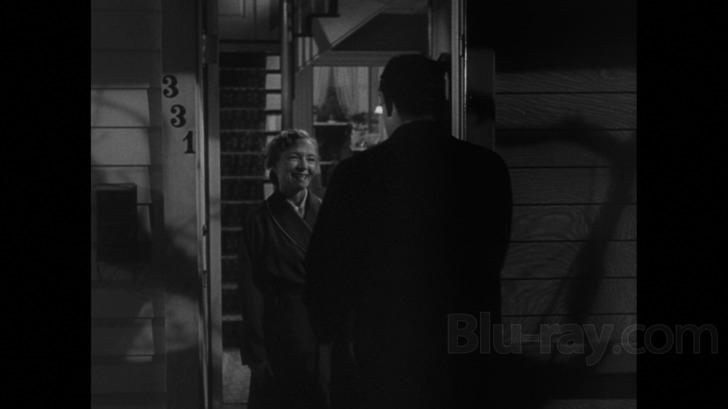
My Son John is presented on Blu-ray courtesy of Olive Films with an AVC encoded 1080p transfer in 1.33:1. This is a decent looking yet sometimes problematic transfer where probably at least some of the issues can be traced to the haphazard filming methods that were necessitated after Robert Walker died unexpectedly before the film had wrapped. Awkward edit points abound, with some scenes featuring weird jumps in angles (note the really bizarre sudden jump to a closer angle in the first three shot in the family car with Jagger, Hayes and Walker). While some of these screencaps look grainy to the point of digital noise, the actual transfer in motion retains a nicely natural appearance, though it does appear that some inserts were perhaps sourced from smaller millimeter formats (I frankly have never seen My Son John theatrically—and I seriously doubt very many have—so can't speak to whether these issues were endemic in the original exhibition). The image here isn't at the "wow" levels of some other Olive black and white catalog releases, but it retains an above average level of clarity and sharpness, with good if unexceptional blacks and decent gray scale. There are moments of damage sprinkled throughout the elements, but nothing major other than the usual specks and minor scratches.
My Son John Blu-ray Movie, Audio Quality
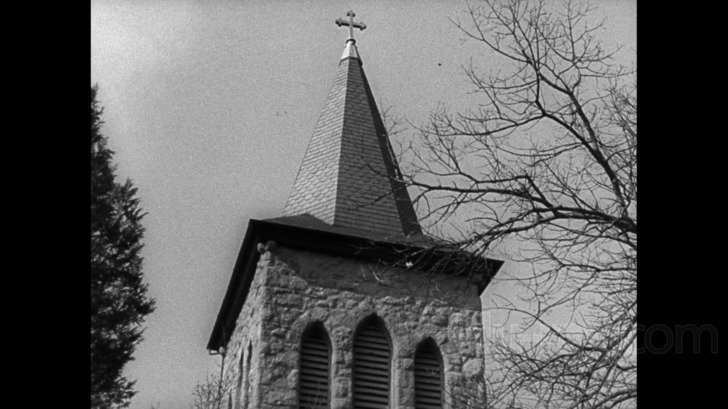
My Son John's lossless DTS-HD Master Audio Mono mix suffers from some of the same problems plaguing the video presentation. Awkward edit points often create pops and clicks in the audio track (and there are a number of other pops and clicks throughout this presentation that frankly have nothing to do with edits). There are also a handful of synchronization issues that seem to be tied to post-looping (watch carefully in the scene between the two departing Jefferson brothers and the parish priest outside of the church on Sunday for a good example). There's also more hiss than usual masking some of the higher frequencies. But overall the soundtrack still manages to boast good fidelity and at least average fullness. Dialogue, despite some occasional minor damage, is still clear and audible.
My Son John Blu-ray Movie, Special Features and Extras
Unfortunately there are no supplements on this release. My Son John really could have used a retrospective featurette or a commentary track.
My Son John Blu-ray Movie, Overall Score and Recommendation
This is one of those rare films that really isn't very good, but which demands to be seen anyway. You don't even need to have had the personal connection with the dialectic between Capitalism and Communism that I and my family have had to "enjoy" My Son John's rather outré sociopolitical screed. This is a film that rather ironically also points out some of the more rampant fear mongering from some elements of the ultra-right in today's world. Simply substitute any number of perceived "threats" (whether they be from those of different ideologies, religions or sexual orientations) for this film's Red Menace, and the result is still largely cogent, often more reflective of the accuser than the accused. While this isn't the greatest looking or sounding catalog release we've had from Olive, for any number of reasons My Son John still comes Highly recommended.
Similar titles
Similar titles you might also like

The Manchurian Candidate 4K
1962

Seven Days in May
Warner Archive Collection
1964

The President's Analyst
Special Edition
1967

Storm Center
1956

The Mortal Storm
Warner Archive Collection
1940

Twilight's Last Gleaming
Nuclear Countdown
1977

The Internecine Project
1974

The Tamarind Seed
1974

Sunflower
I girasoli
1970

Foyle's War: Set 7
2013

Man Hunt
Limited Edition to 3000 - SOLD OUT
1941
Advise & Consent
1962

Summertree
1971

Things to Come
1936

The Atomic City
1952

Quiz Show
1994

Shock and Awe
2017

Fail Safe
1964

Judgment at Nuremberg
Limited Edition to 3000 - SOLD OUT
1961

Billion Dollar Brain
1967