Mussorgsky: Pictures at an Exhibition & Borodin: Symphony No. 2 Blu-ray Movie
HomeMussorgsky: Pictures at an Exhibition & Borodin: Symphony No. 2 Blu-ray Movie 
EUROARTS | 2007 | 91 min | Unrated | Aug 31, 2010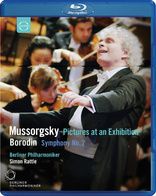

Movie rating
7.6 | / 10 |
Blu-ray rating
| Users |  | 0.0 |
| Reviewer |  | 4.5 |
| Overall | | 4.5 |
Overview
Mussorgsky: Pictures at an Exhibition & Borodin: Symphony No. 2 (2007)
A true celebration, ushering in the New Year with one of the finest orchestras and greatest conductors in the world.
| Music | 100% |
Specifications
Video
Video codec: MPEG-2
Video resolution: 1080i
Aspect ratio: 1.78:1
Original aspect ratio: 1.78:1
Audio
Music: DTS-HD Master Audio 5.1
Music: LPCM 2.0
Subtitles
None
Discs
25GB Blu-ray Disc
Single disc (1 BD)
Playback
Region free
Review
Rating summary
| Movie | | 4.5 |
| Video | | 4.5 |
| Audio |  | 5.0 |
| Extras | | 0.0 |
| Overall | | 4.5 |
Mussorgsky: Pictures at an Exhibition & Borodin: Symphony No. 2 Blu-ray Movie Review
Sir Simon Rattle conducts the Berlin Philharmonic in a festive evening of Russian Music which ushered in New Years 2008.
Reviewed by Jeffrey Kauffman August 29, 2010Not to state the numerically obvious, but before there were Les Six, there were The Five. Of course the French group from the early 20th century, which included such iconoclasts as Auric, Honegger, Poulenc and especially Milhaud, had been anointed with their soubriquet by French critic Henri Collet, who specifically based his coinage on the quintet of Russian composers who had formed a new national school of music some 75 years earlier. It’s fascinating to compare the lives of at least some of these Five, most of whom worked at composition as at most an avocation while they simultaneously pursued more traditional careers, with, for example, Tchaikovsky, who was, after all, composing full time at more or less the same time and becoming probably the best known Russian composer of his generation. Tchaikovsky, with his rigorous training and cosmopolitan temperament, didn’t know quite what to think of these more supposedly rustic folk, who basically crafted their music on inspiration alone, not worrying about the fineries of structure or orchestration. How much the more amazing, then, that The Five hosted the sumptuous musical languages of two of the most important and influential composers of the 19th century, inside or outside of Russia, Alexander Borodin and Modest Mussorgsky. How much more amazing as well that these two crafted incredibly complex and inerrantly luscious pieces that offered gorgeous melody coupled with sometimes astounding orchestral technique. The old adage about art being 99% perspiration, 1% inspiration, may well be true, but sometimes that supposedly slight injection from the Muses is enough to overcome the trials and tribulations of not knowing exactly how to convey an artistic idea in a coherent and cohesive way. Sir Simon Rattle focuses on Borodin and Mussorgsky, as well as perhaps anachronistically Shostakovich, in this thrilling concert by the Berlin Philharmonic recorded on New Year’s Eve 2007.
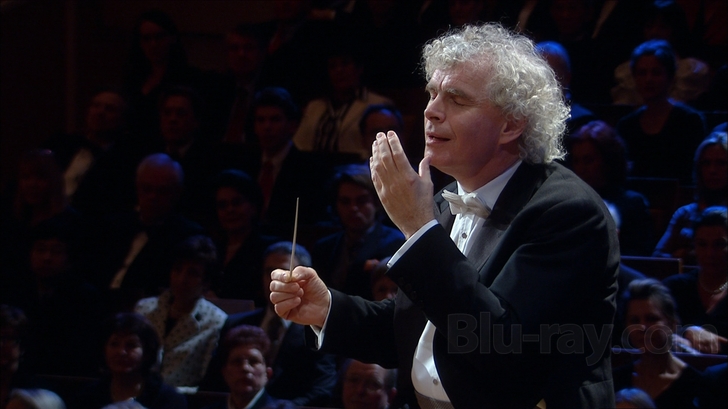
Sir Simon, transported by the music.
Borodin is one of the most fascinating members of The Five, a man who made a comfortable living for himself as a chemist and only “dabbled” in music as a passing fancy. The world could use a lot more of this kind of “dabbling.” Graced with a seemingly facile ability to draw down one impeccable melody after another from the heavens, Borodin’s music is achingly lyrical and always surging with emotion, sometimes tender, sometimes fierce. Even people who don’t particularly care for classical music have perhaps been unwittingly exposed to Borodin’s ravishing music, albeit in somewhat bowdlerized and transmogrified versions, as the Broadway team of Wright and Forrest utilized Borodin’s compositions as the musical bases for their songs in the 1950s musical hit Kismet. Therefore, the strains of “Stranger in Paradise” suddenly emanate from Borodin’s Polovtsian Dances like an old friend you remember from a context you can’t quite put your finger on. This dance suite culled from his Prince Igor opera is one of his most rhythmically astute pieces, with frequent changes in tempi and temperament, and Rattle marshals his forces with considerable aplomb here, though there are a couple of instrumental bobbles (not “Baubles, Bangles and Beads,” if I may interpolate a truly awful pun) in the quicksilver chromatic motif which makes up a recurring commentary.
Rattle next gives a reasonably stirring account of one of Borodin’s large scale works, his impressive Second Symphony in B minor. This is a brooding and sometimes discordant work which does reveal its compositional seams at times (perhaps the result of it having been written over a relatively long span of several years), needing a firm hand to smooth over abrupt transitions of musical material and mood. Rattle and the Berliners do exceedingly well here, though I personally would have liked a bit faster tempo on the opening movement, which is, after all, marked “Allegro—Animato assai.” Not quite “assai” enough in my opinion, but otherwise glitteringly sonic and assured. Interestingly, Borodin “exchanges” the second and third movements’ typical formulation, giving us a “Scherzo Prestissimo” in the second slot and and “Andante” in the third. Rightly called kaleidoscopic, the second movement cascades through a series of thrilling orchestral colors, all of which the Berlin Philharmonic executes flawlessly. The third movement, a langorous callback to the Slavic minstrel tradition, allows the Philharmonic’s vaunted string section to shine gloriously. Borodin manages to introduce a number of innovations in his finale, including an unusual form and some unexpected colors, like a whole tone scale. Rattle commands his forces ably here, evincing a lot of passion and purity.
A lesser known piece, Mussorgsky’s charming Khovanshchina: Introduction acts as a brief interlude before the other big piece of the evening takes off, Mussorgsky’s much loved Pictures at an Exhibition. This overwhelming, and overwhelmingly gorgeous, suite, which has been adapted into rock, jazz and other idioms perhaps more than any other repertory piece from the 19th century, is a compendium of brilliant piano compositional technique married to a variety of forms. Rattle here uses the Ravel orchestration, which culls an amazing variety of colors from the orchestra and allows several soloists with the Philharmonic to strut their stuff. Rattle provides a rousing interpretation of this great piece, generating an incredible momentum through the ten “pictures,” with some lovely pauses for breath at the repeated “Promenades”.
I think it’s worth noting in passing the incredible influence both Borodin and Mussorgsky must have had on Stravinsky, especially with his boundary shattering work in Le Sacre and The Firebird. Listen carefully in both the Polovtsian Dances and Pictures at an Exhibition, and you will hear nascent themes and ideas which Stravinsky enlarged and built upon in both of his behemoths. Of course the orchestration line is quite clearly there already, as another member of the The Five, Rimsky-Korsakov (largely self taught in the art of orchestration, as were most the quintet), became a mentor to Stravinsky.
The one seemingly odd choice in the evening’s concert, Shostakovich’s bracingly discordant Ballet Suite from The Golden Age, actually wraps up the night in a festive, if just slightly bizarre, manner, bringing the more outré elements of the Russian penchant for color and odd melody to the fore. It’s not exactly “Auld Lang Syne,” but that of course is not necessarily a bad thing.
Mussorgsky: Pictures at an Exhibition & Borodin: Symphony No. 2 Blu-ray Movie, Video Quality
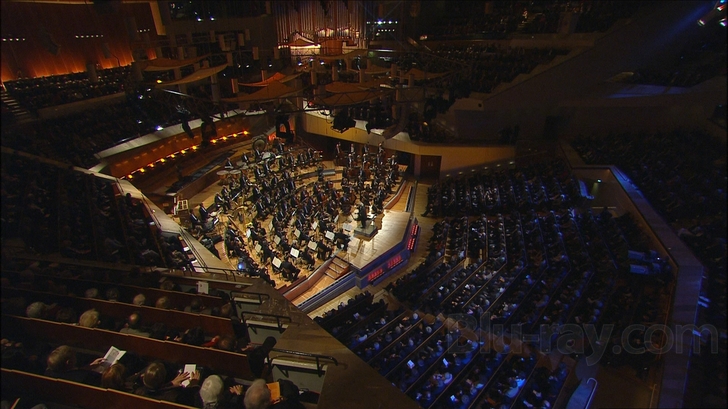
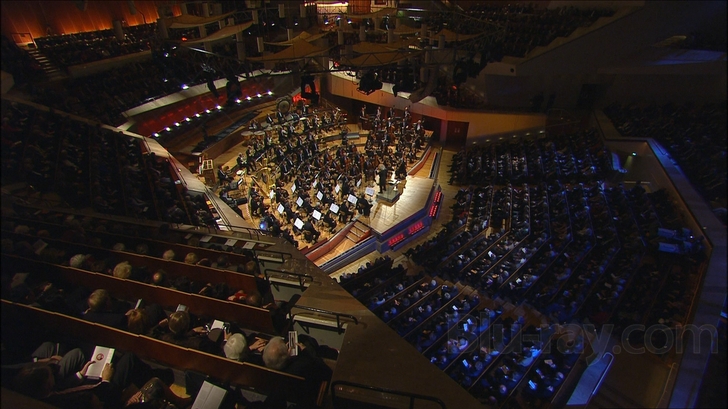
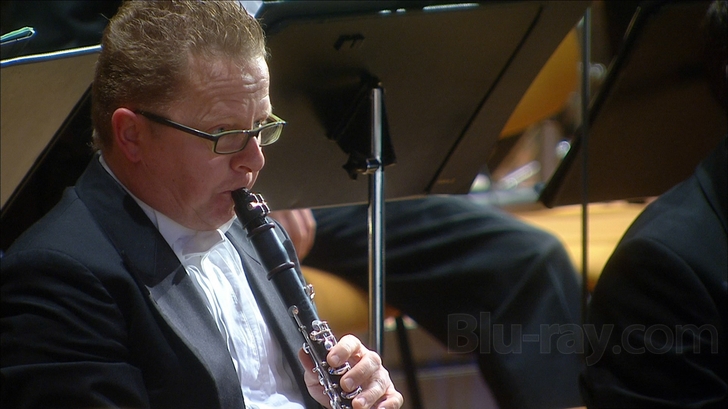
No, you did not misread the video codec specs above, and in fact I did not enter it incorrectly. This EuroArts release utilizes the relatively ancient MPEG-2 compression codec to deliver an actually surprisingly sharp and detailed image, albeit in 1080i (and an aspect ratio of 1.78:1). This television presentation opts for a rather large number of close-ups, and these reveal and really staggering amount of detail at times. Look, for example, at the bodies of the string instruments, and you will be able to see each band of wood which was assembled and then lacquered. Light glances off of a flute with piercing acuity (and in fact there are a couple of moments of refraction throughout this concert). The interlaced video does present a few passing issues, mostly with the hanging microphone cords, which dissolve into aliasing a couple of times. Otherwise, this is a very pleasingly sharp, colorful, presentation which is well directed and provides a lot of visual variety to keep the eye, as well as the ear, entertained.
Mussorgsky: Pictures at an Exhibition & Borodin: Symphony No. 2 Blu-ray Movie, Audio Quality
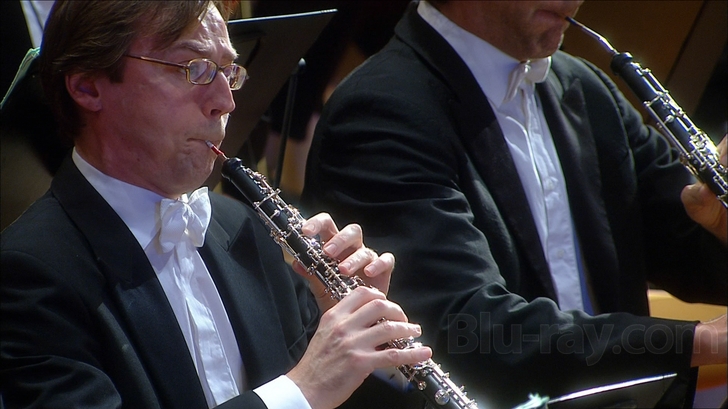
I typically don't opt for this choice, but for some reason I found this Blu-ray's lossless stereo mix, in LPCM 2.0, a bit more robust than the just slightly diffuse surround mix, in DTS-HD Master Audio 5.1. Don't get me wrong, these two lossless offerings are both practically perfect in every way, with sterling fidelity and a lot of "oomph" on the low end especially, but (probably due to nothing more than personal taste), I preferred the narrower soundfield of the stereo mix this time out. Whatever your personal preference may be, you're in for a sonic treat with these incredibly colorful scores. The Five of course relished in "Orientalism," filling their scores with clanging glockenspiels, and massed woodwinds, punctuated with outbursts from the brass, and it's all caught here with brilliant clarity. Dynamic range is exceptional, and interior lines are always easily discernable. Both of these lossless offerings show off not only the brilliant playing of the Berlin Philharmonic, but the aural potential for Blu-ray in and of itself.
Mussorgsky: Pictures at an Exhibition & Borodin: Symphony No. 2 Blu-ray Movie, Special Features and Extras
No supplements are offered on the disc. The insert booklet has a good essay on The Five.
Mussorgsky: Pictures at an Exhibition & Borodin: Symphony No. 2 Blu-ray Movie, Overall Score and Recommendation
Russia and Germany make for fine musical allies on this New Year's Eve Gala. Rattle conducts with ferocity and tenderness, and the playing is about 99.9% superb. With a neatly sharp image and a really outstanding set of lossless audio tracks, you can have your own celebration, no matter what day it is, with this highly recommended Blu-ray.
