Mussorgsky: Boris Godunov Blu-ray Movie
HomeMussorgsky: Boris Godunov Blu-ray Movie 
Opus Arte | 2010 | 164 min | Not rated | Aug 30, 2011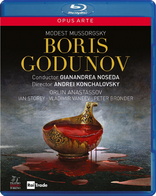
Price
List price:Listed on Amazon marketplace

Movie rating
Movie has not been rated yetBlu-ray rating
| Users |  | 0.0 |
| Reviewer |  | 4.0 |
| Overall | | 4.0 |
Overview
Mussorgsky: Boris Godunov (2010)
Boris Godunov is the story not only of a troubled leader but of an entire nation, and its history is as eventful as that of Mother Russia herself. In this new production, the legendary director Andrei Konchalovsky presents a personal vision of the opera that takes Mussorgsky’s bare and monumental first version as its basis, while adding the final scene from the composer’s revision, in which not only the Tsar but the people themselves reveal their fatal flaws.
Starring: Orlin Anastassov, Ian Storey, Vladimir Vaneev, Peter BronderDirector: Andrey Konchalovskiy, Francesca Nesler
| Music | 100% |
Specifications
Video
Video codec: MPEG-4 AVC
Video resolution: 1080i
Aspect ratio: 1.78:1
Original aspect ratio: 1.78:1
Audio
Russian: DTS-HD Master Audio 5.1
Russian: LPCM 2.0
Subtitles
English, French, Spanish, German
Discs
50GB Blu-ray Disc
Single disc (1 BD)
Playback
Region A (B, C untested)
Review
Rating summary
| Movie | | 4.0 |
| Video | | 4.0 |
| Audio |  | 4.5 |
| Extras |  | 2.5 |
| Overall | | 4.0 |
Mussorgsky: Boris Godunov Blu-ray Movie Review
Is this Godunov good enough?
Reviewed by Jeffrey Kauffman August 29, 2011Russia seems to have a monopoly on the prize for “most convoluted history with national leaders.” Oh, sure, the French may have chopped off a head or two, and the British had that dark and dank Tower of London where a couple of princes and a number of Henry’s wives ended up, but the Russians would probably laugh at those passing antics and whisper derisively, “Amateurs!” For Russia has been seemingly beset by a genetic propensity toward Tsars that were either outright Terrible (as with a certain Ivan), feeble or simply tragic. And yet the Russian people seem similarly genetic predisposed toward desiring an all-powerful ruler who could shape the unruly mass (and masses) that is Russia into something akin to a cohesive whole. After all, when the last of the Tsars and his family were viciously murdered in 1918, the Russian people simply replaced a royal head of state with an equally stern and ruthless dictatorial one. And so one really must think a bit about the Russian soul and its long, often extremely troubled, history when one approaches the most formidable edifice in all of Russian opera, Modest Mussorgksy’s imposing Boris Godunov. Mussorgsky was one of the composers loosely joined together as The Five, and he shared a rather interesting trait with at least some of his compatriot quintet, namely that he never really considered himself a professional composer or even a musician. Mussorgsky earned his living as a civil servant and music was his avocation, much as it was for other Five members like César Cui (an Army officer) and Alexander Borodin (a chemist). In fact only two of The Five were professional musicians, Mily Balakirev and Nicolai Rimsky-Korsakov. That non-professional status has haunted Mussorgksy’s legacy for well over a century now, but it also made him a sort of outsider even in his own day, when Boris Godunov, his only completed opera (and in fact one of just a handful of pieces he managed to complete in his lifetime), was routinely rejected by the Imperial Opera, despite Mussorgsky having radically revised it after its aborted 1869 original version. It’s at least a little ironic, then, that Boris Godunov, in any of its many versions, has become the standard-bearer for Russian opera, as if Mussorgsky’s ghost is thumbing its nose at the critical establishment who disparaged his unorthodox writing style, and is saying, “See? Told ya so!”
There are many operas which might require a flowchart to keep track of their labyrinthine plots, but Boris Godunov may be the only opera, at least the only one to have made it into the general repertoire, which requires a flowchart to keep track of its many versions. Most Mussorgsky fans are aware that after the spectacular failure of the original 1869 version of the opera, Mussorgsky went back to the drawing board and attempted to produce a “kinder, gentler” version of the tragedy which would be more accessible and, frankly, more commercially viable. Even those two versions weren’t enough for many of Mussorgsky’s own friends and comrades, notably Rimsky-Korsakov, who took it upon himself to offer “new, improved” versions of Mussorgsky’s supposedly “rustic” orchestration and harmonizations.
As Enrico M. Ferrando makes clear in his concise but illuminating liner notes included in the insert booklet (and which do in fact contain a flowchart of sorts), there are many more versions with which to contend for anyone taking it upon themselves to attempt to produce Mussorgsky’s masterpiece. A recent critical edition of the opera, and one which the Teatro Regio utilized for this performance, comes right out and suggests to companies that they simply use the edition as a resource, from which they can cobble together their own “new, improved” versions. As it stands, this Boris Godunov is mostly Mussorgsky’s original 1869 conception, with a couple of interpolations from the 1872 revision. All of the orchestration and harmonization is Mussorgsky’s own handiwork, not the subsequent changes imposed from more schooled academics who insisted the composer didn’t really know what he was doing.
It’s hard to be a real bona fide purist with a piece like Boris Godunov, since there are so many competing versions that one almost seems arbitrary in arguing for one over the other, at least with regard to Mussorgsky’s own versions. But some may find it odd that director Andrei Konchalovsky and conductor Gianandrea Noseda kind of hedge their bets with this production, not really having the complete courage of their convictions to stage the original 1869 version, supposed warts and all, and shoehorning some of the 1872 version. Does it work? Probably, though Mussorgsky’s rougher hewn original conception is slightly “refined” now, seeming to split hairs between the tragedy of Boris and the tragedy of the Russian people. Is it cohesive? Probably less so, but only for those who are well acquainted with either and/or both Mussorgsky versions.
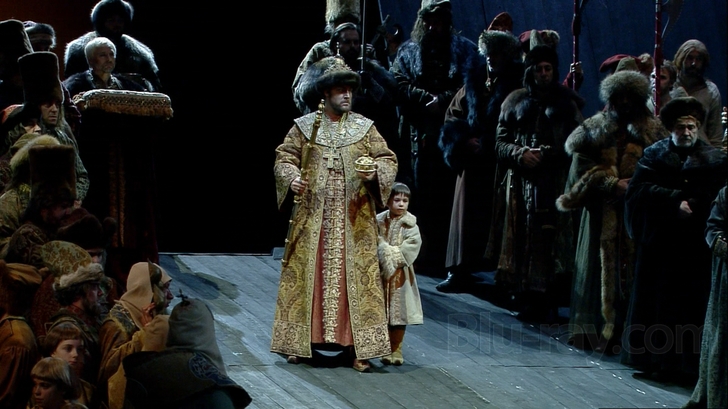
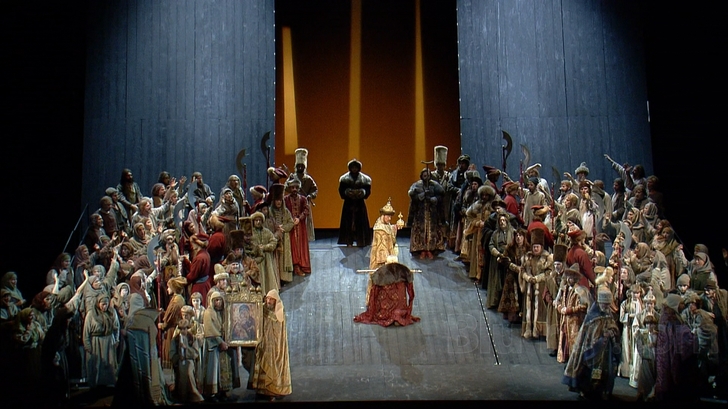
What this production has going for it in spades is ravishing music, both vocally from a very adroit cast led by Orlin Anastassov as Boris, and by the equally adept orchestra under Noseda’s very firm and energetic baton. The physical production is also suitably immense and sumptuous, including a rather dramatically raked stage (a subtle indication of the uphill struggle of the Russian people perhaps?), unbelievably opulent costumes and some well crafted, if more minimal, sets and props. Boris Godunov is such a gargantuan piece at its core, though, that it really doesn’t need much window dressing, and the good news here is that at its most fundamental center, this production emphasizes Mussorgsky’s glorious, folk-inspired score, and does so brilliantly.
Mussorgsky: Boris Godunov Blu-ray Movie, Video Quality
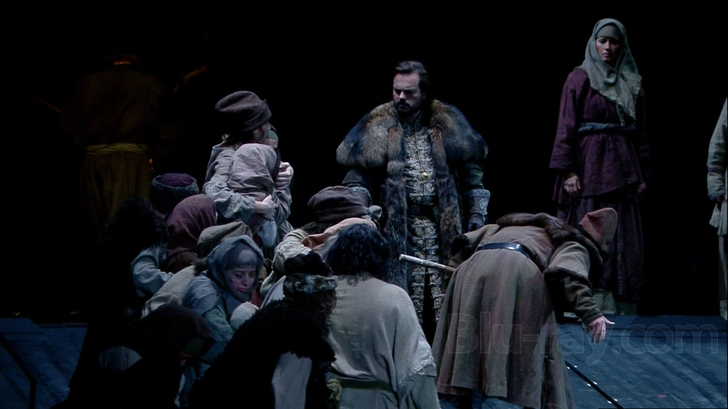
Boris Godunov arrives on Blu-ray courtesy of Opus Arte with an AVC encoded 1080i transfer in 1.78:1. While this presentation offers really gorgeous color and some beautifully detailed costumes, overall it suffers from fairly noticeable crush and lack of shadow detail, due to an overly dark lighting scheme in several key sequences. Upstage areas virtually disappear into the gloom and even character downstage tend to fade if they exit the brightest areas of the stage lighting. The general dimness, which is of course perfectly in keeping with the opera's dour ambience, does tend to cast a somewhat soft looking haze over many of the proceedings here. Otherwise, though, this is a really nice looking Blu-ray, with admirable fine detail in close-ups (get a good look at Boris' beautiful costumes in some of the screencaptures included with this review).
Mussorgsky: Boris Godunov Blu-ray Movie, Audio Quality
Boris Godunov is presented with two excellent lossless audio options, a DTS-HD Master Audio 5.1 surround mix and an LPCM 2.0 stereo fold down. The 5.1 mix is amazingly full and features wonderful hall ambience, and it also spreads Mussorgsky's dense orchestration and especially massed ensemble singing very well over the surround channels, giving the listener a chance for a new or renewed appreciation for the composer's highly idiosyncratic writing style in this piece. Boris Godunov is an intrinsically "heavy" piece, with an emphasis on low ranges for many instruments, and the good news is the low frequencies here are brilliantly reproduced, with no distortion, and even better, with no muddiness or murkiness. Balance is exceptional between soloists, ensemble and orchestra. Playing and singing are top notch in this production and they are presented with abundant fidelity and excellent dynamic range on this recording.
Mussorgsky: Boris Godunov Blu-ray Movie, Special Features and Extras
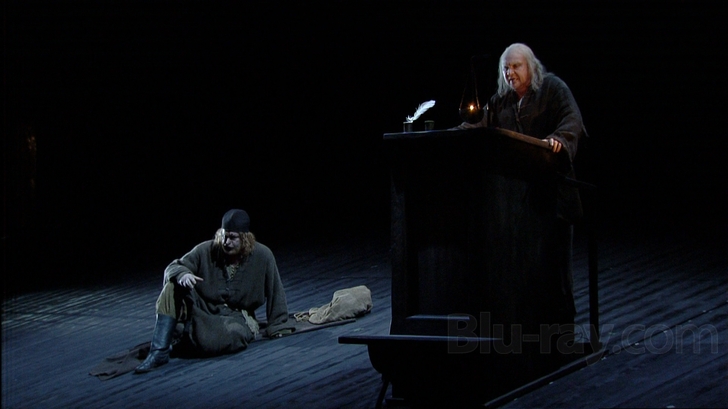
- Interviews with Andrei Konchalovsky (1080i; 10:19) and Gianandrea Noseda (1080i; 7:26) may be relatively brief, but they're fascinating. It's actually rather funny to hear Konchalovsky proclaim that the "words aren't important" in opera, since the audience can glean the meaning from the music, while Noseda talks about how important Mussorgsky's libretto is to the success of Boris Godunov. Overall, Noseda's is the more interesting piece as he gives a wealth of historical background information on the various versions, as well as explains why this hybrid version chose what it did.
- Cast Gallery
Mussorgsky: Boris Godunov Blu-ray Movie, Overall Score and Recommendation
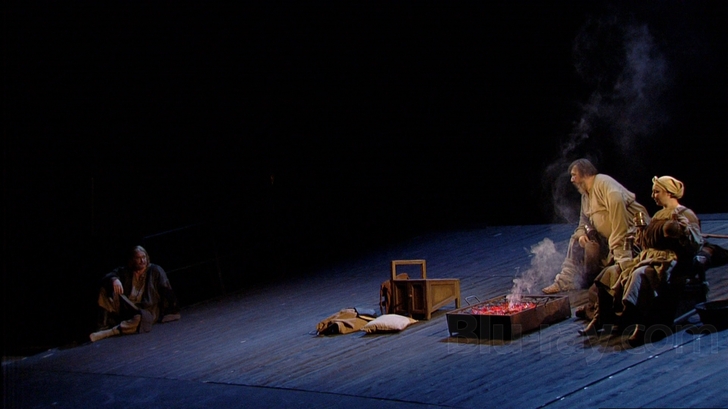
Sometimes the learned elite don't know best, despite the best of intentions. Mussorgsky may not have had the long training that many of his contemporaries had, but he had something else that too many overly schooled composers don't: vision. This gargantuan opera is a testament to Mussorgsky's very individual genius, and though this production might be faulted for hedging its bets with regard to which of many versions to present, it at least has the courage to stick to Mussorgsky and not one of his many revisers. Of course Mussorgsky himself sought to "correct" some elements of Boris Godunov, and a couple of those "corrections" creep into this version. What would be fascinating is a two-BD set of the 1869 and 1872 versions, done by the same company, just so viewers could see them side by side, as it were. While this is mostly the 1869 version, it may not satisfy those who want the original and only the original. That said, this is a gorgeously sung and played production and one which certainly comes Recommended.