Music is the Language of the Heart and Soul Blu-ray Movie
HomeMusic is the Language of the Heart and Soul Blu-ray Movie 
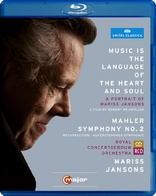
Mahler: Symphony No. 2 “Resurrection”C MAJOR | 2012 | 142 min | Not rated | Apr 24, 2012

Movie rating
6.5 | / 10 |
Blu-ray rating
| Users |  | 0.0 |
| Reviewer |  | 4.0 |
| Overall | | 4.0 |
Overview
Music is the Language of the Heart and Soul (2012)
Mariss Jansons is one of the most influential conductors of our age. In 2012 the charismatic Latvian musician conducted his second New Year Concert in Vienna, an honour that very few conductors have enjoyed. By way of a bonus, this release features a complete performance of Mahler’s Second Symphony with the Royal Concertgebouw Orchestra under Mariss Jansons.
| Music | Uncertain |
| Documentary | Uncertain |
Specifications
Video
Video codec: MPEG-4 AVC
Video resolution: 1080i
Aspect ratio: 1.78:1
Audio
German: DTS-HD Master Audio 5.0
German: LPCM 2.0
Subtitles
English, French, Spanish, German, Cantonese, Korean
Discs
50GB Blu-ray Disc
Single disc (1 BD)
Playback
Region free
Review
Rating summary
| Movie | | 4.0 |
| Video | | 4.0 |
| Audio |  | 4.5 |
| Extras | | 0.0 |
| Overall | | 4.0 |
Music is the Language of the Heart and Soul Blu-ray Movie Review
Portrait of the artist as an older man.
Reviewed by Jeffrey Kauffman April 23, 2012The life of a major symphony conductor may seem like a nonstop parade of glamour, pomp and pageantry, but if the life
of Mariss Jansons is any indication, things aren't always sunshine and roses, even for those who seem to have
everything going for them. From the outside, Jansons would seem to have been born to be a conductor; his father
was a famous conductor (Arvids Jansons) and his mother was an opera singer (Iraida Jansons). And yet as
Jansons himself quite charmingly discusses in this fascinating documentary Music Is the Language of the Heart and
Soul, his parents never forced a life of music on their son. Instead of pressuring their son into a life they had
chosen, they simply let him tag along (Jansons states that the family never had a babysitter, so he grew up in the
opera houses where his parents worked), perhaps subtly pointing the way rather than insisting on it. Jansons likens
this to a beautiful ray of sunshine illuminating the right path to take, and there's little doubt that it was indeed the right
path for Jansons, as he has become one of the most commanding figures on the international stage, prized especially
for his interpretations of Russian music, as well as for his well articulated performances of the works of Mahler.
Music Is the Language of the Heart and Soul plays unabashedly like an elegy at times, led by its subject himself,
who, while still spritely and full of life, seems rather aware of his own impending mortality, something that brings a
sense of poignance and urgency to the documentary. Jansons revisits a number of important places from several
different epochs of his long life, and he seems more than a little amazed at how far he's come, despite the head start
having been born into a celebrated musical family may have given him.
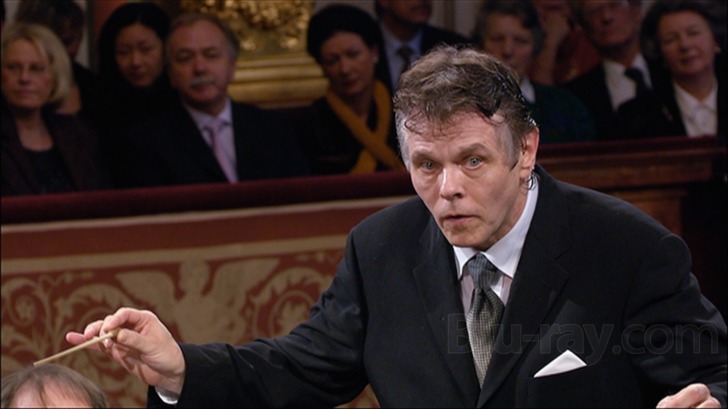
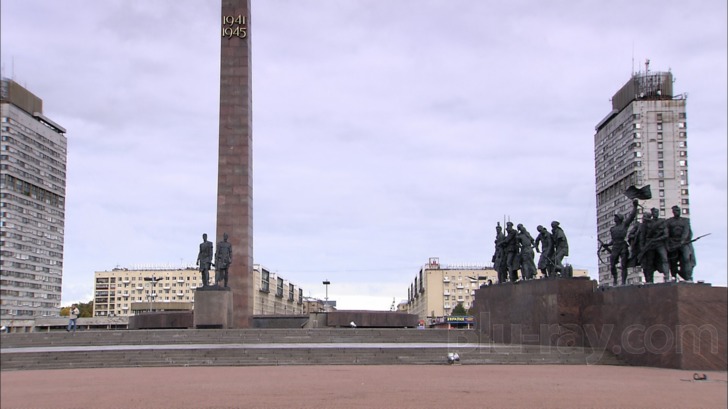
It's perhaps a little odd that Music is the Language of the Heart and Soul wasn't included as a supplement on the recent release of Eugene Onegin, as the documentary shows Jansons in rehearsal for the Nederlandse Opera production in Amsterdam. Eugene Onegin is being released on Opus Arte, while this new disc combining Music is the Language of the Heart and Soul with Mahler's Second Symphony is a Unitel Classica – C Major release, which no doubt accounts for the disparity. But filmmaker Robert Neumüller isn't content to merely follow Jansons to Amsterdam, and instead has the conductor visit a number of different locales, including St. Petersburg and Riga, both very important cities in the musician's upbringing and career development.
Jansons is unusually forthcoming about his emotions, and in fact seems close to tearing up several times throughout this documentary. He revisits his childhood home in Riga, which now a museum devoted to the work of author Andreja Upisa. While Jansons walks through the rooms remembering which was a bedroom, which was the kitchen, and so on, what really seems to strike home (no pun intended) is when he looks out the window and suddenly remembers when, deep in the Stalinist period, KGB agents showed up one day and spirited his Aunt away when Jansons was a little boy. He was very concerned and asked the men when she would return, and they told him not to worry, pointing to a house across the street, claiming that they were just taking her there for a little while and she would be back soon. "They shipped her off to Siberia and we never saw her again," Jansons comments with a rueful little laugh.
It's in allusions like this that one begins to realize the hardships that Jansons had to overcome. The Stalinist regime was notoriously jealous of its homegrown talent, and Jansons suffered for his art, with limited access to international orchestras and in fact a refusal on the part of the regime to even pass along some job offers. It was only through a fortuitous chance encounter with Herbert von Karajan, who was visiting the Soviet Union at the time, that Jansons finally was able to pry himself away from the Communist country and begin making his way toward a more ecumenical career. There's some really great archival footage here of both von Karajan and Jansons himself from decades ago, showing the clear line of mentorship from the elder Austrian conductor to his younger Latvian protégé.
Jansons reveals that von Karajan would actually record any operas he was going to perform before they actually were staged, so that when the staged versions began rehearsals, the musical elements were already in place. That kind of attention to preparation runs through several of the key sequences here, showing Jansons to be completely in control of the musical elements before he ever sets foot on the podium. The documentary also has some interesting information which may strike some as fairly surprising, including the fact that Johann Strauss is so beloved in St. Petersburg, and that a major portion of the composer's later life was spent in concerts there.
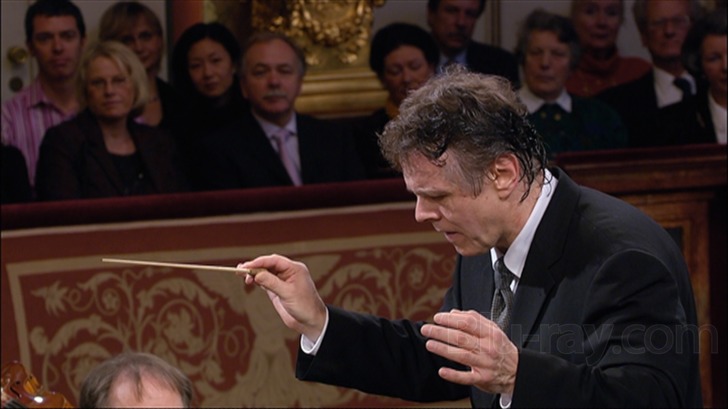
The second "feature" on this disc is a gorgeous performance of Mahler's gargantuan Second Symphony, the so-called Resurrection, performed here by the Royal Concertgebouw Orchestra, with soloists Ricarda Merbeth (soprano) and Bernarda Fink (mezzo-soprano), as well as the Netherlands Radio Choir. Jansons is a master of finessing the often bizarre segues that populate any given Mahler piece, and he proves that here with some arrestingly effective transitions that breathe fascinating life into this piece. His opening movement is especially telling, full of a sort of tension and sinister mystery, especially in the bombastic opening bars. Jansons also delivers a completely hyperbolic Scherzo, manic and viscerally impactful. The singing in the fourth movement is languid and expressive, followed by a rousing final movement that is capped by Jansons furiously wiping his heavily perspiring head and face. It's a well earned moment.
Music is the Language of the Heart and Soul Blu-ray Movie, Video Quality
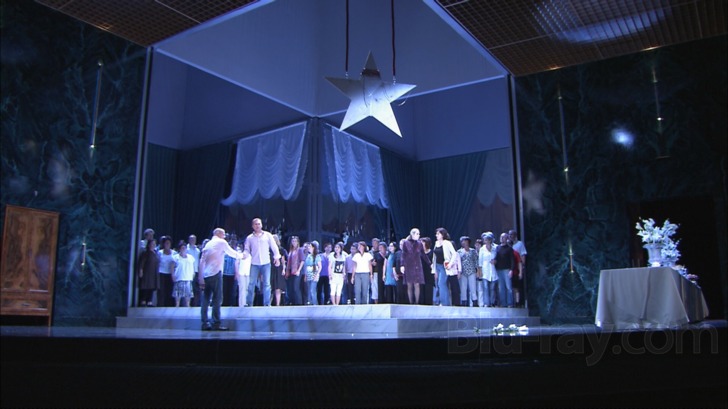
Music is the Language of the Heart and Soul and Mahler: Symphony No. 2 "Resurrection" are presented on
Blu-ray courtesy of Unitel Classica and C Major with AVC encoded 1080i transfers in 1.78:1. The image here is sharp and
accurate looking, with good saturation and natural looking colors. There are some minor issues in Music is the
Language of the Heart and Soul with regard to moiré patterns on a couple of Jansons' tweed jackets, but otherwise the
presentation is stable and clear looking. The symphony boasts excellent video quality, with appealing fine detail on display
in the close-ups of Jansons, the singers and the orchestra players.
Music is the Language of the Heart and Soul Blu-ray Movie, Audio Quality
Music is the Language of the Heart and Soul features an uncompressed LPCM 2.0 track in German, while Mahler:
Symphony No. 2 "Resurrection" boasts both an uncompressed LPCM 2.0 track as well as a lossless DTS-HD Master
Audio 5.0 surround mix. The documentary sounds fine within its narrow ambitions, though some of the archival footage is
understandably less fulsome sounding than the bulk of the piece. The talking heads segments and interview segments
sound natural, clear and precise. The Symphony boasts awesome dynamic range and crystal clear fidelity, with all sections
of the orchestra sounding full and brilliantly alive. The singing is well mixed and prioritized here, and even the fullest Mahler
tutti never devolves into any distortion whatsoever.
Music is the Language of the Heart and Soul Blu-ray Movie, Special Features and Extras
There are no supplements per se on this disc (other than trailers, which I never count in scoring), though of course
the disc includes both the documentary Music is the Language of the Heart and Soul as well as a thrilling
performance of Mahler's Second Symphony, so it's a rather full program in any case.
Music is the Language of the Heart and Soul Blu-ray Movie, Overall Score and Recommendation
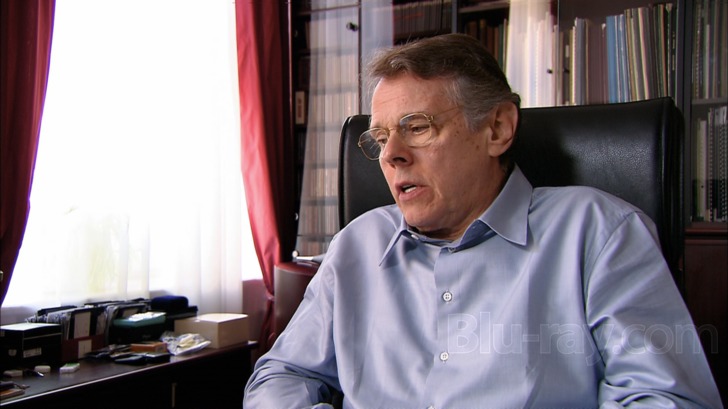
Mariss Jansons is obviously a man of great faith and internal fortitude. "I believe God decides what path we take," Jansons
states at one point in Music is the Language of the Heart and Soul, adding, "I believe that only God know what's
right, but we must all take responsibility for our own lives. Art and religion can heal. They're a form of medicine, so to
speak." Jansons is looking back now over a long and storied career that has had its share of ups and downs, and the
documentary shows that he's very comfortable in his own skin (and psyche). The documentary also shows that Jansons is
inherently a very sweet, kind and good natured conductor (not always the case, believe me). The Mahler Second is
kind of like the icing on the cake here (or is it vice versa?), a rousing performance of an evergreen that Jansons
brings a lot of vibrancy and nuance to. The overall program here is very impressive, with excellent video and
superior audio, and it comes Highly recommended.