Museum Hours Blu-ray Movie
HomeMuseum Hours Blu-ray Movie 
Cinema Guild | 2012 | 107 min | Not rated | Dec 03, 2013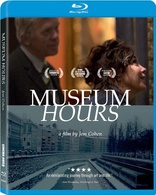

Movie rating
6.8 | / 10 |
Blu-ray rating
| Users |  | 0.0 |
| Reviewer |  | 4.0 |
| Overall | | 4.0 |
Overview
Museum Hours (2012)
When a Vienna museum guard befriends an adrift out-of-town visitor, the grand Kunsthistorisches Art Museum becomes a mysterious crossroads which sparks explorations of their lives, the city, and the ways artworks reflect and shape the world.
Starring: Mary Margaret O'Hara, Bobby SommerDirector: Jem Cohen
| Drama | 100% |
Specifications
Video
Video codec: MPEG-4 AVC
Video resolution: 1080p
Aspect ratio: 1.78:1
Original aspect ratio: 1.85:1
Audio
German: DTS-HD Master Audio 5.1
English: Dolby Digital 5.1
Subtitles
English
Discs
50GB Blu-ray Disc
Single disc (1 BD)
Playback
Region A, B (C untested)
Review
Rating summary
| Movie | | 4.0 |
| Video | | 4.0 |
| Audio | | 4.0 |
| Extras |  | 3.5 |
| Overall | | 4.0 |
Museum Hours Blu-ray Movie Review
Museum, Ours.
Reviewed by Casey Broadwater January 3, 2014If our bodies are temples, our minds are museums—archiving the past, organizing our personal histories, curating both the minutia and the momentous
events that come to define us. In Museum Hours, writer/director Jem Cohen draws this comparison sharply, observing his two protagonists with
the patience and curiosity of an art patron who sits in front of, say, a Bruegel painting for two hours, studying its details, meditating on its internal
significance. But Cohen also looks outward at the world, itself a museum of all-that-is, examining the artifacts of humanity that present themselves in
Vienna, the film's Old World-meets-cosmopolitan setting. Fleamarket finds. Bits of trash. Extinguished cigarettes. The signage inside a hospital. Cohen
looks at it all with interest that goes beyond the ephemeral. This is the stuff that surrounds us, the stuff that makes up our lives.
Cohen is best known for Instrument, his documentary on the seminal D.C. band Fugazi, and if you only knew him from this, Museum
Hours might seem surprisingly precise and restrained. But the punk filmmaker—who has collaborated with Godspeed You Black Emperor, Blond
Redhead, and numerous other groups that straddle the music/art divide—is a varied, multi-track artist himself, whose work includes "street"
documentaries, video installations, and still photography. In a way, Museum Hours is a combination of all three, threaded together with a
simple narrative that emphasizes reflection over drama.
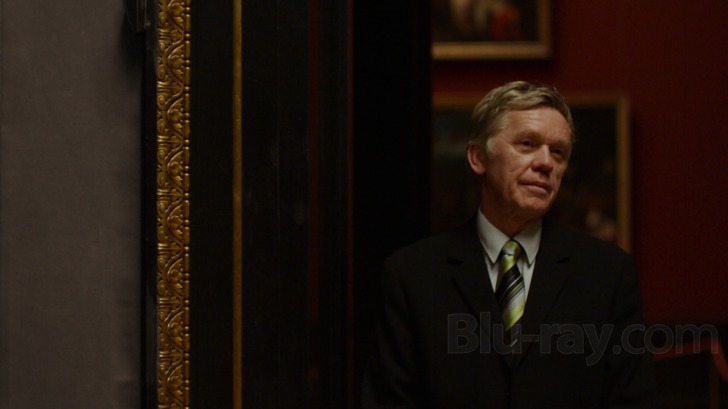
The plot is spare. Canadian singer Mary Margaret O'Hara plays Anne, a middle-aged Montrealer who gets summoned to Vienna as the sole surviving relative of her cousin, who has recently fallen into a coma. Anne speaks no German, is short on cash—she's a freelancer—and has no idea what to do with her time as she waits for some better-or-worse change in her cousin's condition. In the city's Kunsthistorisches art museum, however, she meets museum guard Johann (Bobby Sommer), a soft-spoken former band manager and woodshop instructor who has given up the noise of his prior lines of work for the quiet and contemplation of days spent looking at—and looking at visitors looking at—Renaissance-era artwork. Johann gives Anne some kind advice, which snowballs into him going to visit the hospital with her, and soon the two are walking and talking all over Vienna, which breaks his usual downtime monotony—he tends to hole up in his flat playing online poker—and gives her a view of the city she would've otherwise never seen. It's a kind of platonic Before Sunset; Johann and Anne seem this close to becoming somehow romantically involved, but Cohen keeps them at arm's length, never allowing their mutual interests to bloom into passion.
Realistically—that is, in "real life," not the fantasyland of most movies—this is probably how their relationship would go, and Cohen is nothing if not concerned with real life. Museum Hours aims for verisimilitude and squarely hits the mark. The film is an honest, intimate look at unexpected friendship. It explores the uneasiness of being a traveler out of one's element. It's about the joy of discovery, of paying attention, of taking the time to notice what's always been right there. And Johann and Anne are the kind of characters who feel so real as to be instantly familiar—their worries are our worries, their boredom is our boredom, their happiness is our own. If it feels like we've met them before, it's because we are them, all of us, to some extent. Non-actor Bobby Sommer is a natural as Johann—gentle, concerned, gradually warmed by affection—and Mary Margaret O'Hara is a perfect vessel for our empathy. We've all been in situations, like hers, where we feel displaced and uncertain and anxious for a human connection.
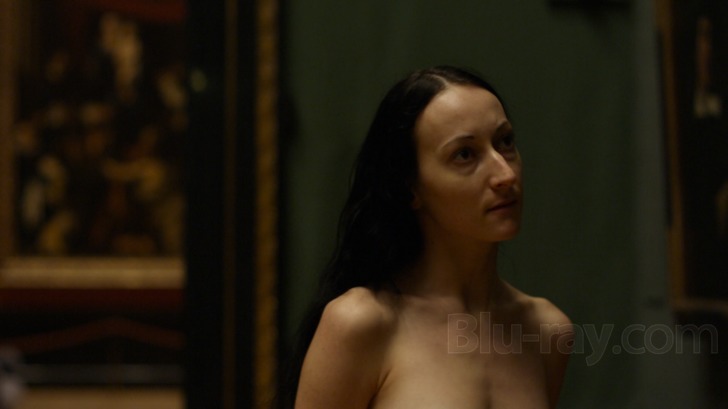
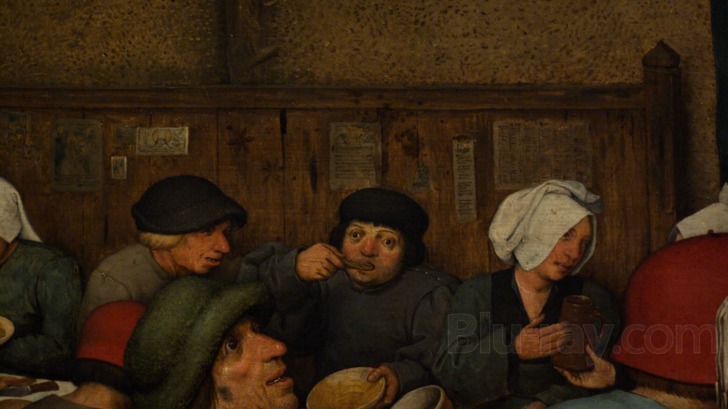
While the film is extremely true to life, it's also aware—in a meta way—of the ways in which life is depicted in art. Cohen and his characters spend a lot of time peering at canvases, specifically those in the Breugel room of the Kunsthistorisches, where Johann is often stationed. Breugel's seemingly "quaint" scenes of peasant life offer up more than initially meets the eye, drawing us from detail to unexpected detail, and the same can be said of Museum Hours itself. Just when we've gotten settled in with Cohen's quiet, observational mode of filmmaking, he gives us a strikingly surreal scene in which the museum's patrons are suddenly stark naked, a commentary on the discomfort we tend to feel with in-person, all-shapes-and-sizes nudity compared to the casual acceptance we have of painted nudes.
This scene is all the more powerful for how much it stands out in an otherwise low-key, unconfrontational film. It should be said that Museum Hours is probably not for viewers hoping for the immediate gratification of melodrama or a narrative that's pushed along by conflict. The story drifts instead on the slow rhythms of life, giving us a guided tour of Vienna and—in the growing connection between these two idiosyncratic characters—a loving lecture on kindness.
Museum Hours Blu-ray Movie, Video Quality

Museum Hours was shot on the fly with a small crew—sometimes just director Jem Cohen himself—using digital video for interior scenes and a 16mm Bolex for the exteriors of Vienna. Despite the different mediums, the film does have a visual consistency; the low-light/high ISO noise of the digital video actually matches the 16mm grain structure quite well. The digital photography tends to be a little sharper, overall—and there are some shots that are just slightly out of focus, which can happen when you're working without a focus puller—but the clarity in the Blu-ray's 1080p/AVC-encoded transfer is good throughout, looking true to its low-budget source materials. Color is nicely graded too, with a lean, realistic look and balanced contrast and saturation. There are also no obvious issues with the encode itself, which does not appear to be overly compressed, and no signs of excessive noise reduction or edge enhancement. Museum Hours isn't the sharpest or cleanest of new releases, but I have no doubt that Cinema Guild's Blu-ray looks absolutely true to intent.
Museum Hours Blu-ray Movie, Audio Quality
The disc features a lossless DTS-HD Master Audio 5.1 surround track that, likewise, is exacting in its realism. The front and rear channels work together to bring the museum and its Vienna environs to life, from the quiet hush of patrons as they move from room to room, to flea market bustle, coffee shop chatter, and the dim rush of traffic. It's all quiet but alive, which is a good way to describe the film as a whole. Aside from Mary Margaret O'Hara's lonesome occasional singing, music is nearly non-existent here—don't expect a score to nudge you from one feeling to the next—so the emphasis is decidedly on the ambience and the characters' conversations. Dialogue, in German and English, is always clear and easy to understand. The lone oddity is that when you turn on the English subtitles, they only appear for the German dialogue, leaving hard-of-hearing viewers in the lurch for the English sections.
Museum Hours Blu-ray Movie, Special Features and Extras
- Alternate English Voice-Over Track: An all-English audio track, presented without subtitles.
- Rare Short Films by Jem Cohen
- Amber City (1999, SD, 48:41): "Commissioned 16mm film portrait of an unnamed Italian city, drawing on history, folklore, and chance observation. Music by Chan Marshall (Cat Power), Blonde Redhead, Arnold Dreyblatt, Stephen Vitiello, and others."
- Anne Truitt, Working (2010, SD, 12:38): "A portrait of artist Anne Truitt made primarily in and around her studio at the Yaddo artists' community."
- Museum (1997, SD, 7:28): "Unreleased silent Super 8 film, shot in the mid 1990s; an early precursor to Museum Hours."
- Theatrical Trailer (HD, 2:05)
- Festival Trailer (HD, 1:39)
- Booklet: Inside the case you'll find a 22-page booklet with an essay by Luc Sante and reflections on the making of the film by Jem Cohen.
Museum Hours Blu-ray Movie, Overall Score and Recommendation
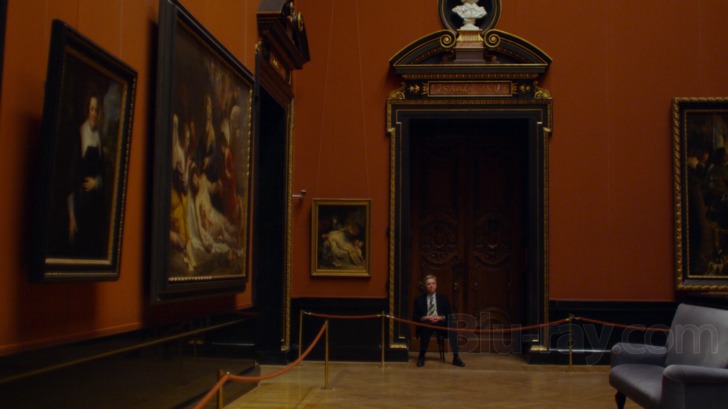
Museum Hours is probably the quietest, nigh-unto-drama-less film of 2013, but there's so much being in this living diorama of a story, which is filled with material and emotional detail. Director Jem Cohen has taken the perusing techniques of your average, genuinely curious museum goer —the patience, the lingering looks, the hunt for meaning and connections—and applied them to life itself, examining a series of existential topics from all angles, as one would circle a sculpture. This tact might put off those who typically like to breeze through exhibitions and films—taking in only the easily observed, easily digestible highlights—but for those who like to meditate on what they're seeing, Museum Hours is an inviting place in which to sit and think. Cinema Guild's Blu-ray release is welcoming as well, with excellent audio and video, several worthwhile supplements, and a booklet that features an essay on the film and some thoughts from Cohen about art, life, and moviemaking. Highly recommended.
Similar titles
Similar titles you might also like
(Still not reliable for this title)

The Mill and the Cross
2011

Pariah
2011

Scorpio
Limited Edition to 3000 - SOLD OUT
1973

Saint Jack
Limited Edition - 1,500 copies
1979

The Daughter
2015

Pals
Colegas | Standard Edition
1982

El Pico 2
1984

The Night Porter
Il portiere di notte
1974

Connecting Rooms
1970

Old Joy
2006

Queen of Earth
Slipcover in Original Pressing
2015

I, Daniel Blake
2016

Kameradschaft
Comradeship
1931

The New Girlfriend
Une nouvelle amie
2014

The Rocket
2013

In a Better World
Hævnen
2010

Betty
1992

Cemetery of Splendor
2015

Out 1
Out 1, noli me tangere
1971

Sundays and Cybèle
Les dimanches de Ville d'Avray
1962