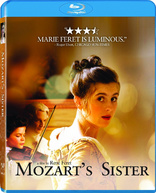
Mozart's Sister Blu-ray Movie
HomeMozart's Sister Blu-ray Movie 
Blu-ray + CDMusic Box Films | 2010 | 120 min | Not rated | Feb 14, 2012
Price
List price:Amazon: $24.95 (Save 17%)
Third party: $24.95 (Save 17%)
Only 1 left in stock (more on the way).

Movie rating
6 | / 10 |
Blu-ray rating
| Users |  | 3.5 |
| Reviewer | | 3.5 |
| Overall | | 3.5 |
Overview
Mozart's Sister (2010)
A speculative account of Maria Anna "Nannerl" Mozart, five years older than Wolfgang and a musical prodigy in her own right. Originally the featured performer, she has given way to Wolfgang as the main attraction, as their strict but loving father Leopold tours his talented offspring in front of the royal courts of pre-French revolution Europe.
Starring: Marie Feret, David Moreau (I)Director: Rene Feret
| Drama | 100% |
Specifications
Video
Video codec: MPEG-4 AVC
Video resolution: 1080p
Aspect ratio: 1.85:1
Original aspect ratio: 1.85:1
Audio
French: DTS-HD Master Audio 5.1
Subtitles
English
Discs
25GB Blu-ray Disc
Two-disc set (1 BD, 1 CD)
Playback
Region A (B, C untested)
Review
Rating summary
| Movie |  | 3.0 |
| Video |  | 4.0 |
| Audio |  | 4.5 |
| Extras |  | 1.5 |
| Overall | | 3.5 |
Mozart's Sister Blu-ray Movie Review
It’s tough to play second fiddle—especially when violins aren’t suitable instruments for a girl.
Reviewed by Jeffrey Kauffman February 9, 2012There’s a bright yellow façade in what amounts to “downtown” Salzburg that houses an incredibly tiny set of rooms where one of the titans of music was born and lived for the bulk of his childhood and adolescence. “Mozart’s Gerburtshaus,” or Mozart’s Birth House, is an abject lesson in how a small physical space cannot effectively contain one man’s genius. The fact that little Wolfgang Amadeus wasn’t the only Mozart living in these cramped quarters only makes the story all the more amazing. While the elder Mozarts gave birth to several children, as was the case more often than not in those days, many died in infancy or early childhood, and ultimately the family’s fortunes rested on two Mozart children, Wolfgang and his older sister Maria Anna, who had the odd nickname of Nannerl. Wolfgang had become infatuated both with his older sister and with music itself by watching his father, Leopold, give music lessons to Nannerl when Wolfgang was still a toddler. And early indications were that it was Nannerl who was perhaps the more natural virtuoso, soon establishing a semi-professional career that only blossomed when Wolfgang joined her for what was in a way the “Donny and Marie” act of its day. Due to any number of factors, some of which are inarguably related to that era’s sexual roles, Wolfgang’s prominence soon was ascendant while Nannerl found herself shunted into the background. As was the standard mode of operation back then, once Nannerl had attained the age of marriage, her performing days were through, and while there’s some historical record supporting the fact that the young woman continued to compose, both that pursuit and her virtuoso playing became, of necessity, an avocation. Mozart’s Sister makes no pretentions as to outright historical accuracy, but it posits a fanciful take on the sibling relationship between Wolfgang and Maria Anna at a seminal point in both of their development, when Wolfgang was poised to become the “European Idol” of the Continent at virtually the same moment that Nannerl was being told her professional music making days were quickly drawing to a close.
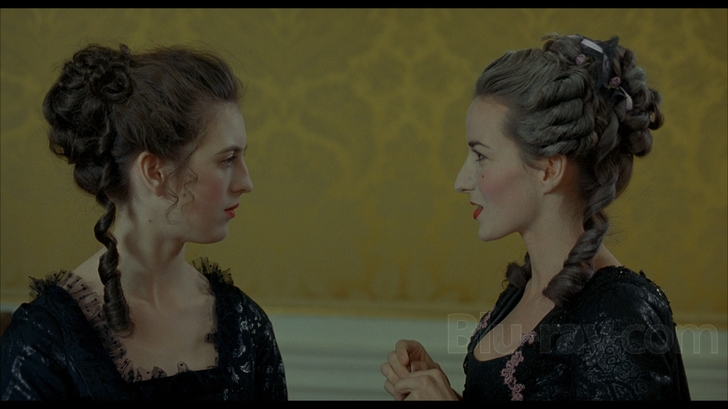
The life of a touring musician isn’t easy even in this era of jet planes, internet connectivity and the “benefits” of groupies, but imagine what it must have been like for the Mozart family in the eighteenth century. As Mozart’s Sister makes abundantly clear, traveling by coach was a hazard in and of itself, and often even once the destination was reached, the family waited for weeks until they were received by whatever royalty they were supposedly there to see and perform for. The close quarters required by these traveling and living arrangements seem claustrophobic by today’s standards, but, again, that tiny assemblage of rooms in Salzburg is a good measuring stick by which to put things in their proper historical context. But one way or the other, Mozart’s Sister quite clearly depicts how there was little to no privacy for the family during this time, with all four sharing a bedroom and Nannerl silently witnessing her parents’ hushed tryst in the middle of the night in one memorable scene.
Amadeus reinvented Mozart for a whole new generation and posited a (largely fictionalized) conflict with supposedly “rival” composer Salieri, and the fact is in its own way Mozart’s Sister is also similarly fanciful in how it approaches these iconic characters. Of course Mozart is a young boy in this outing, but his mischievous nature is ably brought to life by young actor David Moreau. Marie Féret, daughter of writer-director René Féret, portrays the title character here, one who doesn’t exactly have a sibling rivalry to equal the one forwarded between Mozart and Salieri in Amadeus, but one who nonetheless feels the obvious inequity of a time and place that made women second class citizens, and by extraction, second class performing musicians (and composers). One telling scene has Nannerl and Wolfgang looking over a supposed notebook chronicling Nannerl’s musical life, which instead is filled with their father Leopold’s picayune ruminations on Wolfgang’s genius.
Mozart’s Sister is on relatively sure footing when it depicts the incipient inequality between the sexes with regard to how it plays out in the Mozart family itself. The film stumbles at least partially in a rather silly subplot that sees Nannerl cross-dressing as a male to get close to the Dauphin and to continue composing and playing the violin (the violin was considered a “boy’s instrument,” and Leopold scolds the girl for playing it in an early scene in the film). This whole classical Tootsie element is patently at odds with the film’s intimate, supposedly realistic look at the Mozart family at a critical crossroads in both Nannerl’s and Wolfgang’s development. When a putative romance between Nannerl and the Dauphin is added in, Mozart’s Sister tips over into melodrama that is soap operatic rather than the ebullient stuff of Mozart’s actual operas.
The major problem with Mozart’s Sister is that in Féret’s conception, Nannerl remains mostly a cipher. Is she supposed to be a wronged heroine, a supposed icon of women’s rights? Probably, but there’s no real passion here that would make her an appropriate character to really root for. Instead the film plays out as a somewhat stuffy look at the sexual morés of a society, without ever really investing them with depth or visceral human emotion. Director Féret wants this to be some middling ground between cinema verite and more polished historical drama, with an almost nonstop use of handheld (read: jiggly) cameras that move through opulent settings to a rather dichotomous feeling result. His daughter does fine work in what remains an underwritten role. Why so much time is wasted on silly cross-dressing subplots when a real examination of what Nannerl was like and what she endured is anyone’s guess, but despite being handsomely mounted and dealing with fascinating characters, Mozart’s Sister is still at least partly out of tune.
Mozart's Sister Blu-ray Movie, Video Quality
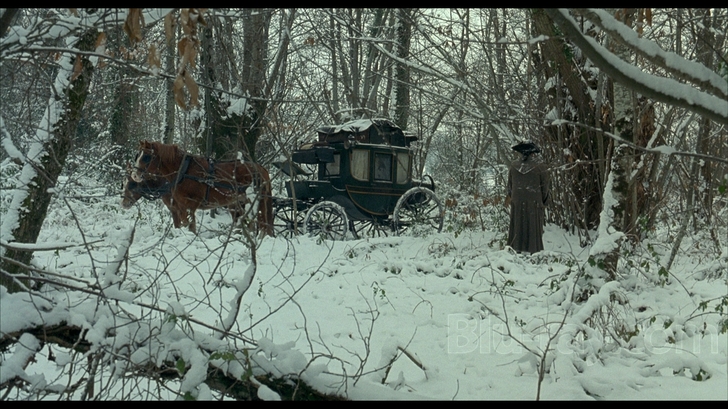
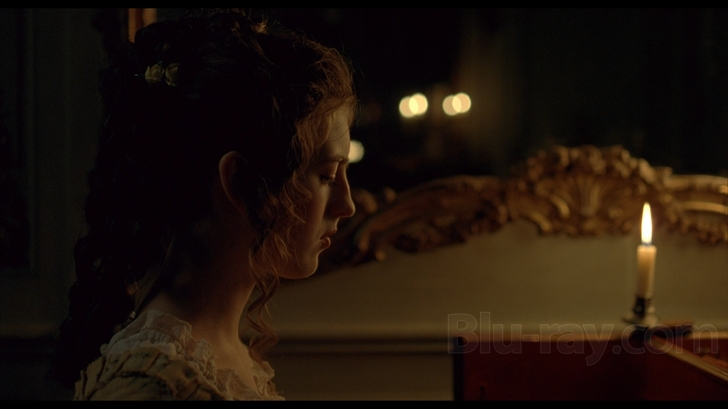
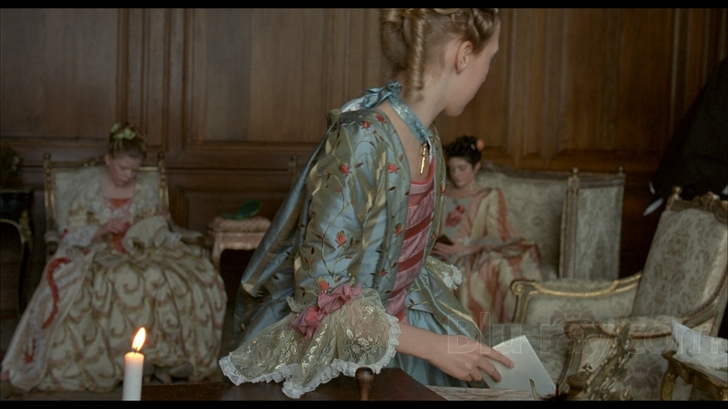
Mozart's Sister is presented on Blu-ray courtesy of Music Box films with an AVC encoded 1080p transfer in 1.85:1. The film follows in the footsteps of such other period pieces as Stanley Kubrick's Barry Lyndon in that it looks like it was shot utilizing as much natural light as possible, which means that (perhaps ironically) a lot of the interior shots in this film are quite dark. Shadow detail is at best murky in many of these sequences, and fine detail is also negligible. When the film gets into outdoor locales or more brightly lit daytime interior shots, things perk up considerably, with some very nicely saturated color, especially with regard to reds, which are featured quite prominently in some of the courtiers' costumes. The film has an intentionally diffuse look in several scenes in what is a nod to soft focus historical epics of yore, but the vast bulk of the scenes, including the great sequence at the White Cliffs of Dover caught in several of the screencaps included with this review, pop really well in this high definition presentation.
Mozart's Sister Blu-ray Movie, Audio Quality
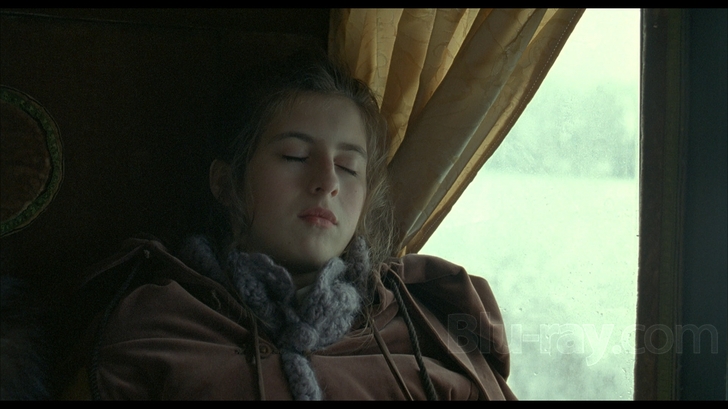
Mozart's Sister features its original French language track delivered via a nice sounding lossless DTS-HD Master Audio 5.1 mix. The film has a surprisingly spacious sounding mix considering its quiet ambitions. A lot of this is due not just to the evocative soundtrack, which is filled with source cues (as might be expected), but also with a rather nicely immersive use of the surrounds to establish the cavernous ambience of Versailles and, earlier in the film, an Abbey where the Mozarts stay for a few days as their carriage is repaired after an axle cracks. Dialogue is crisply and cleanly presented and there are a couple of nice scenes in large halls where various people's voices are clearly directional, adding to the aural scope of the film. Fidelity is excellent throughout the track, and while there's not huge or overly impressive dynamic range, within the quieter confines of the film, what's here works extremely well.
Mozart's Sister Blu-ray Movie, Special Features and Extras
A CD featuring selections from the soundtrack is included.
Mozart's Sister Blu-ray Movie, Overall Score and Recommendation
Amadeus paved the way for fictional treatments of the Mozart story, and that tendency is continued in Mozart's Sister, a piece which wants to give an outline of Nannerl's real life while adding on a bunch of window dressing (or cross-dressing, as the case may be) that really isn't necessary. The truth is stranger than fiction, as that old adage goes, and someone somewhere really ought to make a film about the real life stories of the Mozart clan, for it's a story well worth telling from any number of standpoints. Mozart's Sister might be seen as something of a vanity project for writer-director René Féret, who features not one but two of his daughters in starring or featured roles (aside from Marie, Princess Louise is played by little sister Lisa Féret), but the writing could have given Marie especially more of a showcase. She's fine as far she's allowed to go, but the film never adequately defines Nannerl or indeed what the film itself wants to say about her. All of this said, Mozart's Sister is extremely handsome and easy on the eyes and ears, and lovers of historical drama (albeit highly fictionalized) will probably find a lot to like here, especially given this Blu-ray's nice looking video and great sounding audio. With the caveats noted above, Mozart's Sister is Recommended.
Similar titles
Similar titles you might also like
(Still not reliable for this title)

Zeroville
2019

Grace of Monaco
2014

The Nun
La religieuse
1966

Age of Uprising: The Legend of Michael Kohlhaas
2013

Flashbacks of a Fool
2008

The Damned United
2009

Intolerance
Intolerance / The Mother and the Law / The Fall of Babylon
1916

Beauty of the Devil
La beauté du diable
1950

A Master Builder
2013

Clouds of Sils Maria
2014

Challengers
2024

Five Easy Pieces
1970
The Concorde: Airport '79
1979

The Fabelmans 4K
2022

Barney's Version
2010

Heaven Knows What
2014

The Descendants
2011

Boyhood
2014
Henry V
1944

Moonlight 4K
2016