Mozart: Die Zauberflote Blu-ray Movie
HomeMozart: Die Zauberflote Blu-ray Movie 
Teatro alla Scala, MIlanOpus Arte | 2011 | 172 min | Not rated | Feb 24, 2012
Price
List price:Listed on Amazon marketplace

Movie rating
6.6 | / 10 |
Blu-ray rating
| Users |  | 4.0 |
| Reviewer |  | 4.5 |
| Overall | | 4.0 |
Overview
Mozart: Die Zauberflote (2011)
From the Queen of the Night's vocal pyrotechnics to Papageno's chirpy birdsongs, The Magic Flute is one of Mozart's most charming and engaging operas. However, its fairytale surface conceals the mysteries of an initiation ritual and a multi-layered plot, packed with allegories to fire up the imagination. This celebrated production by artist William Kentridge joyfully bursts onto the stage of Teatro alla Scala in Milan, featuring the dazzling Russian coloratura Albina Shagimuratova as the Queen of the Night, and Italian bass Alex Esposito as Papageno, one of the most sought after artists of his generation.
Starring: Saimir Pirgu, Genia Kuhmeier| Music | 100% |
Specifications
Video
Video codec: MPEG-4 AVC
Video resolution: 1080i
Aspect ratio: 1.78:1
Original aspect ratio: 1.78:1
Audio
German: DTS-HD Master Audio 5.1
German: LPCM 2.0
Subtitles
English, French, Spanish, German, Italian
Discs
50GB Blu-ray Disc
Single disc (1 BD)
Playback
Region A (B, C untested)
Review
Rating summary
| Movie | | 4.5 |
| Video |  | 3.5 |
| Audio | | 4.5 |
| Extras |  | 2.0 |
| Overall | | 4.5 |
Mozart: Die Zauberflote Blu-ray Movie Review
Is magic in the air?
Reviewed by Jeffrey Kauffman March 14, 2012When Umberto Eco’s The Name of the Rose became an international sensation in the early eighties, readers the world over found themselves needing several reference texts in order to wade through Eco’s labyrinthine world of history and arcane allusions. Perhaps the first thing they had to look up was right on the title page, where Eco described his novel as a “palimpsest” (something the film version also carried over). Palimpsests are ancient manuscript pages that have had their original texts and/or drawings washed or even scraped clean so that they can be reused. It must be remembered that in days of yore parchment or any other substance used to write upon wasn’t as readily available as paper is today, and long before recycling became a necessity for the modern world, scribes would reuse scrolls that had been denuded of their previous information. Contemporary South African artist William Kentridge has taken the idea of a palimpsest into a new medium, with a series of inventive animated shorts where a drawing— perhaps only a line—is magically erased, and then is morphed into some new shape or being. This “trial and error” sort of animation almost gives the indication of watching an artist create a work willy-nilly, though of course there’s probably more thought and intention to it than that. But think of this for a moment: if the drawing, especially if done in black, is thought of as darkness, then the erasing can be thought of as light. Perhaps that was at least part of what provided inspiration for Kentridge’s fairly astounding production of Mozart’s legendary Die Zauberflöte (The Magic Flute) at Milan’s equally legendary La Scala in March of 2011. Kentridge provides the opera with a unique and evocative production design which includes all sorts of multimedia elements, including some fun but cogent animations that indeed seem to be depicting some kind of eternal battle between the forces of light and darkness.
Die Zauberflöte was first performed in Vienna in 1791 and remains one of the most popular, if enigmatic of Mozart’s operas. The piece can be appreciated as a simple story of lovers overcoming obstacles to achieve a harmonious union, but of course acres of trees have met their demise in scholarly analyses (some perhaps even on palimpsests) attempting to elucidate the Masonic subtext of Emanuel Schikaneder’s libretto. That Shikaneder and Mozart were Masons, even lodge brothers, is largely inarguable, and there’s similarly little question that Die Zauberflöte is a manifesto of sorts attempting to portray Mankind’s quest from ignorance to enlightenment. The piece is stuffed to the gills with references to everything from Zoroastrianism to Gnosticism to Ancient Egyptian mythology, and as such it stands as a sort of operatic Encyclopedia Brittanica of occult wisdom and theology. But the fascinating thing is how effortlessly Schikaneder and Mozart deal with this potentially problematic material. Die Zauberflöte usually plays like a fable, not a dry and musty litany of ancient ritual.
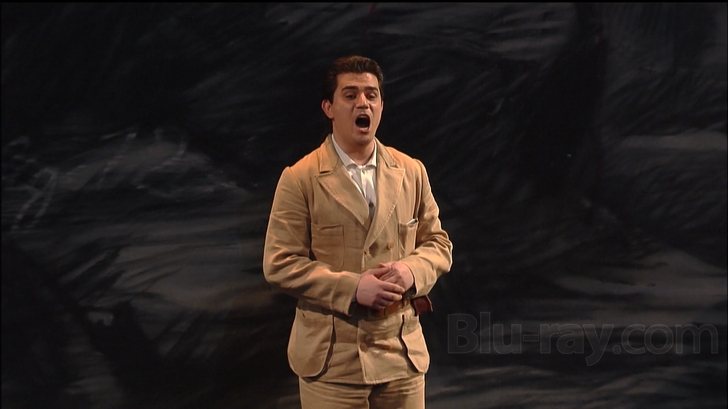
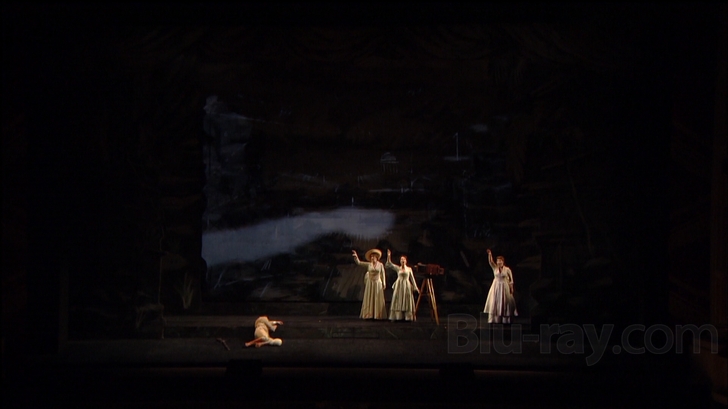
Kentridge wisely eschews outright philosophizing in his production (as he mentions in an interesting interview included as a supplement on this Blu-ray), but hints at the opera’s subtext in intriguing ways. Kentridge both directed and provided the set designs for this opulent production, and he places the opera in a sort of British Colonial milieu, with a safari-hatted Tamino and ruffled blouse and long skirt wearing Three Ladies. One of Kentridge’s master strokes is his use of a prop camera as a suitable metaphor for the mixing of darkness and light. While his palimpsest-inspired animations are projected as the Prelude plays out (ironically here the actual drawings are in white, against a black background, a sort of reverse palimpsest as it were), the Three Ladies primp before an old style box camera. Then as Tamino makes his entrance, fearful of the serpent, the serpent turns out to be the image cast by one of the Three Women’s arms, playing with shadows from the light emanating from the camera. It's just an incredibly subtle and smart piece of stagecraft and it's indicative of the intelligence Kentridge brings to this production.
An international cast is mostly superb in this production. Saimir Pirgu plays Tamino, Genia Kühmeier is Pamina, Günther Groissböck is Sarastro, Alex Esposito is Papageno and Albina Shagimuratova is the Queen of the Night. Shagimuratova of course has one of the most insanely difficult arias in the entire operatic repertoire, and she handles it generally well, though she is just a tad thin and brittle sounding in that stratospheric upper register. The supporting cast is wonderful, and the performance caliber all around is playful without ever lapsing into silliness. The orchestra and chorus of the Teatro alla Scala also do admirable work under the baton of Conductor Roland Böer and Chorus Master Bruno Casoni.
But the real star here is undoubtedly William Kentridge. Those of you who have read my opera reviews here over the past few years know I am not especially prone to suffering what I perceive to be directorial fools gladly, those who want to remake legendary pieces in their own image, with scant attention paid to what the text and music are actually saying. Kentridge seems to be the wonderful exception to that all too tiresome rule. He has brought a verve and vivacity to this project which is visually arresting without ever ignoring the tenor and tone of Die Zauberflöte. This is a rare reimagining that manages to cast a venerable piece in a totally new light (and darkness, as a matter of fact) without divorcing itself from its source. That’s some real magic, and it’s laudable.
Mozart: Die Zauberflote Blu-ray Movie, Video Quality
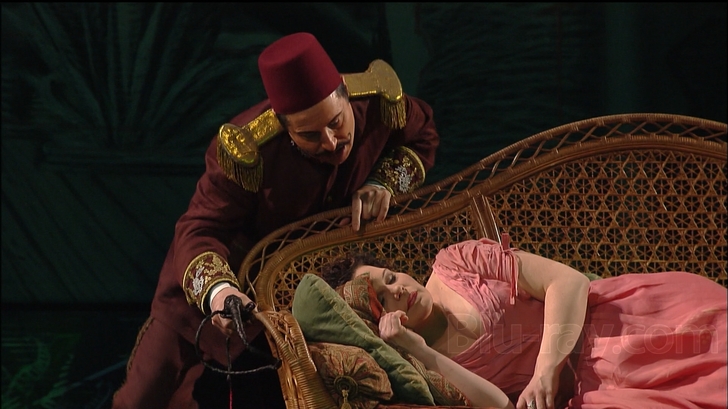
Die Zauberflöte is presented on Blu-ray courtesy of Opus Arte with an AVC encoded 1080i transfer in 1.78:1. This is a weirdly bifurcated high definition presentation that has both pluses and minuses. On the plus side, the production design itself is lovely, with sumptuous costumes and some intriguing projections. On the minus side, the overall image quality here is on the soft side and is also hampered by Kentridge's preference for a mostly dark stage, which leads to murky shadow detail and outright crush at times. The television director Patrizia Carmine also has a tendency to prefer midrange shots, which add to the overall softness factor. When close-ups do finally occur, the uptick in sharpness and clarity is quite noticeable, with some great fine detail, excellently saturated color and nicely variegated contrast.
Mozart: Die Zauberflote Blu-ray Movie, Audio Quality
Die Zauberflöte has two appealing audio mixes, a DTS-HD Master Audio 5.1 mix and an LPCM 2.0 stereo fold down. Fidelity is exceptionally clear and precise, with very good balance between the singers, the ensemble and the orchestra. The vaunted hall ambience of La Scala is perfectly captured in the DTS mix, with a nice spaciousness and breathing room. Dynamic range is quite good, especially with regard to the orchestra which exploits some dramatic changes in volume. Both of these options do reveal some of the very slight thinness in Shagimuratova's most extreme high register, something that certainly should be understandable considering the extreme ambitus of her role.
Mozart: Die Zauberflote Blu-ray Movie, Special Features and Extras
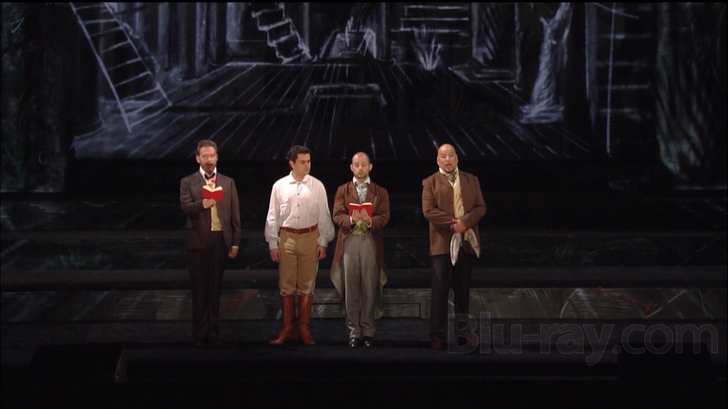
- Interview with Director and Set Designer William Kentridge and Conductor Roland Böer (1080i; 12:13). This is a brief but really interesting and informative piece. Kentridge talks about not wanting to club the audience's head with Masonic overload, which turns out to be a very smart decision, and Böer speaks to Mozart's interest in Egypt and Masonic ritual and how that informed his work on the opera. This interview is in and of itself is fascinating, but it touches on a number of really interesting elements that the featurette doesn't take the time to fully explore. It would have been great to have had a full length documentary really delving into the Masonic background of the opera and how Kentridge decided to approach the material.
- Cast Gallery
Mozart: Die Zauberflote Blu-ray Movie, Overall Score and Recommendation
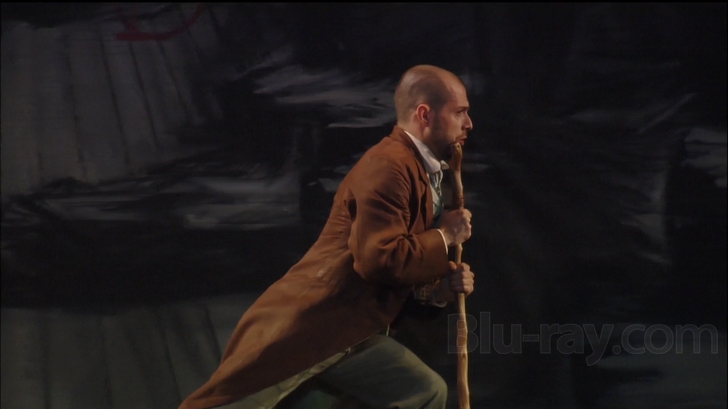
William Kentridge's production of Die Zauberflöte is an incredibly invigorating and thoughtful reexamination of Mozart and Schikaneder's ur-text, one that manages to artfully recast some of the inherent ideas of the original into a perfectly fitting new milieu. The production features a brilliant use of intriguing animations that offer such suitable yet provocative contrasts as a Masonic compass morphing into a metronome, with the arc of the metronome's pendulum proscribing the same arc of the compass. The cast and orchestra is uniformly very good to excellent, but it's Kentridge's contributions that are the true star of this presentation. While the video on this Blu-ray may not be up to the usual pristine standards of most Opus Arte releases, the audio is excellent and the supplementary interview is also quite good. Highly recommended.