Mozart: Così fan tutte Blu-ray Movie
HomeMozart: Così fan tutte Blu-ray Movie 
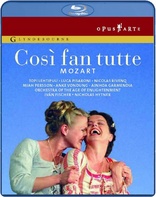
Glyndebourne Festival OperaOpus Arte | 2006 | 210 min | Not rated | Aug 25, 2009
Price
List price:Listed on Amazon marketplace

Movie rating
7.1 | / 10 |
Blu-ray rating
| Users |  | 0.0 |
| Reviewer |  | 4.5 |
| Overall | | 4.5 |
Overview
Mozart: Così fan tutte (2006)
Mozart's beloved opera arrives on stage courtesy of director of Nicholas Hytner in this performance from the Glyndebourne Festival in 2006. This production features Topu Lehtipuu as Ferrando and Luca Pisaroni as Guglielmo.
Starring: Topi Lehtipuu, Luca Pisaroni, Miah Persson, Nicolas Rivenq, Anke VondungDirector: Francesca Kemp, Nicholas Hytner
| Music | 100% |
Specifications
Video
Video codec: MPEG-4 AVC
Video resolution: 1080i
Aspect ratio: 1.78:1
Audio
Italian: Dolby TrueHD 5.0
Italian: Dolby TrueHD 2.0
Subtitles
English, French, Spanish, German, Italian
Discs
50GB Blu-ray Disc
Single disc (1 BD)
Playback
Region free
Review
Rating summary
| Movie | | 4.5 |
| Video |  | 3.5 |
| Audio | | 4.5 |
| Extras |  | 3.0 |
| Overall | | 4.5 |
Mozart: Così fan tutte Blu-ray Movie Review
Mozart and da Ponte skirt (pun intended) with misogyny in one of the pair's most controversial operas.
Reviewed by Jeffrey Kauffman September 15, 2009Had there been a National Organization for Women in the 18th century, I have little doubt the picket signs protesting Cosi fan Tutte would have been legion. While some of Mozart’s operas may seem at least a trifle politically incorrect for various reasons to modern eyes (The Abduction from the Seraglio, for example, which might offend contemporary Muslims, rightly or wrongly), but Cosi fan Tutte was that rare piece which was questioned almost from its first performance. Part of this questioning may indeed have come from the untimely death of Mozart’s benefactor, Emperor Joseph II, a man whose liberal proclivities would have at least tolerated if not condoned Mozart’s (and librettist Lorenzo da Ponte’s) glib assessment that “women are all like that” (a more or less literal translation of the title), meaning they’re prone to infidelity. The opera’s almost cruel subtext, as affianced sisters Fiordiligi (Miah Persson) and Dorabella (Anke Vondung) are put to “the test” by their respective beaus (in disguise, of course) Gugliemo (Luca Pisaroni) and Ferrando (Topi Lehtipuu), is that women can’t be trusted, but what are you to do? The happily ever after conclusion of this piece seems rather oddly placed after two acts of subterfuge and at least tangential immorality.
If the 20th century musical theater was graced by such immortal pairings as Rodgers and Hammerstein and Lerner and Loewe, 18th century audiences may have felt more or less the same about Wolfgang Amadeus Mozart and Lorenzo da Ponte. The two collaborators were responsible for three of the crown jewels of all operatic literature, Le Nozze di Figaro and Don Giovanni being the two siblings to Cosi fan Tutte. Cosi was the last to be written, in fact premiering only about a year before Mozart’s death, and it shows the two attempting to stretch the commonly accepted practices for opera of that era. In fact, it’s difficult to peg Cosi as either a seria or buffo, as it contains elements of both genres, and Mozart seems to be explicitly drawing on vocal “types” from each of the idioms. In fact, as was the case with their previous collaboration, Don Giovanni, Mozart and da Ponte labeled their effort a drama giocoso, literally a “jocund drama,” which I guess might translate into modern terms as that current sitcommish subgenre, the dramedy. With a cast of six principals, Mozart and da Ponte delight in the various small groupings that can be culled from various interchangeable duets, trios and choruses. This is “grand opera” written on a remarkably intimate scale and it provides some luscious opportunities for Mozart’s almost frighteningly accomplished use of double and triple counterpoint, as various vocal lines weave in and out of each other.

The sisters await their betrothed.
In terms of the opera’s controversial plot, there really is no easy way to ignore the faint whiff of misogyny, however good naturedly it may be presented. The “saving grace” here is the aspect of forgiveness, though adamant feminists may well argue that it’s the men doing the forgiving when they were the ones pulling an Age of Enlightenment version of “Punk’d” on their hapless mates. Musicologists may also point to Mozart’s almost incessant use of major keys underlying a lot of the choral music here, which at least subliminally may be saying to the audience, “Don’t take this very seriously, it’s all in good (diatonic) fun.”
Glyndebourne’s quietly elegant production of Cosi fan Tutte hits just the right balance between the serious and comic elements of the opera. With the focus so solidly on the six principals, this is a piece that, despite its lighter than air feeling (despite its rather heavy-handed plot machinations), demands impeccable vocal technique, especially in small group blends. Cosi fan Tutte is actually remarkable in that it has a relative paucity of show stopping arias, preferring instead to concentrate on choral moments. Lehtipuu and Pisaroni make two surprisingly appealing rakes, and Persson and Vondung are similarly winning in roles that are not easy to pull off for modern sensibilities. Lying just beneath the surface throughout this piece is a compositional subtext where Mozart, in such glorious melodies as when Dorabella alludes to the dormant volcano Vesuvius as an analog to her about to erupt desires, makes his allegiances clear. If da Ponte’s libretto is, at least at first glance, rather ambivalent in its portrayal of women’s capacities for loyalty and trustworthiness, Mozart undercuts and repaints it with a sympathetic approach that helps to make the women seem more understandable.
Film director Nicholas Hytner (The History Boys) brings a firm and polished touch to the proceedings, eliciting effervescently youthful performances from the four leads, and some winningly jaded ones from Nicolas Revenq as Don Alfonso, the older man who lures the younger guys into their deceptive ways, and Ainhoa Garmendia as Despina, the girls’ maid who is both sour and satiric. Hytner does hedge his bets at the opera’s conclusions, opting for neither of the two most performed versions and leaving things up in the air for the two loving pairs, something that’s more than a bit unusual for Cosi. (This was one of the more frequently Bowdlerized operas in Mozart’s oeuvre, and one which fell into disfavor so quickly after its premiere, that it exists in several different versions, though since the latter half of the 20th century, it has generally been restored to something approaching its original form). Gorgeously sung, with a handsome, if not overly opulent, physical production, this Cosi proves that when the source material is revolutionary in and of itself, a “traditional” mounting can suit the proceedings to a tee, something this production does with effortless élan.
Mozart: Così fan tutte Blu-ray Movie, Video Quality
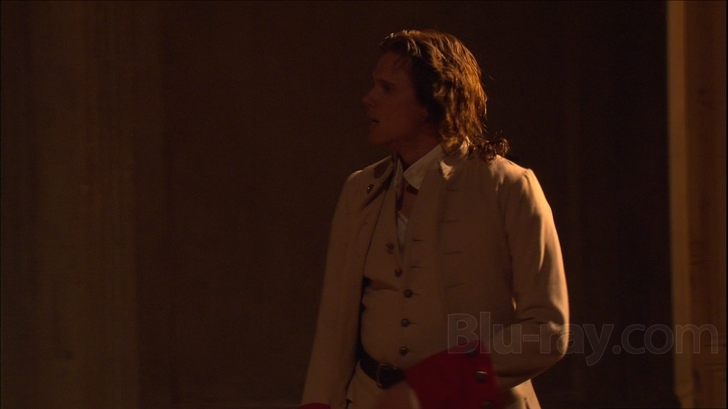
Cosi fan Tutte offers a referendum on the old "glass half full" or "glass half empty" adage. What's here is crisp, well detailed and, for the most part, sharp as a tack, in the typical Opus Arte AVC 1.78:1 1080i live for television transfer. What isn't here can be traced directly to the production itself, and that is a wealth of eye popping colors. For some reason Hytner has chosen to cast this production in a rather odd (and bland) assortment of pale colors, with an equally oddly desaturated palette for the sets and lighting. So if you can live with a sort of pastel ambience throughout this opera, you get some brilliantly clear images, with lifelike, if somewhat pallid, reproduction. The opera is also plagued with some poor lighting choices, which are stunningly rendered (joke) here. Some of the darker scenes are quite hard to make out, but conversely, some of the scenes supposedly awash in bright Italian sunlight have a peculiar washed out air. This is not endemic to the transfer but to the lighting design itself. In between these two extremes is enough solid image quality to satisfy all but the pickiest viewers. Contrast and black levels are excellent and consistent and when there's a suitably saturated palette to represent (as in the nicely amber opening scene), this Blu-ray does a great job. All told, this BD offers an accurate recreation of what was seen on the stage. What was on the stage, though, may not be everyone's cup of high definition tea.
Mozart: Così fan tutte Blu-ray Movie, Audio Quality
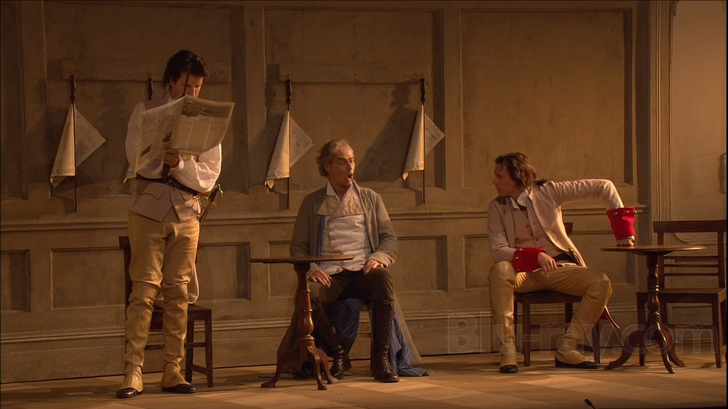
Cosi fan Tutte offers two soundtracks, a Dolby True HD 5.0 48 kHz streaming at around 3.5 Mbps and a Dolby True HD 2.0 48 kHz streaming at around 1.6 Mbps. Glyndebourne's acoustics offer sonic delights galore in this opera, and there's no doubt that the 5.0 mix offers a much fuller, realistic representation of the production. In fact, for a True HD mix, I was actually sort of surprised at the thinness and overly dynamically compressed sound of the 2.0 option. But the 5.0 offers robust fidelity, with intertwining vocal lines and accompaniments filling the surround channels with at times startling clarity. The Orchestra of the Age of Enlightenment, under the direction of Iván Fischer, has a deeply burnished sound which nonetheless has remarkable brightness in the brass, all of which is reproduced here with clarity and punch. No anomalies of any kind are present in either soundtrack, with levels excellent throughout, and no dropouts or pops or cracks to report.
Mozart: Così fan tutte Blu-ray Movie, Special Features and Extras
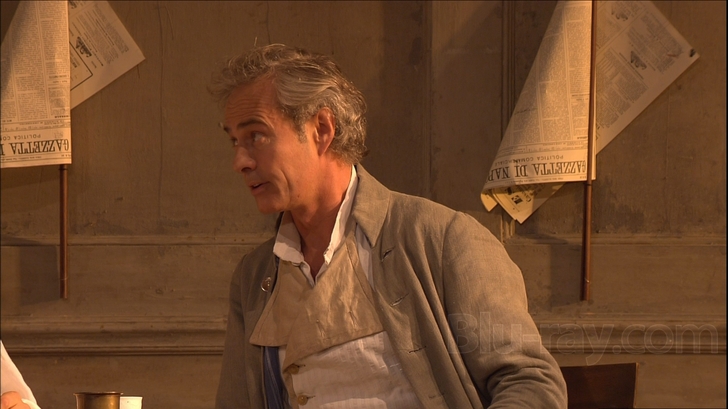
Opus Arte offers its typically excellent assortment of supplements, including a beautifully illustrated insert booklet with a nice essay. On the BD itself are an illustrated synopsis, animated cast gallery, as well as three fairly brief, but informative, interview featurettes (all in HD), with conductor Iván Fischer (6:46), director Nicholas Hytner (6:54), and the principal cast members (6:02).
Mozart: Così fan tutte Blu-ray Movie, Overall Score and Recommendation

Cosi fan Tutte puts the lie to the commonly accepted image of Mozart as a carefree naïf. Uncommonly cynical and even reproachfully politically incorrect, Cosi fan Tutte shows Mozart stretching the boundaries of not just opera, but a whole cultural zeitgeist about women. This Glyndebourne production is not incredibly opulent, but it delivers the goods vocally and orchestrally and should be enjoyed by all Mozart and opera fans.
Similar titles
Similar titles you might also like
(Still not reliable for this title)

Pink Floyd: Wish You Were Here
Blu-ray Audio | 50th Anniversary Edition
1975

David Gilmour - Live at the Circus Maximus
2024

Prince and the Revolution: Purple Rain
Blu-ray Audio
1984

Fleetwood Mac: Rumours
Atmos Blu-ray Audio
1977

The Beatles: Let It Be
Super Deluxe Edition | Blu-ray Audio
1970

David Bowie: The Rise and Fall of Ziggy Stardust and the Spiders from Mars
Dolby Atmos Blu-ray Audio
1972
Depeche Mode: Strange Too
1990
Depeche Mode: Strange
1988

Pink Floyd: The Dark Side of the Moon
50th Anniversary Atmos Remix / Blu-ray Audio
1973

Roy Orbison: Black & White Night 30
1987-2017

Prince and the Revolution: Live
1985

John Williams: The Berlin Concert
Limited Deluxe Edition
2021

Pink Floyd: Pulse
1995

Pink Floyd: Animals
Atmos Remix / Blu-ray Audio
1977

Eric Clapton: The Lady in the Balcony - Lockdown Sessions 4K
2021

The World of Hans Zimmer: Live at Hollywood in Vienna
2018

Madonna: The Girlie Show - Live Down Under
1993

S&M2: Metallica and San Francisco Symphony
2019

John Williams - Live in Vienna
2020

Nick Mason's Saucerful of Secrets: Live at the Roundhouse
2019