Monteverdi: L'Orféo Blu-ray Movie
HomeMonteverdi: L'Orféo Blu-ray Movie 
Teatro alla ScalaOpus Arte | 2009 | 116 min | Not rated | Mar 29, 2011

Movie rating
7.3 | / 10 |
Blu-ray rating
| Users |  | 0.0 |
| Reviewer |  | 4.5 |
| Overall | | 4.5 |
Overview
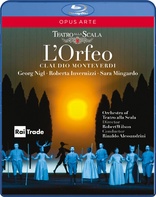
Monteverdi: L'Orféo (2009)
Monteverdi's seminal first opera tells the dramatic story from Ovid's Metamorphoses of the descent of Orfeo into the underworld to recover his beloved wife Euridice.
Starring: Georg Nigl, Roberta Invernizzi, Sara Mingardo, Luca Dordolo, Leonardo CortellazziDirector: Robert Wilson (I)
| Music | 100% |
Specifications
Video
Video codec: MPEG-4 AVC
Video resolution: 1080i
Aspect ratio: 1.78:1
Original aspect ratio: 1.78:1
Audio
Italian: DTS-HD Master Audio 5.1
Italian: LPCM 2.0
Subtitles
English, French, Spanish, German, Italian
Discs
50GB Blu-ray Disc
Single disc (1 BD)
Playback
Region free
Review
Rating summary
| Movie | | 4.5 |
| Video |  | 4.0 |
| Audio | | 4.5 |
| Extras |  | 2.0 |
| Overall | | 4.5 |
Monteverdi: L'Orféo Blu-ray Movie Review
Blue, Green and occasionally Purple Orpheus.
Reviewed by Jeffrey Kauffman March 26, 2011The myth of Orpheus has long proven attractive to a wide range of creative artists in virtually every pursuit imaginable, from painting to sculpture to film to (of course) music. This ancient character whose facility with music and verse enabled him to charm everything from humans to rocks with his melodic endeavors might seem to be more peculiarly apt for musical adaptations, and of course there have been many through the generations. But the legend of Orpheus has always had a wider ranging pull on artistic types, perhaps because of its inherent melancholy (what artist worth his salt doesn’t want to think of him or herself as a tortured artist, after all?), but perhaps more because of its fascinating dialectic between what might be termed destiny or fate and a seemingly inherent inability on the part of Orpheus to “leave well enough alone,” specifically with regard to his own inner urgings to take one final glance at his beloved Eurydice, whom he has almost—almost—saved from the clutches of Hades. This aching story has fascinated humankind from the dark recesses of Ovid and Virgil to more contemporary accounts like Jean Cocteau’s Orphic Trilogy, where in the middle film of his iconic triptych, Orphée, the philosopher-poet of mid-20th century French cinema transported at least elements of the story into (then) present-day France. And of course one of the most bracing and brilliant films of the post-World War II era remains another reimagining of the story by another Frenchman, Marcel Camus’ inestimable Black Orpheus, a 1959 Brazilian masterpiece which moved the Orpheus and Eurydice myth to the roiling streets of Carnaval in Rio de Janeiro, and which in no small measure helped to popularize Bossa Nova around the world, courtesy of its gorgeous score by Luiz Bonfa and Antonio Carlos Jobim.
Over three centuries before Cocteau and Camus, however, another groundbreaking artist was adapting the Orpheus legend for a “new” form which was just beginning to make its impact felt around the courts of Europe, and especially Italy: namely, opera. Claudio Monteverdi, a childhood prodigy who climbed the corporate ladder as it were in the Italian court musician system to become maestro della musica at the Duke of Mantua’s court in the early 17th century, found himself fortuitously placed to help develop this nascent artistic form. The Duke was a lover of theater and seemed especially fascinated by the blossoming of the “newfangled” musical theater which was slowly penetrating spoken dramatic performances by way of interstitial sung and danced elements called intermedio.
While there are conflicting and incomplete historical records of what exactly was performed at the Duke’s court and when, there’s little doubt that Monteverdi was at the forefront of experiencing this new revolution of sung theater. There’s also some circumstantial evidence that Monteverdi may have accompanied the Duke to a courtly wedding where he probably saw Peri’s Euridice, a piece which may very well have inspired the composer to try his own hand at writing a large scale sung theatrical enterprise which recounted the story of the doomed lovers. Interestingly enough, especially in terms of Camus’ Black Orpheus, Monteverdi’s L’Orfeo was first staged in 1617 in Mantua as part of that duchy’s annual Carnival celebration, a sort of historical Mardi Gras that signaled the beginning of the Lenten season.
L’Orfeo stands at the brink of several nascent developments in the history of music. Not only is it often termed the first “real” opera, it also signals a major transition from the Renaissance to the Baroque period. Monteverdi mines competing ideas and compositional techniques here, melding a florid madrigal style (especially with regard to some of the ravishing ensemble numbers) to what would become more standard operatic tropes like recitative. As was the custom in those days, Monteverdi left quite a bit of the actual accompaniment up to the conductor and the individual pit musicians, and so there is also almost a jazz element to various productions of this masterpiece, with often rather amazing differences between approaches, especially with regard to the continuo, depending on who is conducting and playing.
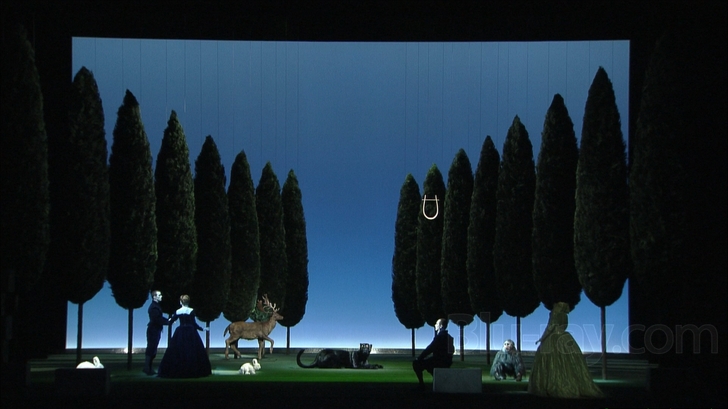
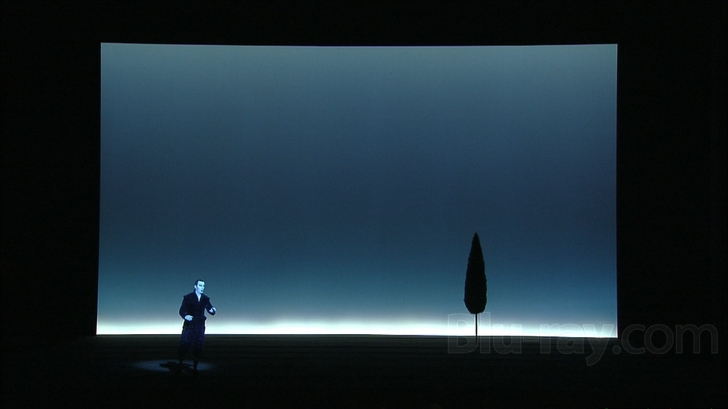
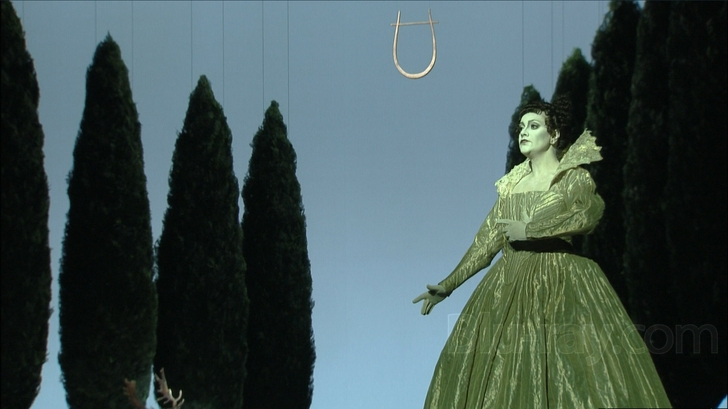
This elegantly spare and appropriately mythic production from La Scala manages to take a piece which was envisaged for a smaller house and expand it to one of the grandest operatic stages in the world. Director Robert Wilson (who also designed the lights and the evocative sets) opens the piece, which is supposed to be on the Thracian fields, with a cypress lined minimal set and actors, almost like mannequins, placed around the stage so that they seem to be in a sort of Grecian version of Seurat’s Un dimanche après-midi à l'Île de la Grande Jatte. Once La Musica (Roberta Invernizzi, who also portrays Euridice) sets the audience’s collective raging hearts at ease, we enter the actual story of Orpheus (Georg Nigl), and are immediately swept up in a commanding sound world that still has an incredibly visceral quality centuries after its premiere.
Conductor Rinaldo Alessandrini leads a period instrument ensemble of the Orchestra of Teatro alla Scala, with continuo providedby Concerto Italiano. This is some of the most beautifully played Monteverdi you could hope for, with a gorgeous, slightly abrasive secco sound from the strings and brilliantly fulsome brass. Some of the period wind instruments like the sackbut sound appropriately raspy, but always with a certain elegance and nuance that makes this one of the more bracing accounts of L’Orfeu in recent memory.
The almost all Italian cast is perfectly suited to bring Monteverdi’s masterpiece to life. Invernizzi’s incredibly gorgeous, well rounded tone is achingly lyrical and her facility with Monteverdi’s melismas is magical. Nigl is a stout and athletically voiced baritone, but he brings a surprising amount of care and precision to the role. The supporting cast is marvelous, and the ensemble is unbelievably beautiful in some of Monteverdi’s most commanding choral music.
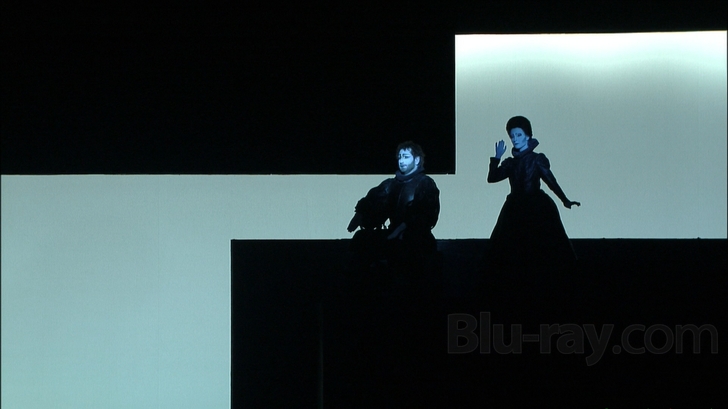
Special note (no pun intended) should be made of Wilson's unusual and provocative lighting scheme, which plays hand in hand with some equally unusual makeup and costume choices. Almost all of the major characters exist within certain color palettes, so that La Musica for example appears in a florid green dress, with similarly verdant looking skin. Orpheus exists in a similarly green-gray palette that changes to blue and purple as the story progresses. It's a really interesting conceit that adds a fair amount of visual flair to this presentation. The costumes themselves (by Jacques Reynaud) are sumptuous and easily evoke a distant mythical realm of iconic characters. This is also an unusually well directed outing in terms of the filming techniques. Nice dissolves, lots of great close-ups, and excellent coverage of the orchestra during the interludes help elevate the visual presentation.
L'Orfeo helped usher in the modern idea of opera, but perhaps its most singular achievement is that even now, centuries after its debut, it still retains such impact and clarity. Wilson, Alessandrini, the entire cast and La Scala deserve kudos for treating this project with appropriate respect, while at the same time delivering a fully alive production that should help ensure the charms of Orpheus are sustained for generations to come.
Monteverdi: L'Orféo Blu-ray Movie, Video Quality
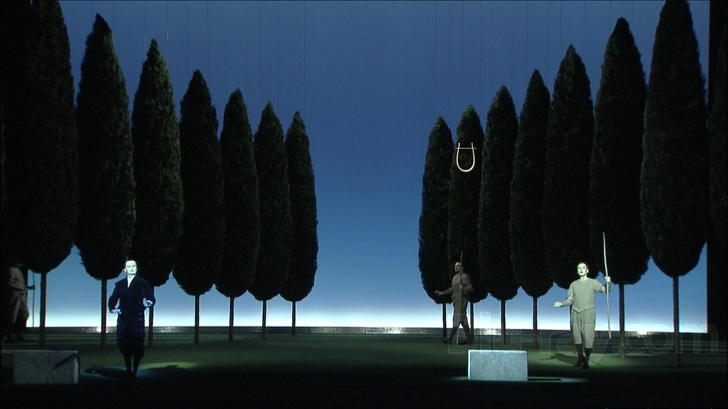
L'Orfeo is presented on Blu-ray by Opus Arte with an AVC encoded 1080i transfer in 1.78:1. The image here may appear to some to be slightly on the soft side, but my opinion is this is based largely on the unusual lighting scheme director Robert Wilson employs for his staging of the opera. We get long scenes played out almost entirely within the framework of one spectrum, sometimes green, sometimes blue, sometimes purple, and that monochromatic approach can rob the image of some fine detail. However close-ups reveal a wealth of detail, including gorgeous filigree on the sumptuous costumes by Jacques Reynaud and even the slathered on makeup on the actors which blends their skin tones with whatever individual color is being exploited at the time. There's not much to the set design here, with a stark and minimalist approach. But colors are nicely saturated, contrast and black levels are strong, and though this isn't the sharpest Opus Arte release in recent memory, it sports a well above average image that should entrance most viewers.
Monteverdi: L'Orféo Blu-ray Movie, Audio Quality
L'Orfeo offers two stunning lossless tracks in the original Italian, a DTS-HD Master Audio 5.1 and an LPCM 2.0. Though La Scala is a perhaps improbably large venue for this intimate piece, generally balance is very good to excellent and the fidelity is simply ravishing. The period instruments here sound incredibly full and alive, and there is very expressive dynamic range. Very occasionally some of the singers disappear for just a second or two beneath the orchestral masses, but it's a very small and not very distracting anomaly. The voices generally sound absolutely wonderful here, and special acclamation must be given to the really inimitable work of the ensemble, which sounds simply beautiful in the choral numbers. Hall ambience is very lifelike and there's appropriate "breathing room" given here that allows Monteverdi's beautiful ornamentations to waft out into the soundfield very naturally.
Monteverdi: L'Orféo Blu-ray Movie, Special Features and Extras
- Illustrated Synopsis (1080i; 4:18)
- Cast Gallery (1080i; 00:52)
Monteverdi: L'Orféo Blu-ray Movie, Overall Score and Recommendation
With a piece as iconic and historically important as Claudio Monteverdi's L'Orfeo, there are two diametrically opposed approaches that a lot of companies and directors tend to take, neither of which ultimately works very well. First, there's a tendency to be too respectful of the source material, robbing it of its immediacy and poignancy. Second, and probably worse, is the modern day hubristic approach whereby some directors want to "tart up" the proceedings to supposedly make them more "accessible" to modern day audiences. Robert Wilson toes a very fine line here, probably leaning slightly toward the respectful side, but the good news is he has sacrificed none of L'Orfeo's emotional impact. Even better, this is about as elegantly sung and played a performance as one could hope for. We're still early on for this year's opera and classical music releases, but I for one can't imagine there being a better all around release than this elegant and moving L'Orfeo. Highly recommended.