Mongo Santamaria: Mongo at Montreux Blu-ray Movie
HomeMongo Santamaria: Mongo at Montreux Blu-ray Movie 
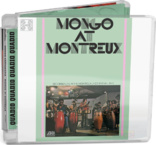
Quadio Blu-ray AudioRhino Music | 1971 | 37 min | Not rated | May 15, 2026
Price
Movie rating
Movie has not been rated yetBlu-ray rating
| Users |  | 0.0 |
| Reviewer |  | 5.0 |
| Overall | | 5.0 |
Overview
Mongo Santamaria: Mongo at Montreux (1971)
Mongo at Montreux is a blistering 1971 live album by Cuban conga legend Mongo Santamaria. Recorded at the famous Swiss jazz festival, the album captures his powerhouse band blending Afro-Cuban rhythms, Latin boogaloo, and heavy funk, highlighted by the extended percussion track "Conversation in Drums".
Starring: Mongo Santamaria| Music | 100% |
Specifications
Video
Video codec: MPEG-4 AVC
Video resolution: 1080p
Aspect ratio: 1.78:1
Original aspect ratio: 1.78:1
Audio
Music: DTS-HD Master Audio 4.0 (192 kHz, 24-bit)
Music: DTS-HD Master Audio 2.0 (192kHz, 24-bit)
Subtitles
None
Discs
Blu-ray Disc
Single disc (1 BD)
Playback
Region A (B, C untested)
Review
Rating summary
| Movie | | 5.0 |
| Video | | 0.0 |
| Audio | | 5.0 |
| Extras | | 0.0 |
| Overall | | 5.0 |
Mongo Santamaria: Mongo at Montreux Blu-ray Movie Review
Reviewed by Jeffrey Kauffman June 10, 2026 Note: The latest bunch of Quadio releases from Rhino feature three artists who have already had at least one previous Quadio release,
namely Carly Simon, Randy Newman and Seals & Crofts, along with newcomer
Mongo Santamaria.
Though it's sadly largely forgotten these days (in more than one way), the United States used to have an official so-called Good Neighbor Policy,
meant to engage our nearest neighbors, and in that regard one of the absolutely fantastic byproduct of those interactions was the virtual eruption
of Afro Cuban rhythms in American popular music post-World War II courtesy of collaborations like those between jazz icons like Dizzy Gillespie and
Cuban percussionist Chano Pazo. The fifties saw even more generally "Latin" rhythms continue to pervade the airwaves, including a relatively short
lived but still potent Mambo craze. Some of the most popular Mambo recordings were done by Tito Puente, and one of Puente's featured conga
player with the unusual name of Mongo Santamaria. Santamaria had already released his own Afro-Cuban efforts under his own name, and while
he continued to work with all sorts of legends*, including the Fania All Stars, he had a significant "solo" (typically with big bands) career on both
Columbia and Atlantic. This was one of Santamaria's last albums during his relatively brief tenure at Atlantic and it captures a really vibrant live
performance.
*Permit me to perhaps blow a few minds with this trivia tidbit which is one of my favorites in what might be called the overlap part of the Venn
Diagram depicting both my film journalism and musical lives: Santamaria was also recording with the legendary Cal Tjader at around the same
time as he was working with Puente. Well, ladies and germs, Cal Tjader appears as a tap dancing tot (I kid you not) under the name Callen Tjader
in Frances Farmer's first film, 1936's Too Many Parents. A somewhat older
Alfalfa is also on hand (director Robert F. McGowan was a veteran of the Our Gang series), for even more weird trivia allure.
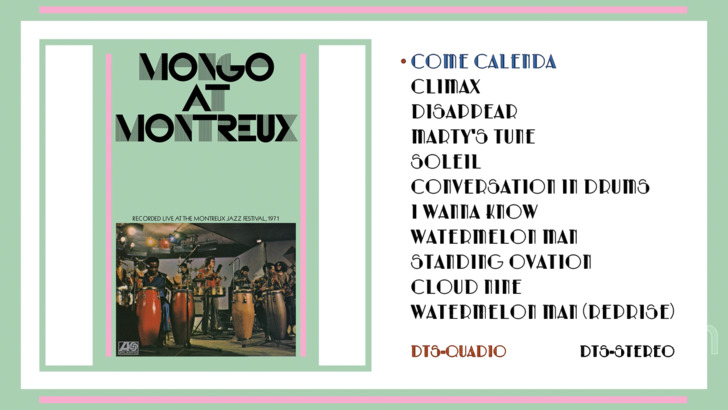
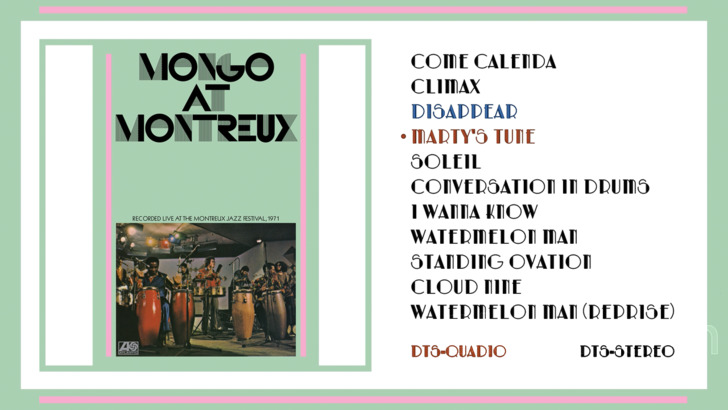
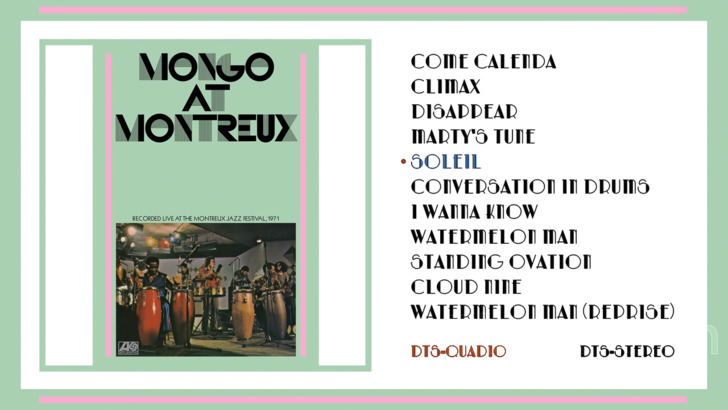
The album's track list can be seen in the screenshots of the disc menu accompanying this review. See the video section below for information about navigating through the menu.
Mongo Santamaria: Mongo at Montreux Blu-ray Movie, Video Quality
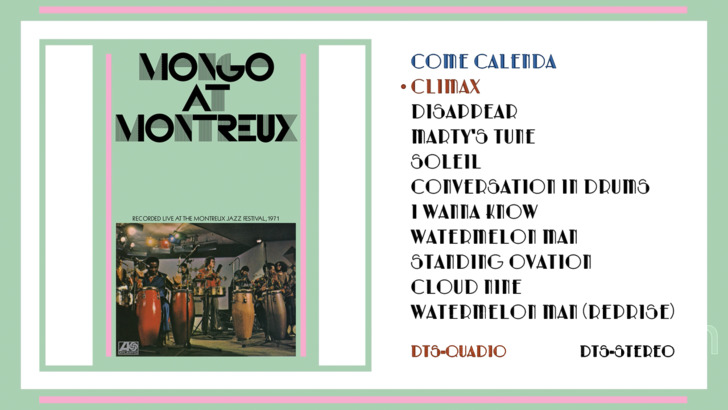
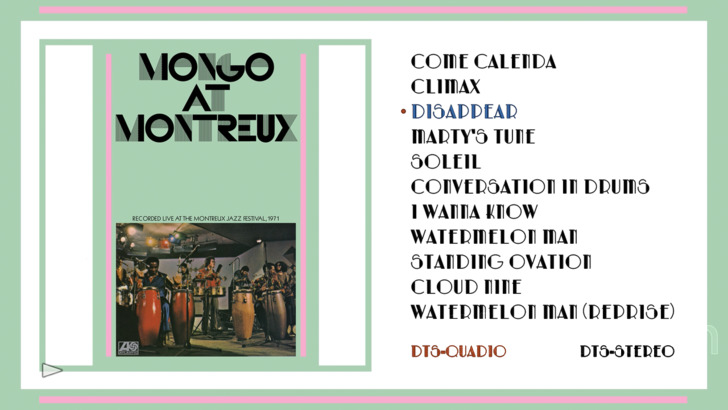
This is another Quadio release with a static menu. As usual, the track listing changes color depending on whether you scroll, chapter skip (which amounts to next track) or actually individually select tracks, and I've offered some examples of the different changes on tap. Unfortunately this is another audio Blu-ray from Rhino where you have to navigate through the tracks to get to the audio codecs to change those, and also unfortunately this is another case where the song starts over once a different codec is chosen.
Mongo Santamaria: Mongo at Montreux Blu-ray Movie, Audio Quality
Mongo at Montreux features DTS-HD Master Audio 4.0 and DTS-HD Master Audio 2.0 options. For those wanting to make sure their rear speakers are functioning correctly, I might jokingly advise utilizing this disc, as the overwhelming sounds of an excited jazz loving crowd virtually explodes from the rear channels as the album starts, and continually throughout the rest of the live performance the crowd noise tends to be rearward, if also generally enveloping. There are a couple of actually hilarious moments where the audience attempts to clap along (unsuccessfully) with very brief interstitial moments from Santamaria's signature hit, Herbie Hancock's Watermelon Man. This is a really spacious sounding quad mix which nicely captures the ambience of the performance venue. There's very appealing separation between winds and brass in particular, with the all important percussion tending to be offered around the listener rather than discretely channeled. Some of the cool chant work (which may remind some of the Portuguese inflected Afro Brasilian offerings from Sergio Mendes in such albums as Primal Roots) are also very immersive.
Mongo Santamaria: Mongo at Montreux Blu-ray Movie, Special Features and Extras
As usual with the Quadio releases, there are no on disc supplements. An insert leaflet reproduces the album's lyrics and credits and also includes Quadio's standard photos of master tape boxes.
Mongo Santamaria: Mongo at Montreux Blu-ray Movie, Overall Score and Recommendation
This is a wonderfully high energy performance that verges more on nascent fusion tendencies at times rather than a strictly traditional Afro Cuban approach. The quad mix is exceptionally spacious. Highly recommended.