Miral Blu-ray Movie
HomeMiral Blu-ray Movie 
Starz / Anchor Bay | 2010 | 106 min | Rated PG-13 | Jul 12, 2011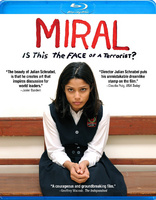
Price
List price:Listed on Amazon marketplace

Movie rating
7.6 | / 10 |
Blu-ray rating
| Users |  | 5.0 |
| Reviewer |  | 4.5 |
| Overall | | 4.5 |
Overview
Miral (2010)
A drama centered on a Palestinian girl growing up in the wake of the first Arab-Israeli war who finds herself drawn into the conflict.
Starring: Freida Pinto, Hiam Abbass, Alexander Siddig, Omar Metwally, Willem DafoeDirector: Julian Schnabel
| Drama | 100% |
Specifications
Video
Video codec: MPEG-4 AVC
Video resolution: 1080p
Aspect ratio: 2.40:1
Original aspect ratio: 2.39:1
Audio
English: DTS-HD Master Audio 5.1
Subtitles
English, English SDH, Spanish
Discs
25GB Blu-ray Disc
Single disc (1 BD)
Playback
Region A (locked)
Review
Rating summary
| Movie | | 4.5 |
| Video | | 4.5 |
| Audio | | 4.5 |
| Extras |  | 4.0 |
| Overall | | 4.5 |
Miral Blu-ray Movie Review
3 Women of Palestine
Reviewed by Michael Reuben July 12, 2011The marketing campaign for director Julian Schnabel's Miral didn't do the film any favors. The tagline "Is This the Face of a Terrorist?", splashed across the one-sheet, print ads and now the Blu-ray jacket above star Freida Pinto attired in a schoolgirl's uniform, utterly misrepresented the film. If you happened to see the trailer, which prominently featured explosions and an insert shot of a primitive bomb that - and this is not a spoiler - has nothing to do with Pinto's character, it merely deepened the false impression. Maybe this approach was The Weinstein Company's attempt to play into the adverse publicity that surrounded the film even before it was released. Based on a semi-autobiographical novel by Palestinian author Rula Jebreal, which she adapted for the screen, the film was said to be an attack on Israel or, worse, anti-Semitic. It is neither, although it does have the oddly subversive effect that great narrative art often creates - that of drawing you into a world you wouldn't otherwise experience, in this case the world of three interrelated Palestinian women from 1947-1993, none of whom is a part of the political, military or covert events that shaped and shook the region throughout those years. (A fourth woman, who was involved, plays an important part in connecting them.) Like all of us, these women had to live in the place and time in which they were born. Through them the film presents an "on the ground" view of circumstances that most of us only know from the abstractions of news reports.
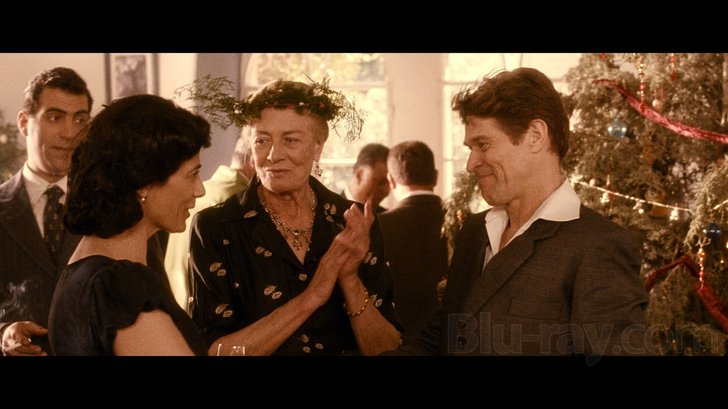
Christmas, 1947
Miral begins in 1947 with Hind Husseini (The Visitor's Hiam Abbass), a real person whose life's work is portrayed in the film. At a Christmas party hosted by Bertha Spafford (Vanessa Redgrave), a devout Christian whose family founded a famous children's hospital in Jerusalem, Hind meets Eddie (Willem Dafoe), a young American. Everyone is full of hope and anticipation for the future. (Schnabel says in the commentary that he tried in these scenes to replicate the texture and colors of the film Exodus.) But the practical realities of founding a nation are not so tidy. Walking home through the streets of Jerusalem one evening, Hind encounters a group of abandoned children, survivors of what would come to be known as the "Deir Yassin massacre". (The film does not use the term, but the children describe what happened.) Hind immediately decides to bring the children to her family home and take them in. Thus was born the Hind Husseini School or “Dar Al-Tifl”, which has educated thousands of Palestinian children and continues to exist (although the student body has now shrunk to about thirty-five students). The film depicts at length the delicate maneuvering in which Hind must constantly engage to keep the school funded but independent and unattached, so that it can survive in a charged and ever-changing climate of conflict. Supportive members of the neighborhood pitch in wherever possible, including Jamal (Alexander Siddig), an imam from a local mosque. Hind's old acquaintance Eddie reappears one day, now a member of the American military, and offers assistance through his contacts. Hind seeks financial aid from a powerful local sheik, Saabah (Juliano Mer-Khamis), who is known as a peaceful man, because she does not want to accept contributions from the PLO. All of Hind's energy is directed toward education. When the uprising known as the "First Intifada" begins in 1987, she addresses her students and explains to them that the best thing they can do is stay in school. The second of Miral's major characters is Nadia (Yasmine Elmasri). The only Palestine she has ever known is one torn by strife. After leaving home to escape sexual abuse by her stepfather, Nadia supports herself by belly dancing and numbs the pain of existence with alcohol. But then she gets into a fight with a Jewish girl on a bus and is sent to jail. Her cellmate is Fatima (Ruba Blal), who is the sister of Jamal, the imam we have already met at Hind Husseini's school. Fatima is serving three consecutive life sentences for terrorist activities. A former head nurse at a major hospital, she was radicalized after being summarily fired for allowing Lebanese soldiers wounded in the 1967 Six Day War to leave and go home. That made her ripe for recruitment by a terrorist cell for which she agreed to plant a bomb in a Jerusalem movie theater. (These are the images used so provocatively in the film's trailer.)

Miral Blu-ray Movie, Video Quality
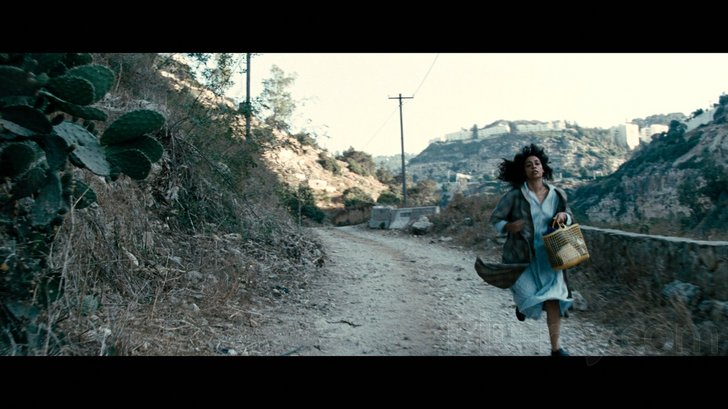
Schnabel used a variety of film stocks and filming techniques for Miral, and he took full advantage of digital post-processing to bring out the deep blues of the night scenes and the sun-drenched ambers of the daytime. The 1080p, AVC-encoded Blu-ray is beautifully detailed such that you can almost feel the sandy soil and the rough-hewn sides of the buildings on cobblestone streets. Schnabel employs numerous long shots to situate characters in the landscape, and the clarity and depth of field in these images is noteworthy. But he also employs close-ups in intimate moments, and because the film spans many years, the aging make-up on Hiam Abbass and Alexander Siddig has to be convincing, and it is. Every wrinkle and gray hair is visible. Black levels are excellent, and I saw no compression-related artifacts or distortions, except for those deliberately put there when the film switches to certain subjective points of view. This is a gorgeous Blu-ray, and I doubt that the film looked better in its limited theatrical engagement.
Miral Blu-ray Movie, Audio Quality
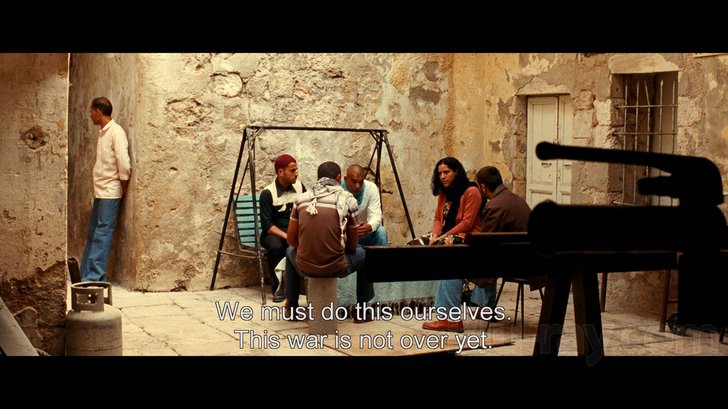
For a non-action film, Miral has an impressive 5.1 track (presented here in DTS lossless). Sounds of environmental ambiance are presented with a notable, often persistent presence. In one country scene, a cuckoo bird can be heard in the background with the kind of continuous drone that often occurs in nature. Obvious candidates for rear channel effects, such as jet flyovers or cars passing, take advantage of the rear speakers, but so do less likely moments, such as a subjective point-of-view shot of waves rushing toward, then past, a character. Bass extension is powerful and deep, and this is most evident in the musical score, which Schnabel assembled from various sources including original compositions by Laurie Anderson and Ennio Morricone's score for The Battle of Algiers (a film which, according to Schnabel, has influenced all his movies). English dialogue is generally clear and centered, but the variety of accents may prompt some viewers to consult the English SDH subtitles. Important: Much of the film's dialogue is in Arabic and Hebrew, but, depending on your player, the disc may default to no subtitles. To have these portions of the dialogue translated, select the "English" subtitles track. Be sure it is selected at the outset, because the Arabic and Hebrew exchanges contain essential plot information.
Miral Blu-ray Movie, Special Features and Extras

As with other Weinstein Company discs from Anchor Bay (e.g., The King's Speech), Anchor Bay has mastered this disc using BD-Java, while omitting the ability to set bookmarks. No BDJ-encoded disc should ever lack this capability. BDJ prevents the user from stopping playback and starting from the same position, and bookmarking is the only workaround. Its omission is inexcusable.
- Commentary with Director Julian Schnabel and Producer Jon Kilik: Recorded in April 2011, Schnabel's commentary is something of a let-down, because he spends too much time describing what's happening on the screen or simply watching in silence, especially in the latter half of the film. Maybe he was simply "talked out" by this point, a possibility that's reinforced by his almost reflexive prompting of Kilik for his opinion on any and every point. But Kilik is clearly not a talker, and his contributions are brief and generic. Still, there are interesting details scattered among Schnabel's remarks, such as the fact that the house where Hiam Abbass, as Hind Husseini, brings the group of children she finds in the street is the house where the real Hind Husseini performed that very action in 1947. The Husseini family generously allowed a largely Israeli film crew to take over the location for several days. Schnabel points out numerous other locations and fills in "backstory" detail on characters that could not be included in the film. He also relates, with obvious emotion, how Juliano Mer-Khamis, who played Sheikh Saabah, whom Hind Husseini persuaded to become a major benefactor of her school, was assassinated just a few weeks before the commentary was recorded; the reasons remain disputed, but Mer-Khamis was a moderate who proclaimed himself both Palestinian and Jewish, and the gunman arrested for his murder was associated with Hamas. Perhaps the most consistent theme in Schnabel's commentary is his bafflement at critics who insisted on staking out ideological positions on the film, often without any apparent regard to what was in it. "It's important to watch what's in the film, not what's not in the film", Schnabel says at one point, making what should be a rather obvious point that this is a story about specific individuals, not a history of the region. He cites with pride a voicemail message he received from Carl Reiner ("my mother's generation", he happily notes) praising the film; Reiner's actual message is included during the credits.
- Deleted Scenes (SD; 2.35:1, enhanced; 3:58): There are three scenes. The longest would have included Hind Husseini's funeral rites as part of the opening sequence. A brief scene in black-and-white shows Hind's family debating whether or not to remain in Jerusalem in 1948. A third scene of the 1993 celebrations on the signing of the Oslo Accords would have been included in the final montage accompanied by Tom Waits's "Down There by the Train".
- The Making of Miral (SD; 1.78:1, enhanced: 14:08): This is an interesting documentary that includes on-location footage as well as interviews with Schnabel, Jebreal, Pinto and Abbass. Perhaps its single best feature is the sight of Jebreal and Pinto sitting side by side. Since the character Miral is based on Jebreal, critics who believe that Pinto, who is of Indian descent, was miscast should consider the extraordinary resemblance between the two women.
- Julian Schnabel Studio Tour (SD; 1.78:1, enhanced; 7:24): Schnabel lets a video crew follow him through his art studio, pointing out various recent canvases. Many of the paintings were inspired by subject matter he encountered while on location for Miral, but otherwise there is no specific connection to the film.
- Filmaker Q&A (SD; 1.78:1, enhanced; 31:51): Taped in black-and-white, this panel followed a screening of the film at the Chicago Palestine Film Festival in April 2011. The panel consisted of Schnabel and Jebreal; Rabbi Brant Rosen of the Jewish Reconstructionist Congregation in Evanston, Illinois; Ali Abunimah, co-founder of Electronic Intifada; and Yali Amit, a member of the Arab-Jewish Partnership for Peace. Much of what Schnabel says is covered elsewhere in the special features, but Jebreal's description of the campaign against the film, which began long before it was shown in the United States, is fascinating. Also of interest is the link that Jebreal sees between the Egyptian uprising against former President Mubarak and the partial thaw in attitude against the film.
- Additional Trailers: The film's trailer is not included. At startup, the disc plays trailers, in standard definition, for The King's Speech, The Company Men and Blue Valentine. These can be skipped with the chapter forward button but are not otherwise available once the disc loads.
Miral Blu-ray Movie, Overall Score and Recommendation
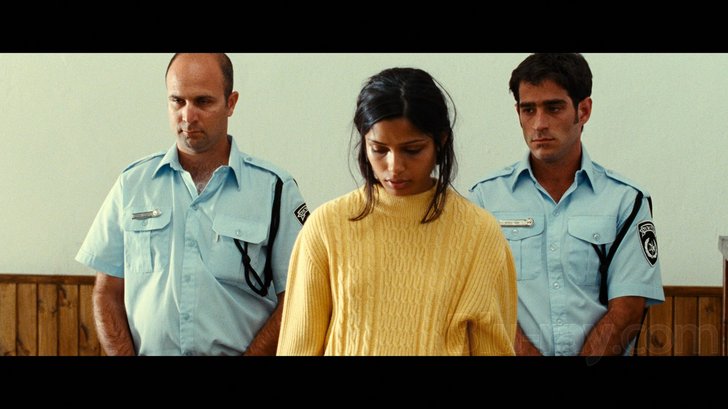
Miral doesn't purport to be a history of the Israeli/Palestinian conflict any more than Huckleberry Finn purports to be a history of ante-bellum America. But the experiences it conveys are vivid, powerful and cannot be denied. Maybe that's why certain parties so dislike the film. Complex human realities such as those embodied by well-wrought narrative fiction undermine the either/or talking points of partisans, who, no matter what their persuasion, have never been especially friendly to artistic pursuits. Ignore the posturing and experience Miral for yourself. Both the film and the Blu-ray are highly recommended.
Similar titles
Similar titles you might also like
(Still not reliable for this title)

Mustang
2015

Wild Tigers I Have Known
Standard Edition
2006

Omar
2013

Capernaum
Capharnaüm
2018

Timbuktu
2014

Wadjda
وجدة
2012

Amira & Sam
2015

Pixote
Pixote: A Lei do Mais Fraco
1980

Welcome to the Dollhouse
1995

Girlhood
Bande de filles
2014

Sorry We Missed You
2019

Not Wanted
1949

Moonlight 4K
2016

Aparajito 4K
অপরাজিত / The Unvanquished
1956

Where Is the Friend's House?
خانه دوست کجاست / Khane-ye doust kodjast?
1987

The Insult
L'insulte
2017

Graduation
Bacalaureat
2016

Cemetery of Splendor
2015

Julieta
2016

Like Father, Like Son
2013