Minkus: La Bayadère Blu-ray Movie
HomeMinkus: La Bayadère Blu-ray Movie 
Paris Opera BalletKultur | 133 min | Not rated | Apr 27, 2010
Price
List price:Listed on Amazon marketplace

Movie rating
6.5 | / 10 |
Blu-ray rating
| Users |  | 0.0 |
| Reviewer |  | 4.0 |
| Overall | | 4.0 |
Overview
Minkus: La Bayadère ()
Starring: Isabelle Guerin, Laurent Hilaire, Élisabeth Platel, Lionel Delanoe, Wilfried RomoliDirector: Alexandre Tarta
| Music | 100% |
Specifications
Video
Video codec: VC-1
Video resolution: 1080i
Aspect ratio: 1.78:1
Audio
Music: LPCM 2.0
Subtitles
None
Discs
25GB Blu-ray Disc
Single disc (1 BD)
Playback
Region A (B, C untested)
Review
Rating summary
| Movie | | 4.0 |
| Video |  | 3.5 |
| Audio |  | 4.5 |
| Extras | | 0.0 |
| Overall | | 4.0 |
Minkus: La Bayadère Blu-ray Movie Review
Rudolf Nureyev bade goodbye to ballet with this incredibly opulent production of a 19th century warhorse.
Reviewed by Jeffrey Kauffman June 25, 2010Not to state the obvious, but nineteenth century audiences did not have cable television to aid them in becoming armchair travelers. While the wealthier citizens of the era often engaged in “The Grand Tour,” visiting exotic locales on guided voyages, the run of the mill folk, even those who were to use the current terminology upper middle class, managed to experience foreign cultures only through works of art. Ballet especially exploited this need, with gigantic spectacles built around exotic, far off locales, and no one did it better than Marius Petipa, the iconic Premier Maître de Ballet of the Imperial Theaters. Petipa loved over the top tableaux, often built around a specific locale. Brilliant libretti were not his stock in trade much of the time; instead, Petipa wanted to entertain his audiences with spectacle, the kind of pageantry that today probably has its best analog in summer blockbuster movies. There’s nothing overly intellectual in Petipa’s creations, and that typically includes the music to which he set his dances. These are not exactly “low brow” entertainments, it being ballet and all, but there’s little if any literary ambitions, and none of the innovative elements that would create scandal decades later with the collaboration between, say, Stravinsky and Nijinsky.
La Bayadère is a perfect example of Petipa’s craft, a big, splashy evening of “wow” moments, set to often predictable, if very colorful, orchestral music, in this case by Petipa’s frequent collaborator, the frankly second string Austrian-Russian composer Ludwig Minkus. La Bayadère has managed to stay in the repertory largely by dint of the fact that one of its most famous sections, “The Kingdom of the Shades”, has taken on an independent life of its own and is often performed separately from its source. Petipa’s original creation has been revived and reinterpreted through the years, including in the early 1990’s by Rudolf Nureyev, when he was Artistic Director of The Paris Opera Ballet.
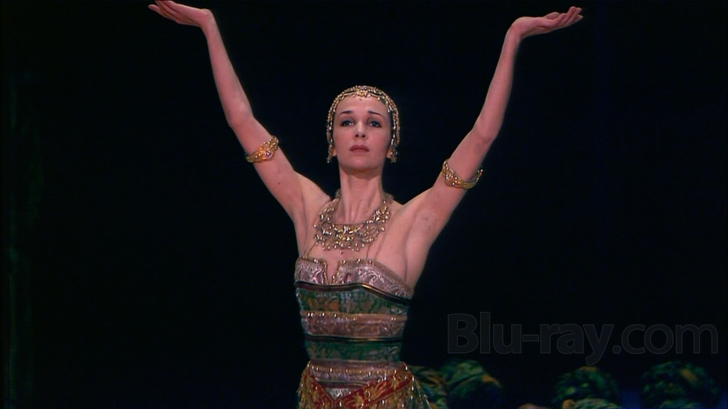
Isabelle Guérin
One of the problems with La Bayadère is that some of Petipa’s original choreography was lost to the ravages of time. That meant that intervening choreographers either had to guess at what the original productions of the piece looked like, or had to do major reconstructive work. The Kirov developed the most frequently utilized “guidelines” for the piece in the early 1940’s, but subsequent adapters, like Natalia Makarova, eliminated some of the clunkier aspects of Petipa’s work, like many specialty “character” dances. Nureyev takes a somewhat different approach, reinserting these specialty numbers but eliminating the fourth act, leaving some plot elements dangling as a result.
La Bayadère (which is usually translated as “The Temple Dancer”) really doesn’t rely much on plot when you get right down to it. We are presented with two sets of mismatched lovers, the Temple Dancer Nikiya (Isabelle Guérin) and Solor (Laurent Hilaire), as well as The High Brahmin (Francis Malovic) who lusts after Nikiya, and Gamzatti (Élisabeth Platel), whose father wants her to marry Solor. Recriminations, threats of murder, and actual murder crop up in the original production, not to mention a little recreational opium use, but it’s all simply a foundation for Petipa, and now Nureyev, to hang one eye-popping spectacle after another on.
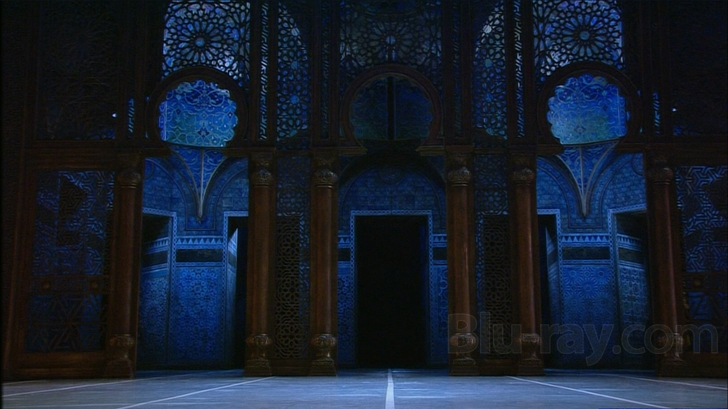
This was Nureyev’s swan song (no pun intended) as both an artist and, perhaps especially, a choreographer and putative producer. The Paris Opera Ballet new that the dancing icons days were numbered due to his progressively worse HIV infection, and they poured enormous sums of money into this production, pulling out all the stops for what was recognized as Nureyev’s final contribution to his art. This is therefore one of the most overwhelmingly opulent productions you’re ever likely to see. Scenic designer Ezio Frigerio and costume designer Franca Squarciapino offer an incredibly evocative production design, one which manages to capture Westerners’ ideas of what India “should” look like without ever tipping over into self-parody.
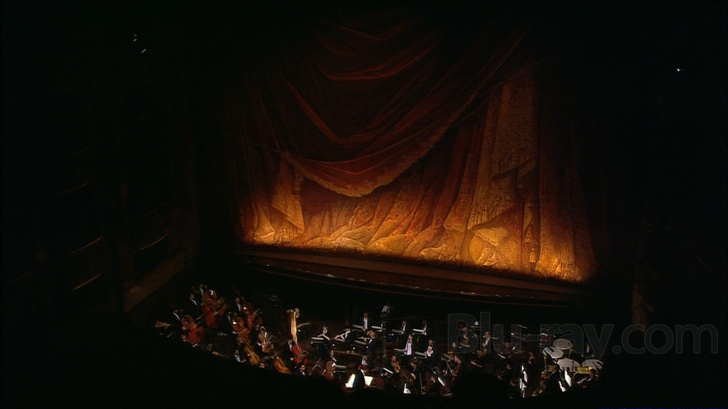
Nureyev had wanted to use Minkus’ original orchestrations, which at the time were only available in Russia, but due to his haste in copying the orchestral parts in St. Petersburg, he missed half of every page, and Royal Ballet master orchestrator John Lanchberry was called into to restore the score to as much of its original luster as could be managed. While little of Minkus’ work here rises to the sumptuous levels of, say, Rimsky-Korsakov’s Scheherazade, it’s colorful enough, with often very impressive effects. Conductor Michel Quéval elicits a robust reading of the material, underpinning the visual spectacle with a considerable amount of panache.
While the featured dancers offer performances of grace and athleticism here, it’s actually the corps dancing where this production excels. Nureyev was almost obsessive compulsive in casting his ensemble, and while the results are almost frighteningly “Stepford”-like at times, with a troupe which seems to have been cloned, the result is a breathtaking unity of movement and appearance which helps to create the frankly surreal world that La Bayadère exploits. Aided by the lush costumes and scenic design, this production is in fact like Solor’s own opium dream that serves as this offering’s finale. It’s a suitable epitaph for Nureyev, whose own stormy dancing career finally ceded to a mature appreciation for the incredible tradition from which he had sprung. If La Bayadère is a little musty, the opulence of this production helps offset that tendency rather dramatically, and it will always be remembered as Nureyev’s loving final goodbye to the art he helped revolutionize as both a dancer and choreographer.
Minkus: La Bayadère Blu-ray Movie, Video Quality
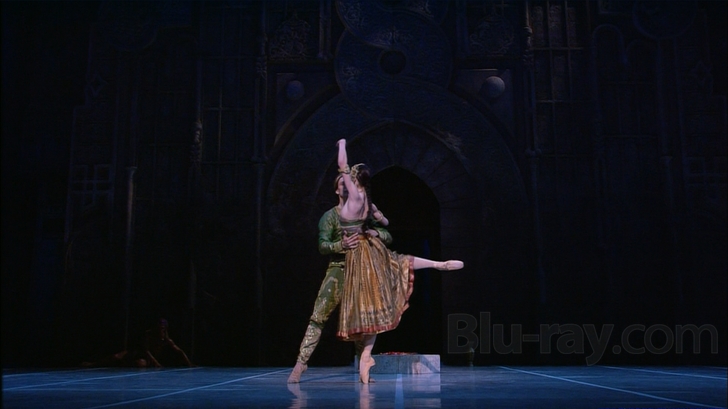
Kultur is doing its darnedest to get into the high definition game, but it's somewhat hobbled by older source videos, and that's the case again here with La Bayadère, which despite a VC-1 encode in 1080i (with an aspect ratio of 1.78:1), belies its videotape origins with a sometimes disappointingly soft image. It's really interesting in a way to see these older videotapes given the high definition treatment, because the conversion can be both boon and bane to the source elements. Here the best thing is the absolutely resplendent color, which is truly eye-popping and should help most viewers overcome the flaws in sharpness. The costumes especially are so brilliantly saturated that from a color perspective La Bayadère approaches near reference quality. Unfortunately, that superb palette is somewhat undermined by an overall softness of image and some spotty contrast, which leads to whites especially occasionally blooming under the bright stage lights. When we're offered a more theatrical lighting experience, as in the blue-hued finale, everything looks a good deal better.
Minkus: La Bayadère Blu-ray Movie, Audio Quality
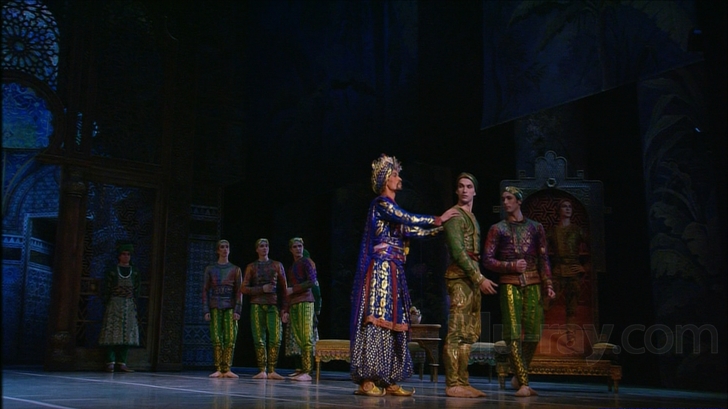
A lossless LPCM 2.0 mix is included with this Blu-ray, which frankly is probably just fine for the limited charms of Minkus' score. While this is colorful music to be sure, there's nothing that screams out for "interior" listening. We're given a typically robust Romantic sound with massed strings and brasses and just the right amount of supposedly "authentic" color to remind us of India. The quality of the recording is quite excellent, with really good dynamic range handling everything from the whispering of the winds to big orchestral tutti with ease. The soundfield is obviously fairly narrow here, but individual instruments do peek out from between the massed orchestration, and the overall sound is very clear.
Minkus: La Bayadère Blu-ray Movie, Special Features and Extras
No supplements are included on this Blu-ray.
Minkus: La Bayadère Blu-ray Movie, Overall Score and Recommendation
The historical importance of this piece (as well as this particular video representation of it) outweighs its mustiness and the flaws of age inherent in the image quality. This is balletic spectacle on the grandest of scales, and Nureyev marshalled a really incredible production here as his personal farewell to the art he helped revolutionize. Even if you don't usually like ballet, you'll be awestruck by the pageantry on display here in probably the most opulent production the Paris Opera Ballet has ever mounted.