Mindcandy Volume 3 Blu-ray Movie
HomeMindcandy Volume 3 Blu-ray Movie 
FUSECON | 2003-2011 | 219 min | Unrated | Dec 06, 2011
Price
List price:Listed on Amazon marketplace

Movie rating
7.4 | / 10 |
Blu-ray rating
| Users |  | 0.0 |
| Reviewer |  | 4.0 |
| Overall | | 4.0 |
Overview
Mindcandy Volume 3 (2003-2011)
Demos from the worldwide demoscene are presented on this compilation, including several audience favorites at such demoparties as Breakpoint.
| Other | Uncertain |
| Music | Uncertain |
Specifications
Video
Video codec: MPEG-4 AVC
Video resolution: 720p
Aspect ratio: 1.78:1
Original aspect ratio: 1.78:1, 1.33:1
Audio
English: Dolby Digital 2.0 (224 kbps)
Subtitles
English, French, German, Spanish
Discs
50GB Blu-ray Disc
Two-disc set (1 BD, 1 DVD)
Playback
Region A (B, C untested)
Review
Rating summary
| Movie | | 4.0 |
| Video |  | 5.0 |
| Audio |  | 3.0 |
| Extras | | 4.0 |
| Overall | | 4.0 |
Mindcandy Volume 3 Blu-ray Movie Review
Tasty, and surprisingly nutritious.
Reviewed by Jeffrey Kauffman November 28, 2011There comes a time in everyone’s life when they get old enough to realize how much the world has changed. I used to marvel at hearing stories of “old timers” relaying what the world was like before television or, in some extreme cases, cars, not really believing that things could have ever been that “primitive.” But I’m old enough now to see a whole range of things that have changed fairly drastically in just the past 20 or 30 years. I’m old enough to remember black and white television, rotary phones, and the birth of both the personal computer and the internet. It’s almost impossible to imagine a world now without widescreen (obviously color) HDTVs, cell phones, and PCs (and Macs of course) and being connected (seemingly eternally) to the World Wide Web. But even those with long computer memories may have erased one of the interesting evolutionary steps along the way to what is now mostly a two-brand system, namely those old Atari computers (and game systems) that were so prevalent a generation or so ago.
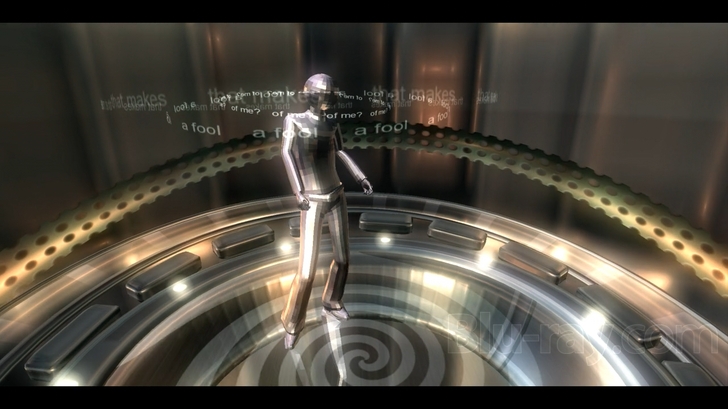
I got my first Atari experience probably in the late 80s or early 90s, when in my guise as a musician-composer, I did my first professional studio work utilizing one of the now ancient consoles to handle MIDI operations. I was immediately blown away by the mammoth possibilities which were suddenly at my fingertips, orchestral extravaganzas that I couldn’t have possibly produced in a practical way without hours of rehearsal and of course an equally mammoth budget to pay all those musicians. My focus was generally quite narrow, working on commissions or my own private pieces, and so I might be forgiven for not realizing that a whole Atari subculture had sprung up seemingly overnight (primarily in Europe), hackers that broke into Atari game codes to reinvent games, a tactic that evidently helped lead to what has become known as the “demoscene,” groups of relatively young coders, graphic artists and musicians who band together to do short form quasi-music videos, almost always with purely abstract visual elements, that they share at huge demo parties at such annual events like Breakpoint.
While the demoscene predated the Atari (anyone remember the Commodore?), the Atari helped popularize the genre, especially with regard to the nascent game “crackers” whose “new, improved” introductions to games helped show off their (now somewhat hilariously primitive looking) programming skills. Things have changed rather radically in the intervening decades, so much so that Breakpoint announced its 2010 gathering would be its last, since there didn’t seem to be as much call for an “underground” movement to find community anymore, given the nature of the internet and the easy access to programming tools nowadays. Maybe even those young “crackers” are starting to understand how quickly and radically the world can change.
As might be expected from a compilation spanning the timeframe of Mindcandy Volume 3 (2003-2010), not to mention the wide variety of participants, there’s no real coherence or consistency, content wise anyway, throughout the approximately three and a half hours of the main demo program on the disc. Everything from purely abstract shapes, some very basic, others undulating and more inviting, to more content driven fare such as homages to Electric Kool Aid or various religious deities, is offered up in a variety of quasi-hallucinogenic outings that play to usually pulsing, techno-esque music. There are a couple of nice exceptions in terms of the accompanying scores, with great washes of soothing synth patches, and to be fair several of the pieces show some real arranging prowess, with nice guitar and keyboard interpolations (“LIfeforce,” with its quasi-Enigma chorus, was one of my favorites in this regard).
While some of the animation seems relatively undeveloped and at times less than perfectly realized (some of the water effects are less than spectacular), overall this is an incredibly impressive group of demos from widely disparate people working with different hardware and software, and with radically different backgrounds. The era of the demoparty may be winding down due to external forces (it’s kind of funny to hear the Breakpoint organizers complain about “getting old”), but fare like Mindcandy proves that the exploratory spirit which infects so many computer “geeks” is something to celebrate. The results here, while wildly variant, are often incredibly expressive and at times just plain gorgeous. The complete list of demos (name of demo followed by the "gamertags" of the creators):
- The Popular Demo: Farbrausch
- Stargazer: Orb & Andromeda
- 1995: Kewlers & mfx
- Wir Sind Einstein: United Force & Digital Dynamite
- Iconoclast: ASD
- Masagin: Farbrausch & Neuro
- Ix: Moppi Productions
- Track One: Fairlight
- Lifeforce: ASD
- Final Audition: Plastic
- Size Antimatters: ASD
- Electric Kool-Aid: Synesthetics
- Theta: Farbrausch
- Deities: mfx
- Passing: Still
- Only One Wish: Fairlight & The Black Lotus
- Bombman: Matt Current
- Nazca: Cocoon
- You Should: Haujobb
- We Cell: Kewlers
- Faded Memories: Farbrausch
- Instant Zen: Synesthetics
- Onwards: Traction
- Metamorphosis: ASD
- Midnight Run: ASD
- Route 1066: UKScene Allstars
- Agenda Circling Forth: CNCD & Fairlight
- Aether: mfx
- Ferner: Still
- theBeauty: Einklang.net & Extrawelt
- Inflorescence: mfx
- Vokawardoai: Satori
- Chromosphere: SQNY
- Debris: Farbrausch
- Rupture: ASD
- Frameranger: CNCD, Fairlight, Orange
- Shad 3: Cocoon
- Into The Pink: Plastic
- Happiness Is Around The Bend: ASD
- Rove: Farbrausch
Mindcandy Volume 3 Blu-ray Movie, Video Quality
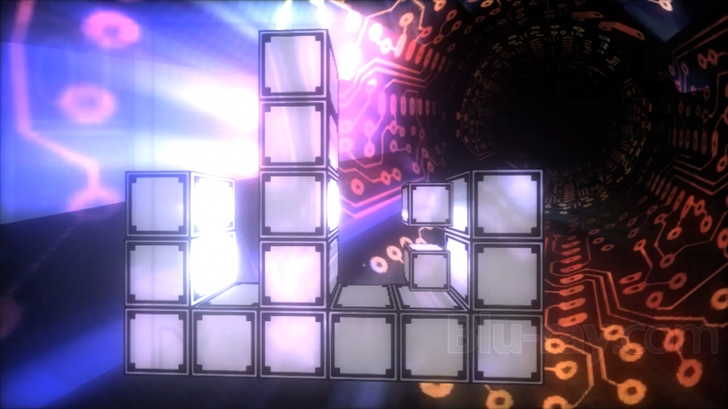
Mindcandy is presented on Blu-ray courtesy of Fusecon in an AVC encoded 720p transfer in a number of different aspect ratios, the most prevalent being 1.78:1. As producer Jim Leonard goes into in his fairly technical production notes, capturing these computer programs in real time meant foregoing 1080i, and even at 720p the authoring team had to do some significant tweaking to arrive at the largely spectacular results on display here. (The "What Went Wrong" segment of the Production Notes featurette is fascinating in this regard). These are 60fps renderings and they for the most part look beautifully smooth and fluid. Colors are beautifully modulated, extremely robust and pop very nicely. Detail, as far as it goes in something that exploits geometric shapes as much as these offerings do, is very good. The disc itself is authored a bit strangely, with a cumbersome menu system that makes navigating from section to section difficult at times, but the transfer of the main demo section is fantastic looking.
Mindcandy Volume 3 Blu-ray Movie, Audio Quality

Musicians never get no respect, I tells ya! What's with the Dolby Digital 2.0 mix on this Blu-ray, especially when there's such great low end on so many of these tracks? This was a "homegrown" release, so the lack of a surround mix is at least partly understandable, but no lossless audio on something so dependent on music seems odd, but perhaps production costs were simply too prohibitive. The good news is that, despite the lossy rendering of all of this music (and the accompanying commentary tracks), fidelity here is actually rather boisterous, with decent reproduction through all frequency ranges and some nice whomping low end for all that bass and drum work. In one kind of neat (though not immediately apparent) extra, you don't actually have to switch to the commentary track to listen to it, if you want to enjoy the music—simply access the optional subtitles which are a textual reproduction of the commentary track and you can read as you watch.
Mindcandy Volume 3 Blu-ray Movie, Special Features and Extras
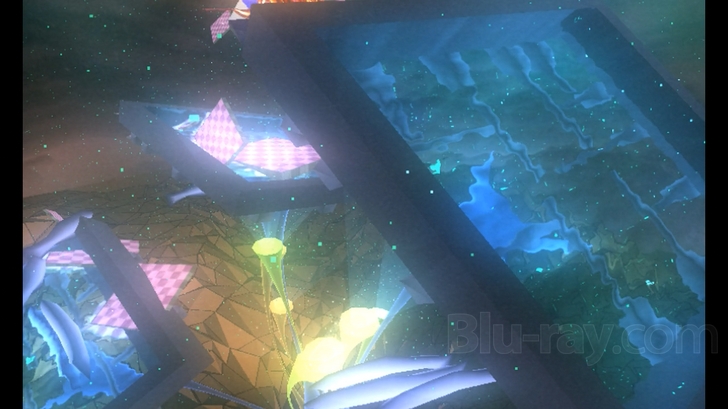
- Commentaries on many of the demos feature members of the creative team talking about how the demos were created.
- An Intro to Intros (720p; 18:23 with intro). This is a fascinating compilation of really short form demos, made up of files as small as 4 KB.
- NVScene 2008 Presentations includes:
The Other Side of Demo Programming (SD; 50:27)
Raytracing on the GPU in 4096 Bytes (SD; 1:00:17)
The History of the Demoscene (HD; 1:05:53)
Procedural Content Creation Taken to Extremes (HD; 1:08:52)
Deconstructing Demos: From Conception to Performance (HD; 1:25:43)
Understanding Realtime as Design Potential (HD; 1:09:56)
Exploring Chunks of Time: Interactive Elements in Linger in Shadows (HD; 46:01)
All NVScene 2008 Talks (SD; 50:57) - RVScene 2008 (HD; 8:12)
- Production Notes (HD; 9:55). Though commentator and producer Jim Leonard describes this as an "easter egg," it's out in plain view and provides a great background on the Mindcandy project, as well as some fairly technical discussion of the authoring of this Blu-ray.
Mindcandy Volume 3 Blu-ray Movie, Overall Score and Recommendation

Mindcandy Volume 3 proves quite admirably that there's no dearth of talent in private homes around the world, guys (for the most part, anyway) who just like fooling around with their computers and seeing what they can create with them. While there's obviously no real rhyme or reason in terms of a through line on this compilation, there's a lot of staggeringly beautiful imagery and some very nicely done music as well. It would have been nice to have had an actual credits page, instead of the internet "gamertags" these guys tend to use, so that any further career developments could be more closely followed. Some may find the Supplements here overly technical, but they're fascinating a lot of the time. The only real downside to this Blu-ray is the lack of lossless audio. As ambient television and as examples of what the personal computer can accomplish, this is some of the most interesting stuff to come down the pike in a long time. Recommended.