Milk of Sorrow Blu-ray Movie
HomeMilk of Sorrow Blu-ray Movie 
La teta asustadaOlive Films | 2009 | 98 min | Not rated | Oct 02, 2012
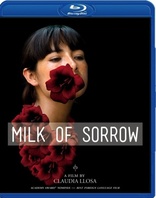
Price
List price:Amazon: $20.08 (Save 33%)
Third party: $20.08 (Save 33%)
Only 1 left in stock - order soon.

Movie rating
6.8 | / 10 |
Blu-ray rating
| Users |  | 0.0 |
| Reviewer |  | 4.0 |
| Overall | | 4.0 |
Overview
Milk of Sorrow (2009)
Fausta is suffering from a rare disease called the Milk of Sorrow, which is transmitted through the breast milk of pregnant women who were abused or raped during or soon after pregnancy. While living in constant fear and confusion due to this disease, she must face the sudden death of her mother. She chooses to take drastic measures to not follow in her mother's footsteps.
Starring: Magaly Solier, Susi Sánchez, Efraín Solís, Marino BallónDirector: Claudia Llosa
| Foreign | Uncertain |
| Period | Uncertain |
| Drama | Uncertain |
Specifications
Video
Video codec: MPEG-4 AVC
Video resolution: 1080p
Aspect ratio: 1.85:1
Original aspect ratio: 1.85:1
Audio
Spanish: DTS-HD Master Audio 2.0
Subtitles
English
Discs
25GB Blu-ray Disc
Single disc (1 BD)
Playback
Region free
Review
Rating summary
| Movie | | 4.0 |
| Video |  | 4.5 |
| Audio | | 4.0 |
| Extras | | 0.0 |
| Overall | | 4.0 |
Milk of Sorrow Blu-ray Movie Review
Mother's milk isn't always sweet.
Reviewed by Jeffrey Kauffman October 1, 2012Is it possible to film a metaphor? In a way, the Dadaists at least thought so, as evidenced by the rampant symbolism in such famous outings as Un Chien Andalou, although strictly speaking the stream of consciousness imagery that wafted and/or sliced its way through such offerings might be more akin in a literary sense to a simile, a comparison rather than an overlay of meaning, so to speak. But how could one hope to film a purely literary metaphor such as the one that informs The Milk of Sorrow? The title itself hints at the central conceit of Claudia Llosa’s screenplay, namely that women who have conceived due to having been raped pass that horror on to their offspring via their breast milk. It’s an unsettling idea, one seemingly culled from the atavistic collective memory of a people (in this case Peruvian) who have weathered tumult and outright subjugation, and that of course is the central metaphor at work here. The film may pretend to be about the trauma suffered by the not so coincidentally named Fausta (Magaly Solier), and in fact deals with her emotional journey rather explicitly throughout the film, but Fausta herself serves as a symbol for an entire class of women, whether Peruvian or not. With so many layers of intention slathered on this story by necessity it’s a minor miracle that any real emotional impact reaches through them to actually affect the viewer. And yet The Milk of Sorrow is one of the most devastating emotional experiences imaginable, a film that plays like a hypnotic and slightly horrifying folk tale, a sort of Grimm reminder of horrors that may be temporally in the past but which have continued to ripple out into the present in unsettling ways.
Perhaps the closest equivalent to filming metaphor is the visualization of magical realism which for some reason seems to be the special purview of Latin cultures, including directors as disparate as Guillermo del Toro and even in his own surreal way Luis Buñuel. Claudia Llosa follows in that tradition with a weird dreamscape in The Milk of Sorrow that sees everything from seeming walking ghosts wandering through several scenes to perhaps the film’s most disturbing image, Fausta’s insertion of a potato into her private parts to prevent her from sharing the same raped fate as her mother. Fausta seems almost zombiefied herself, a rather strange representation of cross-generational post traumatic stress disorder, living out the fear that has been instilled into her by her own mother.
The “story” here is almost irrelevant to the mood of the film, a mood which is delivered in a stifling atmosphere of emotional trauma and a series of fascinating, often odd, imagery. What’s perhaps the oddest thing about this film is its emphasis on music—in a very real way, this is almost a musical (and, no, that’s not a joke). Fausta’s mother’s lament about her past is delivered in a song opening the film before any imagery even appears. That song, as well as several others scattered throughout the film, many of which are sung by Fausta herself, are rather bizarrely placed completely in major keys, despite their subject matter being a litany of human trauma.
There’s a hallucinatory quality to the film, even though some of the hallucinations are only hinted at. While the “internal” potato becomes a recurrent plot motif, we don’t really get a look at it (thankfully), even as it’s referenced and its existence is indicated in a couple of key ways. There’s another recurring image, as Fausta goes to work for a wealthy pianist and begins “earning” pearls from a broken necklace when she entertains her employer with her folk songs. One of the most arresting images in the film is a smashed upright piano which Fausta finds in the street, a keyboard which had belonged to her employer. It’s described as “broken, but still singing,” obviously a metaphor for Fausta herself.
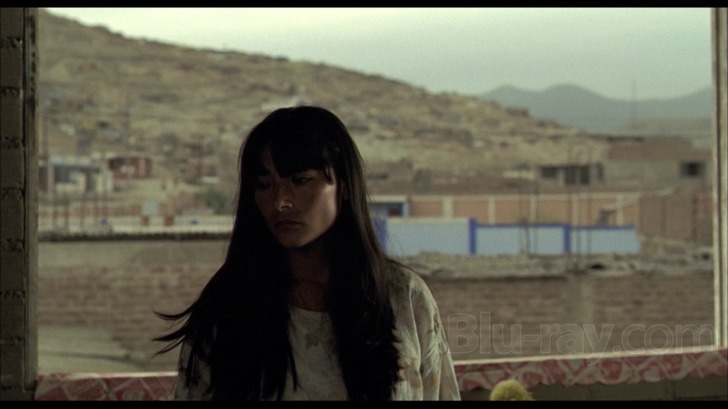
The squalid conditions that Fausta and her family live in also add to the sad demeanor of The Milk of Sorrow. Though this is a much more sandy, barren environment than that of Rio de Janeiro, the teeming ghettos climbing up hills may remind some of any number of iconic films which have focused on Rio’s favelas, like Black Orpheus. There are a number of really arresting sequences with long, languorous shots of what almost look like deserts, long stretches of sand with desperate people searching for some sign of life, both internally and externally.
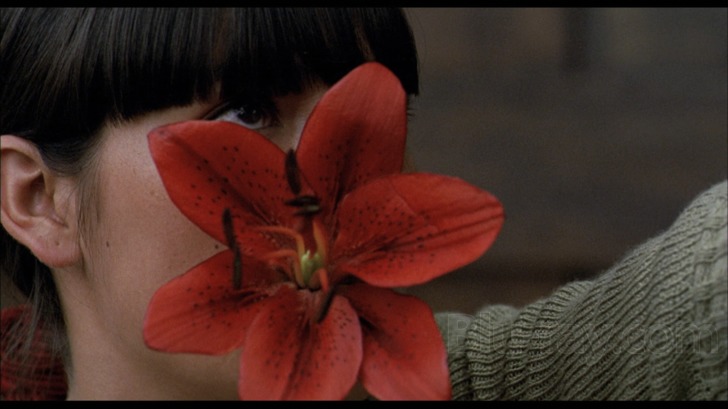
That makes one final central image of the film—namely new life in the form of plants—such a deliberate attempt to depict Fausta’s slow unfolding into a life that may not be permanently scarred by fear. When Fausta places a huge flower (is it an orchid?) into her mouth, it’s as if she’s simultaneously devouring something living and also giving birth to a blossom. It’s one of the most fascinating ideas in the film, one that echoes her mother’s song at the beginning of the film where a baby both suckles from and chews through her mother’s breasts.
The Milk of Sorrow is an emotionally distressing experience, which is rather remarkable in that Fausta often seems strangely removed from her emotions, at least in the early going. But as she slowly begins to connect again with her own humanity, she becomes yet another kind of symbol: one of potential healing. She may indeed bear scars, including ones she “inherited” from her mother, but she also proves the resilience of the human spirit to overcome even imaginary traumas. The traps set by Fausta’s own mind are at least as complex as anything the roiling political atmosphere of Peru confronted her with.
Note: The Milk of Sorrow won the prestigious Golden Bear Prize at the Berlin International Film Festival as well as several other international prizes when it was first released. It was also nominated for the Academy Award for Best Foreign Language Film.
Milk of Sorrow Blu-ray Movie, Video Quality
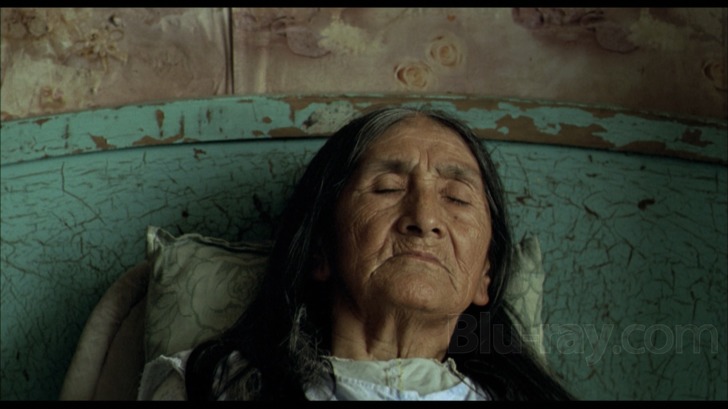
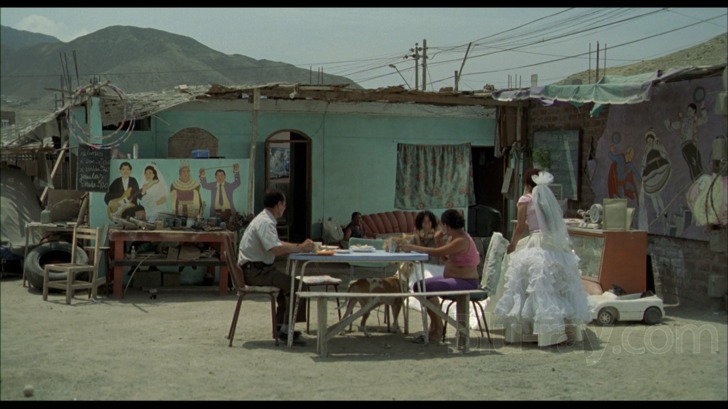
The Milk of Sorrow is presented on Blu-ray courtesy of Olive Films with an AVC encoded 1080p transfer in 1.85:1. Llosa and her cinematographer Natasha Braier lens this film in a quasi-verité style that captures the barren Peruvian landscapes in natural light a lot of the time. Rather surprisingly, then, contrast is very consistent and the film easily segues from the sun drenched exteriors to the kind of drab, dilapidated interiors. Colors are widely varied here, ranging from a glut of beiges and whites to some astoundingly brilliant hues such as those featured in some of the plant life. Fine object detail is exceptional in the film's many close-ups and the overall presentation here boasts very good sharpness and clarity.
Milk of Sorrow Blu-ray Movie, Audio Quality
The Milk of Sorrow features a nicely detailed lossless DTS-HD Master Audio 2.0 mix. There's not an especially wide mix here, although occasionally some of the exterior scenes offer some relatively splayed effects, but the film's subtly understated guitar score rings through with clarity and precision, and both dialogue and the frequent sung elements sound just fine. There's not a whale of a lot of dynamic range here, and in fact there's really not all that much dialogue when you get right down to it, but the soundtrack is nuanced and quietly effective and is reproduced here with excellent fidelity.
Milk of Sorrow Blu-ray Movie, Special Features and Extras
No supplements are included on this disc.
Milk of Sorrow Blu-ray Movie, Overall Score and Recommendation

The Milk of Sorrow is not an especially easy film to watch, but it's an extremely worthwhile one. This film boasts one of the most weirdly dreamlike ambience in recent memory, as Fausta seemingly drifts through her own soul's journey to find some kind of emotional freedom. The film is built out of small moments, but it also surprises with great regularity with a number of completely arresting images. Magaly Solier is superb as Fausta, able to convey the young woman's fragile emotional state without wearing her heart on her sleeve, as it were. In fact one of the most interesting things about this film is how emotionally shut down Magaly is while the film itself is so full of barely tamped down passion. Llosa is a deliberate filmmaker, one who takes her time establishing character, and The Milk of Sorrow may frustrate some who want things to happen in a more bombastic or faster fashion. But for those with a little patience, the emotional payoff here is quite substantial. This is a beautifully wrought film that is indeed unsettling, but which offers a compelling story that may ostensibly be about Peru and its trials, but really is a universal tale of perseverance and escaping the bonds of superstition and actual bona fide fear. This Blu-ray sports superior video and excellent audio, and even without supplements, it comes Highly recommended.
Similar titles
Similar titles you might also like
(Still not reliable for this title)

The Rocket
2013

Of Gods and Men
Des hommes et des dieux
2010

Monos
2019

The Ballad of Narayama
楢山節考 / Narayama bushikô
1958

Endless Poetry
Poesía sin fin
2016

The Dance of Reality
La danza de la realidad
2013

Saint Omer
2022

The Image Book
Le livre d'image
2018

Birds of Passage
Pájaros de verano
2018

A Fantastic Woman
Una mujer fantástica
2017

Betty
1992

Things to Come
L'avenir
2016

Julieta
2016

Taxi
2015

Phoenix
2014
Stray Dogs
郊游 / Jiao you
2013

Beyond the Hills
După dealuri
2012

The Marriage of Maria Braun
Die Ehe der Maria Braun
1978

The Banishment
Izgnanie
2007

Secret Sunshine
밀양 / Milyang
2007